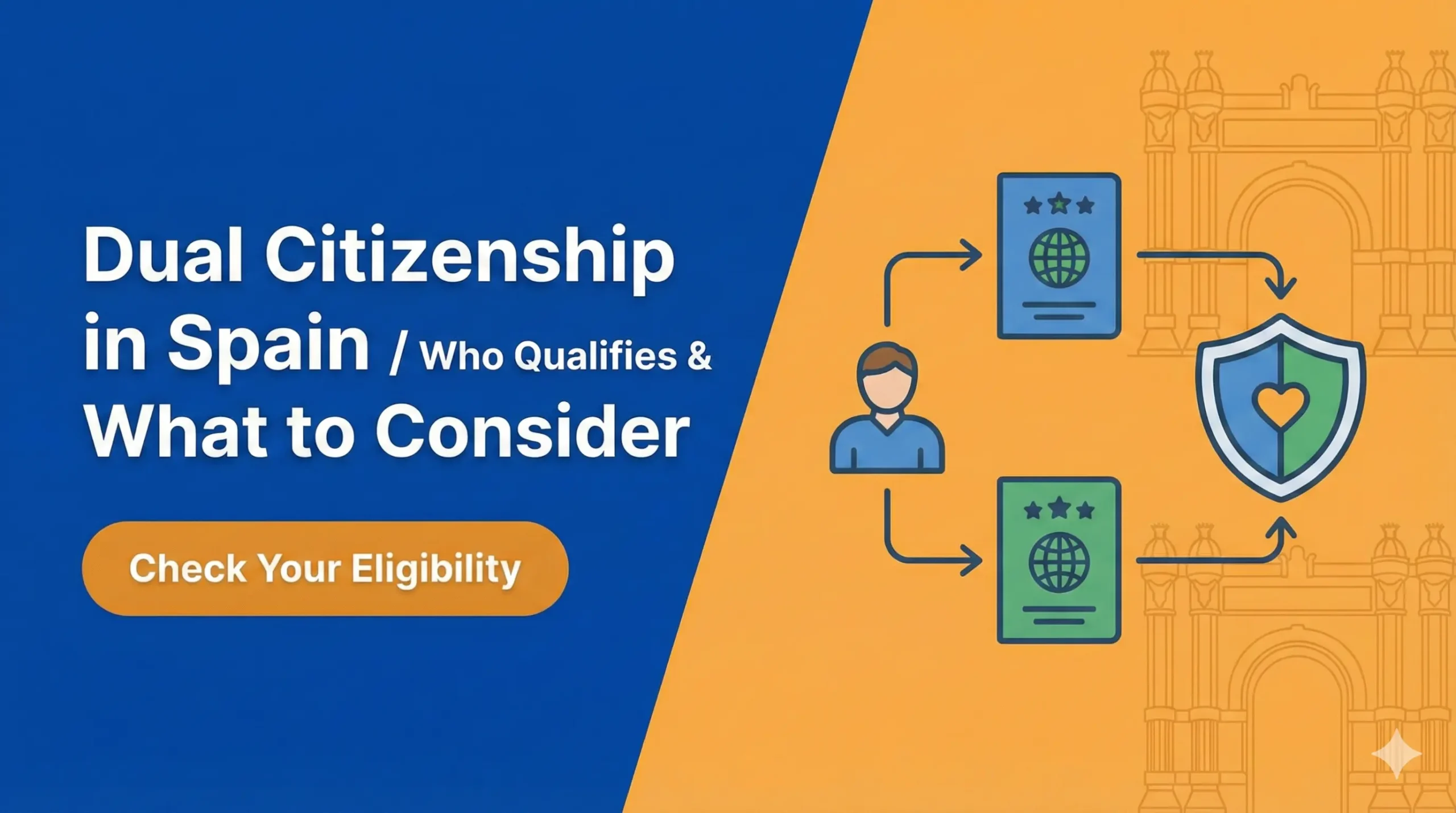
Dual Citizenship in Spain: Who Qualifies and What to Consider
While Spain generally enforces a “single nationality” rule, specific exceptions allow dual citizenship for nationals of Ibero-American countries, France, and Portugal. For US and UK citizens, the path is more complex, often involving a “theoretical” renunciation. This guide details the 2026 eligibility lists, the residency timelines (10 years vs. 2 years), and the tax implications of becoming a Spaniard.
Disclosure: This post may contain affiliate links. We may earn a commission at no extra cost to you if you make a purchase through these links. Read full disclosure.
The General Rule: “Renunciation”
To understand dual citizenship, you must first understand the standard naturalization process.
When a foreign national applies for Spanish citizenship by residence (after 10 years generally), they must appear before a judge or notary to swear allegiance to the King and the Constitution. Crucially, they must also declare their renunciation of their previous nationality.
Legally, in the eyes of Spain, you cease to be American, British, or Australian the moment you become Spanish. You cannot renew your old passport, and you cannot use it to enter Spain.
However, Spain does not have the power to force other countries to strip you of your citizenship. This creates a divergence between “Legal Dual Citizenship” (recognized by Spain) and “De Facto Dual Citizenship” (tolerated but not recognized).
The “Golden List”: Who Can Keep Both?
Spain has specific treaties and constitutional provisions that allow nationals of certain countries to keep their original passport officially. If you are from one of these countries, you do not need to renounce anything. You are fully, legally, dual.
1. Ibero-American Countries
Citizens of former Spanish colonies in the Americas benefit from a “fast track” residency (2 years instead of 10) and full dual citizenship rights.
- The List: Argentina, Bolivia, Brazil, Chile, Colombia, Costa Rica, Cuba, Dominican Republic, Ecuador, El Salvador, Guatemala, Honduras, Mexico, Nicaragua, Panama, Paraguay, Peru, Uruguay, and Venezuela.
- Puerto Rico: Nationals of Puerto Rico can also qualify if they prove their status, despite Puerto Rico being a US territory.
2. The Historic Exceptions
- Philippines
- Equatorial Guinea
- Andorra
- Portugal
3. The France Agreement (New in 2022)
In a historic move, Spain and France signed a bilateral agreement allowing full dual citizenship.
4. Sephardic Jews
While the specific “Law of Return” (Law 12/2015) application window has closed, those who successfully obtained citizenship under this pathway maintain full dual citizenship rights, regardless of their original country.
What About Romania?
As of early 2026, rumors of a Spain-Romania dual citizenship treaty continue to circulate due to the massive Romanian diaspora in Spain. However, at the time of writing, no final treaty has been ratified. Romanians technically still face the renunciation requirement, though enforcement is often lenient given their EU status.
The “Grey Area”: US, UK, and Other Nationals
If you are from the United States, United Kingdom, Canada, or Australia, you are not on the exception list.
The Process:
When you take the oath of Spanish citizenship, you must verbally renounce your previous nationality. Spain records this renunciation.
The Reality:
Spain generally does not require you to go to your home country’s embassy and pay the fee to formally relinquish your citizenship.
- US Citizens: The US State Department does not recognize a renunciation made to a foreign official (like a Spanish notary). To lose US citizenship, you must voluntarily go to a US consulate and sign specific expatriation forms (and pay a $2,350 fee). If you don’t do this, the US still considers you a citizen.
- UK Citizens: Similarly, the UK allows dual citizenship and generally does not strip it unless you formally apply to give it up.
The Result:
Many expats end up in a situation of “De Facto” dual citizenship.
- In Spain: You are Spanish. You enter and exit with your Spanish passport. If you show your US/UK passport to a Spanish official, it has no legal weight (and could theoretically cause administrative trouble if they decide to enforce the renunciation pledge, though this is rare).
- Outside Spain: You continue to use your other passport.
Warning: While common, this is technically a legal grey area. If Spain discovers you are actively using your “renounced” nationality (e.g., renewing that passport while living in Spain), they have the theoretical right to revoke your Spanish citizenship for fraud, though this is extremely uncommon in practice.
Residency Timelines for Citizenship
Before you worry about dual passports, you must qualify to apply. The clock counts “continuous and legal” residency.
| Category | Time Required |
| General Rule (US, UK, Asian, etc.) | 10 Years |
| Refugees | 5 Years |
| Ibero-American Nationals (+ Philippines, Andorra, etc.) | 2 Years |
| Married to a Spaniard | 1 Year |
| Born in Spain (to foreign parents) | 1 Year |
Crucial Note on Student Visas: Time spent on a student visa (estancia) does not count toward citizenship. You must hold a residency card (like a Work Permit, Non-Lucrative Visa, or Digital Nomad Visa).
The End of the “Democratic Memory Law” (Grandchildren’s Law)
For several years (2022–2025), the Ley de Memoria Democrática allowed grandchildren of exiled Spaniards to gain citizenship directly, without residency.
Status in 2026:
The deadline for new applications closed in October 2025.
- If you applied before Oct 2025: Your file is still being processed. The consulates are working through a massive backlog, so expect delays, but your rights are locked in.
- If you missed the deadline: You can no longer use this direct path. You must now move to Spain and apply via the standard residency routes (usually 1 year of residency if you are the child/grandchild of a Spaniard born in Spain).
The Application Process in 2026
If you meet the residency requirements, the application is now digital.
- Exams:
- CCSE: Constitutional and sociocultural knowledge. (Mandatory for most).
- DELE A2: Language exam. (Mandatory for non-native speakers).
- Exemptions: Those who attended high school/university in Spain or are nationals of Spanish-speaking countries (for the language part).
- Documents:
- Birth certificate (Apostilled & Translated).
- Criminal record checks (Current + Home Country).
- Empadronamiento (History of residence).
- Proof of financial means.
- Submission: Via the Ministry of Justice’s digital platform.
- Timeline: In 2026, the “Plan de Choque” (digitization effort) has brought processing times down, but expect 1 to 2 years for approval.
Pros and Cons of Spanish Citizenship
Is it worth the hassle?
The Pros
- EU Mobility: You can live, work, and retire in any of the 27 EU member states without a visa.
- Voting: You can vote in Spanish national and European elections.
- Bureaucracy: No more TIE renewals, no more fear of losing residency if you leave the country for too long.
- Heritage: You pass EU citizenship to your children automatically.
The Cons
- Taxes (The Big One): Spanish citizens are generally expected to be Spanish tax residents if they live in Spain. Unlike the Beckham Law Explained: Spain’s Special Expat Tax Regime (which is for foreigners), citizens are subject to standard progressive tax on worldwide income. Note: Citizenship itself doesn’t trigger tax, residency does. But becoming a citizen signals intent to stay permanently.
- Renunciation: For US/UK nationals, the emotional or administrative complexity of the renunciation pledge.
- Military/Jury Duty: As a citizen, you are eligible for jury duty obligations.
Conclusion
Dual citizenship in Spain is a privilege explicitly reserved for those with historical or cultural ties to the country. For Latin Americans, the Philippines, and France, the door is wide open. For everyone else, becoming Spanish requires a conscious decision to trade your former identity—at least legally—for a European future.
If you are approaching your 10-year (or 2-year) mark, now is the time to audit your absences. Remember, “continuous residence” means you shouldn’t have been out of Spain for more than 3-6 consecutive months depending on your specific timeline.
Ready to start the paperwork? Ensure your birth certificate is fresh and your background checks are clean. Review Spain Criminal Record Certificates: Which Ones You Need and When to prepare your dossier.
References
Primary sources (official)
- Ministry of Justice (Citizenship): Official requirements for naturalization by residence.https://www.mjusticia.gob.es/es/ciudadania/nacionalidad/nacionalidad-espanola/nacionalidad-residencia
- Boletín Oficial del Estado (Civil Code): Articles 20-26 regarding acquisition and loss of nationality.https://www.boe.es/buscar/act.php?id=BOE-A-1889-4763
- U.S. Embassy in Spain: Information on renunciation of U.S. citizenship.https://es.usembassy.gov/u-s-citizen-services/citizenship-services/renunciation-of-u-s-citizenship/
Other helpful sources
- Balcells Group: 2026 Guide to Dual Citizenship rules and exceptions.https://balcellsgroup.com/dual-citizenship-in-spain/
- Jobbatical: Updates on the Democratic Memory Law expiration.https://www.jobbatical.com/blog/spain-democratic-memory-law-deadline
Disclaimer
The information provided in this article is for educational and informational purposes only and does not constitute legal advice. Dual citizenship laws and international treaties are subject to change. The “grey area” regarding renunciation for US/UK citizens carries theoretical legal risks; we strongly recommend consulting with a qualified immigration lawyer to understand your specific obligations.