How to Compare Private Health Plans: Deductibles, Co-Pays, Networks
Disclosure: This article contains affiliate links. If you buy through them, we may earn a commission at no extra cost to you. Read our full disclosure.
Navigating the Spanish private health insurance market can be overwhelming. This comprehensive guide breaks down essential concepts like copayments, deductibles, medical networks, and policy exclusions, helping expats make highly informed, financially sound decisions when comparing health plans for their residency.
Demystifying Spanish Health Insurance Terminology
When you begin shopping for private health insurance in Spain, you will immediately encounter specific Spanish insurance terminology that differs significantly from health systems in the United States, the United Kingdom, or Australia. Understanding these foundational terms is the key to accurately comparing policies and avoiding unexpected out-of-pocket costs down the road.
Copagos and Franquicias Explained
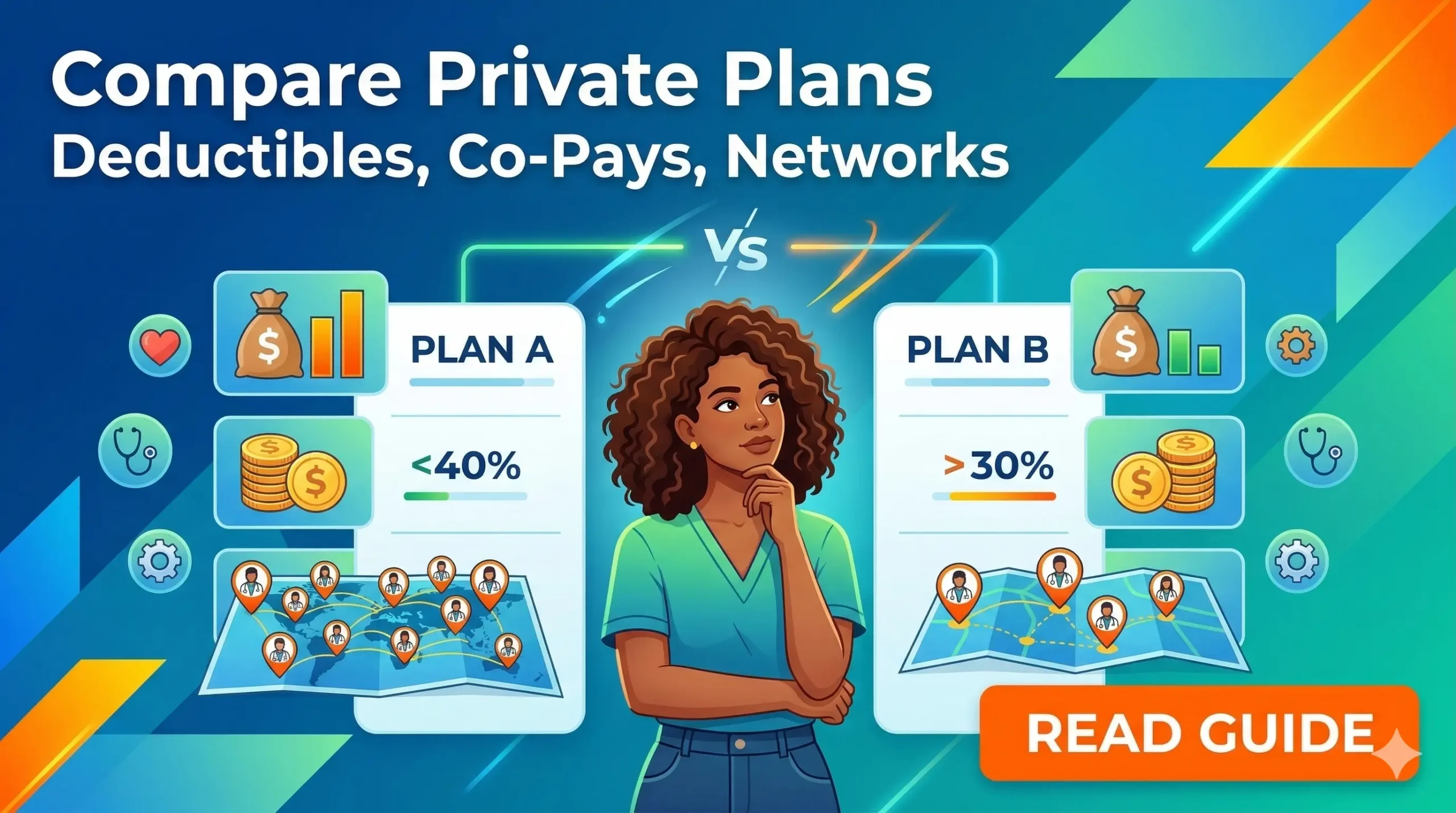
In the Spanish insurance market, a copago (co-payment) is a small, fixed fee that you pay each time you access a specific medical service. Unlike American co-pays which can be substantial, Spanish copagos are generally very low, typically ranging from a few euros for a basic general practitioner visit to perhaps fifteen euros for a specialized diagnostic test or an emergency room visit. Policies with copagos generally have significantly lower monthly premiums, making them highly attractive for young, healthy expats who rarely visit the doctor.
However, if you are applying for a Spanish residency visa, such as the Non-Lucrative Visa or Golden Visa, the Spanish government strictly mandates that your policy must be sin copagos (without co-payments) to ensure you do not become a financial burden on the state. For a deeper understanding of how these costs add up in everyday life, review our guide on Health Costs in Spain: Typical Co-Pays and Out-of-Pocket Fees.
Franquicias (deductibles) operate differently in Spain than in North America. A deductible is a set amount you must pay out of pocket before your insurance coverage officially kicks in. In the standard Spanish private healthcare model, massive annual deductibles are actually quite rare. They are typically only found in specific high-tier reimbursement policies or specialized expat health plans designed for international coverage. Standard local policies usually focus entirely on the copago structure rather than enforcing a high annual franchise limit.
When comparing these financial structures, it is incredibly helpful to use a specialized insurance broker like Innoinsure. Because the Spanish market is saturated with options from major providers, an expert from Innoinsure can clearly outline which plans feature hidden fees and which plans genuinely meet the strict, zero-copayment requirements necessary for your immigration paperwork, saving you hours of frustrating research and potential visa rejections.
Understanding Carencias and Waiting Periods
Another absolutely critical term to understand is carencia, which translates to a waiting period. Almost all private health insurance policies in Spain impose carencias to prevent patients from buying a policy solely because they know they immediately need expensive medical treatment. During a carencia, you pay your monthly premium, but you are blocked from utilizing specific high-cost services.
If you are switching from an existing Spanish health insurance policy to a new provider, you can often successfully negotiate the complete waiver of these carencias by providing a certificate of previous coverage from your old insurer. If you are navigating pre-existing issues and want to understand how waiting periods impact your long-term health strategy, our detailed overview on Chronic Conditions in Spain: Managing Ongoing Care as an Expat provides vital context for managing your care uninterrupted.

Choosing the Right Medical Network
The most fundamental choice you will make when selecting a Spanish private health plan is how you want to access your doctors. Insurance in Spain generally falls into two primary categories: in-network policies and reimbursement policies.
Cuadro Medico In Network Policies
The vast majority of expats and Spanish locals opt for a Cuadro Médico policy. This is a highly integrated, closed-network model. When you purchase this type of plan, the insurance company provides you with a massive directory of approved hospitals, clinics, and independent specialists. As long as you choose a doctor or medical facility from this specific approved list, your medical care is completely covered.
The greatest advantage of a Cuadro Médico policy is its sheer administrative simplicity. You present your physical or digital insurance card at the reception desk, receive your treatment, and leave. No money changes hands, and there is absolutely no paperwork to file afterward. Major insurers boast networks of tens of thousands of medical professionals, meaning finding an English-speaking specialist in expat-heavy areas like the Costa del Sol, Alicante, or Madrid is incredibly easy. To understand how to leverage modern apps to find these in-network doctors instantly, read our breakdown on Health Apps in Spain: Booking, Records, and Telemedicine Options.
However, the major limitation of a Cuadro Médico plan is its rigidity. If you hear about a phenomenal, world-renowned orthopedic surgeon in Barcelona, but they are not listed in your insurer’s specific network, you cannot use your insurance to see them. You would be forced to pay the surgeon’s entire consultation and operating fee completely out of pocket. To compare how this system rivals the state-funded alternative, review the Spain Healthcare System for Expats: Public vs Private.
Reembolso Reimbursement Policies
If ultimate freedom of choice is your primary priority, a Reembolso (reimbursement) policy is the superior option. With a reimbursement plan, you are not restricted to any specific medical network. You can visit absolutely any doctor, specialist, or private hospital in Spain—and often, anywhere else in the world depending on the policy terms.
Managing the large, upfront out-of-pocket costs associated with reimbursement policies requires smart financial tools. Paying a massive surgical invoice with a foreign bank card will trigger exorbitant international transaction fees. Savvy expats use multi-currency accounts like Wise to settle these medical bills. By processing the payment via Wise, you ensure the clinic is paid directly in Euros at the true mid-market exchange rate. When the insurance company processes your claim, the funds are deposited back into your local account. For a step-by-step guide on how to process these specific claims without administrative errors, consult How to Handle Medical Bills in Spain: Receipts, Claims, and Disputes.
Evaluating Policy Coverage and Exclusions
Not all health plans are created equal. Beyond the network format and the price, you must meticulously evaluate the fine print to understand exactly what medical scenarios are comprehensively covered and, more importantly, what is explicitly excluded from your protection.
Pre Existing Conditions and Medical Questionnaires
When you apply for private health insurance in Spain, you are legally required to complete a comprehensive health questionnaire, known as a cuestionario de salud. You must truthfully declare your entire medical history, including past surgeries, chronic illnesses, and ongoing maintenance medications. The insurance company uses this document to meticulously evaluate their financial risk before issuing a policy.
Navigating the application process with pre-existing conditions can be incredibly demoralizing. This is where an expert broker like Innoinsure proves invaluable. They know exactly which Spanish insurers are more lenient regarding specific medical histories and can fiercely advocate on your behalf to secure the most comprehensive coverage possible. If you ultimately find that private insurers will not cover your specific chronic needs, you may need to integrate into the public system for your complex care; learn how to initiate this process in our guide on What Is a ‘Centro de Salud’ in Spain and How Do You Register?.
Dental Vision and Extra Perks
A very common misconception among new expats is that standard private medical insurance includes comprehensive dental and vision care. In Spain, standard health policies almost universally exclude routine adult dentistry and optical services. They will typically only cover basic emergency tooth extractions or severe maxillofacial trauma resulting from an accident.
If you want coverage for routine dental cleanings, cavity fillings, root canals, or orthodontics, you must purchase a dedicated dental add-on, known as a seguro dental. Spanish dental insurance operates on a heavily discounted franchise model rather than providing completely free restorative care. For a thorough comparison of how expats manage their oral health in the country, read Public vs Private Dental Care in Spain: What Expats Usually Choose. Similarly, while a standard policy will cover an ophthalmologist visit to diagnose an eye disease, it will absolutely not pay for your prescription eyeglasses or daily contact lenses.
Many modern policies try to differentiate themselves by offering high-value digital perks. Features like virtual doctor consultations, digital prescription renewals, and mental health chat support are incredibly beneficial for expats facing language barriers. These digital tools can save you countless trips to the physical clinic. Discover how to leverage these benefits in Telemedicine in Spain: When It’s Useful and What to Expect.
If your policy lacks robust preventative wellness coverage, many expats logically supplement their health routines by ordering premium vitamins, probiotics, and holistic supplements through global retailers like iHerb. Keeping your home stocked with high-quality preventative products from iHerb ensures your daily health regimen remains completely uninterrupted while living abroad, proactively reducing your need to visit the doctor.
Financial Considerations for Expats
Choosing a health plan is not merely a medical decision; it is a significant financial commitment that directly impacts your immigration status and your monthly budget.
Visa Requirements and Zero Co Pay Rules
If you are moving to Spain from a non-EU country and require a visa, your private health insurance policy is one of the most heavily scrutinized documents in your entire immigration dossier. The Spanish consulate requires absolute, undeniable proof that you will not become a financial burden on the state-funded public health system.
To satisfy the government’s strict requirements for visas like the Non-Lucrative Visa, the Golden Visa, or the Student Visa, your health policy must perfectly mirror the comprehensive coverage of the public system. This means the policy must be entirely sin copagos (zero co-payments) and feature absolute total coverage without any restrictive annual financial limits. Additionally, the policy must explicitly include repatriation coverage, which covers the immense cost of returning your remains to your home country in the tragic event of your death.
| Policy Feature | Best For Target Audience | Compliant for Spanish Visas | Relative Cost Profile |
| Cuadro Médico (No Copays) | Expats needing residency visas, families | Yes (If full coverage) | Moderate to High Premium |
| Cuadro Médico (With Copays) | Healthy residents, minimal doctor visits | No | Low Premium, Pay-per-visit |
| Reimbursement (Reembolso) | Expats wanting global doctor choice | Varies by specific limits | Very High Premium |
| Basic Outpatient Only | Locals supplementing public care | No | Very Low Premium |
Managing Premium Payments and International Fees
Once you have selected your ideal policy, managing the recurring financial aspect is your final hurdle. Spanish insurance companies heavily prefer, and often mandate, that you pay your monthly or annual premiums via a direct debit, known as a domiciliación bancaria, linked directly to a Spanish IBAN.
To circumvent this frustrating logistical roadblock, financially astute expats establish a multi-currency digital account with platforms like Wise. A Wise account provides you with a legitimate, fully functioning European IBAN that Spanish insurance companies will accept without issue. By setting up your direct debits through this account, you ensure your premiums are paid exactly on time in Euros, fiercely protecting your coverage from accidental cancellation while saving substantial amounts of money on exchange rates.
References
Primary sources (official)
- Dirección General de Seguros y Fondos de Pensiones (DGSFP): http://www.dgsfp.mineco.gob.es/es/Paginas/Iniciodgsfp.aspx
- Ministerio de Sanidad (Ministry of Health Spain): https://www.sanidad.gob.es/
- Ministerio de Asuntos Exteriores – Visados (Visa Requirements): https://www.exteriores.gob.es/es/ServiciosAlCiudadano/Paginas/Servicios-consulares.aspx
Other helpful sources
- Expatica – Health Insurance in Spain: https://www.expatica.com/es/healthcare/healthcare-basics/health-insurance-in-spain-101465/
- Citizens Advice Bureau Spain – Healthcare Information: https://www.citizensadvice.org.es/faq/healthcare/
Disclaimer
The information provided in this article is for educational and informational purposes only and does not constitute formal financial, legal, or immigration advice. Health insurance products, coverage limits, underwriting guidelines, and Spanish visa requirements change frequently and vary significantly by individual provider and consular office. Always verify policy details directly with a licensed Spanish insurance broker or legal immigration expert to ensure the selected health plan meets your specific personal and legal needs.