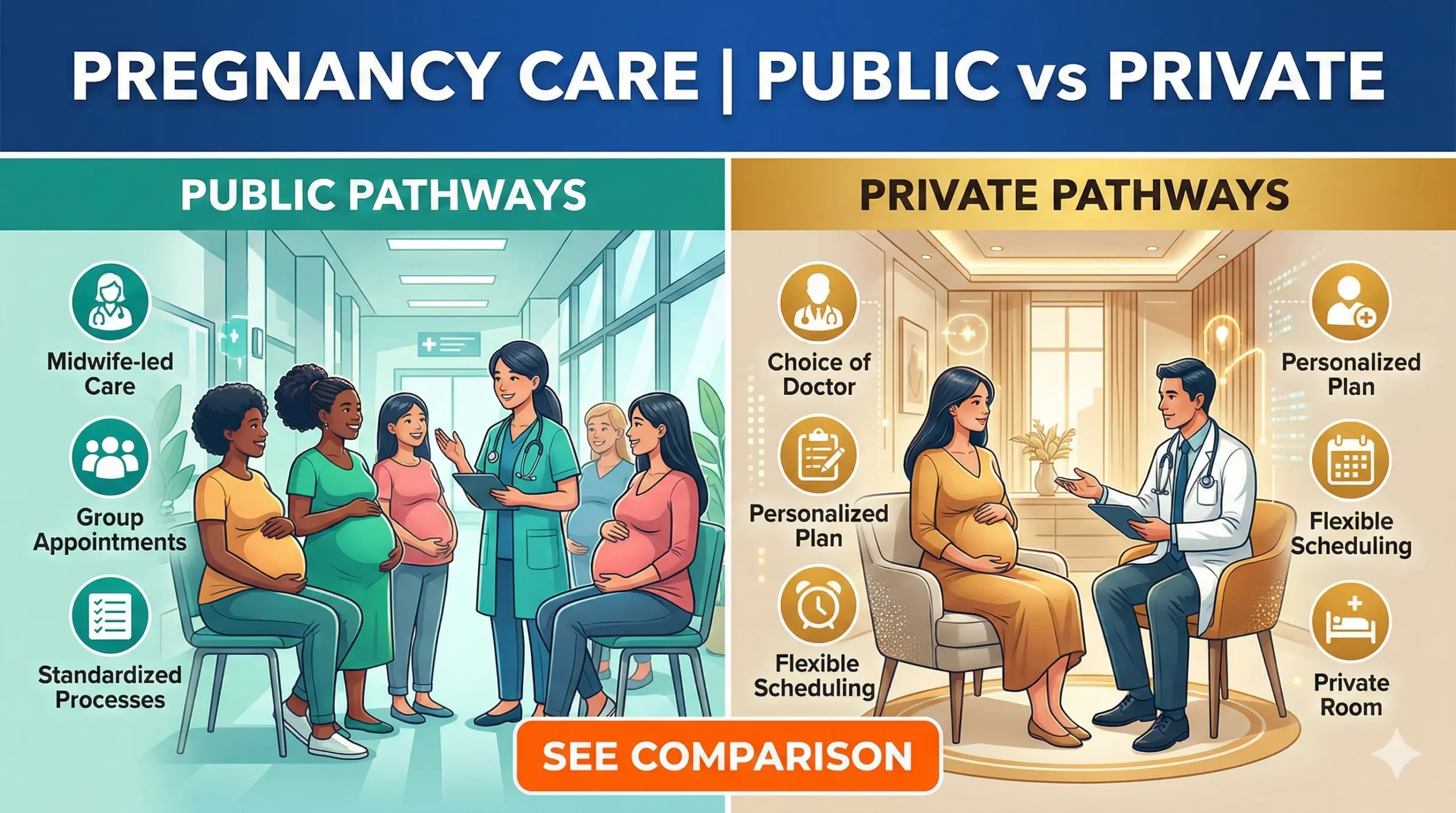
Pregnancy Care in Spain: Public vs Private Maternity Pathways
Imagine being twelve weeks pregnant in Valencia. Your Spanish is shaky, your health card is still “en trámite”, and everyone gives you different advice about whether to stay public or pay for private care. This guide explains both maternity pathways in Spain: how each one works, what each does well and badly, what insurance can and cannot do, and the paperwork that follows the birth.
Disclosure: This post may contain affiliate links. We may earn a commission at no extra cost to you if you make a purchase through these links. Read full disclosure.
How Pregnancy Care Works in Spain’s Public System
I’ll be honest from the start. When I first heard friends describe public pregnancy care in Spain, I expected something rushed and impersonal. The reality was more nuanced. The clinical care is strong, the scans and screening are thorough, and the delivery wards in big public hospitals see huge numbers of births. The friction is mostly about access, language and the feeling of being one patient among many, not about medical quality.
Getting Into the Public System as a Foreigner
Everything starts with your entitlement to public healthcare, and that depends on your status. Employed people paying into Social Security, registered autónomos, their dependants, and some pensioners are covered. Other residents may qualify through regional rules or by paying into the system. If you aren’t sure where you stand, read Who Can Access Public Healthcare in Spain? Eligibility Basics before you make any pregnancy plans. The answer decides whether the public pathway is free for you at the point of care or not open to you at all.
Once you are eligible, you need your health card and an assigned centro de salud. Your local health centre is the front door for pregnancy care. Your family doctor (médico de cabecera) usually confirms the pregnancy and sends you to the midwife, the matrona. The registration steps are covered in What Is a ‘Centro de Salud’ in Spain and How Do You Register? and the card itself in How to Get a Spanish Health Card Tarjeta Sanitaria Step-by-Step. Do these early. A positive test is not the moment to discover your padrón certificate is out of date.
Some regions organise pregnancy care differently. In Catalonia, follow-up often runs through ASSIR, the network of sexual and reproductive health centres, and the midwife is called a llevadora. In Madrid and Andalusia it usually stays inside your centro de salud. The core idea is the same everywhere: a midwife-led primary care pathway, with hospital obstetricians handling scans, specialist checks and the birth.
There is one route worth knowing if you are a resident who doesn’t qualify through work. The Convenio Especial lets some residents pay a regular contribution for access to the public system. It requires a period of padrón registration and the details vary by region, so look at What Is the ‘Convenio Especial’ Healthcare Option in Spain? if this applies to you. It is not instant, so the timing matters a lot if you are already pregnant.
The Appointment Rhythm With Your Matrona and Hospital
Once you are in, the public pathway follows a fairly predictable rhythm. You will get a pregnancy record, often called the cartilla de embarazo or documento de salud de la embarazada. You carry it to every appointment and every professional writes in it. Treat it like your passport during these months. If you turn up at urgencias at night, that booklet tells the duty team your whole history in seconds.
The typical sequence looks like this:
- A first visit with your GP or matrona to confirm the pregnancy, order blood tests and urine analysis, and start folic acid and iodine supplements if you are not taking them already.
- A first-trimester scan at the hospital, usually combined with a blood test as part of the combined screening for chromosomal conditions.
- Regular midwife checks at your health centre for blood pressure, weight, urine and fetal heartbeat, plus questions about how you are coping.
- A detailed mid-pregnancy scan, often called the ecografía morfológica, to check the baby’s anatomy.
- A glucose screening test for gestational diabetes, commonly known by the name of the test, O’Sullivan.
- A third-trimester scan to check growth and position, and a swab test for Group B strep later on.
- Vaccines offered during pregnancy, such as whooping cough (tosferina) and seasonal flu, through your centro de salud.
- Antenatal classes (educación maternal or preparación al parto), usually run free by the midwives at your health centre.
- Fetal monitoring sessions at the hospital (los monitores) as you approach and pass your due date.
For a week-by-week view of these milestones, see Pregnancy Appointment Timeline in Spain: Typical Milestones. On the language side, my strongest advice is to learn a small set of words before your first appointment: matrona, ecografía, análisis de sangre, contracciones, romper aguas (waters breaking), sangrado (bleeding), and epidural. The Spanish Medical Terminology: Common Words Expats Should Know guide is a good starting list.
Here is a scenario often plays out. Sarah, a British teacher in Seville, went to her first matrona appointment expecting to be talked through everything in English. The midwife was warm and patient but spoke Andalusian Spanish at full speed. Sarah left with a stack of test orders she didn’t fully understand. At her second visit she brought a written list of questions in Spanish and recorded the answers on her phone with permission. The difference was night and day. Preparation made the public system feel accessible.
Giving Birth in a Public Hospital
When labour starts, you will usually go to the urgencias de maternidad (maternity emergency entrance) at the hospital assigned to your area. Big public maternity units, such as La Paz in Madrid or the Materno Infantil in Málaga, handle enormous numbers of births. They have neonatal units staffed around the clock. If something goes wrong, you are in a place built for it. Epidurals are widely offered in public hospitals, and anaesthetists are on site.
Most public hospitals accept a plan de parto (birth plan), and many regions publish a standard template. Write one, keep it short, and have it translated into Spanish. It covers practical preferences such as skin-to-skin contact, delayed cord clamping, pain relief and who will be with you. Staff generally respect these plans where it is clinically safe, and a written plan in Spanish saves you from negotiating mid-contraction.
After the birth you move to the maternity ward. Stays tend to be short. Midwives and nurses check you and the baby, help with feeding, and arrange the baby’s newborn screening tests, including the heel-prick test. For a fuller picture of labour day, see Giving Birth in Spain: What Foreign Parents Should Expect.
Pros and Cons of Public Maternity Care
Here is my honest assessment of both sides of public care.
Advantages of public maternity care:
- No bills at the point of care for people with public cover, including scans, tests, the birth itself and any neonatal intensive care.
- Large hospitals with full neonatal units, anaesthesia and emergency obstetric teams on site at all hours.
- A complete screening programme, so routine pregnancies are monitored thoroughly.
- Midwife-led antenatal follow-up and free antenatal classes, which are also a good way to meet local parents.
- Clinical protocols that tend to favour physiological birth where it is safe.
Disadvantages of public maternity care:
- Low continuity of care. You may see different obstetricians at each hospital scan, and the team that delivers your baby will be whoever is on shift, not someone you have met.
- Shared recovery rooms are common in many public hospitals. You might share with another mother, her baby and her visitors, which is hard when you are exhausted.
- Staff mainly speak Spanish, or the regional co-official language. Some professionals speak good English, but you cannot count on it, especially at night or in smaller towns.
- Fewer routine scans than private care, and less flexibility to request extra ones without a medical reason.
- Little choice over which hospital or which professionals look after you, because care is organised by health area.
- Administrative hurdles for new arrivals, since you cannot use the pathway until your entitlement and health card are in place.
For many families the medical safety and the cost benefits outweigh the comfort issues. For others, especially those without Spanish or with anxiety about unfamiliar settings, those disadvantages weigh heavily. Both reactions are valid.
The Private Maternity Pathway in Spain
Private maternity care in Spain revolves around one big difference: you usually choose an obstetrician-gynaecologist who follows your whole pregnancy and, in most cases, attends the birth. That one feature changes the whole experience. You meet the same person at every visit, you can call their clinic with questions, and many of them speak English.
How Private Obstetric Care Differs Day to Day
In the private pathway, your gynaecologist is the centre of your care rather than a matrona at a health centre. Appointments happen at private clinics or hospital consultation suites. Scans are often done at every visit, which many parents find reassuring, and you leave with images and reports. Tests that are routine in the public system are also done, but scheduling tends to be faster and more flexible.
The birth itself takes place in a private hospital or clinic linked to your obstetrician. Most private maternity units in major cities offer private rooms with a bed or sofa for your partner. That feels luxurious after a long labour. Hotel-style comforts, a more relaxed visitor setup and staff who often speak some English are part of the appeal, especially in cities with large foreign communities such as Madrid, Barcelona, Málaga and Alicante.
Consider a different scenario. Lukas and Priya moved to Barcelona for work and had private insurance through his employer. Priya chose an English-speaking obstetrician near Eixample after a few recommendations in a local parents’ group. She saw the same doctor at every visit, had her questions answered by email, and the doctor arrived at the clinic when labour progressed. For her, continuity mattered more than anything else. Private care delivered it.
Insurance, Waiting Periods and the Timing Trap
This is the part that catches people out, so I want to be very clear. Private maternity care is usually paid through a health insurance policy, and maternity cover almost always comes with conditions. Spanish policies commonly apply a waiting period, called carencia, before childbirth is covered. Many policies also exclude a pregnancy that already existed when you signed up. If you take out a policy after a positive test, you may find the birth isn’t covered at all, or only partially.
The practical rule is to arrange insurance before you try to conceive, not after. If you are already pregnant, ask any insurer directly and in writing how they treat an existing pregnancy. Some will cover antenatal visits but not the birth. Some offer reduced terms. Some refuse. Policies can also have copagos, small payments per consultation or test, which add up over a pregnancy with frequent visits. To understand how these terms work, read Choosing a Private Health Insurer in Spain: What to Compare, and for the money side see Giving Birth Privately in Spain: Costs and Insurance Reality Check.
If comparing Spanish policies in a language you are still learning feels overwhelming, a broker can help. Innoinsure works with expats and can lay out several Spanish insurers’ maternity terms side by side in English. That makes it easier to spot differences in waiting periods and exclusions. International health plans are another route for globally mobile families. Cigna Global, for example, offers international cover where maternity is generally an optional element with its own waiting period, so check the provider’s own page for current terms before relying on it.
A word on nomad-style policies, because many remote workers arrive with one. A policy such as SafetyWing is designed mainly around unexpected medical events while you travel or settle. It is not built as a planned maternity pathway. If you hold one and become pregnant, read its pregnancy wording on the provider’s site carefully, and plan your actual antenatal care through the public system or a dedicated private policy.
Pros and Cons of Private Maternity Care
Private care has both sides too, so here they are.
Advantages of private maternity care:
- Continuity of care, with one chosen obstetrician who usually follows you throughout and attends the birth.
- Private rooms in most private maternity units, with space for a partner to stay.
- More frequent scans and faster access to appointments and tests.
- Easier to find English-speaking professionals, particularly in large cities and expat-heavy coastal areas.
- More choice over the hospital, the doctor and many practical details of the stay.
Disadvantages of private maternity care:
- Cost, either through premiums and copagos or directly if you pay without insurance.
- Waiting periods and pre-existing pregnancy exclusions, which can leave a recently insured parent uncovered for the birth.
- Private hospitals in Spain are widely reported to have higher caesarean and intervention rates than public ones, so ask your obstetrician directly about their approach.
- Some smaller private clinics don’t have a high-level neonatal intensive care unit. If a newborn needs complex care, transfer to a public hospital is common.
- Your doctor’s availability shapes the experience. If they are away or another birth is happening, a colleague may attend instead.
- Coordinating with the public system for things like the baby’s health card and vaccinations still takes paperwork, even if the birth was private.
Ask any private clinic one question early on: what neonatal level does it have, and which hospital does it transfer to in an emergency? The answer tells you a lot.
Choosing Your Pathway: Comparison, Hybrid Routes and Real Scenarios
Most families I know didn’t choose purely one system. They mixed and matched. Before getting to that, here is a side-by-side summary of the two pathways.
Public vs Private Maternity Care Side by Side
| Factor | Public pathway | Private pathway |
|---|---|---|
| Who follows your pregnancy | Matrona at your centro de salud plus hospital obstetricians | A chosen private obstetrician-gynaecologist |
| Continuity of care | Low, with different professionals at different visits and on shift at the birth | High, the same doctor usually throughout and at the birth |
| Cost at point of care | No charge for those with public cover | Insurance premiums, copagos or direct payment |
| Routine scans | Standard screening programme, roughly one key scan per trimester | Often a scan at most visits |
| Recovery room | Shared rooms common in many hospitals | Private room in most private units |
| Language | Mainly Spanish or the regional co-official language | English-speaking doctors easier to find in big cities |
| Neonatal intensive care | Large public maternity hospitals have full units | Varies by clinic, with transfers to public hospitals for complex cases |
| Main access hurdle | Public entitlement and health card must be in place | Waiting periods and pre-existing pregnancy exclusions |
| Antenatal classes | Free classes run by midwives | Available, often for a fee or through the clinic |
Read this table with your own priorities in mind. If cost and neonatal safety come first, the public column is very strong. If continuity and comfort come first, the private column wins, provided your insurance actually covers the birth.
The Hybrid Approach Many Expats Use
The hybrid approach is common and completely legitimate. You keep your public follow-up with the matrona and hospital, and you add private consultations or scans for reassurance or for English-language explanations. Some parents see a private obstetrician for extra scans and give birth in the public hospital. Others do most of the pregnancy publicly and switch to private for the birth if their insurance covers it.
If you go hybrid, keep both sides informed. Bring private scan reports to your public appointments and ask your matrona to note them in your cartilla. Spanish public professionals generally don’t mind private results, but they need to see them. Duplicate blood tests and confusing advice usually come from records that never reached the other side.
Language support works well in a hybrid setup too. Even if your clinical care is public, you can prepare with a tutor or a bilingual friend. The Medical Spanish Practice: Rehearsing Symptoms Before You Need To guide is useful for rehearsing what you might need to say at urgencias, such as describing contractions, bleeding or reduced movements.
Three Scenarios to Help You Decide
Scenario one: you are employed in Spain and registered with Social Security, and this is a straightforward first pregnancy. The public pathway covers you fully, the clinical quality is high, and the main downsides are language and shared rooms. Many people in this position stay public, prepare their Spanish carefully, and accept the trade-offs. If English-language reassurance matters to you, add a private scan or two.
Scenario two: you are a newly arrived digital nomad or non-lucrative visa holder with private insurance and no public entitlement. Your insurance is your pathway, so its maternity terms decide everything. Check the waiting period and how an existing pregnancy is handled before you assume anything. If the birth isn’t covered, look into whether you could become eligible for public care, for instance through employment or the Convenio Especial, and how long that would take.
Scenario three: you have a higher-risk pregnancy, for example twins, a previous complicated birth or a chronic condition. Many families in this situation lean towards the large public maternity hospitals because of their neonatal units and specialist teams, even if they also see a private doctor. If you choose private, confirm the clinic’s neonatal capabilities and its transfer arrangements in detail.
Whatever you choose, make sure your residency situation supports it. Having a baby affects family paperwork and residency, and Having a Baby in Spain as a Foreigner: Paperwork and Residency Impacts explains how.
Paperwork, Birth Leave and the Weeks After Delivery
The baby arrives, you are exhausted and elated, and then Spanish bureaucracy gently taps you on the shoulder. The good news is that some of the most important steps happen almost automatically if you give birth in a hospital or clinic. The rest are manageable if you know the order.
Registering the Birth With the Civil Registry
Under Spain’s Civil Registry Law, hospitals and clinics must send each birth that happened there to the Civil Registry within 72 hours. In practice, the hospital gives you a form or questionnaire in the days around the birth. You fill in the parents’ details and the baby’s name, sign it, and the hospital forwards it electronically. Bring passports, residency documents and any marriage certificate with you to the hospital so you can complete it without stress. The What Documents Foreign Parents Need for Hospital Registration (Spain) guide covers what to pack in that folder.
If the baby is born outside a health centre, for example a planned home birth or an unexpectedly fast arrival, or if the hospital did not send the registration, the people obliged to register have 10 days to declare the birth at the Civil Registry. Don’t leave it to the last minute. Registry offices in big cities can be busy, and you may need appointments and documents in order.
Foreign parents should also contact their own country’s embassy or consulate. Your child may be entitled to your nationality and a passport. The consulate will usually want the Spanish birth certificate, sometimes in a specific format, so ask the Civil Registry for the version your consulate requires.
Birth and Childcare Leave for Both Parents
Since 31 July 2025, birth and childcare leave in Spain is 19 weeks per parent, or 32 weeks for a single parent. The benefit is paid at 100% of the regulatory base. The leave splits into three parts:
| Part of the leave | Per parent | Single parent | How and when it is used |
|---|---|---|---|
| Mandatory period | 6 weeks | 6 weeks | Uninterrupted, immediately after the birth |
| Flexible period | 11 weeks | 22 weeks | In weekly blocks until the child is 12 months old; the birth mother may start up to 4 weeks before the due date |
| Later reserved period | 2 weeks | 4 weeks | Usable until the child turns 8 |
| Total | 19 weeks | 32 weeks | Benefit of 100% of the regulatory base |
That 6 plus 11 plus 2 structure gives couples real room to plan. Some parents overlap the first six weeks so both are home together, then stagger the flexible weeks to stretch the time before nursery. Others save the later two weeks for a school-age moment, like a move or a summer. For how this fits with holidays and other leave, see Paid Leave in Spain: Holidays, Sick Leave, and Family Leave.
To receive the contributory birth benefit, you need a minimum contribution record, and it depends on your age:
- Under 21: no minimum contribution period is required.
- Aged 21 to 25: 90 days in the 7 years before the leave, or 180 days over your working life.
- Aged 26 and over: 180 days in the previous 7 years, or 360 days over your working life.
Newer arrivals who have only recently started contributing should check this carefully against their vida laboral record. There is a separate non-contributory benefit for birth mothers who are employed or registered but don’t meet the minimum, so ask the INSS if you fall short.
Applying for the Birth Benefit With the INSS
The benefit is managed by the INSS, the National Social Security Institute. The general process works like this:
- Tell your employer about the birth and the leave dates you plan to take, so they can send the company certificate the INSS needs.
- Gather your identity document, the baby’s birth registration, and bank details for an account in your name.
- Submit the application online through the Social Security portal using a digital certificate or Cl@ve, or book an appointment at an INSS office.
- If you are an autónomo, apply the same way. You must meet the same age-based contribution requirement and be up to date with your contributions.
- Keep a copy of the submission receipt and check your notifications until the resolution arrives.
If your Spanish is still developing, ask a gestoría or a bilingual friend to sit with you while you fill in the online form. It is not complicated, but the vocabulary is specific and you are doing it on very little sleep.
Health Card, Pediatrician and Postnatal Follow-Up
Your baby needs their own public health card, usually requested at your centro de salud using the birth registration and your documents. Once it is issued, the baby is assigned a pediatrician and pediatric nurse, who take over the well-baby checks and the vaccination schedule. Even if you gave birth privately, many families use the public pediatric system for these checks and vaccines, so start the paperwork early.
The first weeks after the birth bring their own appointments. These include a postnatal check with your matrona, a first pediatric visit soon after discharge, feeding support, and a check on your own recovery, including pelvic floor and emotional wellbeing. Public health centres often run postnatal groups and breastfeeding support led by midwives, which are a lifeline for foreign parents far from family. For the full schedule and support options, see Postnatal Care in Spain: Follow‑Ups, Pediatric Visits, and Support.
Finally, look after yourself. The combination of a new baby, a new language and a new country is a lot. If low mood or anxiety builds rather than lifting in the weeks after the birth, tell your matrona or GP. Postnatal mental health support exists in both systems, and asking for it is completely normal.
Disclaimer
This article is for general informational purposes only and does not constitute professional advice. Laws, prices and regulations vary by location and change over time. Consult a qualified professional for guidance on your specific situation.