What Is a ‘Centro de Salud’ in Spain and How Do You Register?
Disclosure: This article contains affiliate links. If you buy through them, we may earn a commission at no extra cost to you. Read our full disclosure.
Navigating the Spanish public healthcare system starts at your local Centro de Salud. This primary care center is your gateway to general practitioners, pediatricians, and specialist referrals. Learn what services they offer and the exact steps to register today.
The Role of the Centro de Salud in the Spanish Medical System
In Spain, the public healthcare system is renowned for its accessibility and quality. At the very heart of this system is the Centro de Salud, which translates to Health Center. Unlike in some countries where you might browse a directory to choose any general practitioner in your city, the Spanish system is strictly geographically organized. Your local Centro de Salud is assigned to you based entirely on your registered home address.
A Gateway to Comprehensive Public Healthcare
The Centro de Salud is designed to handle all of your primary and preventative healthcare needs under one roof. When you register, you are assigned a specific médico de cabecera or médico de familia (general practitioner). This doctor acts as the ultimate gatekeeper for your health. If you have a persistent cough, require a standard blood test, or need to manage a long-term illness, your assigned GP is your first point of contact. You cannot simply walk into a public hospital to see a specialist; you must first be evaluated by your GP, who will then issue an internal referral if specialized care is deemed medically necessary.
Beyond general medicine, these centers are staffed with a multidisciplinary team. You will find dedicated pediatricians to handle your children’s health and vaccination schedules, which is vital for expats setting up family life. For a deeper look at navigating child healthcare, our guide on Pediatric Care in Spain: Choosing a Pediatrician offers valuable insights. The centers also employ highly skilled nursing staff (enfermeros) who independently manage blood draws, wound care, chronic disease monitoring, and routine immunizations. Their role is highly autonomous, and you will often see a nurse for routine check-ups rather than a doctor.
Understanding Consultorios and Emergency Care
Depending on where you live, you might encounter a Consultorio instead of a full Centro de Salud. Consultorios are smaller, satellite clinics located in rural villages or very specific urban neighborhoods. They offer basic GP and nursing services but often share administrative staff and pediatricians with the main regional Centro de Salud. If you require a service that the Consultorio cannot provide, you will be directed to the primary Centro de Salud covering your health zone.
It is also important to know that most Centros de Salud operate a localized emergency department, often called Urgencias de Atención Primaria or PAC (Punto de Atención Continuada). If you suffer a minor emergency—such as a deep cut requiring stitches, a sudden high fever, or a minor sprain—you should head to the emergency entrance of your Centro de Salud rather than clogging up the main hospital emergency room. For a broader overview of how these public emergency services compare to private options, read our analysis on the Spain Healthcare System for Expats: Public vs Private.
Eligibility for Public Healthcare Registration
Before you can walk into a local clinic and register, you must determine if you actually have the legal right to access Spain’s publicly funded healthcare system, the Sistema Nacional de Salud (SNS).
Who Qualifies for Free Public Care
The Spanish public healthcare system is funded by social security contributions. Therefore, access is generally tied to your employment status. You are automatically eligible to register for free public healthcare if you meet one of the following criteria:
- You are legally employed by a Spanish company and paying social security taxes.
- You are registered as self-employed (autónomo) in Spain and paying your monthly social security quotas.
- You are a state pensioner from Spain or from another EU/EEA country (via the S1 form).
- You are a minor child or a pregnant woman residing in Spain.
- You are receiving official Spanish state unemployment benefits.
If you are a temporary visitor or a digital nomad from the European Union, you can use your European Health Insurance Card (EHIC) to access the Centro de Salud for medically necessary treatments during your stay. This does not grant you full resident registration, but it covers you in case you fall ill.
Alternatives for Non Eligible Expats
If you are moving to Spain on a Non-Lucrative Visa, a Student Visa, or certain types of Digital Nomad Visas where you do not immediately contribute to the Spanish social security system, you will not be eligible to register at a public Centro de Salud right away. In these cases, the Spanish government legally requires you to hold comprehensive private health insurance.
Below is a quick comparison to help you understand your immediate options upon arrival:
| Residency / Employment Status | Healthcare Pathway | Registration Action |
| Employed / Autónomo | Public Healthcare (Centro de Salud) | Register with INSS and local clinic. |
| EU Pensioner (S1 Form) | Public Healthcare (Centro de Salud) | Register S1 form with INSS, then clinic. |
| Non-Lucrative Visa Holder | Private Healthcare | Secure policy via Innoinsure before arrival. |
| EU Tourist (Temporary) | Public Healthcare (EHIC) | Present EHIC card at clinic reception. |
Step by Step Guide to Registering at Your Local Clinic
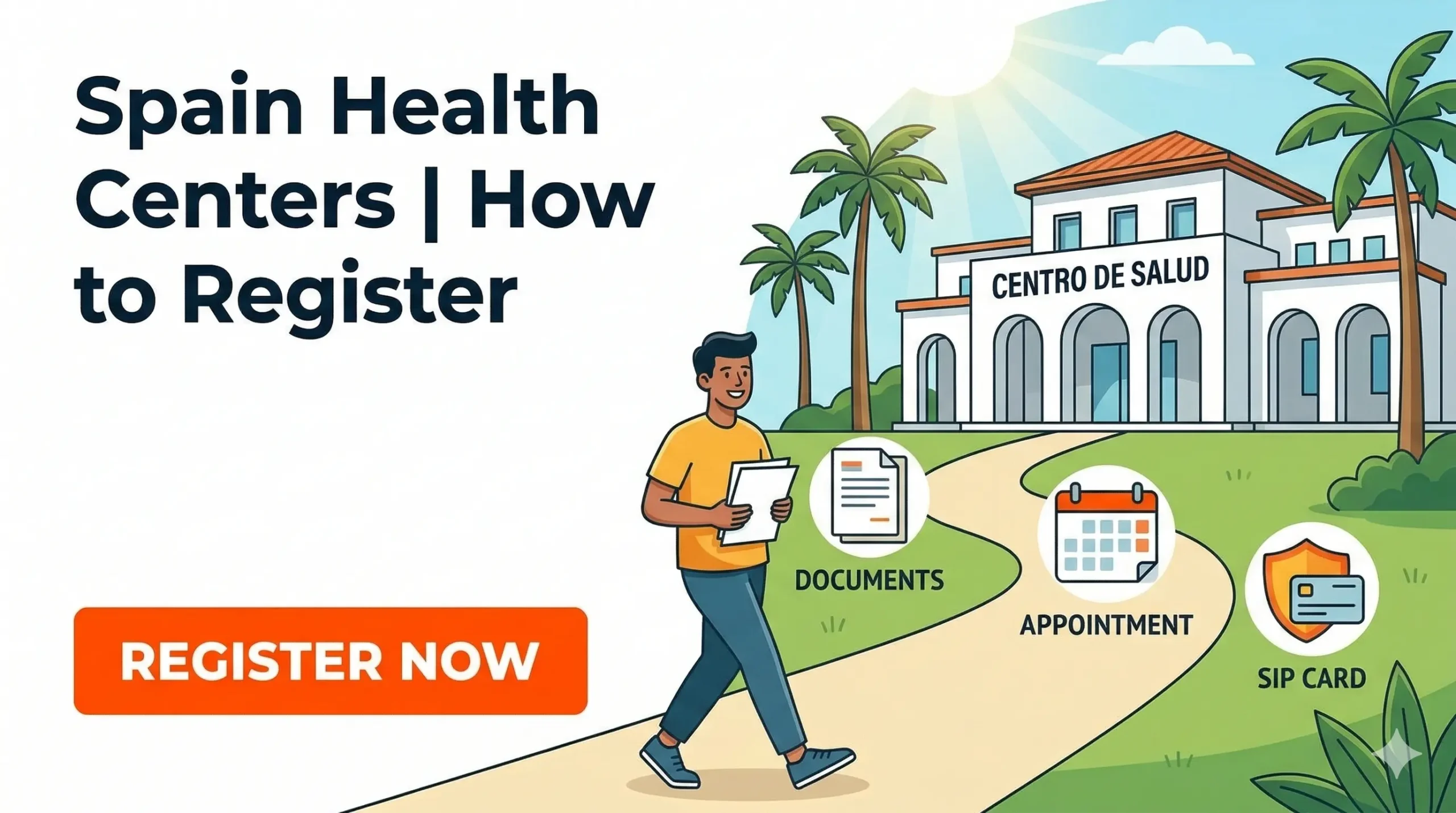
The bureaucratic process of registering for public healthcare in Spain involves three distinct steps. You cannot simply walk into the medical clinic on day one; you must gather your administrative paperwork from other government departments first.
Step One: The Padron Certificate
Your assigned Centro de Salud is dictated by your home address. To prove where you live, you must register on the municipal census at your local Town Hall (Ayuntamiento). This certificate is called the Certificado de Empadronamiento (or simply, the Padrón). To get this, you must present your passport, your rental contract (or property deeds), and a recent utility bill.
If you have just moved and need to set up local direct debits for rent or utilities to secure your Padrón, using a localized financial account is essential. Many expats use Wise to hold Euros and set up local Spanish IBAN details, ensuring rent and bills are paid seamlessly without international transfer fees. A current Padrón is generally valid for three months for administrative purposes, so timing this step right before your healthcare registration is key.
Step Two: Social Security Registration
Once you have your Padrón, you must prove you have the right to public healthcare. This is done through the National Institute of Social Security (INSS). If you have started a job, your employer will have registered you, but you still need to formally request your Documento Acreditativo del Derecho a la Asistencia Sanitaria (Document Accrediting the Right to Healthcare).
You can apply for this document online if you have a Spanish Digital Certificate, or by making a prior appointment (cita previa) at your local INSS office. You will need to present your passport, your residency card (TIE) or NIE, and your social security number. If your Spanish is limited and you need to hire a local administrative agent (gestor) to handle this INSS paperwork on your behalf, you can easily pay their professional fees using Wise, avoiding the exorbitant conversion rates charged by traditional foreign banks.
Step Three: Visiting the Centro de Salud
Armed with your Padrón certificate, your INSS document, and your official ID (Passport and TIE/NIE), you can finally go to your local Centro de Salud.
Approach the administrative reception desk (mostrador de admisión) and tell them you want to register. They will input your data into the regional health system and immediately assign you a general practitioner. You will be given a temporary paper document that allows you to book appointments right away. A few weeks later, your official plastic health card—the Tarjeta Sanitaria Individual (TSI or SIP card)—will either arrive in the mail or be ready for collection at the clinic. This card is your master key to the system; you must bring it to every single medical appointment. For guidance on how your health data is subsequently tracked and stored, review our article on Medical Records in Spain: Accessing and Sharing Your History.
Booking Appointments and Navigating Daily Care
Once you are fully registered and holding your health card, interacting with your Centro de Salud becomes a routine part of daily life in Spain.
How to Book a Cita Previa
You can rarely see a doctor on a walk-in basis in Spain unless it is a localized emergency. For routine issues, you must book a cita previa (prior appointment). The Spanish public healthcare system has modernized rapidly, meaning you no longer have to call the reception desk and wait on hold.
Every autonomous community in Spain has its own dedicated mobile application and online portal for health management. For example, residents in Andalusia use “Salud Andalucía,” while those in Catalonia use “La Meva Salut.” By downloading your regional app and entering your health card number, you can view your assigned doctor’s calendar and book an appointment with a few taps. We detail how to navigate these digital tools extensively in our guide on Health Apps in Spain: Booking, Records, and Telemedicine Options.
If your issue is minor, the apps also allow you to book a telephone consultation (cita telefónica). The doctor will call you at the scheduled time, which is highly efficient for discussing basic blood test results or requesting sick leave notes for work. If you require immediate advice but cannot secure a timely public appointment, reading up on Telemedicine in Spain: When It’s Useful and What to Expect can provide alternative solutions for rapid medical triage.
The Electronic Prescription System
Spain operates a brilliant nationwide electronic prescription network (receta electrónica). Your doctor at the Centro de Salud does not write paper prescriptions. Instead, they digitally authorize medications directly to your health card. You simply walk into any Spanish pharmacy (farmacia), hand over your card, and the pharmacist dispenses your medication.
Public prescriptions are heavily subsidized by the state based on your income bracket. You will typically pay a small percentage of the total cost at the pharmacy counter, known as the copago. If you want to understand exactly how much you can expect to pay for your medications, refer to our comprehensive breakdown in Health Costs in Spain: Typical Co‑Pays and Out‑of‑Pocket Fees and Medication Refills in Spain: How Renewals Work.
While the public system covers essential, life-saving pharmaceuticals beautifully, it does not subsidize over-the-counter wellness products, holistic remedies, or specialized dietary supplements. If your Spanish doctor recommends high-dose vitamins, specific probiotics, or natural joint supplements to manage a chronic condition, purchasing these at a local Spanish pharmacy can be incredibly expensive due to high retail markups. To save money, the expat community routinely relies on global retailers like iHerb. By ordering through iHerb, you can access a massive variety of trusted international wellness brands at competitive prices, shipped directly to your Spanish address.
Managing Ongoing Care and Specialist Referrals
If you suffer from a chronic illness such as diabetes, hypertension, or a thyroid condition, your Centro de Salud is the central hub for your ongoing care. Your primary care doctor will schedule regular check-ups, order routine blood panels, and adjust your digital prescriptions as necessary. For expats managing long-term health logistics, our guide on Chronic Conditions in Spain: Managing Ongoing Care as an Expat offers practical advice for coordinating these vital services.
However, the primary frustration expats face with the Centro de Salud is accessing specialists. If your GP refers you to a public dermatologist, gynecologist, or orthopedic surgeon, you may wait several months for the appointment depending on the severity of your condition and regional backlogs. Furthermore, certain disciplines, like adult routine dentistry, are almost entirely excluded from the public system. If you experience sudden tooth pain, you will need to seek private care, a scenario we cover thoroughly in Emergency Dental Care in Spain: Where to Go.
To bypass these lengthy public specialist waiting lists, having supplementary coverage is a game-changer. By holding a private policy secured through Innoinsure, you can immediately book an appointment directly with a private specialist in their network, completely bypassing the Centro de Salud’s gatekeeper system. When paying for specialized private treatments or covering the out-of-pocket costs for elective procedures, managing your funds efficiently via Wise ensures your healthcare budget stretches further.
References
Primary sources (official)
- Ministerio de Sanidad – Asistencia Sanitaria Pública: https://www.sanidad.gob.es/ciudadanos/prestaciones/centros/home.htm
- Seguridad Social – Asistencia Sanitaria: https://www.seg-social.es/wps/portal/wss/internet/Trabajadores/PrestacionesPensionesTrabajadores/10938/30476
Other helpful sources
- Expatica – Healthcare in Spain: https://www.expatica.com/es/healthcare/healthcare-basics/healthcare-in-spain-101467/
- Citizens Advice Bureau Spain – Registering for Healthcare: https://www.citizensadvice.org.es/faq/registering-for-healthcare-in-spain/
Disclaimer
The information provided in this article is for educational and informational purposes only and does not constitute official legal, medical, or financial advice. Immigration requirements, social security eligibility, and healthcare registration protocols in Spain are subject to frequent changes by national and regional authorities. Always consult directly with the Instituto Nacional de la Seguridad Social (INSS), your local Centro de Salud, or a qualified administrative professional (gestor) for advice tailored to your specific residency and employment situation.