Mental Health in Spain: Psychologists vs Psychiatrists Explained
Disclosure: This article contains affiliate links. If you buy through them, we may earn a commission at no extra cost to you. Read our full disclosure.
Navigating mental health care in a foreign country can be overwhelming. This comprehensive guide clarifies the critical differences between psychologists and psychiatrists in Spain, explains how to access public and private care, and provides essential resources for English-speaking expats.
The Cultural Shift in Spanish Mental Health Care
For decades, mental health care in Spain carried a heavy social stigma. Seeking therapy was often viewed as a last resort, whispered about behind closed doors, or dismissed entirely in favor of relying on tight-knit family structures for emotional support.
However, Spain has undergone a massive cultural awakening regarding psychological well-being, a shift heavily accelerated by the global pandemic. Today, mental health is a prominent topic of national conversation. The Spanish government, public figures, and younger generations are actively breaking down the historical stigmas associated with anxiety, depression, and therapeutic intervention.
This cultural evolution has led to increased demand for professional services and significant legislative actions, including the launch of national suicide prevention strategies and increased funding for public mental health infrastructure. Despite this progress, the clinical system remains deeply bifurcated. The way care is delivered depends entirely on whether the professional approaches the mind from a behavioral perspective or a purely medical one.
What is a Psychologist in Spain
In Spain, a psychologist (el psicólogo) is a highly trained professional who studies human behavior, emotional regulation, and cognitive processes. They are the professionals you seek when you need “talk therapy” to work through trauma, manage daily anxiety, navigate relationship issues, or develop healthier coping mechanisms.
Educational Pathways PIR vs Master Degree
The regulation of psychology in Spain is strict, and not everyone with a psychology degree can legally treat patients in a clinical setting. To practice in the healthcare sector, a professional must complete a four-year university degree in Psychology (Grado en Psicología) followed by one of two specific regulatory pathways:
- General Health Psychologist (Psicólogo General Sanitario): This requires completing a highly regulated, two-year official Master’s degree. These professionals typically work in private practice and handle the evaluation, prevention, and treatment of psychological issues that do not require specialized public hospital intervention.
- Clinical Psychologist (Psicólogo Clínico): This is the highest level of specialization. After their university degree, these candidates must pass a fiercely competitive national exam known as the PIR (Psicólogo Interno Residente). If they pass, they complete a four-year paid residency in the public hospital system, rotating through various mental health departments. Only those who complete the PIR can work as clinical psychologists within the state-funded public healthcare system.
The Treatment Approach
Regardless of their specific title, psychologists in Spain utilize various therapeutic modalities, such as Cognitive Behavioral Therapy (CBT), psychoanalysis, Eye Movement Desensitization and Reprocessing (EMDR), and humanistic therapy. A typical session lasts between 45 and 60 minutes.
The Crucial Limitation: In Spain, psychologists are not medical doctors. Under Spanish law, they possess absolutely zero prescriptive authority. A psychologist cannot prescribe antidepressants, anti-anxiety medications, or any other pharmaceutical drug. If they believe your condition requires medical intervention, they must refer you to a psychiatrist or a general practitioner.
What is a Psychiatrist in Spain
A psychiatrist (el psiquiatra) is, first and foremost, a licensed medical doctor. Their approach to mental health is fundamentally rooted in biology, neurochemistry, and physiology. They treat severe mental health disorders by addressing chemical imbalances in the brain and central nervous system.
The Medical Pathway The MIR System
The journey to becoming a psychiatrist in Spain is incredibly rigorous. A candidate must first complete a six-year medical degree at a university to become a physician. Following graduation, they must pass the MIR (Médico Interno Residente) exam, a notoriously difficult national medical residency test.
Upon passing the MIR, the doctor enters a five-year specialized psychiatric residency within the Spanish hospital system. During this half-decade of specialized training, they manage acute psychiatric emergencies, severe clinical depression, bipolar disorder, schizophrenia, and severe personality disorders.
The Treatment Approach and Medication
Because they are medical doctors, psychiatrists in Spain hold full prescriptive authority. They are the professionals who diagnose psychiatric illnesses and prescribe psychotropic medications.
It is vital for expats to understand the cultural difference in how Spanish psychiatrists operate compared to those in North America. In Spain, particularly within the public system, a psychiatrist rarely conducts weekly 50-minute talk therapy sessions. Their role is heavily clinical and diagnostic. A typical psychiatric consultation may last only 15 to 30 minutes, during which the doctor evaluates your symptoms, assesses your physical reaction to a medication, adjusts your dosages, and monitors for side effects. For comprehensive care, a psychiatrist will often work in tandem with a psychologist—the psychiatrist manages the medication, while the psychologist provides the ongoing behavioral therapy.
Summary Comparison Psychologist vs Psychiatrist
To help you quickly determine which professional you need, refer to this comparative breakdown of the two disciplines in Spain.
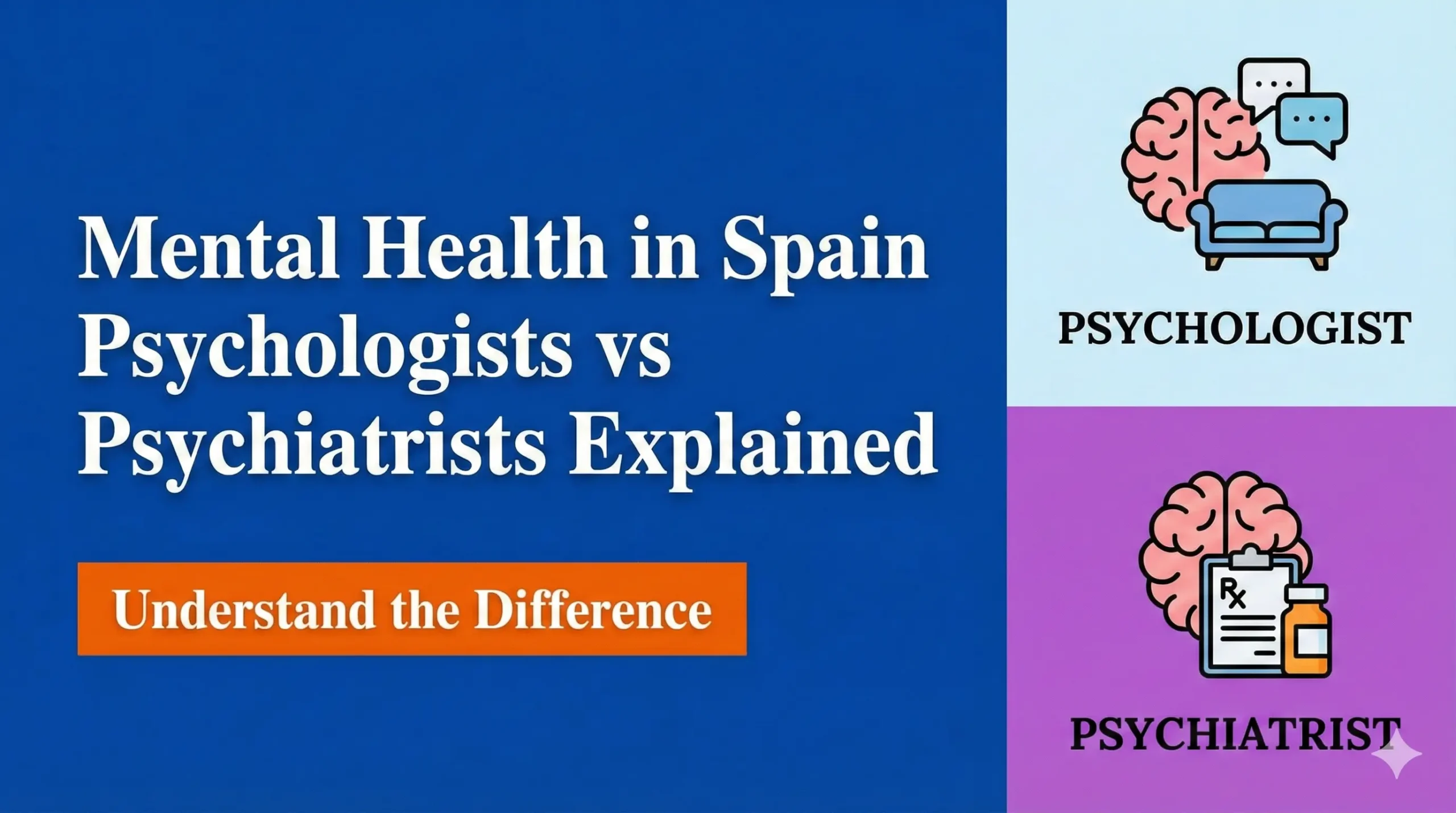
| Feature | Psychologist (Psicólogo) | Psychiatrist (Psiquiatra) |
| Foundational Education | University Degree in Psychology | University Degree in Medicine |
| Postgraduate Training | PIR Residency (4 years) or Master’s (2 years) | MIR Psychiatric Residency (5 years) |
| Prescriptive Authority | No. Strictly forbidden by law. | Yes. Full medical prescriptive authority. |
| Primary Treatment Method | Talk therapy, CBT, behavioral evaluations. | Medical diagnosis, pharmaceutical management. |
| Typical Session Length | 45 to 60 minutes. | 15 to 30 minutes. |
| Best Suited For… | Grief, mild/moderate anxiety, relationship issues, trauma processing. | Severe clinical depression, bipolar disorder, schizophrenia, ADHD medication. |
Navigating the Public Mental Health System
If you are legally working in Spain and contributing to the social security system, you have the right to access mental health care through the state-funded public network (Sanidad Pública). To grasp how this vast infrastructure is funded and managed at a regional level, you can review our overview on Understanding the Spanish Healthcare System.
The Role of the Primary Care Doctor
In the public system, you cannot simply browse a directory and book a public psychologist. The system is strictly tiered. Your first point of contact must always be your assigned general practitioner (médico de cabecera) at your local health center. If you are unsure how to secure this initial consultation, you should follow the administrative steps detailed in How to Book GP Appointments in Spain.
During your appointment, you must explain your psychological distress to your general practitioner. The GP will evaluate your symptoms. For mild anxiety or transient depression, the GP themselves may prescribe a basic antidepressant and monitor your progress. If the GP determines your case requires specialized intervention, they will issue an official referral (volante) to the mental health unit of your designated regional hospital, directing you to either a public psychologist or a psychiatrist.
The Reality of Public Sector Wait Times
While the quality of professionals in the Spanish public system is exceptionally high, the system is severely under-resourced. Spain currently has one of the lowest ratios of public clinical psychologists per 100,000 inhabitants in the European Union.
Consequently, the waiting lists for public mental health care are a significant issue. Unless you are classified as having an acute, severe psychiatric emergency, waiting for your first therapy session can take several months. Furthermore, once you are in the system, the overwhelming patient load means you might only see your public psychologist once every four to six weeks, which is often insufficient for effective, ongoing behavioral therapy.
Utilizing the Private Healthcare Sector for Therapy
Due to the bureaucratic bottlenecks and extended wait times in the public sector, a massive percentage of the expatriate community turns to the private healthcare sector for their mental health needs.
Navigating Private Health Insurance Limits
If you hold a comprehensive expat insurance policy, you have direct access to private mental health professionals without needing a referral from a general practitioner. You can use your insurer’s medical directory to book an appointment with a psychiatrist within days. To ensure you have this level of flexibility, carefully evaluate your policy options when Choosing the Right Private Health Insurance in Spain.
However, when it comes to psychologists and ongoing talk therapy, you must read the fine print of your private policy carefully. Most Spanish health insurance plans place strict annual limits on psychological therapy. A standard policy might only cover 15 to 20 therapy sessions per calendar year. Once you hit that cap, you must pay out of pocket. Furthermore, some insurers will only cover sessions if they are prescribed by a psychiatrist first, or they may only cover therapy for specific diagnoses like eating disorders or severe clinical depression, explicitly excluding marriage counseling or general life coaching.
Paying Out of Pocket
Many expats bypass insurance entirely and pay for private therapy out of pocket. This grants you total freedom to choose any therapist, dictate the frequency of your sessions, and keep your mental health records entirely separate from your medical insurance profile.
In major Spanish cities like Madrid, Barcelona, and Valencia, a private, 60-minute therapy session with a licensed psychologist typically costs between €60 and €100. A private consultation with a psychiatrist is generally more expensive, ranging from €80 to €150 per visit. Balancing these ongoing out-of-pocket costs requires careful financial planning; you can explore strategies for managing your broader financial life in our Cost of Living in Spain: Realistic Budgets and Savings Tips.
Finding an English Speaking Therapist
Engaging in psychological therapy requires profound vulnerability and precise communication. Attempting to articulate complex emotional trauma, subtle mood shifts, or deeply ingrained anxieties in a second language is incredibly difficult and can severely hinder your therapeutic progress. Finding a professional who speaks native or highly fluent English is often the highest priority for expats.
Online Directories
The private sector in Spain is accustomed to serving the international community. Powerful digital directories like Doctoralia and TopDoctors allow you to search for psychologists and psychiatrists in your specific city and apply a language filter to only show professionals who consult in English. You can read patient reviews, view their academic credentials, and book appointments directly online. For broader strategies on utilizing these platforms, consult our guide on Finding an English-Speaking Doctor in Spain.
Teletherapy and International Platforms
Since the pandemic, teletherapy has become fully normalized in Spain. If you live in a rural area or a smaller coastal town where English-speaking professionals are scarce, you can easily conduct your therapy sessions via video call with a licensed Spanish psychologist based in Madrid or Barcelona. Alternatively, many expats utilize international digital counseling platforms to connect with therapists licensed in their home countries, ensuring zero cultural or linguistic barriers.
Managing Mental Health Medication in Spain
If your treatment plan requires pharmaceutical intervention, you must understand how to navigate the strict Spanish pharmacy system.
In Spain, psychotropic medications—including SSRI antidepressants (like Sertraline or Fluoxetine), anti-anxiety medications (like Diazepam or Lorazepam), and ADHD stimulants (like Methylphenidate)—are heavily controlled. You absolutely cannot purchase them over the counter.
You must have a valid prescription (receta) from a licensed Spanish medical doctor—either your public GP, a public psychiatrist, or a private psychiatrist. If you bring an empty pill bottle from your home country to a Spanish pharmacy, the pharmacist will legally refuse to refill it without authorization from a local doctor. If you are bringing your existing medical records to establish a new prescription loop locally, you can familiarize yourself with the dispensing rules in our Spanish Pharmacy Guide: Prescriptions and Over-the-Counter Medicine.
Once you are established in the public system, your doctor will load your recurring prescriptions onto your electronic health card (Tarjeta Sanitaria), allowing you to pick up your medication at any local pharmacy with heavy state subsidies, making the cost of antidepressants remarkably cheap.
Emergency Mental Health Resources in Spain
If you or someone you know is experiencing an acute mental health crisis, severe panic attacks, or suicidal ideation, you must bypass the standard appointment booking systems and seek immediate emergency care. The Spanish healthcare system provides robust, immediate safety nets for crises.
- The 024 Hotline: The Spanish Ministry of Health operates the 024 Suicidal Behavior Hotline (Línea de atención a la conducta suicida). This number is completely free, confidential, does not appear on your phone bill, and is operational 24 hours a day, 365 days a year. The service includes a tele-translation system to assist non-Spanish speakers.
- 112 General Emergency: Dialing 112 connects you to the national emergency dispatch. You can request an ambulance or emergency medical assistance for psychiatric emergencies. Operators generally speak English.
- Hospital Urgencias: Every major public hospital in Spain has a 24-hour emergency room (Urgencias) with an on-call psychiatric team. If you are in immediate danger, you can walk into any public hospital emergency department and receive immediate, free psychiatric triage and stabilization, regardless of your insurance status or residency paperwork.
Conclusion
Navigating the mental health landscape in a foreign country requires patience, advocacy, and a clear understanding of the local medical framework. In Spain, the roles of psychologists and psychiatrists are strictly defined by their educational backgrounds and their legal ability to prescribe medication.
Whether you choose to navigate the wait times of the highly qualified public system or leverage the speed and linguistic flexibility of the private sector, Spain offers the professional infrastructure necessary to support your mental well-being. Do not let the initial administrative confusion deter you from seeking help. By understanding how the system operates, you can secure the right professional support to ensure your expatriate journey is not just culturally enriching, but emotionally sustainable.
References
Primary sources (official)
- Ministerio de Sanidad (024 Suicide Prevention Hotline Info): https://www.sanidad.gob.es/en/linea024/home.htm
- Ministerio de Sanidad (National Mental Health Strategy): https://www.sanidad.gob.es/areas/calidadAsistencial/estrategias/saludMental/docs/strategyMentalHealth.pdf
- Consejo General de la Psicología de España (General Council of Psychology): https://www.cop.es/
Other helpful sources
- TherapyRoute (Mental Health Licensing & Regulation in Spain Guide): https://www.therapyroute.com/article/mental-health-licensing-regulation-in-spain-2025-guide-by-therapyroute
- Support in Spain (Directory of Mental Health Organisations): https://www.supportinspain.info/organisations/024-suicide-prevention-national-helpline/
Disclaimer
The information provided in this article is for educational and informational purposes only and does not constitute formal medical or psychiatric advice. Healthcare administration rules, private insurance coverage limits, and professional licensing pathways (PIR/MIR) are subject to change by the Spanish Ministry of Health and regional authorities. If you are experiencing a medical or mental health emergency, please dial 112 or 024 immediately. Always consult a licensed medical professional in Spain for personalized diagnosis and treatment.