Prescription System in Spain: How ePrescriptions Work
Disclosure: This article contains affiliate links. If you buy through them, we may earn a commission at no extra cost to you. Read our full disclosure.
Navigating the Spanish healthcare system is much easier once you understand the receta electrónica. This comprehensive guide explains how Spain’s ePrescription system works, how to use your public health card at the pharmacy, and how to seamlessly manage medication refills.
The Foundation of the Electronic Prescription
To understand how ePrescriptions work in Spain, you first need to understand the role of the public health card. The entire digital prescription ecosystem is built around the Tarjeta Sanitaria Individual, the personal health card issued to every legal resident who is registered within the public healthcare system.
When you register with your regional health service—whether that is CatSalut in Catalonia, the Servicio Madrileño de Salud in Madrid, or the Servicio Andaluz de Salud in Andalusia—you are issued a physical plastic card. This card contains a magnetic stripe or an embedded microchip, along with a unique identification number that links you to your centralized medical records.
The receta electrónica is not an app you download, nor is it an email sent to your phone. It is a secure digital file stored on the regional health authority’s central servers. Your physical health card acts as the physical key that unlocks this file. Therefore, you cannot access the public electronic prescription system without having completed the necessary administrative steps to secure your local healthcare coverage. If you have recently relocated and have not yet registered with the local medical authorities, you will want to prioritize this step, which is detailed in our guide on How to Get a Spanish Health Card: Step-by-Step.
The Consultation and Prescribing Process
The journey of an electronic prescription begins in the doctor’s office. When you visit your primary care physician or a specialist within the public health network, the consultation is entirely digitized.
During your appointment, the doctor accesses your complete medical history through their secure terminal. If the doctor determines that you require medication, they will open the electronic prescribing module within your patient file. Here is what happens behind the screen:
First, the system automatically cross-references the new medication against your existing active prescriptions and your recorded medical allergies. If there is a potential for a dangerous drug interaction or an allergic reaction, the software immediately alerts the physician. This built-in safety mechanism is one of the primary medical benefits of the receta electrónica, significantly reducing human error and adverse drug events.
Second, the doctor will typically prescribe the active pharmaceutical ingredient rather than a specific commercial brand name. For instance, instead of prescribing “Advil,” they will prescribe “Ibuprofen.” The Spanish public healthcare system heavily favors generic medications to control costs. The doctor will specify the exact dosage, the frequency of administration, and the total duration of the treatment.
Once the doctor hits the authorize button, the prescription is instantly uploaded to the central server. The doctor will then print a document called the Hoja de Tratamiento or Treatment Information Sheet. This piece of paper is not the actual prescription; rather, it is a personal guide for you. It lists all your active medications, the exact doses you need to take, and instructions on how and when to take them. If you are struggling to communicate your needs or understand the doctor’s instructions during this crucial step, you may find our insights on Finding Doctors in Spain: Appointments, Referrals, and Language Tips particularly helpful.
Collecting Your Medication at the Pharmacy
Once your doctor has authorized the medication, you can walk into any pharmacy in your region to collect it. Pharmacies in Spain are universally easily identifiable by a large, illuminated green cross displayed on the exterior of the building.
The process of collecting an ePrescription is incredibly straightforward and efficient. When it is your turn at the counter, you simply hand your physical Tarjeta Sanitaria Individual to the pharmacist. You do not need to show them the printed Treatment Information Sheet unless there is a specific discrepancy you want to discuss.
The pharmacist will insert your health card into their secure card reader. Their computer terminal will instantly connect to the regional health server and display a list of your “dispensable” medications. The pharmacist will select the items that are ready for collection, retrieve them from their inventory, and process the transaction.
As a helpful final step, it is standard practice for Spanish pharmacists to use a pen to write the dosage instructions directly on the cardboard packaging of the medication. For example, they might write “1 c/ 8h” on a box of antibiotics, meaning one pill every eight hours. This cultural habit provides an excellent secondary safety check for patients. For more advice on interacting with local pharmaceutical professionals and understanding what you can buy over the counter, review our article covering Pharmacies in Spain: Prescriptions, Over-the-Counter Meds, and Practical Tips.
Managing Acute versus Chronic Medications
The ePrescription system differentiates between acute treatments and chronic treatments, applying different dispensing rules to each to prevent medication hoarding and ensure patient safety.
Acute medications are prescribed for a short, specific duration to treat a temporary illness. A common example is a seven-day course of antibiotics for a sinus infection or a short prescription for strong painkillers following a dental extraction. Once the pharmacist dispenses this medication to you, it disappears from your active ePrescription profile. If you lose the pills or fail to finish the course, you cannot simply go back to the pharmacy to get more; you must return to the doctor for a new medical evaluation.
Chronic medications, on the other hand, are handled via a rolling calendar system. If you suffer from hypertension, asthma, diabetes, or a thyroid condition, your doctor will classify your prescription as a tratamiento crónico. The doctor can authorize the ePrescription for a full year.
However, you cannot walk into the pharmacy and demand a twelve-month supply of your blood pressure medication on the same day. The system calculates a strict dispensing calendar based on the prescribed dosage. The pharmacist can only give you one or two boxes at a time. The system will then lock that specific medication, displaying a “next available dispensing date” on the pharmacist’s screen. You must wait until you are a few days away from running out before the system will allow the pharmacist to give you your next box.
The Automatic Renewal Process
One of the greatest conveniences of the Spanish ePrescription system is the dramatic reduction in unnecessary doctor visits for patients with chronic conditions. In the era of paper prescriptions, patients had to schedule an appointment with their primary care physician every month or two simply to get a new slip of paper signed.
Today, the annual authorization handles this automatically. You only need to visit the pharmacy according to your dispensing calendar. When your one-year authorization is nearing its expiration date, the pharmacist will usually warn you, noting that your receta is about to expire. At this point, you must contact your health center. In many regions, you do not even need an in-person appointment for a simple renewal; you can request an administrative renewal over the phone or through the regional health app, and the doctor will digitally extend the prescription for another year following a brief review of your file. If you want a deeper dive into the specific rules surrounding these extensions, you should read our breakdown on Medication Refills in Spain: How Renewals Work.
Understanding Pharmacy Copayments and Fees
A common question among expats is how much they will have to pay at the pharmacy counter. Unlike some countries where public healthcare implies completely free medication, the Spanish system utilizes a subsidized copayment structure known as the copago farmacéutico.
When the pharmacist swipes your health card, the system does not just pull up your medication list; it also instantly references your tax and social security records to determine your exact copayment tier. This means the price you are charged is automatically calculated based on your employment status, your age, and your declared annual income. You do not need to show proof of income at the pharmacy; the backend digital integration handles it seamlessly.
The copayment tiers are divided into several categories, which are printed as a code (like TSI 001, TSI 002) directly on your health card.
Spanish Public Healthcare Copayment Tiers
| Beneficiary Status | Annual Income Level | Copayment Percentage | Monthly Cap (Limits) |
| Active Workers | Under €18,000 | 40% of retail price | No monthly cap |
| Active Workers | €18,000 to €100,000 | 50% of retail price | No monthly cap |
| Active Workers | Over €100,000 | 60% of retail price | No monthly cap |
| State Pensioners | Under €18,000 | 10% of retail price | Capped at roughly €8/month |
| State Pensioners | €18,000 to €100,000 | 10% of retail price | Capped at roughly €18/month |
| State Pensioners | Over €100,000 | 60% of retail price | Capped at roughly €61/month |
| Exempt Groups | Severe disability, minimum vital income recipients | 0% (Fully Free) | €0 |
Note: The exact monthly caps for pensioners adjust slightly each year with inflation, but the percentage structures remain legally fixed. Certain life-saving medications for severe chronic illnesses also have heavily reduced copayments regardless of income.
Private Healthcare and Electronic Prescriptions
Everything discussed so far applies to the public Sistema Nacional de Salud. But what happens if you bypass the public system and use private health insurance?
Historically, the private healthcare sector in Spain lagged significantly behind the public sector regarding digital prescriptions. For many years, if you visited a private doctor through a provider like Sanitas, Adeslas, or DKV, the doctor would write your prescription on a physical, stamped piece of paper. You would have to take that paper to the pharmacy and pay 100% of the retail price for the medication, as private insurance generally does not cover outpatient pharmacy costs in Spain.
However, the private sector has rapidly modernized. The Spanish Medical Colleges Organization recently implemented a standardized private electronic prescription system known as the Receta Médica Privada Electrónica.
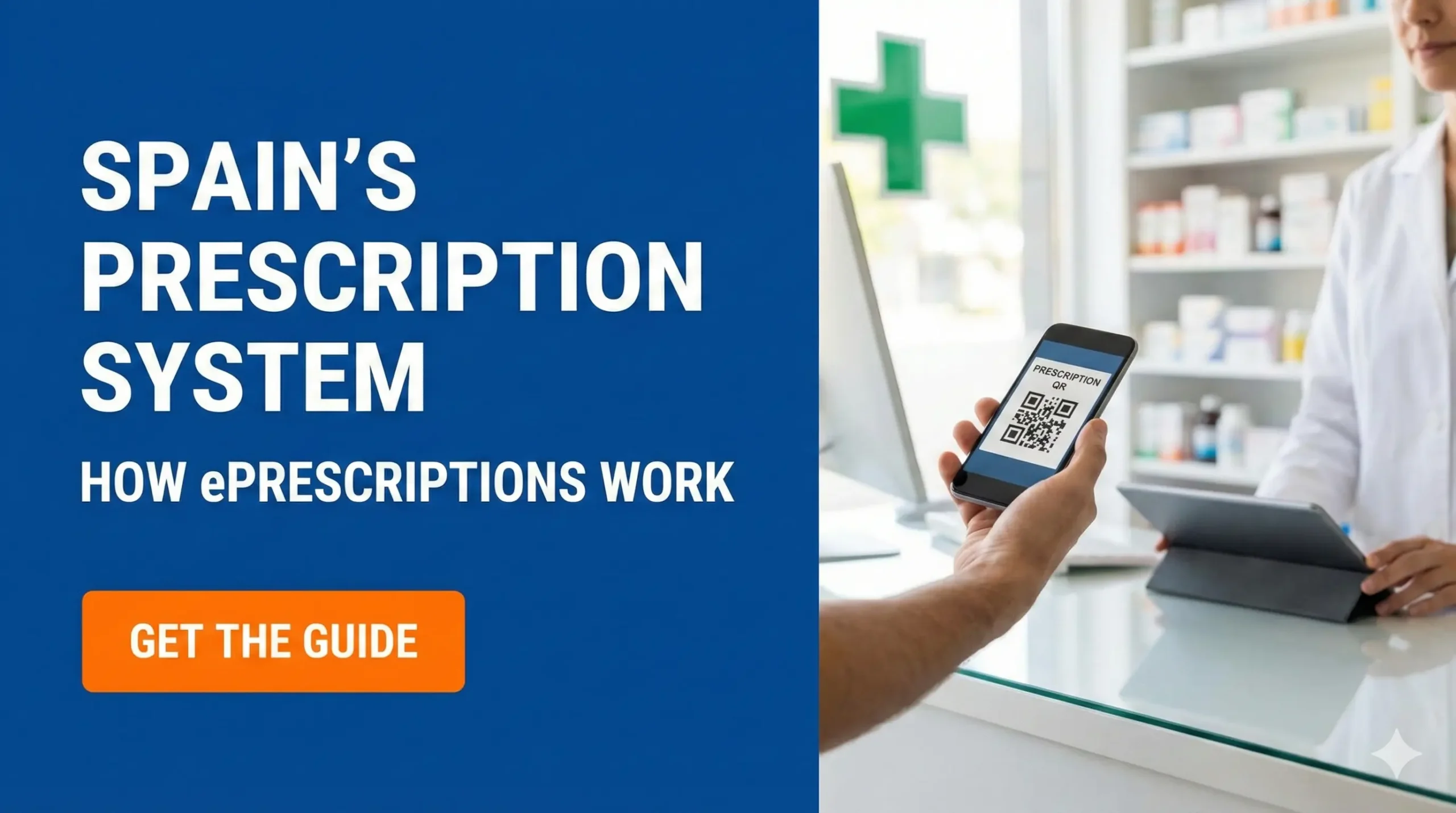
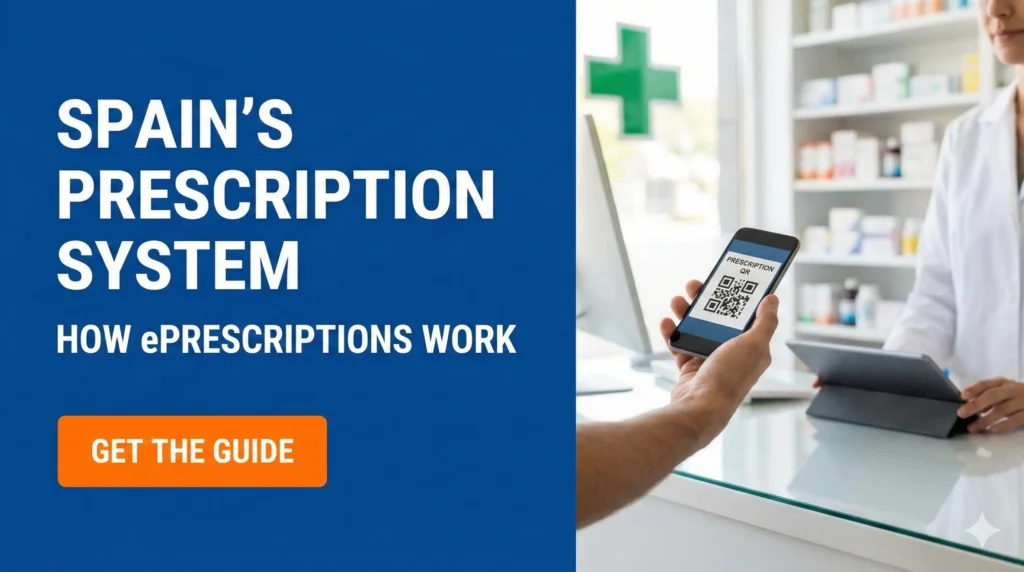
Today, if you have a video consultation or an in-person appointment with a private physician, they will generate a digital prescription. Instead of being linked to a public health card, this private ePrescription is typically sent directly to your email or your private insurance provider’s mobile app in the form of a secure QR code or a barcode.
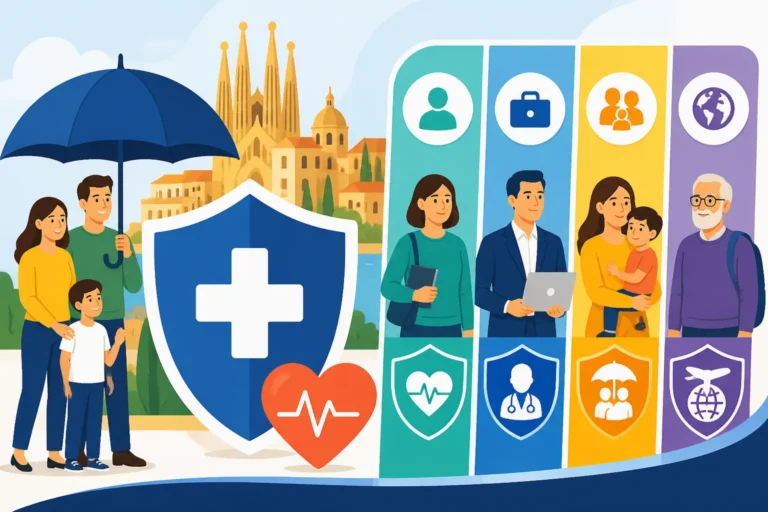
When you go to the pharmacy, you simply open the app on your smartphone, present the QR code to the pharmacist, and they scan it with their barcode reader to dispense the medication. This has vastly improved the telemedicine experience for expats relying on private coverage. If you are currently weighing the benefits of private policies to secure your residency or bypass public waiting lists, exploring the nuances in Health Insurance in Spain: Options for Residents, Students, and Families will provide crucial context.
National Interoperability Crossing Regional Borders
Because the Spanish public healthcare system is managed by seventeen different autonomous communities, a major logistical problem used to exist for travelers. In the early days of the ePrescription rollout, the servers in Andalusia could not communicate with the servers in Madrid. If you lived in Seville but went on a summer vacation to the northern coast of Asturias and forgot your medication, the local Asturian pharmacy could not read your Andalusian health card. You had to visit a local doctor to get a temporary paper prescription.
Fortunately, this fragmentation is a thing of the past. The Ministry of Health spearheaded a massive integration initiative called the Interoperability of the Electronic Prescription Project.
Today, the electronic prescription system is fully interoperable across all of Spain. If you are an expat living in Valencia and you travel to the Canary Islands for a holiday, you can walk into any local pharmacy, present your Valencian health card, and the pharmacist in the Canary Islands can securely access your digital file and dispense your chronic medication without issue. Your standard copayment tier will apply exactly as it does in your home region.
The Role of Regional Health Applications
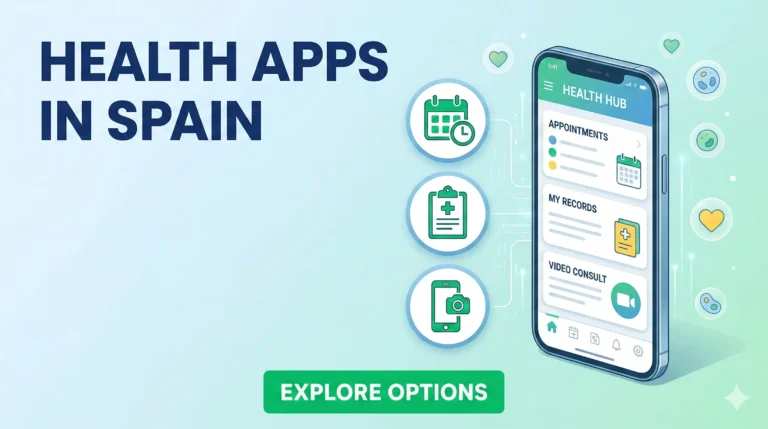
The digital experience of the Spanish patient extends far beyond the pharmacy counter. Every autonomous community in Spain has developed its own dedicated health application for smartphones. Examples include La Meva Salut in Catalonia, Tarjeta Sanitaria Virtual in Madrid, and ClicSalud+ in Andalusia.
These applications are incredibly powerful tools for managing your ePrescriptions. Once you securely log into your regional app using a digital certificate or a pin code provided by your local health center, you have full transparency over your pharmaceutical profile.
Within the app, you can view your active Treatment Information Sheet, see the exact names and dosages of the medications you are currently prescribed, and most importantly, check the exact dates when your next refill will become available at the pharmacy. The app eliminates the guesswork of wondering if it is too early to pick up your next box of pills. Furthermore, these apps serve as digital health wallets, allowing you to access diagnostic results and book doctor appointments. For a comprehensive look at how to download and utilize these platforms, read our guide on Health Apps in Spain: Booking, Records, and Telemedicine Options.
Picking Up Medication for Family Members
A common practical concern is whether you can pick up medication on behalf of someone else. If your spouse is sick in bed with the flu, or if you are caring for an elderly parent who cannot easily walk to the pharmacy, the system accommodates this cultural reality seamlessly.
In Spain, you do not need formal legal power of attorney to pick up a standard prescription for a family member or a neighbor. However, you must have their physical Tarjeta Sanitaria Individual.
You simply take their health card to the pharmacy and present it to the pharmacist. The pharmacist will process the transaction exactly as if the patient were standing there. Occasionally, for highly controlled substances like strong narcotics or certain psychiatric medications, the pharmacist may ask to see your personal identification card (DNI or NIE) to record who collected the dangerous drugs, but for standard antibiotics, blood pressure pills, or pain relievers, presenting the patient’s health card is entirely sufficient.
Troubleshooting Common ePrescription Issues
While the receta electrónica system is remarkably robust, technology is not infallible. Here are a few common issues you might encounter and how to resolve them:
- The Pharmacy is Out of Stock: It is not uncommon for a local pharmacy to be out of stock of a specific medication. Do not panic. Spanish pharmacies receive multiple deliveries per day from central pharmaceutical distributors. If you present your card in the morning and they lack the inventory, they will usually order it immediately and tell you to return after 5:00 PM the same day, or the following morning, to collect it.
- Your Prescription Has Expired: If you hand over your card and the pharmacist tells you the prescription has expired, they are legally forbidden from dispensing the medication, even if you are out of pills. You must contact your health center immediately to request a renewal.
- You Lost Your Health Card: If you lose your physical card, you cannot access your ePrescriptions. You must go to your local health center to report the loss. They will issue you a temporary paper document with a barcode that the pharmacist can scan while you wait for your replacement plastic card to arrive in the mail.
- System Outages: On very rare occasions, the regional health servers may experience a temporary IT outage, meaning pharmacies cannot access patient files. In these instances, you simply have to wait an hour or two for the system to come back online. If it is a life-threatening emergency, you should proceed to a hospital emergency room.
Conclusion
The electronic prescription system is a shining example of how digital infrastructure can vastly improve the daily lives of residents. By eliminating the reliance on easily lost paper slips, reducing the risk of dangerous drug interactions, and automating the renewal process for chronic patients, Spain has created a patient-centric pharmaceutical experience.
For expats, taking the time to properly register with the public health system, understanding the copayment structures, and downloading the regional health app will transform a potentially stressful chore into a seamless, modern, and highly efficient aspect of your new life in Spain.
References
Primary sources (official)
- Ministerio de Sanidad (Ministry of Health – Interoperability Project): https://www.sanidad.gob.es/
- Seguridad Social (Social Security Portal – Copayment Information): https://www.seg-social.es/
Other helpful sources
- Consejo General de Colegios Farmacéuticos (General Council of Official Colleges of Pharmacists): https://www.farmaceuticos.com/
- Organización Médica Colegial de España (Private ePrescription Guidelines): https://www.cgcom.es/
Disclaimer
The information provided in this article is for general informational and educational purposes only and does not constitute formal medical or legal advice. Healthcare regulations, copayment percentages, and technological infrastructure within the Spanish public and private healthcare systems are subject to change by national and regional authorities. Always consult with a licensed healthcare professional, your local health center, or a registered pharmacist regarding specific medical treatments, prescription renewals, and medication costs.