Emergency Healthcare in Spain: 112, Urgent Care, and What to Expect
Disclosure: This article contains affiliate links. If you buy through them, we may earn a commission at no extra cost to you. Read our full disclosure.
Navigating a medical emergency in a foreign country can be daunting. This comprehensive guide explains how to use Spain’s 112 emergency number, the critical differences between hospital emergency rooms and local urgent care centers, and how the Spanish triage system works.
The Universal Lifeline Dialing 112 in Spain
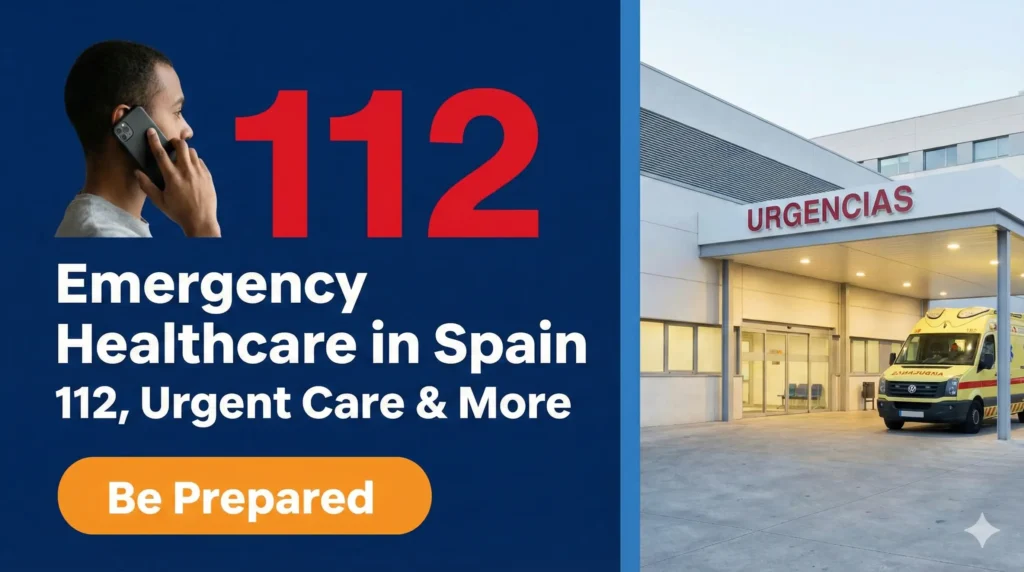
When a severe emergency strikes, your first instinct should be to reach for your phone. In Spain, as in the rest of the European Union, the primary emergency telephone number you need to memorize is 112.
The 112 emergency line is a centralized, pan-European dispatch service that operates twenty-four hours a day, seven days a week, and is completely free of charge. You can dial 112 from any landline, payphone, or mobile phone. Crucially for travelers and expatriates, you can connect to 112 even if your mobile phone is locked, if you have run out of prepaid credit, or even if your phone does not have a Spanish SIM card inserted, provided your device can pick up any local network signal.
One of the most reassuring aspects of the 112 service in Spain is its multilingual capacity. If you do not speak Spanish, you do not need to panic. The dispatch centers employ operators who speak a variety of languages, including English. When the operator answers, simply state your language preference clearly and calmly.
It is important to understand that 112 is a coordinating center. The person answering the phone is not necessarily a doctor or a police officer; they are a highly trained dispatcher. When you call, they will ask you a series of rapid questions to determine the nature of the emergency and dispatch the appropriate resources. They have the authority to send the police, the fire brigade, or medical services—or all three simultaneously—if the situation requires it.
If you are put on hold or hear a recorded message when you first dial, do not hang up. Hanging up and redialing simply moves you to the back of the queue. Stay on the line until an operator answers. They will ask for your exact location, the nature of the medical issue, who is involved, and the current state of the patient. Follow the operator’s advice, and do not end the call until they explicitly instruct you to do so.
While 112 is the primary umbrella number, Spain does have specific direct lines for individual services. For instance, 061 is a dedicated number for medical emergencies in many autonomous regions, 091 connects to the National Police, and 080 connects to the fire brigade. However, unless you speak fluent Spanish and know exactly which service you need, authorities strongly recommend that foreigners stick exclusively to 112 to avoid confusion and ensure the fastest possible response.
For a deeper dive into the specific roles of the different police forces and specialized local helplines, review our dedicated guide on Emergency Numbers in Spain: 112 and When to Use It.
The Spanish Ambulance Fleet
If the 112 dispatcher determines that an ambulance is necessary, it is helpful to know that Spain utilizes different tiers of emergency medical vehicles. The dispatch center will decide which type to send based on the severity of your symptoms.
The first tier is the Basic Life Support ambulance, known as Soporte Vital Básico (SVB). These vehicles are staffed by highly trained emergency medical technicians (EMTs). They respond to non-life-threatening emergencies, stabilize patients, and transport them safely to the nearest appropriate hospital.
The second tier is the Advanced Life Support ambulance, known as Soporte Vital Avanzado (SVA) or colloquially as a UVI móvil (Mobile Intensive Care Unit). This is a unique and highly effective feature of the Spanish medical system. These ambulances are essentially rolling emergency rooms. They are staffed not only by technicians but also by an emergency physician and a specialized nurse. If a patient is suffering from a heart attack, a severe stroke, or major trauma, the UVI móvil brings the hospital’s capabilities directly to the street, allowing doctors to administer critical medications and perform life-saving procedures before the patient even reaches the hospital doors.
Public vs Private Emergency Rooms
Spain operates a dual healthcare system, meaning there is a massive network of public hospitals funded by taxpayers and a parallel network of private hospitals funded by individual insurance premiums. Both sectors have emergency rooms, universally known in Spain as Urgencias. Knowing which one to choose during a crisis depends entirely on your insurance status and the severity of the medical event.
To fully grasp the broader differences in wait times, coverage, and eligibility between these two sectors, we recommend reading Spain Healthcare System for Expats: Public vs Private.
Public hospital emergency rooms are the backbone of the country’s trauma and critical care response. Under Spanish law, public hospitals are obligated to provide emergency medical care to anyone who requires it until their condition is stabilized, regardless of their nationality, immigration status, or ability to pay. If you suffer a life-threatening emergency, such as a severe car accident or a massive cardiac event, even a private ambulance will likely transport you to a major public teaching hospital. This is because public hospitals possess the largest blood banks, the most comprehensive surgical suites, and 24/7 access to highly specialized trauma surgeons.
Private hospital emergency rooms offer a very different experience. They are known for their comfort, exceptional speed, and a high likelihood of finding English-speaking staff. If you have a comprehensive private Spanish health insurance policy, visiting a private Urgencias for a broken arm, severe food poisoning, or a high fever is generally the preferred route. The wait times are a fraction of what you would experience in the public sector.
However, you must be extremely cautious if you do not have an approved private insurance policy. Private hospitals are businesses. If you walk into a private ER without recognized insurance, they will demand a substantial credit card deposit—often running into thousands of euros—before they will allow you past the reception desk. They are not legally obligated to treat uninsured walk-ins unless the patient is in immediate, undeniable danger of losing their life.
Hospital ER vs Urgent Care PAC and SUAP
One of the most common mistakes newly arrived expatriates make is rushing to a massive hospital emergency room for minor medical issues. Going to a major teaching hospital for a sore throat, a minor sprain, or a mild allergic reaction will result in you sitting in a waiting room for eight to twelve hours.
For non-life-threatening emergencies, Spain has an excellent network of urgent care facilities attached to primary care centers. During normal business hours, your first point of contact should be your local Centro de Salud (Health Center).
If you have recently moved and have not yet registered with your local clinic, our guide on What Is a ‘Centro de Salud’ in Spain and How Do You Register? explains the administrative steps required to get into the system.
Outside of normal business hours—such as evenings, weekends, and public holidays—many of these primary care centers operate dedicated urgent care wards. Depending on the autonomous region you live in, these out-of-hours clinics are called PAC (Punto de Atención Continuada) or SUAP (Servicio de Urgencias de Atención Primaria).
These urgent care centers are staffed by doctors and nurses who can treat cuts requiring stitches, minor burns, asthma flare-ups, and sudden fevers. The wait times at a PAC are significantly shorter than at a major hospital. Furthermore, utilizing these local centers helps prevent the overcrowding of hospital ERs, leaving the trauma teams free to deal with true emergencies. If the doctor at the PAC evaluates you and decides your condition is more serious than initially thought, they will immediately arrange for an ambulance to transfer you directly to the main hospital.
What to Expect When You Arrive at the ER
Arriving at a Spanish Urgencias can feel chaotic, but the underlying process is highly structured and logical. Understanding the physical flow of the emergency department will help reduce your anxiety and help you navigate the system effectively.
Step One is Admission (Admisión). Upon walking through the doors, you must approach the administration desk or window. You will be asked to explain the reason for your visit and provide your identification and your health coverage.
To ensure you are never turned away or bogged down in paperwork during a stressful moment, prepare a dedicated medical folder beforehand using our What to Bring to a Hospital in Spain: Practical Packing List.
Step Two is Triage (Triaje). After registering at the desk, you will be called into a small room by a specialized triage nurse. This is not the medical consultation. The nurse’s sole job is to perform a rapid clinical assessment: they will ask about your symptoms, check your vital signs (blood pressure, pulse, temperature), and evaluate your general state to assign a priority level to your case. They do not diagnose or treat you; they simply categorize you to ensure that the most critical patients receive care first.
Step Three is the Waiting Room (Sala de Espera). Once you have been triaged, you will be directed to wait. It is vital to understand that the Spanish emergency system operates strictly on clinical severity, not on a first-come, first-served basis. If you arrive with a sprained ankle and have been waiting for three hours, and another patient arrives clutching their chest with breathing difficulties, that new patient will bypass you entirely and be seen immediately.
Step Four is the Treatment Room (Box). When your name or assigned number is called, you will be taken into a clinical treatment area, commonly referred to as a “box.” Here, the emergency physician will examine you in detail, order necessary blood tests or X-rays, and administer initial treatment.
Step Five is the Resolution. After your test results return, the doctor will make a final decision. You will either be admitted to a hospital ward (Planta) for further observation and surgery, or you will be officially discharged (Alta) with a comprehensive medical report and a prescription.
The Spanish Triage System Explained
To manage patient flows safely and efficiently, Spanish hospitals utilize structured triage systems, primarily the Sistema Español de Triaje (SET) or the Manchester Triage System (MTS). Both of these robust systems rely on a five-level, color-coded scale to determine exactly how long a patient can safely wait before a doctor must examine them.
Understanding these assigned colors will help you manage your expectations when you are sitting in the waiting room.
| Priority Level | Color Code | Category | Clinical Meaning | Target Response Time |
| Level 1 | Red | Immediate / Resuscitation | Absolute life-threatening emergency (cardiac arrest, severe trauma, massive hemorrhage). Patient requires immediate, simultaneous intervention by medical staff. | 0 Minutes (Immediate) |
| Level 2 | Orange | Very Urgent / Emergency | Severe condition with a high risk of deterioration (severe chest pain, moderate respiratory distress, stroke symptoms). | 10 – 15 Minutes |
| Level 3 | Yellow | Urgent | Serious but stable condition requiring prompt attention (high fever with poor general state, persistent vomiting, closed fractures). | 30 – 60 Minutes |
| Level 4 | Green | Less Urgent / Standard | Minor injuries or illnesses that require medical evaluation but are not life-threatening (sprains, minor cuts, earaches). | 60 – 120 Minutes |
| Level 5 | Blue | Non-Urgent | Chronic issues or very minor complaints that should ideally be handled by a primary care GP, not an emergency room. | 120 – 240 Minutes |
If you are designated as Green or Blue during a busy weekend or during peak flu season, you must be prepared to wait several hours. The triage system is functioning exactly as it is designed to; it keeps the medical teams free for the Red and Orange critical cases that require immediate life-saving intervention.
Costs, Billing, and Insurance Coverage
The concept of “free healthcare” in Spain often causes immense confusion among foreigners facing a sudden emergency. While public hospitals will never deny you life-saving stabilization care based on your wallet, that does not mean the care is inherently free for everyone who walks through the doors.
If you are a legal resident contributing to the Spanish Social Security system, your emergency care in a public hospital is fully covered by the state. You will present your Tarjeta Sanitaria at the admission desk, and you will not see a bill for your treatment.
If you are a tourist or a temporary visitor from the European Union or the United Kingdom, you must present your valid European Health Insurance Card (EHIC) or Global Health Insurance Card (GHIC). These cards act as an international voucher; they guarantee that your home country will reimburse Spain for your emergency treatment, meaning you will not be charged out of pocket at the hospital.
However, if you are a non-EU tourist (such as an American or Canadian traveler), or an expatriate living in Spain solely on a private health insurance visa (like the Non-Lucrative Visa or the Digital Nomad Visa), you fall outside the financial umbrella of the public social security system. If you utilize a public emergency room, the hospital’s billing department will process your details. Once you are stabilized and eventually discharged, they will generate an invoice for the full cost of your diagnostic tests and treatments, and send it to your registered address. You will then need to pay this bill directly and seek reimbursement from your private travel or health insurance provider.
To ensure you are fully compliant with residency laws and protected against exorbitant, unexpected medical bills, it is critical to select the right coverage before you need it. Read our comprehensive breakdown in Health Insurance in Spain: Options for Residents, Students, and Families.
After Discharge Getting Emergency Medication
Medical emergencies do not respect standard business hours. It is highly common to be discharged from a hospital ER at three in the morning with a strict prescription for strong antibiotics or specialized painkillers.
In Spain, the pharmaceutical rules are strict: you cannot walk into a 24-hour supermarket or a gas station to buy over-the-counter medication or fulfill a prescription. By law, all medical drugs must be dispensed by a licensed, dedicated pharmacy (Farmacia).
To accommodate after-hours emergencies and midnight hospital discharges, the Spanish pharmacy system operates a regional rotating schedule known as the Farmacia de Guardia (on-duty pharmacy). By law, every municipality must have at least one pharmacy open twenty-four hours a day, including Sundays and major public holidays.
Usually, every closed pharmacy in town will post a printed list on their front door detailing the name and address of the specific pharmacy that is on duty that night. Alternatively, you can search online for “Farmacia de Guardia near me” to find the currently open location.
The Spanish pharmacy system acts as a highly effective secondary layer of healthcare. To learn how to navigate it, ask for advice from pharmacists, and understand the state copayment system, explore Pharmacies in Spain: Opening Hours and Night Pharmacies (Farmacia de Guardia).
Essential Spanish Vocabulary for Medical Emergencies
In an adrenaline-filled crisis, trying to use a digital translation app on your phone is highly impractical. Memorizing a few critical Spanish phrases can dramatically improve your ability to get help quickly from bystanders, operators, and triage nurses.
- Help!: ¡Socorro! or ¡Ayuda!
- I need an ambulance: Necesito una ambulancia.
- It is an emergency: Es una urgencia.
- Where is the emergency room?: ¿Dónde están las urgencias?
- I am in pain: Tengo mucho dolor.
- My chest hurts: Me duele el pecho.
- I cannot breathe: No puedo respirar.
- I am bleeding: Estoy sangrando.
- I need a doctor: Necesito un médico.
- I have private insurance: Tengo seguro privado.
- Does anyone speak English?: ¿Alguien habla inglés?
We highly recommend writing these phrases down, along with your exact Spanish home address, and keeping them on a physical card in your wallet or saved as a favorite, easily accessible note on your mobile phone.
Conclusion
Navigating a medical emergency in Spain requires a blend of mental preparation and an understanding of local clinical protocols. By keeping the pan-European 112 number saved, recognizing the functional difference between a local urgent care center and a major trauma hospital, and respecting the color-coded triage system, you ensure that you or your loved ones receive the best possible care with minimal administrative stress. The Spanish healthcare system is robust and world-class; understanding how to interact with it efficiently is your ultimate safety net in a new country.
References
Primary sources (official)
- European Commission (112 Emergency Number Info): https://ec.europa.eu/commission/presscorner/detail/en/memo_08_358
- SciELO España (El triaje: herramienta fundamental en urgencias): https://scielo.isciii.es/scielo.php?script=sci_arttext&pid=S1137-66272010000200008
- 112 Belgium/EU Official Guidelines: https://112.be/en/frequently-asked-questions
Other helpful sources
- European Emergency Number Association (EENA): https://eena.org/about-112/whats-112-all-about/
- Expatica (Emergency numbers and helplines in Spain): https://www.expatica.com/es/healthcare/healthcare-basics/emergency-number-spain-102154/
Disclaimer
The information provided in this article is for general informational and educational purposes only and does not constitute medical or legal advice. In the event of an actual medical emergency, immediately dial 112 or seek professional medical assistance. Healthcare procedures, insurance requirements, and clinical triage systems are subject to change by Spanish health authorities and individual hospital policies.