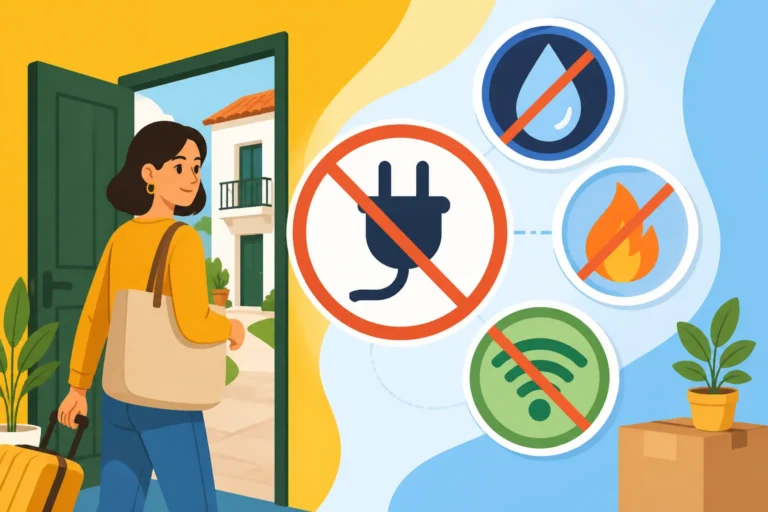
Moving House in Spain: Hiring Movers and Registering Utilities
Disclosure: This article contains affiliate links. If you buy through them, we may earn a commission at no extra cost to you. Read our full disclosure.
Relocating within Spain involves specific logistical hurdles, from securing municipal parking permits for moving trucks to navigating the complex bureaucracy of utility transfers. This guide provides a step-by-step roadmap for hiring reliable movers, managing the Boletín Eléctrico, and successfully registering your new address.
Hiring a Professional Moving Company
The Spanish moving market is saturated with options, ranging from professional national logistics firms to informal “man with a van” services found on classified ad websites. Distinguishing between a legitimate business and an uninsured operator is critical for the safety of your belongings.
Evaluating Mudanzas Companies
In Spain, a moving company is called an empresa de mudanzas. When searching for a provider, you should look for companies that are members of FEDEM (Spanish Federation of Moving Companies). Membership ensures the company holds the mandatory transport licenses and civil liability insurance.
You should always request a formal, written quote (presupuesto). Legitimate companies will send a representative to your home (or conduct a detailed video survey) to assess the volume of your belongings before giving a price. Be wary of companies that give you a flat rate over the phone without seeing your furniture.
A professional quote must include:
- The total cost excluding and including IVA (Value Added Tax). Moving services are subject to 21% IVA. If a mover offers to do the job “cash in hand” to save the tax, you lose all insurance protection if your items are broken or stolen.
- Packaging materials. Specify if boxes, bubble wrap, and wardrobe cartons are included or if you must pack everything yourself (embalaje).
- Insurance coverage. Basic transit insurance is mandatory, but it often pays by weight rather than value. For high-value items, ask for additional seguro a todo riesgo (all-risk insurance).
Access Issues and the Exterior Elevator
One of the most unique aspects of moving in Spain is the frequent use of an exterior furniture lift (elevador de muebles or plataforma elevadora).
Many Spanish residential buildings have narrow staircases and small elevators that cannot accommodate a sofa or a queen-sized mattress. In these cases, movers set up a mechanical ladder lift on the street and hoist your furniture directly through the balcony or living room window.
If your move requires this equipment, it drastically alters the logistics. The moving company must apply for a municipal permit to occupy the public sidewalk (permiso de ocupación de vía pública). This permit fee varies by town hall but typically costs between €60 and €150. You must confirm whether this fee is included in your quote or if it will be billed separately.

The DIY Move vs Professional Movers
For smaller moves or tight budgets, renting a van and doing it yourself is an option, but it comes with hidden risks in Spanish cities.
Vehicle Rentals and Driving Licenses
You can rent a cargo van with a standard B driving license, provided the vehicle’s Maximum Authorized Mass (MAM) does not exceed 3,500 kg. Major rental chains like Enterprise and Sixt are widely available. However, navigating a long-wheelbase van through the narrow, one-way streets of Spanish historic centers requires significant driving skill.
Parking Regulations
The biggest hurdle for the DIY mover is parking. You cannot reserve a parking space on a public street simply by putting out cones or chairs; this has no legal standing. To legally reserve space for a rental van, you must apply to the local Ayuntamiento (Town Hall) at least 72 hours in advance to obtain temporary “No Parking” signs (placas de prohibido estacionar), which the local police will enforce.
If you block a street or a garage entrance without a permit, your rental vehicle will be towed immediately. The cost of the fine and the tow truck will likely exceed the cost of hiring professional movers.
Estimated Moving Costs in Spain
| Service Type | Apartment Size | Distance | Estimated Cost (excl. IVA) |
| Professional Move | 1 Bedroom / Studio | Same City | €300 – €500 |
| Professional Move | 3 Bedrooms | Same City | €700 – €1,200 |
| Professional Move | 3 Bedrooms | Inter-city (e.g., Madrid to Valencia) | €1,500 – €2,500 |
| DIY Van Rental | Any Size | Same City | €80 – €150 per day + Fuel |
| External Elevator | N/A | Daily Rental | €150 – €250 |
Managing Electricity Contracts
Once the physical move is complete, the battle for utilities begins. Electricity is the most complex utility to manage due to the technical certification requirements.
Transferring Ownership (Cambio de Titular)
If the previous tenant or owner had an active electricity supply, you should always attempt to perform a Cambio de Titular (Change of Holder). This transfers the existing contract into your name.
This is the cheapest and fastest option. It is usually free, though you may be charged a small security deposit on your first bill. You will need the previous owner’s recent electricity bill to find the CUPS number (Universal Supply Point Code), which acts as the ID card for the property’s electricity connection. To handle these payments, you will need a local IBAN; ensure you have one ready by consulting Opening a Spanish Bank Account for Real Estate Purchases.
The Trap of the Boletín Eléctrico
The most common problem arises when the previous installation is old (over 20 years) or if the power was cut off (baja) by the previous owner.
When you try to switch the name or reactivate the supply, the electricity distributor may demand a new Certificado de Instalación Eléctrica (CIE), commonly known as a Boletín. This document certifies that the wiring meets current safety standards.
If the house is old, it will almost certainly fail the modern standards. You will then be forced to hire an electrician to upgrade the fuse box and wiring before you can get power. This can cost anywhere from €300 to €2,000 and delay your move-in by weeks. Always ask to see a valid Boletín before signing a rental contract or buying a property.
Choosing Your Power (Potencia)
In Spain, you pay a fixed standing charge based on the maximum amount of kilowatts (kW) you can draw at once, known as potencia contratada.
- 3.45 kW to 4.6 kW: Sufficient for most standard apartments.
- 5.75 kW+: Necessary if you have air conditioning, electric heating, and an induction hob running simultaneously.
If you trip the main breaker frequently, you need to upgrade your potencia. However, upgrading often triggers a request for a new Boletín if the current one is old. For more on managing monthly costs, refer to Setting Up Utilities in Spain: Electricity, Gas, and Water Basics.
Managing Water and Gas
Water and gas follow similar principles but are generally more localized.
Water (Agua)
Water is managed at the municipal level. Depending on where you live, the provider might be a public entity (like Canal de Isabel II in Madrid) or a private concession (like Agbar in Barcelona).
When moving, you must provide the deed of sale (Escritura) or your rental contract to prove you have the right to the water supply.
- Important: Check if the previous tenant has unpaid water bills. In many municipalities, the debt stays with the meter. You must ensure the previous owner settles their debt, or you might be forced to pay it to unlock the supply. Your legal representative should check this during the due diligence phase; see How to Choose a ‘Gestor’ for Housing Paperwork in Spain for assistance.
Gas
If the property has piped natural gas (gas natural), the process is similar to electricity. You perform a change of holder.
If the property uses butane gas bottles (bombonas), typical in older properties or rural areas, you must sign a contract with a supplier like Repsol or Cepsa to obtain the orange bottles legally. You will need an inspection certificate for the gas appliances (cooker/boiler) to get this contract.
Internet and Fiber Optic
Spain has excellent fiber optic coverage. Moving your internet connection is usually straightforward but can take time.
Most major providers (Movistar, Vodafone, Orange) allow you to move your line (traslado de línea). This is often free if you commit to a renewed contract term (permanence clause).
- Timing: Notify your provider at least 15 days before your move. Technician appointments can be scarce, especially in summer.
- New Installation: If moving a line is not possible, you must cancel the old one and start a new contract. Be careful with cancellation fees if you are leaving a contract early.
Post-Move Bureaucracy: The Padrón
Once you have moved in and have your keys, you have a legal obligation to update your residency records.
Empadronamiento
You must register at your new local town hall (Ayuntamiento). This process is called empadronamiento. It is mandatory for accessing local healthcare, enrolling children in school, and voting (if eligible).
To register, you will need:
- Your passport or TIE/NIE.
- Your new rental contract or property deed.
- A recent utility bill in your name (or proof of contract).
If you do not have utility bills yet, the rental contract is usually sufficient. This step is vital for your long-term legal status in Spain. You can find a detailed walkthrough of this specific appointment in Spanish Bureaucracy for Daily Life: Padrón, IDs, and Local Services.
Notifying Authorities
After updating your Padrón, you must notify other government bodies of your new address:
- DGT (Traffic Authority): If you have a Spanish driving license or own a car, you must update your address with the DGT. Traffic fines are sent to your registered address; if you miss them, they double in price and eventually lead to account embargoes.
- Social Security and Tax Agency: You must update your address with the Seguridad Social and Agencia Tributaria to ensure you receive important notifications regarding your taxes and healthcare benefits.
- Bank: Update your billing address to ensure replacement cards are sent to the correct location.
Dealing with Leftover Items
Moving often involves purging old belongings. Spain has a strict system for disposing of furniture and large appliances. You cannot simply leave an old mattress next to the street dumpsters (contenedores).
Most municipalities have a designated “furniture collection day” (e.g., every Tuesday night). You must check your local town hall website for the schedule. Alternatively, you can take items to a Punto Limpio (Clean Point), a municipal recycling center that accepts large items, electronics, and hazardous waste for free.
If the property you are moving into requires minor repairs or painting before you settle in, it is best to handle this before unloading your boxes. You can find tips on managing these tasks in Home Renovations in Spain: Permits, Contractors, and Budgeting.
Conclusion
Moving house in Spain is a rite of passage that tests your organizational skills. The key to a smooth transition lies in the timing: contacting moving companies for quotes at least one month in advance, requesting utility transfers two weeks before the move, and securing your municipal parking permits well ahead of the big day.
While the bureaucratic layers of the Boletín Eléctrico and the Padrón may seem tedious, they are the foundation of your legal life in your new home. By methodically working through these steps, you ensure that your first night in your new Spanish home is spent enjoying a glass of wine, rather than sitting in the dark waiting for the power to come on.
References
Primary sources (official)
- Dirección General de Tráfico (Address Change): https://sede.dgt.gob.es/
- Ministry for the Ecological Transition (Energy Efficiency & Utilities): https://www.miteco.gob.es/
- FEDEM (Spanish Federation of Removal Companies): https://www.fedem.es/
Other helpful sources
- Endesa (Guide to Changing Electricity Holder): https://www.endesa.com/en/
- Idealista (Moving Guide): https://www.idealista.com/en/news/property-for-sale-in-spain/
Disclaimer
The information provided in this article is for educational and informational purposes only and does not constitute formal legal or technical advice. Municipal regulations regarding parking permits, utility connection fees, and administrative procedures (such as the Padrón) vary significantly between different Spanish regions and town halls. We strongly recommend verifying specific requirements with your local Ayuntamiento and utility providers.