Spain to Italy: Ferries, Flights, and the Overland Route
Ah, the eternal question for anyone living in or visiting Spain: how do I get to Italy without tearing my hair out? Planning international travel, even within Europe, can feel like navigating a labyrinth designed by a bored bureaucrat, with countless websites, different operators, and confusing connections. But don't you worry, my friend, because this guide is here to unravel all those knots and show you the most efficient and enjoyable ways to make the journey from the tapas bars of Spain to the pasta plates of Italy, often with a single, straightforward solution like Omio.
Disclosure: This post may contain affiliate links. We may earn a commission at no extra cost to you if you make a purchase through these links. Read full disclosure.
The Grand Overview: How to Get from Spain to Italy
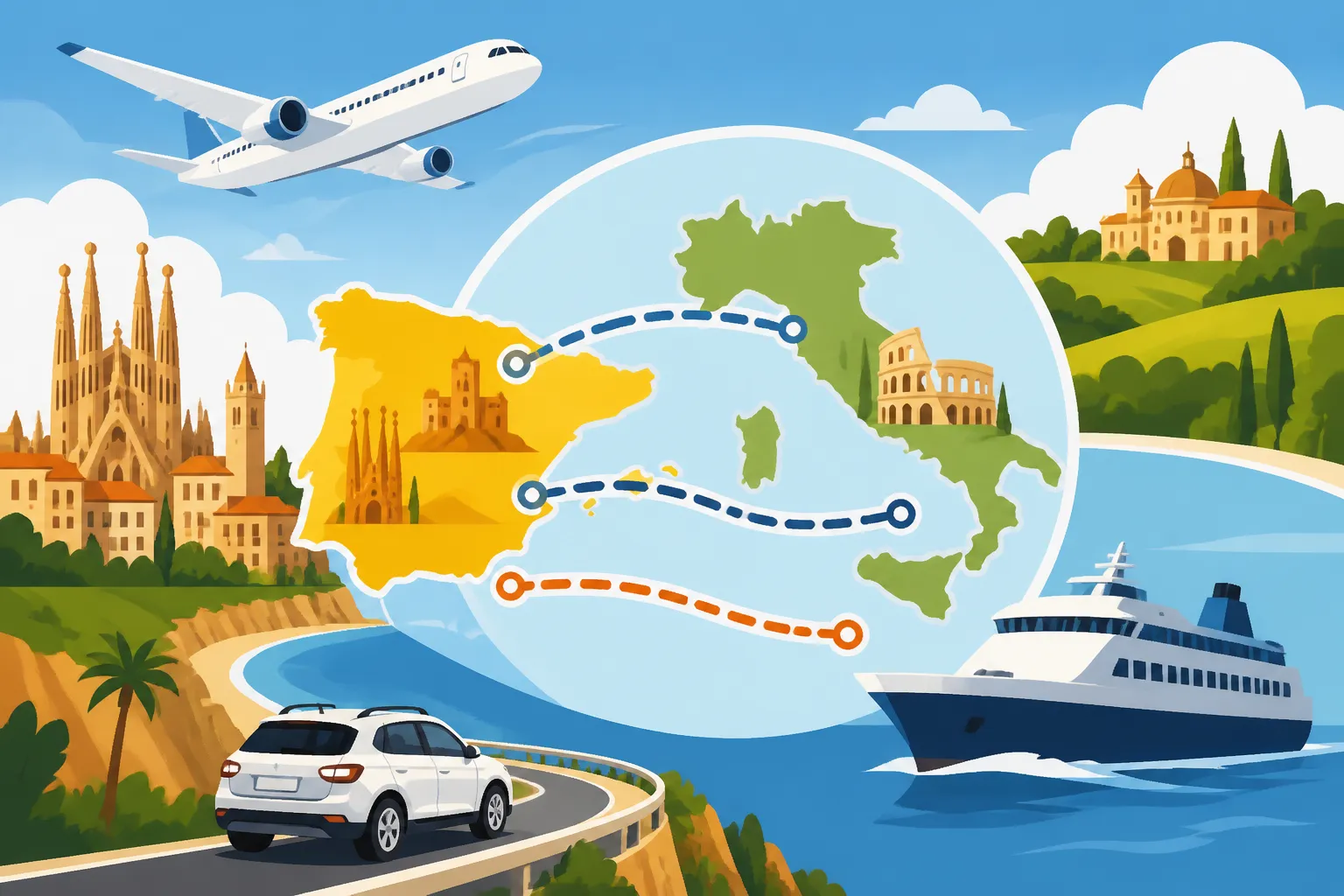
Spain and Italy, two jewels of Southern Europe, are separated by more than just the Mediterranean Sea. You've got France and the formidable Alps in between, which means your travel options are pretty distinct: you can fly over everything, sail across the sea, or embark on a multi-country overland adventure by train or bus. Each method has its charm and its challenges, depending on your budget, time, and appetite for adventure.
Flying: The Quickest Way, Usually
Let's be real, for sheer speed, flying is almost always the winner when you're crossing significant distances in Europe. From major hubs like Madrid Barajas Airport or Barcelona El Prat, you can catch direct flights to Italian cities such as Rome (Fiumicino), Milan (Malpensa or Linate), or even Naples and Venice. The journey itself is usually just a couple of hours in the air.
However, don't let that short flight time fool you into thinking it's always a quick trip door-to-door. You've got to factor in getting to the airport, the often-infuriating security lines, boarding times, and then, of course, the reverse process upon arrival in Italy – navigating Italian airport transfers, which can be just as much fun as their Spanish counterparts! The biggest advantage, though, is that you can cover the distance quickly, leaving more time for actual sightseeing or settling in. It’s also often the most cost-effective if booked in advance, especially with the prevalence of budget airlines across Europe. When you're trying to figure out which airline has the best deal or the most convenient schedule, a platform like Omio becomes your best friend, pulling up all the flight options for you in one easy search.
Ferries: A Scenic, Relaxed Option
If you're not in a mad rush and prefer the romance of the sea, taking a ferry from Spain to Italy is a fantastic alternative. This option is particularly popular if you're traveling with a car, copious luggage, or just want a more relaxed, overnight journey. You can actually sleep your way across the Mediterranean!
The main ferry routes typically depart from Barcelona, heading towards major Italian ports like Civitavecchia (which is the port for Rome) or Genoa. Companies like Grimaldi Lines and GNV operate these routes. The journey is long – often 20-30 hours – but it means you avoid driving through France and the Alps. You board in the evening, enjoy dinner, maybe catch a movie, sleep in a cabin, and wake up ready to explore Italy. It’s a completely different travel experience, more akin to a mini-cruise. The downside? It's slower, and a cabin can add to the cost, but for some, the convenience of arriving with your own vehicle or simply avoiding airports makes it worthwhile. Again, Omio can help you sort through ferry schedules and prices, making the booking process much smoother than sifting through individual operator websites.
Overland by Train or Bus: The Epic Journey
For the truly adventurous, or those who simply detest flying and prefer to keep their feet on solid ground, an overland journey by train or bus is possible. But let's be realistic: this isn't a direct hop. There's no magical high-speed train that zips you from Madrid to Milan without multiple changes and crossing at least one other country. This is an epic, multi-day adventure that takes you through France, and potentially even a sliver of Switzerland, before reaching Italy.
Think of it as a continental tour rather than a simple commute. You'd typically take a high-speed train, perhaps Renfe's AVE, from a Spanish city like Barcelona or Madrid into France, likely to Paris or Lyon. From there, you'd connect to another high-speed service, perhaps the French SNCF or a TGV, heading towards the Italian border, eventually connecting with Trenitalia services to your final destination like Milan, Turin, or even down to Florence or Rome. Buses, offered by companies like FlixBus, are generally cheaper but significantly slower, involving even more hours on the road and multiple transfers. The benefit is the sheer amount of scenery you'll absorb, the flexibility to stop in fascinating French cities along the way, and a truly immersive European travel experience. However, the time commitment and potential for multiple bookings can be daunting. This is precisely where a tool like Omio shines, allowing you to string together these complex multi-leg journeys, comparing train and bus options across various countries and operators, all in one place. Planning your itinerary through France can even be a mini-adventure in itself; remember to check out Traveling Around Spain: Trains, Buses, Flights, and Car Hire for more on local Spanish transport connections to get you started on the right foot.
Deep Dive into Each Travel Method
Now that we've had the overview, let's peel back the layers and look at the nitty-gritty of each option. After all, knowing the pros and cons in detail helps you make the best choice for your trip.
Air Travel: Practicalities and Pitfalls
Flying, while fast, requires strategy. When booking flights from Spain to Italy, it's generally best to book as far in advance as possible to snag the best prices, especially with budget carriers like Ryanair and Vueling. These airlines are ubiquitous across Europe, offering a vast network of routes from Spanish cities like Barcelona, Madrid, Valencia, Seville, and Málaga to almost every major Italian city. Full-service carriers like Iberia (Spain's national airline) or ITA Airways (Italy's national airline) often provide more comfort, better luggage allowances, and direct services, but at a higher price point.
The biggest "pitfall" with flying is often the hidden time and cost of airport transfers. Consider, for example, flying into Rome Fiumicino (FCO). While the flight might be two hours, getting from central Madrid to Barajas airport, checking in, going through security, boarding, then landing at FCO, collecting luggage, and taking the Leonardo Express into Rome Termini station can easily turn into a 6-8 hour ordeal. These transfers add up, not just in time but in money, as airport train or bus tickets can be surprisingly pricey. Always compare the total journey time and cost, including transfers and luggage fees.
One of the great frustrations as an expat or tourist in Spain is trying to juggle multiple airline websites to compare prices. This is where Omio steps in as a lifesaver. You input your departure and arrival cities, and it shows you all available flights, across different airlines, with their prices and journey times. It's a fantastic way to quickly compare a Vueling flight from Barcelona to Rome against an ITA Airways flight, including the different departure times and potential layovers. This kind of consolidated view saves you hours of frustrating tab-hopping.
Ferry Adventures: Routes and Booking Tips
If you've got time and an appreciation for sea travel, the ferries offer a unique experience. The primary routes from Spain to Italy are indeed from Barcelona to Civitavecchia (Rome) and Barcelona to Genoa. These are typically overnight journeys, ranging from 20 to 30 hours. Imagine boarding in Barcelona, strolling the deck as the city lights fade, enjoying a meal onboard (often with Mediterranean views), then waking up to the shores of Italy. It’s certainly more relaxing than an early morning airport dash!
Onboard, you can choose from various accommodations: a simple reclining seat, an interior cabin, or even a spacious exterior cabin with a view. Bringing a car is a huge plus, as it means you avoid the hassle of renting one in Italy and can easily explore upon arrival. You'll simply drive your vehicle onto the ship in Barcelona and drive it off in Civitavecchia, ready for a road trip through Tuscany or Umbria. Companies like Grimaldi Lines are well-established on these routes.
Booking ferries involves securing your passage and any cabins or vehicle spots. Prices can vary significantly based on the season, how far in advance you book, and your chosen cabin type. Summer months (June-August) are naturally the most expensive and busiest. While you can book directly with the ferry operators, using Omio allows you to see all the available ferry options alongside flights and trains. This means you can easily weigh the cost and time of a ferry journey against a quick flight, giving you the full picture to make an informed decision. Remember, for those longer trips, having your documents in order is key; make sure your passport is valid and always double-check Spain Schengen Rules: 90/180 Day Rule Explained for Spain if you're a non-EU citizen.
The Overland Saga: Trains, Buses, and Stops Along the Way
Embarking on an overland journey from Spain to Italy is not for the faint of heart, but it promises an unforgettable experience. This typically means traversing France. Let's trace a popular path:
- Spain to France: You'd begin, most likely, from Barcelona Sants station. High-speed TGV trains, operated jointly by Renfe and SNCF, can take you directly from Barcelona to major French cities like Paris (Gare de Lyon) or Lyon. This leg itself is a comfortable 6-7 hour journey. You could consider a stopover in Day Trips and Weekend Getaways Across Spain before heading off internationally.
- Through France to Italy: From Paris or Lyon, you'd connect to another high-speed train heading east towards Italy. For instance, from Paris Gare de Lyon, you can catch a TGV or Frecciarossa (operated by Trenitalia, Italy’s national rail company) directly to Milan Centrale or Turin Porta Nuova. These journeys can take another 6-8 hours, depending on the route and connections.
- Bus Options: For a more budget-friendly (but time-intensive) option, companies like FlixBus offer routes from various Spanish cities into Italy. These typically involve one or two changes in France and can take upwards of 24-30 hours, often more. You're looking at a serious commitment to bus travel here!
The beauty of the overland route is the flexibility. You could spend a night or two exploring Lyon's incredible food scene, or take in the glamor of Nice on the French Riviera, truly making the journey part of your vacation. This is travel as exploration, not just transportation. However, it requires careful planning across multiple rail or bus operators, and the costs can add up if you don't book well in advance.
This is precisely the kind of complex travel scenario where Omio truly shines. Instead of hopping between Renfe, SNCF, Trenitalia, and FlixBus websites, you can input your desired route (e.g., Madrid to Florence) and Omio will present you with all the viable train and bus combinations, showing you prices, journey times, and even suggesting routes with comfortable connections. It's a game-changer for piecing together multi-country travel, allowing you to compare a 12-hour train journey with a stopover against a 30-hour direct bus, giving you the power to choose based on your priorities. Also, don't forget that Mobile Data and eSIMs for Travel in Spain will become even more crucial when you are travelling across borders, so ensure your phone is set up for international roaming or get an eSIM beforehand.
Choosing Your Best Route: Considerations for Expats and Tourists
Deciding how to journey from Spain to Italy really comes down to what you value most for your trip. Are you chasing speed, savings, or a unique experience? Expat experience suggests that there's no single "best" way – only the best way for you right now.
Time vs. Cost vs. Experience: A Balancing Act
This is the eternal triangle of travel, isn't it?
- If time is your most precious commodity: Flying is almost certainly your answer. A quick two-hour flight means you maximize your time in Italy, perfect for a short weekend getaway or if you're on a tight schedule. Just remember to account for airport hassle.
- If cost is your primary concern: Buses are often the cheapest, but they demand a significant time investment. Budget flights can also be very affordable if booked far in advance and if you travel light (beware those luggage fees!). Ferries can sometimes surprise you with competitive prices, especially if you opt for a reclining seat instead of a cabin.
- If the journey itself is part of the experience: The overland train route through France offers incredible scenery and the chance to explore a third country. The ferry provides a relaxing, unique overnight journey, particularly appealing if you're bringing a car or just want to truly unwind.
Consider your personal comfort levels too. Some people dread airport security; others get seasick. If you plan to rent a car in Spain and drive through, don't forget to review Renting a Car in Spain: Requirements, Insurance, and Driving Tips as rules might differ slightly when crossing borders, and always carry your ID.
Booking Smart: Why a Consolidated Platform Helps
This is where a service like Omio really proves its worth. Imagine you're trying to figure out if it's cheaper to fly from Barcelona to Rome or take the ferry. Or perhaps you're wondering if a train to Milan is feasible from Madrid. Trying to navigate different airline websites, ferry company portals, and national rail services, then converting currencies and comparing departure times, is exhausting.
Omio simplifies this by acting as a central hub. You put in your starting point and destination, and it instantly shows you all the flight, train, and bus options, often including ferry routes where applicable, from multiple operators. This direct comparison, all on one screen, allows you to instantly see the trade-offs in terms of price, journey duration, and number of changes. It's incredibly empowering to have all this information at your fingertips, letting you decide whether that cheap bus ticket is worth the extra 15 hours of travel or if splashing out on a faster train makes more sense for your schedule. Seriously, it takes the guesswork out of booking complex European itineraries, consolidating everything into a user-friendly interface. So, if you're ready to explore Italy, head over to Omio and let them find your perfect route!
Practical Tips for a Smooth Journey
No matter which mode of transport you choose, a little preparation goes a long way:
- Documents: Always carry your passport or valid ID card. If you're a non-EU citizen, ensure your visa situation for both Spain and Italy (and France, if going overland) is in order. Most of Europe is part of the Schengen Area, but it's always wise to double-check.
- Luggage: Be mindful of luggage allowances, especially with budget airlines. Ferry and train travel are much more forgiving, but you still need to be able to manage your bags.
- Language: While English is widely spoken in major tourist areas, knowing a few basic phrases in Spanish and Italian will make your life much easier and is always appreciated by locals. For some helpful phrases, check out Spanish Language and Everyday Communication for Visitors.
- Flexibility: Europe's transport systems are generally reliable, but delays can happen. Build a little buffer into your plans, especially if you have tight connections.
- Money: Ensure you have access to funds. Most places accept cards, but it's always good to have some euros for smaller purchases or emergencies. Read up on Money for Travel in Spain: Cards, Cash, and ATMs for practical advice.
- Safety: Always be aware of your surroundings, especially in busy train stations, airports, or tourist hotspots. Keep an eye on your belongings. You can find more comprehensive advice in Staying Safe in Spain: Common-Sense Tips for Travelers.
| Travel Mode | Typical Journey Time (Spain to Italy) | Estimated Cost Range (One-Way) | Key Pros | Key Cons | Best For… |
|---|---|---|---|---|---|
| Flight | 2-3 hours (air time) + transfers | €50 – €200+ | Fastest door-to-door, often cheapest if booked | Airport hassle, luggage fees, transfers add up | Quick trips, maximizing time in Italy |
| Ferry | 20-30 hours (overnight) | €80 – €300+ (with cabin/car) | Relaxing, bring car, unique experience, avoid airports | Long journey, can be more expensive, specific ports | Travelers with cars, those who dislike flying, leisurely pace |
| Train | 12-20 hours (multiple legs/changes) | €100 – €300+ | Scenic, comfortable, can stop in France | Multiple changes, longer than flying | Sightseeing en route, fear of flying, comfort |
| Bus | 24-36+ hours (multiple legs/changes) | €40 – €150+ | Most budget-friendly | Very long, less comfort, more changes | Strict budget travelers, extreme patience |
Note: Costs are approximate and can vary wildly based on booking time, season, and specific routes.
Disclaimer
The information provided in this article is intended for general guidance only and may not be exhaustive or entirely up-to-date. Travel regulations, visa requirements, transport schedules, and prices can change rapidly. Always verify the latest information with official sources, relevant embassies or consulates, and transportation providers before making any travel plans. This content is not a substitute for professional travel advice.