Barcelona to Valencia: Train vs Bus on Cost and Time
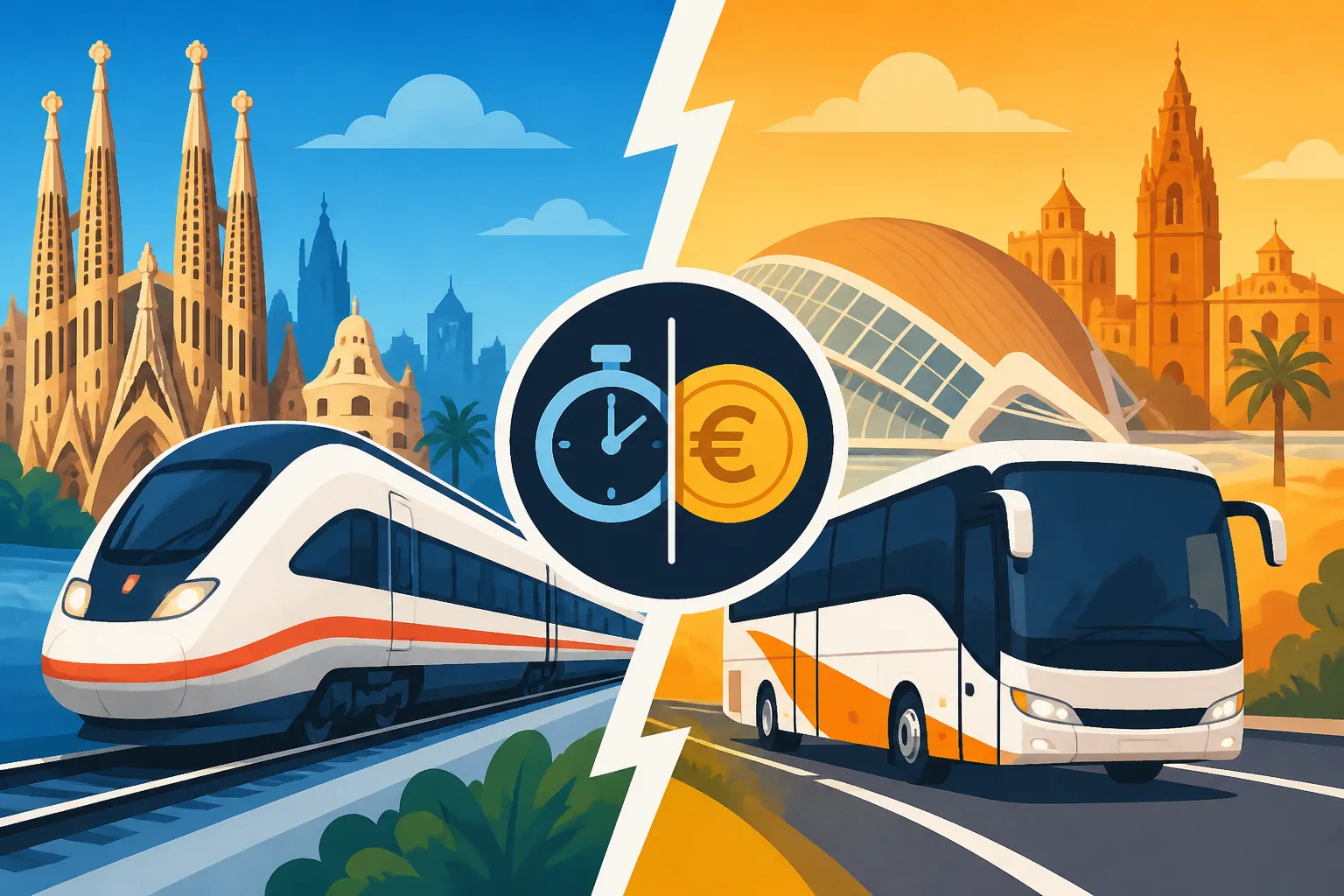
Picture standing in the departures hall at Barcelona-Sants, staring at a board full of trains to Valencia, while a friend texts that the bus is “way cheaper.” Should you trust them? This guide compares the train and the bus on the Barcelona to Valencia route in real journey time, cost behaviour, comfort and hassle, so you can book with confidence.
Disclosure: This post may contain affiliate links. We may earn a commission at no extra cost to you if you make a purchase through these links. Read full disclosure.
Barcelona to Valencia at a Glance: The Real Journey Times
I’ve done this trip more times than I can count. I’ve done it for weekend paella runs, for visa paperwork, and once on a very grim Sunday after a friend’s wedding. The first thing to understand is that “the train” is not one thing on this route. Several different services run along the Mediterranean corridor, and the gap between the fastest and slowest is huge. That gap decides whether you arrive in time for a long lunch or barely make dinner.
Train Options on the Line
Renfe runs four main types of service between Barcelona-Sants and Valencia-Estació del Nord, and each has a very different personality. The Euromed is the quickest, taking between 2h 47m and 3h 26m depending on the departure and how many stops it makes. If you’re travelling from Valencia back to Barcelona, the Euromed runs between 3h 09m and 3h 25m. For most visitors, this is the train to aim for.
Below the Euromed sit the Intercity and the Alvia. The Intercity takes between 3h 27m and 4h 05m. The Alvia takes about 3h 57m to 4h 01m. These are still comfortable long-distance trains with assigned seats, but they stop more often along the coast. So the slower long-distance trains top out at about four hours. That’s still a perfectly civilised journey, especially if the timing suits you better than the next Euromed.
Then there’s the outlier: the single daily Regional Exprés, which takes about 5h 52m to 5h 59m depending on direction. This is the slow, stop-everywhere option. It calls at small coastal towns that the faster trains skip. Some people love it for exactly that reason. You see the orange groves around Castelló and the little stations with their tiled signs. But if your goal is simply to get from one city to the other, it costs you about three extra hours compared with a fast Euromed.
What the Bus Actually Looks Like
Coaches on this route are run mainly by ALSA, with FlixBus also active in the corridor. Buses typically leave from Barcelona Nord bus station, and some departures use the bus terminal by Sants. In Valencia, they usually arrive at the main bus station on Avenida Menéndez Pidal, across the Turia gardens from the old town.
A direct coach generally takes about as long as the slowest Intercity and Alvia trains, or somewhat longer. Services that stop in places like Tarragona, Tortosa or Castelló can stretch well beyond that. Bus times also depend on traffic on the AP-7 motorway. A Friday afternoon heading out of Barcelona, or a summer Sunday heading back, can add real time that no timetable shows. Trains simply don’t have that problem.
The upside of the bus is frequency at odd hours and, very often, price. Coaches sometimes run very early in the morning or late at night when train options thin out. If your flight lands late or you need to be somewhere first thing, check the bus timetable before you dismiss it.
Door-to-Door Time Matters More Than Headline Time
Here’s the thing nobody tells you when you first move here: the timetable is only half the story. Barcelona-Sants is well connected by metro and Rodalies. Valencia-Estació del Nord is right in the city centre, steps from Plaça de l’Ajuntament and a short walk from the Mercat Central. Arriving there by Euromed means you can be sipping horchata within minutes of stepping off the train.
The Valencia bus station is further out. It’s still reachable on foot if you’re travelling light, or by metro and bus, but it adds a bit of friction. On the Barcelona side, Barcelona Nord is central and easy to reach, so the difference is smaller there. Still, add a realistic buffer for getting to and from each terminal when you compare options.
To make the comparison concrete, here’s how the main options stack up on journey time alone:
| Service | Operator Type | Journey Time | Departure Point in Barcelona | Arrival Point in Valencia |
|---|---|---|---|---|
| Euromed | Renfe long-distance train | 2h 47m to 3h 26m | Barcelona-Sants | Valencia-Estació del Nord |
| Euromed, Valencia to Barcelona direction | Renfe long-distance train | 3h 09m to 3h 25m | Valencia-Estació del Nord | Barcelona-Sants |
| Intercity | Renfe long-distance train | 3h 27m to 4h 05m | Barcelona-Sants | Valencia-Estació del Nord |
| Alvia | Renfe long-distance train | About 3h 57m to 4h 01m | Barcelona-Sants | Valencia-Estació del Nord |
| Regional Exprés, one daily service | Renfe regional train | About 5h 52m to 5h 59m | Barcelona-Sants | Valencia-Estació del Nord |
| Direct coach | ALSA or FlixBus | Comparable to the slowest long-distance trains or somewhat longer, plus traffic risk | Barcelona Nord or Sants bus terminal | Valencia bus station |
| Stopping coach | ALSA or FlixBus | Longer than a direct coach, varies by stops | Barcelona Nord or Sants bus terminal | Valencia bus station |
If you want a wider view of how Spain’s rail operators differ, see Renfe vs Ouigo vs Iryo vs Avlo: Spain’s High-Speed Competition Compared.
Comparing Cost Without Getting Burned
Cost is where people get emotional, and I get it. When you’re new in Spain, everything feels expensive at first. The rent deposit, the gestor and the forty-seven photocopies all add up. The last thing you want is to overpay for a three-hour journey. But Spanish transport pricing doesn’t work like a fixed menu. It moves constantly, and understanding how it moves matters more than chasing a single “typical” figure.
How Train Fares Move
Renfe uses dynamic pricing on its long-distance services. The Euromed, Intercity and Alvia fares tend to start low when tickets first go on sale. They climb as the departure date approaches and as seats fill up. A Euromed on a quiet Tuesday morning booked weeks ahead can be surprisingly gentle on your wallet. The same train on the Friday before a long weekend, booked two days out, can make you wince.
Fare class matters too. Renfe sells different tiers with different flexibility. The cheapest fares usually come with strict change and refund conditions, while pricier ones let you swap trains or cancel with less pain. If your plans are wobbly, paying more for flexibility can be the cheaper choice in the end. Spanish Train Classes Explained: Turista, Elige, and Premium breaks down what you get at each level. Renfe Ticket Types: Change and Refund Rules by Fare Class covers the fine print on changes.
The Regional Exprés is priced differently. Regional fares are usually more stable and don’t swing as dramatically with demand. That makes the slow train a reasonable fallback when the fast trains have spiked. You’re trading time for predictability, which can be a fair deal if you have a book and a free afternoon.
How Bus Fares Behave
Coach fares on this route also vary, but the starting point is usually lower than the train. FlixBus in particular uses aggressive dynamic pricing, so early bookers often grab the lowest prices. ALSA offers several fare types, including more flexible ones, and sometimes runs promotional fares on popular routes.
The bus is very often the cheapest way between the two cities. It’s not guaranteed, though. A last-minute bus on a peak day can cost more than an early-booked train. Travellers often assume the bus will be cheaper, book late, and then find a Euromed ticket bought earlier would have cost about the same. That’s why comparing both on the same screen is so useful.
If you’re deciding between the two coach companies, ALSA vs FlixBus in Spain: Comfort, Price, and Route Coverage goes deeper into how they compare on seats, legroom and network.
Hidden Costs to Watch
The ticket price is not always the full price. On buses, luggage allowances can be tight, and extra or oversized bags may cost more. Some coach fares charge separately for choosing a specific seat. Trains are generally more relaxed about luggage, though there are still limits on size and number of bags. Before you pack your entire life into three suitcases, read Luggage Rules on Spanish Trains and Buses: Limits and Fees.
Then there’s the cost of getting to and from each terminal. Arriving at Valencia-Estació del Nord usually means you can walk to your accommodation in the centre. Arriving at the bus station may mean a taxi, a metro ride or a longer walk with your bags. Those small extras add up, especially for a family.
Finally, factor in the value of your time. If the bus saves you money but costs you an extra couple of hours plus traffic risk, ask yourself what those hours are worth. On a short city break, they’re precious. On a slow-travel month, maybe not so much.
| Cost Factor | Euromed | Intercity and Alvia | Regional Exprés | Coach |
|---|---|---|---|---|
| Pricing style | Dynamic, rises closer to departure | Dynamic, rises closer to departure | More stable, less demand-driven | Dynamic, often lowest when booked early |
| Typical position on price | Often the priciest, but early fares can be reasonable | Often mid-range | Often predictable and moderate | Often the cheapest |
| Flexibility | Depends on fare class | Depends on fare class | Usually simple conditions | Depends on operator and fare type |
| Luggage | Generous compared with coaches | Generous compared with coaches | Generous, but racks fill up | Tighter limits, extra bags may cost more |
| Extra cost at Valencia end | Low, central arrival | Low, central arrival | Low, central arrival | Possible taxi or transit to the centre |
Comfort, Scenery and Practical Realities
Numbers aside, how the journey feels matters. I’ve arrived in Valencia from this trip feeling refreshed and ready to explore. I’ve also arrived feeling like I’d been folded into a suitcase. The difference was almost always the mode of transport.
On Board the Euromed and Long-Distance Trains
The Euromed is a genuinely pleasant way to travel. Seats are assigned, there’s room to stretch your legs, and you can get up and walk around. Many trains have a café car, and power sockets are common, which matters if you’re working remotely or need to charge your phone before navigating Valencia. The stretch along the coast past Tarragona and down towards Castelló gives you flashes of sea and rice fields that make the time pass quickly.
The Intercity and Alvia offer a similar experience at a slightly slower pace. You still get assigned seating and decent comfort. The extra stops can actually be handy if you’re heading to a coastal town rather than Valencia itself.
One thing that catches newcomers out: security screening. At Barcelona-Sants and Valencia, long-distance trains have bag scanners before the platform. They move fast, but arrive with a little time to spare. Boarding usually opens shortly before departure, and the doors close firmly on time.
Coach Comfort and Its Limits
Modern Spanish coaches are a lot better than many people expect. ALSA’s premium services can be quite comfortable. FlixBus coaches generally offer Wi-Fi and power, though in my experience the Wi-Fi is better described as “optimistic.” Seats recline, and there’s usually a toilet on board.
But a coach is still a coach. You’re seated for the whole journey, legroom is limited, and you can’t wander to a café car. Motorway traffic can make the ride stop-start. If you get motion sick or have a bad back, the train will treat you more kindly. Long coach journeys also tend to include short rest stops, which break up the trip but add to the clock.
On the other hand, if you can sleep anywhere and you’re travelling on a tight budget, an early or late coach can be a smart, low-cost option. Plenty of students and backpackers I know swear by it.
The Stations at Each End
Barcelona-Sants is big, busy and a little chaotic, but well signposted. It connects to metro lines and Rodalies trains, so you can reach almost anywhere in the city. Barcelona Nord bus station is calmer and sits near Arc de Triomf, close to the old town and El Born.
At the Valencia end, the contrast is bigger. Estació del Nord is a stunning modernista building decorated with orange motifs. It sits right in the centre, next to the bullring and a short stroll from the cathedral. If you’re staying in Ciutat Vella or Ruzafa, you can walk. For help choosing a neighbourhood, see Where to Stay in Valencia: Ciutat Vella, Ruzafa, and the Beach.
The Valencia bus station is functional rather than charming, and it’s further from the main sights. It’s fine, just less convenient. Once you’ve arrived, Valencia City Guide: Old Town, Beaches, and Science Park will help you make the most of your time.
Which Option Fits Which Traveller
After years of watching friends, visitors and colleagues tackle this route, I’ve noticed that the “best” choice depends heavily on who you are and why you’re travelling. Let’s walk through some real scenarios.
Weekend Visitors and Business Travellers
Say you live in Barcelona and want a Saturday-and-Sunday escape to Valencia for paella at the beach. Your time is the scarcest thing you have. A Euromed that gets you there in 2h 47m to 3h 26m, straight into the city centre, is hard to beat. You’ll have lunch by the sea before a coach traveller has reached the outskirts. For weekend trips, I’d book the Euromed early and treat it as part of the treat.
Business travellers face a similar calculation. Arriving fresh, with a laptop charged and emails answered on board, is worth a lot. The train also gives you predictable arrival times for meetings, without the motorway roulette of a Friday coach. If you need flexibility because meetings move, consider a fare class that allows changes.
Imagine Sofia, a marketing consultant based in Gràcia, who has a client meeting in Valencia at noon. She books an early Euromed, works on her slides on the way, walks from Estació del Nord to the client’s office near Plaça de la Reina, and is back on an afternoon train the same day. On a coach, that same day would be cramped and stressful.
Budget Travellers and Students
Now picture Tom, a language student on a tight monthly budget in Barcelona. He wants to see Las Fallas or just escape the city for a few days. For him, a coach booked well ahead is often the obvious choice. A few extra hours on the road don’t hurt much when the savings go towards food and a hostel bed.
The Regional Exprés is another option for budget-minded travellers who like the slow approach. At about 5h 52m to 5h 59m, it’s a long ride. But with only one service a day, it’s worth checking whether its timing suits you and how its fare compares on your date.
Even for budget travellers, though, I’d always compare against the train. Early Euromed fares sometimes come close to coach prices, and then the train wins easily on comfort and time.
Families and Travellers With Lots of Luggage
Families have their own set of priorities. Kids need to move, eat, use the bathroom and generally not be strapped into a seat for hours. The train gives you room to walk the aisle, visit the café car, and keep little ones occupied. The luggage rules are also more forgiving, which matters when you’re travelling with a pushchair and bags.
Coaches can work for families, but the limited space and stricter luggage rules make them harder going. If you’re travelling with children, see Booking Spanish Transport With Kids: Child Fares, Seats, and Prams for practical tips on fares and seating.
Anyone moving house or travelling with heavy bags should lean towards the train. Dragging three suitcases from the Valencia bus station to a flat in the centre is not how anyone wants to start a new chapter.
| Traveller Type | Best Choice | Why |
|---|---|---|
| Weekend visitor | Euromed | Fastest option, central arrival, more time to enjoy Valencia |
| Business traveller | Euromed, or Intercity if timing suits | Predictable arrival, space to work, flexible fare classes available |
| Budget student or backpacker | Coach booked early, or train if early fares are close | Often lowest price, frequent odd-hour departures |
| Slow traveller who enjoys scenery | Regional Exprés | About 5h 52m to 5h 59m with coastal stops and stable pricing |
| Family with young children | Euromed or Intercity | Room to move, café car, easier luggage |
| Traveller with heavy luggage | Any long-distance train | More generous luggage rules and central Valencia arrival |
| Late-night or very early traveller | Coach | May offer departures when train options are thinner |
Booking Barcelona to Valencia Tickets With Omio
Here’s where I’ll be honest about how I actually book this trip now. In my first year in Spain, I juggled the Renfe website, ALSA’s site and FlixBus’s app in separate tabs, trying to work out which was cheaper on which day. My foreign card got declined on one of them, and the Spanish-only error message told me nothing. It was exhausting. These days, I search the route on Omio first, and it has saved me a lot of hassle.
Why Comparing Everything in One Place Works
The core problem on the Barcelona to Valencia route is that the best option changes from day to day. Sometimes the Euromed is a bargain. Sometimes the coach is far cheaper. Sometimes the Intercity hits the sweet spot between price and time. Checking each operator separately is slow, and it’s easy to miss something.
Omio pulls trains and buses for the same route into a single search. You can see the Euromed, Intercity, Alvia, Regional Exprés and coach departures side by side, with journey times and prices listed together. That makes the trade-off between time and money visible at a glance, instead of something you piece together across several websites.
For expats, there’s another big advantage: the interface works in English and accepts international payment methods. If you’ve ever struggled with Spanish booking sites, see Paying for Spanish Transport With a Foreign Card: Declines and Fixes. Booking through Omio sidesteps many of those headaches. Check Omio’s own page for any booking fees on your chosen ticket, since the overall price shown at checkout is what counts.
Step-by-Step Booking Process
Here’s exactly how I book a Barcelona to Valencia trip, from first search to boarding:
- Open Omio on your phone or laptop and enter Barcelona as your origin and Valencia as your destination.
- Choose your travel date, and if you’re flexible, check a few nearby dates to see how prices shift.
- Look at the results with trains and buses shown together, and note the journey time listed for each departure.
- Sort or filter by duration if time matters most, or by price if your budget is the priority.
- Check the departure station for each option, since trains leave from Barcelona-Sants while coaches may use Barcelona Nord or the Sants bus terminal.
- Read the fare conditions before you pay, especially rules on changes, refunds and luggage.
- Enter passenger details exactly as they appear on your passport or ID, because names are sometimes checked.
- Pay with your preferred card or payment method, and confirm the total before you finish.
- Save the mobile ticket in the app or download it, so you aren’t relying on patchy station Wi-Fi.
- Arrive early enough for security screening at the train station, or for boarding at the coach bay.
Tips for Getting the Best Fare
Book early when you can. Both Renfe and the coach operators reward early bookers, and fares tend to climb as departure approaches. Spanish Train Price Curves: How Fares Move From 60 Days Out to Departure explains this pattern in more detail. Setting yourself a reminder to search as soon as your plans are fixed is one of the simplest ways to save.
Be flexible on timing if you can. Midweek and midday departures are often cheaper than Friday afternoons or Sunday evenings. Long weekends and festival periods like Las Fallas push demand up sharply on this route. Running a quick search on Omio across several days makes these patterns obvious within seconds.
Think about flexibility as part of the cost. If there’s any chance you’ll need to change plans, a slightly pricier fare with better change rules may save you from buying a whole new ticket later. Read the conditions before you commit. And whatever you choose, keep your booking confirmation handy on your phone.
When Things Go Wrong on the Route
No guide to Spanish travel would be honest without admitting that things sometimes go sideways. Strikes, delays and technical problems happen. Knowing what to do keeps a bad day from becoming a disaster.
Strikes, Delays and Cancellations
Spain has a history of transport strikes. During those periods, operators usually run minimum services, but your specific train or bus may be cancelled or rescheduled. Keep an eye on the news in the days before travel, especially around announced strike dates. Rail passengers have rights when trains are significantly delayed or cancelled, and coach passengers have protections too.
If your service is disrupted, read the operator’s notices and your booking confirmation carefully. They will explain your options for rebooking or refunds. For a full rundown, see Strikes and Cancellations in Spain: Your Rights and Rebooking Options.
On this particular route, the train is generally more reliable on timing than the coach, simply because it isn’t stuck in motorway traffic. If you have a tight connection on arrival, such as a flight from Valencia airport or an appointment, the train gives you a much safer margin.
Payment Problems and Booking Errors
Foreign cards are a recurring headache for newcomers. Some Spanish booking systems decline overseas cards or ask for extra verification that never arrives. If that happens, try a different card, check that your bank allows online international payments, or use a platform designed for international travellers. This is one of the reasons I steer friends towards Omio when they’re new.
Name mismatches can also cause problems. Make sure the name on your ticket matches your ID exactly, including any middle names that appear on your passport. If you spot an error after booking, contact customer support as soon as possible rather than waiting until the day of travel.
Last-Minute Plan Changes
Life happens. A friend’s plans change, a work meeting moves, or you simply wake up and decide to stay another day. Your options depend entirely on the fare you bought. Flexible fares let you change with little fuss, while the cheapest fares may not allow changes at all.
When you’re deciding between a cheap non-flexible fare and a slightly more expensive flexible one, be honest with yourself about how firm your plans are. I’ve been burned more than once by booking the cheapest fare and then having to buy a second ticket.
If you do miss a train or bus, don’t panic. Go to the operator’s ticket desk at the station and ask about your options. If that fails, open Omio and search for the next departure, whether that’s another train or a coach. On a route this busy, there’s almost always another way to get there the same day.
My Honest Verdict on Train vs Bus
After all these trips, my verdict is simple. For most people, most of the time, the Euromed is the best way to travel between Barcelona and Valencia. At 2h 47m to 3h 26m, it’s the fastest option by a clear margin. It drops you right in central Valencia and turns the journey into a relaxed part of your trip. If the timing doesn’t suit, the Intercity at 3h 27m to 4h 05m and the Alvia at about 3h 57m to 4h 01m are solid alternatives.
The coach earns its place when budget is the top priority, when you’ve booked early and found a great fare, or when you need a departure at an unusual hour. The Regional Exprés, at about 5h 52m to 5h 59m, is a niche choice for slow travellers and the scenery-curious.
What matters most is comparing on the day you actually want to travel, because prices on this route move constantly. Search on Omio, compare the trains and buses side by side, and pick the option that fits your time, budget and comfort. Then sit back, watch the Mediterranean roll past, and start planning where you’ll eat when you arrive.
Disclaimer
This article is for general informational purposes only and does not constitute professional advice. Laws, prices and regulations vary by location and change over time. Consult a qualified professional for guidance on your specific situation.