Sending Money From Latin America to Spain: Corridor Costs and Timing
Disclosure: This article contains affiliate links. If you buy through them, we may earn a commission at no extra cost to you. Read our full disclosure.
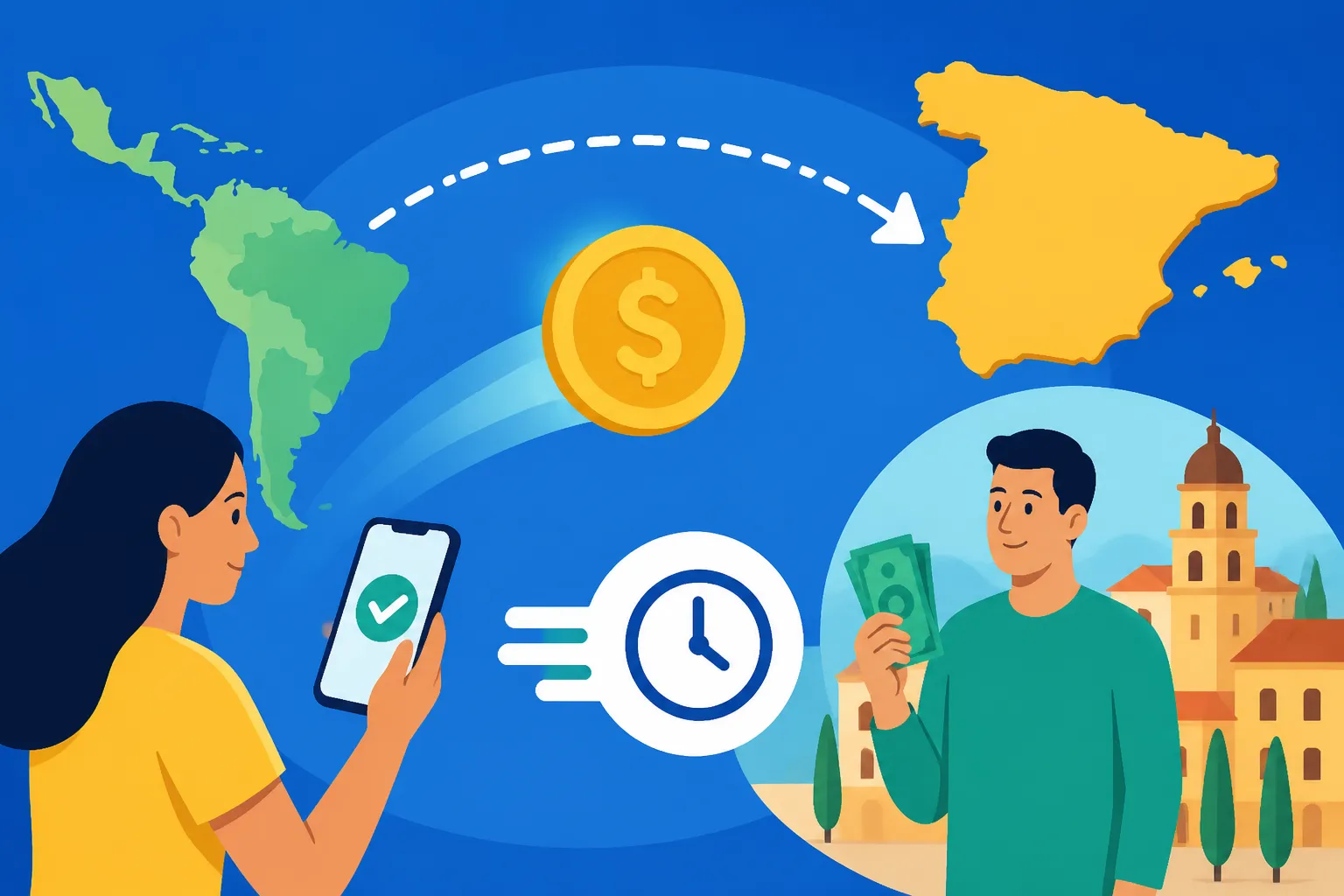
You have signed a lease in Madrid, the landlord wants the deposit by Friday, and your savings are sitting in a bank account in Bogotá, Mexico City or Buenos Aires. Your bank quotes a transfer fee that seems reasonable, but when the euros land in your Spanish account days later, the amount is noticeably smaller than you calculated. This guide breaks down what sending money from Latin America to Spain really costs on the main corridors, how long it takes, and how to move your money faster and with fewer surprises.
Many people from across Latin America go through this. The pattern is always the same: the visible fee is small, the exchange rate is where the money disappears, and the timing depends on details nobody explains. Once you see how each piece works, you can choose the right route for your corridor with confidence.
What a Transfer to Spain Really Costs
Every international transfer has several cost layers. Banks and transfer services package them differently, which is why comparing headline fees alone is misleading.
The Four Layers of Cost
- The sending fee. The visible charge for making the transfer, either a flat amount or a percentage.
- The exchange rate margin. The difference between the mid-market rate, the real rate banks use between themselves, and the rate you are given. This is often the largest cost and the least visible.
- Intermediary bank fees. On traditional international wire transfers through the SWIFT network, one or more correspondent banks may deduct a fee along the way.
- Receiving fees and local taxes. Some Spanish banks charge for incoming transfers from outside the SEPA area, and some Latin American countries apply taxes to foreign exchange operations.
Most people only look at the first layer. The second and third layers are where the real cost hides.
Why the Exchange Rate Matters Most
Imagine you are converting the equivalent of 10,000 euros. If your bank’s rate is 3 percent worse than the mid-market rate, you lose 300 euros on the conversion, regardless of how small the transfer fee looks. A margin of 4 to 5 percent, which is not unusual for traditional banks on less commonly traded currencies, costs 400 to 500 euros on the same amount.
This is why I recommend Wise as the first service to check on any corridor it supports. It converts at the mid-market rate and shows its fee separately and upfront, so you can see exactly how many euros will arrive before you send. Instead of a margin hidden in the rate, you see one clear fee. Check Wise’s own website or app for the current fee on your exact corridor and amount, since fees vary by currency and change over time.
SWIFT Versus Local Payment Networks
Traditional bank transfers from Latin America to Spain usually travel through SWIFT. Your bank sends the money to a correspondent bank, often in the United States or Europe, which sends it on to your Spanish bank. Each link in the chain can take time and deduct a fee, and you often do not know the final amount until it arrives.
Services like Wise work differently. You pay into the service locally in your home currency, using the local payment system where available, and it pays out to your Spanish account in euros through the European SEPA system. The money does not cross borders as a single international wire, which generally reduces both the cost and the uncertainty. The differences between payment networks are explained in Spanish IBAN, SEPA, and SWIFT: Sending and Receiving Money Explained.
Receiving in Spain
On the Spanish side, transfers that arrive through SEPA in euros are usually free to receive. International transfers arriving through SWIFT may incur a receiving fee, depending on your bank and account. Ask your bank, and look at your account’s fee schedule for “transferencias recibidas desde fuera del EEE” or similar wording. Sending Money to/from Spain: Comparing Banks vs Transfer Services compares the options from the Spanish side.
Corridor by Corridor: Mexico, Colombia, Argentina, Brazil and More
Each Latin American country has its own currency rules, payment systems and quirks. Here is what to expect on the most common corridors. Availability of specific services varies by country and sometimes by direction, so always check whether a service supports sending from your currency before planning around it.
Overview Table
| Corridor | Currency | Typical bank route | Main complications | What to check |
|---|---|---|---|---|
| Mexico to Spain | MXN | SWIFT wire from a Mexican bank | Bank exchange margins; documentation for large amounts | Whether you can fund the transfer locally in pesos |
| Colombia to Spain | COP | SWIFT wire; foreign exchange declarations | Exchange declarations for certain transfers; bank paperwork | The declaration requirements for your type of transfer |
| Argentina to Spain | ARS | Bank wire subject to exchange regulations | Exchange controls and taxes that have changed frequently | The current rules for individuals buying foreign currency |
| Brazil to Spain | BRL | SWIFT wire or licensed exchange provider | IOF tax on foreign exchange operations | The IOF rate applied to your type of transfer |
| Chile to Spain | CLP | SWIFT wire | Bank margins | Bank fees and exchange rate |
| Peru to Spain | PEN or USD | SWIFT wire, often via US dollars | Double conversion if sent via dollars | Whether you can send soles directly |
| Ecuador to Spain | USD | SWIFT wire in dollars | Dollar to euro conversion in Spain | Who does the conversion and at what rate |
Mexico to Spain
Mexico has a relatively open foreign exchange market and modern domestic payment systems. Mexican banks can send international transfers, but their exchange margins on euros can be significant. Many people moving from Mexico to Spain compare their bank’s offer with a service like Wise, which, where it supports sending from pesos, lets you pay in locally and receive euros in Spain.
For large transfers, both Mexican and Spanish banks may ask for documentation about the source of funds, such as the sale of a property or savings accumulated over time. Prepare it before you start. If you are shipping household goods as well, Moving to Spain from Mexico: Shipping Routes and Customs Paperwork covers that side of the move.
Colombia to Spain
Colombia is one of the largest sources of migration to Spain, and the corridor is well used. Colombian banks send international transfers through SWIFT, and some transfers require a foreign exchange declaration, depending on the purpose and how the money is moved. Your bank will usually guide you through the form, but expect paperwork, particularly for large amounts.
Timing can be affected by Colombian bank cut-off times and by holidays in both countries. Colombia has a large number of public holidays, many of them moved to Mondays, and a transfer started on a Friday before a holiday weekend may not move until the following Tuesday. If you are still preparing your move, Spain Visa Guide for Colombia Citizens: Tourist, Study & Work Basics covers the immigration side.
Argentina to Spain
Argentina is the most complex corridor in this guide. For years, Argentina operated strict exchange controls, with multiple exchange rates, limits on how much foreign currency individuals could buy, and additional taxes on foreign currency purchases. Many of these restrictions have been relaxed for individuals in recent times, but the rules have changed many times and may change again.
Before you send money from Argentina, check the current rules with your bank on how much foreign currency you can buy, which exchange rate applies, and whether any taxes or withholdings apply. Many Argentinians moving to Spain hold savings in US dollars already, which changes the calculation: you may be converting dollars to euros rather than pesos to euros.
Brazil to Spain
Brazil applies a tax on foreign exchange operations, known as IOF, to many international transfers. The rate depends on the type of operation, and it has been changed several times by the Brazilian government. When comparing options, make sure the quote you are given includes IOF, so that you compare totals rather than partial costs.
Brazilian banks and licensed exchange providers offer international transfers, and several digital providers serve the Brazil to Europe corridor. It is worth checking whether Wise supports sending from Brazilian reais for your amount, and comparing its total with your bank’s. Moving to Spain from Brazil: Atlantic Shipping Routes and Timelines covers the shipping side of the move.
Chile, Peru, Ecuador and Others
Chile has a relatively open market, and the main cost is the bank margin. Peru often uses US dollars for larger transactions, and sending via dollars can mean converting twice: soles to dollars, then dollars to euros. Each conversion adds a margin. A family in Lima sending 8,000 euros’ worth of soles through dollars at two margins of 2 percent each loses roughly 320 euros, against about 160 euros for a single conversion at the same margin, before any fees are added. Ecuador uses the US dollar as its currency, so the only conversion is from dollars to euros, but who carries out that conversion, your Ecuadorian bank, a correspondent bank or your Spanish bank, makes a large difference to the rate.
Venezuela is a special case, with exchange controls, sanctions-related restrictions on banking and a limited choice of channels. Anyone moving money from Venezuela should seek specific advice and expect a slower, more documented process.
How Long Transfers Take and How to Speed Them Up
Timing matters when a landlord, a university or a visa appointment is waiting for proof of funds.
Typical Timelines by Method
| Method | What drives the timing | Typical range |
|---|---|---|
| Traditional bank SWIFT wire | Number of correspondent banks, cut-off times, compliance checks | Usually one to five business days, sometimes longer |
| Specialist transfer service using local payment rails | Speed of local pay-in, verification, SEPA payout in Spain | Often faster than SWIFT, but depends on the corridor |
| Cash pick-up services | Agent network availability | Fast, but rarely suitable for large amounts or bank deposits |
| Carrying cash | Travel time | Immediate on arrival, but with declaration obligations and security risks |
For a specialist service, check the estimated delivery time shown in its app when you set up the transfer, because it depends on your corridor, payment method and verification status.
What Slows Transfers Down
- Cut-off times. Transfers started after the sending bank’s daily cut-off are processed the next business day.
- Public holidays in either country. A holiday in Spain or in your home country can add a day or more.
- Compliance checks. Large or unusual transfers may be held while the bank asks questions about the source of funds.
- Verification. New accounts with transfer services need identity verification before the first transfer. Do it well before you need to send money.
- Incorrect details. A wrong IBAN, beneficiary name or BIC code can cause a transfer to be returned, which can take days.
- Transfer limits. Banks and services may cap individual or monthly transfers. The caps of one widely used service are set out in Wise Transfer Limits for Spain: Caps, Thresholds, and Verification Tiers.
How to Speed Things Up
- Open your Spanish account early. You need a Spanish IBAN to receive euros, and opening an account can take time.
- Verify your transfer service account in advance. Upload your ID and proof of address before you need to send.
- Send a small test transfer first. It confirms your details and shows you the real timing on your corridor.
- Avoid Fridays and holidays. Send early in the week and early in the day.
- Have documents ready. For large amounts, prepare proof of the source of funds before you send.
Three Transfers Worked Through
Numbers make the cost layers easier to see. The three examples below use round, illustrative figures to show how the same amount can arrive very differently depending on the route. They are not quotes from any bank or provider, and exchange rates are expressed in euros to keep the arithmetic simple.
Valeria: A Rental Deposit From Mexico City
Valeria is moving to Valencia for a master’s degree and needs to pay a deposit and the first month’s rent, 2,400 euros in total, within a week. She holds pesos in a Mexican bank account.
Her bank quotes a sending fee equivalent to 35 euros and applies an exchange rate about 4 percent worse than the mid-market rate. On the pesos needed to buy 2,400 euros at the mid-market rate, a 4 percent margin costs her roughly 96 euros. A correspondent bank deducts a further 20 euros on the way, and her Spanish bank charges 10 euros to receive a non-SEPA transfer. Her total cost is about 161 euros. Because the intermediary and receiving charges are taken out of the transfer itself, only 2,370 euros reach her new Spanish account instead of 2,400, so she has to send a second, small transfer to make up the difference before she can pay the landlord.
With a service that converts at the mid-market rate and pays out through SEPA, she would pay a single upfront fee, know the exact amount arriving, and avoid the intermediary and receiving charges. The lesson for Valeria is not only about cost: the uncertainty of a SWIFT wire is a real problem when the amount must arrive exactly. Paying a deposit from abroad has its own pitfalls, covered in Paying a Spanish Rental Deposit From Abroad: Transfer Routes and Proof.
Andrés: Savings From Medellín
Andrés has saved the equivalent of 20,000 euros in Colombia and is moving to Madrid. His bank asks him to complete a foreign exchange declaration and quotes a margin of around 3 percent, which on 20,000 euros is about 600 euros. A specialist service with a transparent fee might charge a fraction of that, but Andrés must first check whether it supports sending from Colombian pesos and what limits apply to his account.
Andrés splits his move into two steps. He sends 5,000 euros early to cover his first months, keeping the rest in Colombia until he has opened his Spanish account and gathered the documents his Spanish bank will want for the larger sum. When the remaining 15,000 euros arrive, he has his bank statements and employment certificates ready, and the bank’s questions take a single email to resolve.
Lucía: Dollars From Buenos Aires
Lucía already holds her savings in US dollars in an Argentine bank, so for her the key conversion is from dollars to euros. Her question is who does the conversion. If her Argentine bank sends dollars and her Spanish bank converts them on arrival, she pays the Spanish bank’s margin. If she converts first, she pays the Argentine bank’s margin and any taxes that apply to the operation at the time.
She asks both banks for a quote on the same day and compares the euros that would arrive, then compares those figures with a specialist service that accepts dollars. Because Argentine rules have changed frequently, she also confirms with her bank that the transfer is permitted for her type of account before she starts. Her result: a few hundred euros saved on 15,000 dollars, and no surprises on arrival.
The Pattern Behind the Examples
| Cost layer | Valeria, SWIFT wire | How to reduce it |
|---|---|---|
| Sending fee | 35 euros | Compare providers |
| Exchange margin | 96 euros | Use a mid-market rate provider |
| Intermediary deduction | 20 euros | Avoid multi-bank SWIFT chains |
| Receiving fee in Spain | 10 euros | Receive through SEPA in euros |
| Total | 161 euros |
The exchange margin is the largest single item, which is the same pattern we saw at the start of this guide.
Common Mistakes on Latin America to Spain Transfers
- Comparing fees instead of euros received. Always compare the final amount.
- Sending to an account in someone else’s name without telling the bank why, which triggers compliance questions.
- Starting on a Friday before a holiday weekend in either country.
- Ignoring local taxes such as Brazil’s IOF or Argentina’s rules on foreign currency purchases.
- Leaving verification until the last minute, then discovering that documents are needed before the first transfer.
- Sending everything at once when part of the money could stay at home until your Spanish account and paperwork are ready.
Large Transfers, Documentation and Tax in Spain
Moving your life savings to Spain involves more than finding a good exchange rate. Banks, tax authorities and immigration offices all have an interest in where your money came from.
Bank Scrutiny on Arrival
Spanish banks are required to apply anti-money-laundering checks. When a large transfer arrives from abroad, especially from outside the EU, your bank may ask you to explain its origin and provide documents. Typical evidence includes:
- Bank statements from your home account showing how the balance accumulated.
- A property sale deed if the money comes from selling a home.
- Employment contracts and payslips for savings from salary.
- Inheritance or gift documents if relevant.
Supplying these quickly avoids the frustrating experience of having your funds held. It also helps to tell your Spanish bank in advance that a large transfer is coming, what it is for and where it comes from. A short email to your branch manager with the documents attached often means the transfer is cleared on arrival rather than held for a week. The Spanish side of this process is explained in Bringing Your Savings Into Spain: Declaring Large Transfers and Bank Scrutiny.
Carrying Cash Is Rarely the Answer
Travellers entering Spain from outside the EU must declare cash or equivalent instruments of 10,000 euros or more. Failing to declare can lead to fines and seizure. Even when declared, large amounts of cash are difficult to deposit into Spanish banks without extensive documentation. For most people, a documented transfer is safer and simpler.
Proof of Funds for Visas
If you are applying for a Spanish visa that requires proof of funds, such as the non-lucrative visa or a student visa, the timing and form of your transfers matter. Consulates often want to see stable balances over several months rather than a large sum appearing suddenly. Plan your transfers with the visa requirements in mind, as explained in Proof of Funds for Spain Visas: Accepted Bank Statements and Formats.
Gifts From Family
If your parents or relatives in Latin America are sending you money as a gift once you are resident in Spain, the recipient may be liable for Spanish gift tax, which is regulated by each autonomous community, with very different allowances and rates. Moving your own savings from your own account is not a gift, but money from someone else can be. See Inheritance and Gift Tax in Spain: Basic Rules for Expats.
Very Large Transfers
For very large sums, such as the proceeds of a property sale, it is worth comparing a specialist transfer service with a currency broker, and asking both for a quote on the same day for the same amount. Wise vs Currency Brokers for Large Transfers to Spain: When a Broker Wins explains when each approach makes sense.
Choosing the Right Route for Your Corridor
Bringing it all together, here is how I would approach a transfer from Latin America to Spain.
Step-by-Step Plan
- Open your Spanish bank account and note your IBAN and the exact account holder name.
- Check whether Wise supports sending from your currency. If it does, create and verify your account, and get a quote for your amount.
- Get a quote from your home bank for the same amount, and ask what exchange rate it will use, whether intermediary fees may be deducted, and how many euros will arrive.
- Ask your Spanish bank whether it charges for incoming international transfers.
- Compare the euros received, not the fees. The service that delivers the most euros at the speed you need is the winner.
- Prepare documentation for the source of funds if the amount is large.
- Send a small test transfer and then the main amount, avoiding Fridays and holidays.
- Keep records of every transfer, including confirmations and exchange rates, for your own files and for any future tax questions.
A Comparison You Can Do in Ten Minutes
| Question | Your bank | Wise |
|---|---|---|
| What exchange rate is applied? | Ask for the rate and compare it with the mid-market rate | Mid-market rate shown in the quote |
| What fees are charged? | Sending fee, plus possible intermediary fees | One fee shown upfront |
| How many euros arrive? | Often not known exactly in advance for SWIFT | Shown before you send |
| How long will it take? | Ask; often one to five business days | Estimated in the app for your corridor |
| What documents are needed? | Depends on bank and amount | Identity verification; source of funds for some transfers |
Fill in the table with real quotes for your corridor and amount. In my experience, and in the experience of most friends who have done this, Wise is either the clear winner or very close to it on the corridors it supports, and the transparency alone makes planning much easier.
Questions to Ask Your Bank Before Sending
Bank staff in Latin America are often helpful, but they will rarely volunteer the full cost of an international transfer. Ask these questions directly, and write down the answers:
- What exchange rate will you apply to pesos, reais or soles into euros today, and how does it compare with the mid-market rate?
- Will the transfer go directly to Spain, or through a correspondent bank, and can any fee be deducted on the way?
- Can I choose to pay all charges myself, so the full amount arrives? On SWIFT transfers this option is usually labelled OUR, as opposed to SHA, where charges are shared.
- What is your daily cut-off time, and which holidays will affect processing this month?
- Which declarations or documents do you need from me for this amount and purpose?
- Is there a maximum amount per transfer, per day or per month?
If the bank cannot tell you how many euros will arrive, treat that as a cost in itself, especially when the money must arrive in full for a deposit, tuition fee or visa application.
Ongoing Transfers After You Move
Once you are living in Spain, you may still need to move money regularly, for example from a pension, rental income or a business back home. Setting up a recurring transfer with a transparent service helps, and so does planning for exchange rate movements. How to Plan for Currency Fluctuations When Living in Spain has practical strategies.
Final Advice
Do not let the transfer be the last thing you think about. Open your Spanish account, verify your transfer service account, and run a test transfer weeks before the money is actually needed. Then, when the landlord asks for the deposit by Friday, you will already know exactly how many euros will arrive and when.
Disclaimer
This article is for general informational purposes only and does not constitute professional advice. Laws, prices and regulations vary by location and change over time. Consult a qualified professional for guidance on your specific situation.