Spain’s Best Mainland Beaches by Region
Choosing the wrong coastal region in Spain can mean the difference between a tranquil paradise and a wind-blasted, overcrowded disappointment. I spent my first two years here mistakenly thinking every "Costa" was the same until I realized how much the Atlantic and Mediterranean differ. This guide breaks down the best mainland beaches by region to help you find your perfect spot.
Disclosure: This post may contain affiliate links. We may earn a commission at no extra cost to you if you make a purchase through these links. Read full disclosure.
The Atlantic North: Galicia, Asturias, and Cantabria
When I first moved to Spain, I was told that the north was too rainy for a beach holiday. That is the biggest lie in Spanish tourism, and it is usually told by people who want to keep the "Mar de Cristal" of Galicia all to themselves. The northern coast, often referred to as Green Spain, offers a dramatic, Celtic-feeling landscape that is worlds apart from the dry, dusty south. Here, the mountains meet the sea in a collision of granite cliffs and eucalyptus forests.
Galicia and the Islas Cíes
Galicia is famous for its "Rías"—estuaries that carve deep into the land, creating sheltered bays with calm, turquoise water. If you were to look at a photo of Playa de Rodas in the Cíes Islands, you would swear you were looking at the Caribbean. The sand is blindingly white and as fine as powdered sugar. However, there is a catch that every expat learns the hard way: the water temperature. Even in the height of August, the Atlantic here is bracingly cold. It is refreshing, certainly, but do not expect the bath-water warmth of the Mediterranean.
To visit the Cíes Islands, you need to plan ahead. The local government limits daily visitors to protect the ecosystem, so you must apply for a permit online before you can even book a ferry. It is worth checking Spain's Regions and Where to Go: A Traveler's Overview to see how Galicia fits into a broader northern itinerary. Once you are there, the lack of cars and high-rise hotels makes it feel like you have stepped back in time. It is the ultimate antidote to the "concrete jungle" reputation of some southern resorts.
Asturias and the Costa Verde
Asturias is my personal favorite for what I call "slow beaching." The Costa Verde (Green Coast) is dotted with hundreds of tiny, shell-shaped coves that are often invisible from the main road. Playa del Silencio is the crown jewel here. There are no beach bars (chiringuitos), no umbrella rentals, and no music—just a natural amphitheater of rock and silent, deep blue water. It requires a bit of a hike down a steep path, which tends to keep the loudest crowds away.
If you prefer a beach town with a bit more life, Ribadesella and Llanes are spectacular. These towns offer a mix of high-quality urban beaches and easy access to the Picos de Europa mountains. You can surf in the morning and be hiking in a limestone gorge by the afternoon. This region is also where you will find the best cider in the world. Learning to pour it "de escanciado" (from a height) is a rite of passage for any visitor. For more on the local lifestyle, you might find Outdoor Activities in Spain: Safe Hiking, Swimming, and Sun Care useful for planning your gear.
The Rugged Northeast: Catalonia and the Costa Brava
Moving over to the Mediterranean side, the Costa Brava (the "Rugged Coast") starts at the French border and runs down to Blanes. This is not the place for long, flat stretches of sand. Instead, the Costa Brava is defined by "Calas"—deep, rocky inlets surrounded by pine trees that grow right down to the water’s edge. The scent of salt water mixed with pine needles is, to me, the definitive smell of a Spanish summer.
The Hidden Gems of Cadaqués and Begur
Cadaqués is perhaps the most beautiful town in Spain. Accessible only by a winding, stomach-churning road through the mountains, it has remained remarkably preserved. The beaches here are pebbly rather than sandy, but the water is crystal clear and perfect for snorkeling. If you are staying in Barcelona and looking for an escape, a practical option is using Omio to check the train and bus connections to Figueres or Girona, followed by a local bus, as driving and parking in Cadaqués can be a nightmare for the uninitiated.
Further south, near the town of Begur, you will find Calas like Sa Tuna and Aiguablava. These are the coves you see on postcards. Aiguablava, as the name suggests, has water so blue it looks like it has been digitally enhanced. Because these beaches are small, they fill up by 10:00 AM in July and August. As a veteran, my advice is to arrive early, claim your spot, and then retreat to a shaded restaurant for a long paella lunch when the sun is at its peak. Be sure to check Sun Safety in Spain: UV Index Basics and Habits because the Mediterranean breeze can be deceptive, masking just how quickly you are burning.
The Camí de Ronda Coastal Path
What makes the Costa Brava unique is the Camí de Ronda. This is a historical footpatch that was originally used by the Guardia Civil to patrol for smugglers. Today, it connects nearly every beach and cove along the coast. You can walk for hours, moving from a crowded beach with all the amenities to a completely deserted rocky outcrop where you can swim in total privacy.
For those who enjoy a bit of adventure, I highly recommend booking a kayaking tour to the Medes Islands near L'Estartit. You can find these easily on GetYourGuide, and it is one of the few places on the mainland where you can see such a high density of marine life due to its status as a protected reserve. The contrast between the rocky cliffs and the soft, sandy beaches of the nearby Costa Dorada is a great example of Spain’s coastal diversity.
The Golden Levant: Valencia and the Costa Blanca
The "Levante" is what most people picture when they think of a Spanish beach holiday: wide, golden sands, palm trees, and vibrant city life. This region, encompassing the provinces of Valencia and Alicante, is the heart of Spanish tourism for a reason. The infrastructure is excellent, and the weather is the most reliable in the country.
Valencia City and the Costa del Azahar
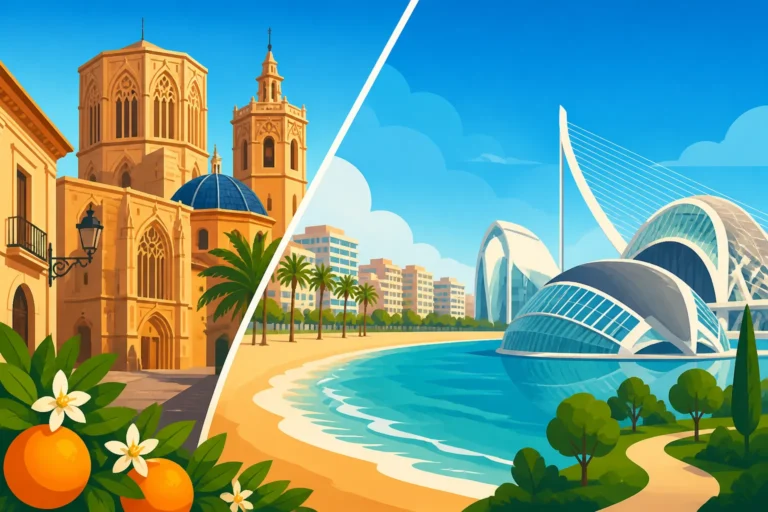
Valencia’s city beaches, Playa de la Malvarrosa and El Saler, are massive. You will never have to fight for a spot to put your towel here, which is a huge relief if you have spent time in the cramped coves of the north. The sand is fine and golden, and the promenade is lined with some of the best authentic paella restaurants in the country. If you are visiting during the summer, you must be aware of Heatwaves in Spain: Health Precautions for Expats as the humidity in Valencia can make 35 degrees feel like 45.
Just south of the city lies the Albufera Natural Park. Here, the beaches are backed by sand dunes and pine forests rather than apartment blocks. It feels wilder and more "Spanish" than the more commercialized areas further south. It is the perfect place to watch the sunset over the freshwater lagoon before heading back into the city for a late dinner.
The White Coast: Costa Blanca
The Costa Blanca stretches through the Alicante province and is home to famous spots like Benidorm, Altea, and Jávea. While Benidorm gets a lot of flak for its skyscrapers, its beaches (Levante and Poniente) are actually meticulously maintained and hold Blue Flag status year after year. However, if you want the expat secret, head to Jávea (Xàbia).
Cala Granadella in Jávea is consistently voted one of the best beaches in Spain. It is a horseshoe-shaped bay with turquoise water and dramatic cliffs. Because of its popularity, the local council now restricts car access during the summer, so you have to take a shuttle bus. This is a common theme in Spain now; the best spots require a bit of logistical planning. I always recommend using Booking.com to find accommodation in the "Old Town" areas of these coastal cities rather than the beachfront strips, as you get a much more authentic experience and better value for your money.
| Region | Beach Type | Best For | Water Temp |
|---|---|---|---|
| Galicia | Fine White Sand | Scenery & Solitude | Cold (15-18°C) |
| Costa Brava | Rocky Coves | Snorkeling & Hiking | Moderate (21-24°C) |
| Costa Blanca | Wide Golden Sand | Families & Nightlife | Warm (24-27°C) |
| Costa de la Luz | Wild Dunes | Windsurfing & Sunset | Bracing (19-21°C) |
| Costa del Sol | Dark Sand/Pebbles | Resorts & Dining | Warm (23-26°C) |
The Deep South: Andalusia’s Two Coasts
Andalusia is unique because it offers two very different coastal experiences: the Mediterranean Costa del Sol and the Atlantic Costa de la Luz. I often tell people that the Costa del Sol is for "lifestyle" and the Costa de la Luz is for "soul." Choosing between them depends entirely on whether you want a cocktail by a pool or a kite-surf across a windswept dune.
The Glamour of the Costa del Sol
The Costa del Sol is world-renowned. From Nerja in the east to Estepona in the west, this coastline is built for comfort. Nerja is famous for the Balcón de Europa and its "Calas," which feel like a miniature version of the Costa Brava but with warmer water. The sand here tends to be darker and coarser than in Valencia, often a mix of sand and small pebbles.
Further west, you hit the heavy hitters like Marbella and Puerto Banús. These are the places to see and be seen. The beaches are lined with luxury "Beach Clubs" where you can rent a sunbed that costs more than a hotel room. If you are planning a trip through this area, Andalusia for Travelers: Cities, Coast, and Culture will help you balance the beach time with the incredible history of cities like Granada and Seville. One thing to watch out for is the "Terral" wind—a hot, dry wind from the interior that can spike temperatures in minutes.
The Wild Costa de la Luz
Once you pass Gibraltar and head toward Tarifa, everything changes. You are back on the Atlantic, but it’s a different beast than the north. This is the Costa de la Luz (Coast of Light). The beaches here, like Bolonia and Valdevaqueros, are vast and backed by enormous shifting sand dunes. The Roman ruins of Baelo Claudia sit right on the sand at Bolonia, offering one of the coolest cultural backdrops for a swim in the world.
Tarifa is the wind capital of Europe. If you are into kite-surfing or windsurfing, this is your mecca. If you are just trying to read a book on a towel, the wind (the "Levante") can be maddening, literally sandblasting you as you sit. Expats here check the wind forecast as often as the temperature. When the wind is calm, there is nowhere better on earth. The sunsets over the Atlantic, with the mountains of Morocco visible across the strait, are a spiritual experience.
Navigating the Logistics of the Spanish Coast
Getting to these beaches is usually straightforward, but "getting to" and "parking at" are two very different things in Spain. If you are planning to hit multiple regions, the High-Speed Trains in Spain (AVE): Routes, Booking, and Savings are your best friend for moving between major hubs like Madrid, Barcelona, Valencia, and Málaga.
Car Rentals and Hidden Costs
For the hidden gems in Asturias or the Costa Brava, you absolutely need a car. Public transport in rural Spain is romanticized in movies but can be a nightmare in reality, with buses that only run twice a day. When renting, make sure you understand the requirements. I suggest reading Renting a Car in Spain: Requirements, Insurance, and Driving Tips to avoid being overcharged at the counter for "mandatory" insurance you already have.
Also, be prepared for the parking situation. In the summer, any beach worth visiting will have a parking crisis by 11:00 AM. Many "free" parking areas near beaches are patrolled by "gorrillas"—unofficial parking attendants who will expect a Euro or two to "watch" your car. It is a small price to pay for peace of mind and is a standard part of the Spanish coastal experience. If you do get a ticket, the process for paying can be confusing, so check out Parking in Spain: Resident Permits, Zones, and Fine Appeals for a breakdown of how to handle it.
Seasonal Timing and Local Customs
The "Spanish summer" is longer than you think. While July and August are the peak, June and September are often much better times to visit. The water is still warm (or warming up), the crowds are half the size, and the prices for accommodation on Booking.com drop significantly.
Also, keep in mind the local rhythm. Between 2:00 PM and 5:00 PM, the beaches often thin out as locals head for a heavy lunch and a siesta. This is the best time to find a spot, provided you can handle the heat. Always bring plenty of water and familiarise yourself with the "Chiringuito" culture. A chiringuito is more than a beach bar; it is a social hub. Ordering a "tinto de verano" (red wine with lemon soda) and a plate of "espetos" (sardines grilled on a skewer) is the most authentic way to end a day on the sand. For more tips on navigating the menu, Spanish Food and Drink: A Practical Culture Guide is an essential read for any foodie traveler.
Disclaimer
The information provided in this guide is for informational purposes only. While every effort has been made to ensure accuracy, beach conditions, local regulations, and travel requirements in Spain can change frequently. Always check local weather forecasts and official municipal websites before planning your visit.