Ordering Food and Drinks in Spanish: A Practical Phrasebook
You are standing at a crowded, tile-walled bar in the heart of Madrid, the air is thick with the scent of sizzling garlic, and a waiter is shouting "¿Qué va a ser?" while looking directly at you. I remember my first week in Spain, staring at a chalkboard menu and feeling my throat tighten as my carefully practiced classroom Spanish evaporated into thin air. This guide solves that paralyzing "deer-in-the-headlights" moment by providing the exact, real-world phrases you need to order food and drinks like a seasoned local.
Disclosure: This post may contain affiliate links. We may earn a commission at no extra cost to you if you make a purchase through these links. Read full disclosure.
Navigating the Spanish Menu Landscape
Before you even open your mouth to speak, you have to understand the logic of a Spanish menu, which is fundamentally different from the standard "appetizer-entree-dessert" flow you might be used to back home. If you walk into a traditional mesón or taberna, the sheer variety of ways to eat can be overwhelming. Are you there for a quick bite at the bar, or are you sitting down for a three-hour marathon of flavors?
Understanding the Menú del Día
The absolute king of the Spanish lunch hour is the Menú del Día. Developed decades ago to ensure workers had access to a nutritious, affordable meal, it remains the gold standard for value and authenticity. Typically offered from 1:30 PM to 4:00 PM on weekdays, it consists of a "primer plato" (first course, usually a vegetable, soup, or pasta), a "segundo plato" (second course, usually meat or fish), bread, a drink, and dessert or coffee.
When you see this on a chalkboard outside, don't expect a printed menu at the table; often, the waiter will simply recite the options at lightning speed. You’ll need to listen for keywords. For a deeper look at how this system works and how to spot the best ones, check out our guide on What Is a ‘Menú del Día’ and How Does It Work?. Understanding this structure is the first step in avoiding the overpriced tourist traps found in the main squares.
Deciphering Tapas vs Raciones
One of the most common mistakes newcomers make is misunderstanding the scale of what they are ordering. In most of Spain, a "tapa" is a small snack, often served with a drink. A "media ración" is a half-portion, and a "ración" is a full plate intended for sharing. If you are a group of four and you order four raciones, you are likely looking at enough food to feed an army.
We ended up with three massive platters that we couldn't possibly finish. To avoid this, always ask the waiter "¿Es muy grande?" (Is it very large?). For more nuances on the sharing culture, see our article on Spanish Tapas Culture: How to Order and Where to Go. Sharing is the soul of Spanish dining, and getting the proportions right is key to a smooth experience.
Meal Times and Kitchen Closures
If you show up at a restaurant at 6:30 PM expecting dinner, you will likely find the lights off or the staff cleaning. Spain runs on a unique clock. Lunch is the main event, usually starting around 2:00 PM. Dinner rarely starts before 9:00 PM, and in cities like Madrid or Barcelona, 10:00 PM is the peak.
Many kitchens close entirely between 4:30 PM and 8:30 PM. If you are traveling between cities using a service like Omio to catch a late train, plan your meals accordingly. During these "down hours," your only options might be cold tapas sitting on the bar or "raciones frías." To prepare your stomach for the local rhythm, read through Spanish Meal Times and Dining Etiquette Explained. Knowing when to eat is just as important as knowing what to say.
Essential Phrases for Arriving and Seating
The way you enter a Spanish establishment sets the tone for your entire meal. Unlike some countries where you wait for a "hostess" to greet you, Spanish bars are often a bit of a free-for-all. If it’s a casual spot, you might just find a gap at the bar and claim it. If it’s a sit-down restaurant, a little more formality is required.
Asking for a Table
When you walk in, make eye contact with a staff member. A simple "Hola" is essential—never skip the greeting. Then, you can ask: "¿Tiene una mesa para dos/tres/cuatro?" (Do you have a table for two/three/four?). If you haven't made a booking through a platform like Booking.com for a hotel-based restaurant, you might be asked, "¿Tiene reserva?" (Do you have a reservation?).
If the place is packed and you see people standing around, you might ask, "¿Hay que apuntarse en alguna lista?" (Do we need to put our names on a list?). This shows you understand the system. If you prefer to sit outside to enjoy the evening air, ask for "una mesa en la terraza." Be aware that many places charge a small "plus" for terrace seating, often noted on the menu as "terraza +10%."
Interpreting the Waiter's Initial Questions
Spanish waiters are professional and efficient, which can sometimes come across as brusque to those used to overly chatty service. When they approach you, they will often say "¿Qué les pongo?" or "¿Qué va a ser?"—both essentially mean "What can I get you?".
Don't be offended if they don't introduce themselves or ask how your day is. They are focused on the task. If you aren't ready yet, say "Un momento, por favor" or "Todavía no sabemos" (We don't know yet). If you are looking for local recommendations, a great phrase is "¿Qué nos recomienda?" (What do you recommend to us?). This often leads to the freshest "fuera de carta" (off-menu) specials.
Dealing with Reservations
In popular areas, especially during weekends or holidays, a reservation is a must. If you are using GetYourGuide to book a food tour or a flamenco show, they often recommend nearby spots that require booking days in advance. When you arrive for your reservation, say "Hola, tengo una reserva a nombre de [Your Name]."
If you realize you're going to be late—a common occurrence in Spain—it is polite to call. However, don't be surprised if they give your table away after 15 or 20 minutes. The demand for tables during peak hours is intense, and the "no-show" culture is something local businesses fight against vigorously.
The Art of Ordering Drinks and Coffee
Ordering a drink in Spain is more than just quenching thirst; it’s a social ritual. Whether it’s the morning caffeine hit or the evening "caña," there are specific terms that will make you sound less like a tourist and more like a resident.
Coffee Variations Explained
If you just order "un café," you will likely be asked "¿Cómo lo quiere?". The options are numerous. A "café solo" is a small, strong espresso. A "café cortado" is an espresso with a tiny splash of milk to "cut" the acidity. My personal favorite, and the most common breakfast choice, is the "café con leche"—equal parts espresso and steamed milk.
If you are visiting in the sweltering summer months, you must try a "café con hielo." You will receive your hot coffee and a separate glass with large ice cubes. You pour the coffee over the ice yourself. For a complete deep dive into these rituals, including the "carajillo" (coffee with brandy), refer to our guide on Coffee Culture in Spain: How to Order Like a Local.
Ordering Beer, Wine, and Soft Drinks
Beer is usually ordered by size. A "caña" is a small draught beer, perfect for staying cold until the last drop. A "doble" is roughly double that size, and a "tanque" or "jarra" is a large mug. If you want a bottled beer, ask for "un tercio" (330ml) or "un quinto" (200ml).
For wine, you don't always need to know the specific grape. You can simply ask for "un tinto" (red), "un blanco" (white), or "un rosado" (rosé). In most casual bars, asking for "un tinto de la casa" will get you a perfectly drinkable local wine for a few euros. If you want something more specific, you might ask for a "Rioja" or a "Ribera" (referring to the famous wine regions). To learn more about ordering etiquette in these settings, see Spanish Bar and Café Etiquette for Newcomers.
Typical Phrases for the Vermut Hour
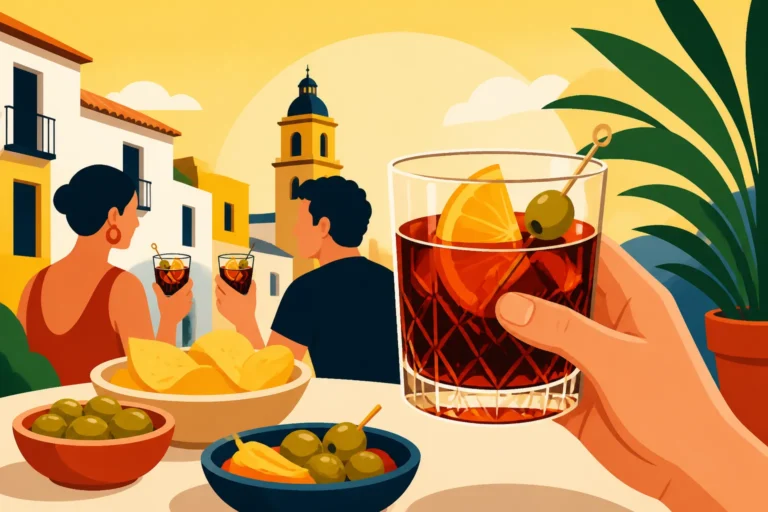
The "hora del vermut" is a sacred tradition, particularly on Sundays before lunch. It involves drinking sweet Spanish vermouth on tap, usually garnished with an olive and an orange slice. To join in, simply ask for "un vermut de grifo."
This is often accompanied by salty snacks like olives or "gildas" (a skewer of olive, pepper, and anchovy). If you want to know more about this fashionable pre-lunch tradition, check out What Is Vermut Hour in Spain and How to Join In. It's the perfect way to experience the local lifestyle while waiting for the restaurants to open for lunch.
Ordering Main Courses and Dietary Requirements
This is where the "heavy lifting" of the conversation happens. Ordering your main meal requires a bit more vocabulary, especially if you have specific needs or preferences.
Step-by-Step Ordering Process
When the waiter returns with their notepad, it's time to be clear. Use the verb "querer" (to want) or, even better, "poner" (to put/serve). For example, "Para mí, póngame la merluza" (For me, give me the hake). It sounds direct in English, but in Spanish, it’s perfectly standard and polite.
If you are sharing raciones, point to the items on the menu and say "Para compartir, queremos las croquetas, el pulpo y la ensaladilla." This signals to the waiter that the plates should be placed in the center of the table. If you want to explore the variety of dishes available, you might want to read about Spanish Regional Dishes Every Visitor Should Try before you head out.
Communicating Allergies and Preferences
Spain has become much more aware of dietary restrictions in recent years, but you still need to be very explicit. If you are celiac, say "Soy celíaco/a. ¿Tiene platos sin gluten?". If you have a nut allergy, say "Soy alérgico a los frutos secos. ¿Lleva nueces este plato?".
Vegetarians should be cautious; sometimes a "vegetable sandwich" (sándwich vegetal) contains tuna or egg unless specified otherwise. Always ask, "¿Lleva carne o pescado?" (Does it have meat or fish?). For more detailed tips on navigating menus with restrictions, see How to Eat Gluten-Free in Spain (Sin Gluten Tips).
Describing Food Quality and Doneness
When ordering steak (filete or chuletón), the waiter will ask how you want it cooked. Your options are:
- "Muy hecho" (Well done)
- "Al punto" (Medium)
- "Poco hecho" (Rare)
- "Vuelta y vuelta" (Very rare/Seared)
If the food arrives and something is wrong, don't suffer in silence. Politeness goes a long way. "Perdone, esto está frío" (Excuse me, this is cold) or "Esto no es lo que he pedido" (This isn't what I ordered) are necessary phrases. However, remember that Spanish service is rarely about speed; it’s about the experience.
The Finale: Dessert, Coffee, and the Bill
The end of the meal in Spain is not a signal to leave immediately. In fact, "la sobremesa"—the period of conversation after the food is gone—is one of the most cherished parts of the culture.
Asking for the Bill Without Offense
In many cultures, the waiter brings the check as soon as you finish your last bite. In Spain, this is considered rude. They will wait for you to ask for it. You can catch the waiter’s eye and say "La cuenta, por favor" or use the universal hand gesture of scribbling in the air.
If you are in a rush to catch a bus booked via Omio, you might want to ask for the bill at the same time you order dessert or coffee. Say, "Tráigame la cuenta cuando pueda, por favor." This ensures you aren't stuck waiting for twenty minutes when you have a departure to catch. To understand more about these subtle social cues, read How to Ask for the Bill in a Spanish Restaurant.
Tipping Norms and Payment Methods
Tipping (la propina) in Spain is not mandatory and certainly not the 20% standard found in the US. For a casual lunch or drinks, leaving the small change is sufficient. For a nice dinner, 5-10% is considered a generous tip.
Most places accept cards, but it’s always wise to ask "¿Se puede pagar con tarjeta?" before you sit down, especially in rural areas or very old-school bars. If you want to pay separately, it can be a bit of a headache for the staff. It’s better to say "Queremos pagar por separado" (We want to pay separately) or simply have one person pay and use an app to settle up later. For a full breakdown of the etiquette, see How to Tip at a Restaurant in Spain.
Essential Phrases for Post-Meal Socializing
Once the bill is paid, don't feel the need to bolt. You can stay and finish your wine or "chupito" (a small shot, often offered "on the house" after a large meal). Common chupitos include "hierbas" (herbal liqueur) or "crema de orujo."
When you finally decide to leave, a simple "Gracias, todo estaba muy rico" (Thank you, everything was very tasty) is a lovely way to acknowledge the kitchen. If you've had a particularly good experience, you can say "Volveremos" (We will return).
Practical Phrasebook for Ordering
| English | Spanish | Phonetic Pronunciation |
|---|---|---|
| A table for two, please | Una mesa para dos, por favor | Oo-na meh-sa pa-ra dos, por fa-vor |
| What do you recommend? | ¿Qué nos recomienda? | Keh nos reh-ko-myen-da |
| The bill, please | La cuenta, por favor | La kwen-ta, por fa-vor |
| Can I pay by card? | ¿Puedo pagar con tarjeta? | Pweh-do pa-gar kon tar-heh-ta |
| I am allergic to… | Soy alérgico/a a… | Soy ah-ler-hee-ko/a ah |
| A draught beer | Una caña | Oo-na ka-nya |
| Still/Sparkling water | Agua sin gas / con gas | Ah-gwa seen gas / kon gas |
| Everything was delicious | Todo estaba riquísimo | Toh-do es-ta-ba ree-kee-see-mo |
Disclaimer
The information provided in this guide is for general informational purposes only. Language nuances and dining customs can vary significantly between different regions of Spain (such as Catalonia, the Basque Country, and Galicia). While we strive to keep our content accurate and up to date as of June 2026, we recommend always remaining observant of local practices and being patient with the staff as you practice your Spanish. Happy dining!