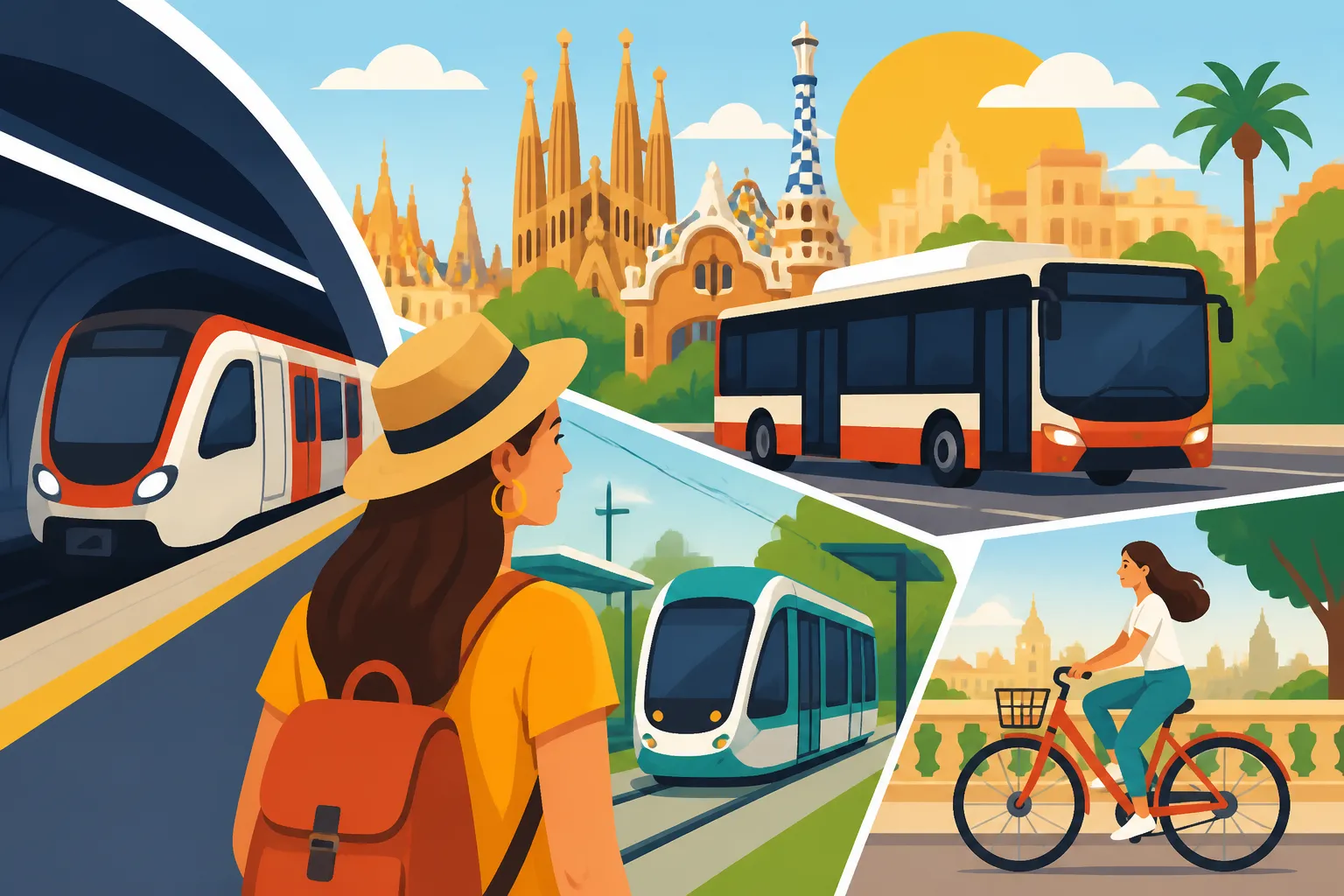
Getting Around Spanish Cities: Metro, Bus, Tram, and Bikes
Disclosure: This article contains affiliate links. If you buy through them, we may earn a commission at no extra cost to you. Read our full disclosure.
Trying to figure out which colorful plastic card opens which gate in a new Spanish city can feel like a high-stakes puzzle when you're late for an appointment. I still remember my first week in Madrid, standing paralyzed in front of a Metro machine while a queue of impatient locals sighed behind me. This guide breaks down the urban transit maze in Spain so you can navigate the metro, buses, and bike-shares like a seasoned resident.
Mastering the Metro: Spain’s Underground Arteries
The metro is the heartbeat of Spain’s major metropolises. While Madrid and Barcelona boast the most extensive networks, you will also find efficient systems in Valencia, Bilbao, Seville, and Palma de Mallorca. Each has its own personality. Madrid’s system is incredibly deep—expect long escalator rides—while Barcelona’s can feel like a sauna in the peak of July.
The Madrid and Barcelona Heavyweights
In Madrid, the Metro is your best friend. It is clean, remarkably punctual, and covers almost every corner of the city. One thing I learned the hard way: always check which direction you are heading by the name of the last station on the line, not just the "North" or "South" logic you might be used to elsewhere. If you are arriving at Barajas, you’ll want to know How to Get From Madrid Airport to the City Center to avoid the expensive taxi queues.
Barcelona’s TMB (Transports Metropolitans de Barcelona) is equally vital. The lines are color-coded and easy to follow, but the heat in the older stations can be intense. If you are staying in the city center, you will likely use the L1 (red) or L3 (green) lines constantly. For newcomers arriving by plane, understanding How to Get From Barcelona Airport to the City Center is the first step to mastering the local geography. Both cities have moved toward contactless "multi" cards. You buy a card for a few euros at a machine, and then you "top it up" with 10-trip bundles, which are significantly cheaper than single tickets.
Metro Systems in Smaller Cities
Don't overlook the metro in cities like Bilbao or Valencia. Bilbao’s metro is a work of art, designed by Norman Foster—the locals affectionately call the glass entrances "fosteritos." It’s a simple, linear system that makes getting to the Guggenheim or the suburbs a breeze. Valencia’s Metrovalencia is a hybrid of underground metro and overground tram. It is divided into zones (A, B, and C), and if you accidentally cross into a zone you haven't paid for, the exit gates won't open. This can be an embarrassing moment, so always check the zone map near the ticket machines.
Seville’s Metro is just one line, but it’s incredibly useful for crossing the river from Aljarafe into the center. It’s modern and air-conditioned, which is a lifesaver in a city where 40-degree days are the norm. When you're first starting out, you might feel overwhelmed by the language barrier at the kiosks, but there is usually an English button. If you're nervous, you can look at a guide on How to Get Around a Spanish City Without Speaking Spanish to build your confidence before you hit the platforms.
Essential Metro Etiquette and Safety
In Spain, the metro is a social hub, but there are unwritten rules. Always stand on the right side of the escalator to let the "rush-hour sprinters" pass on the left. During peak hours, people will pack in tightly; it’s not considered rude, just necessary. However, this is also when you need to be most vigilant. Pickpockets are unfortunately skilled in crowded transit hubs. Keep your backpack on your front and your phone out of your back pocket. For more detailed advice, read through Staying Safe in Spain: Practical Safety Tips for New Residents.
The Urban Bus Network: Reaching Every Corner
While the metro is great for speed, the urban buses (Autobuses Urbanos) are what actually connect the local neighborhoods. In many cities, the bus company is known as the EMT. Riding the bus gives you a much better sense of the city’s layout than traveling underground, and it’s often the only way to reach certain hilltop neighborhoods or quiet residential plazas.
How to Ride and Pay
In most Spanish cities, you enter the bus through the front door and exit through the middle or back. You must "validate" your card on the machine near the driver. If you don't have a card, many cities now allow "Tap-to-Pay" with a contactless credit card or phone, but older buses might still require cash (usually no larger than a 5 or 10-euro note).
One quirk of Spanish buses: they won't always stop just because you are standing at the bus stop. You need to clearly signal the driver with a wave of your hand. If you’re inside and want to get off, press the "Solicitud de Parada" button well in advance. I’ve missed my stop more than once because I waited until the bus was actually at the curb to press the button. If you are a resident, you should definitely look into Public Transport Discounts in Spain: Youth, Senior, and Resident Options to see if you qualify for the heavily subsidized monthly passes.
The Magic of the Búho (Night Bus)
When the metro shuts down around 1:30 AM (on weekends), the "Búho" or "Owl" buses take over. These night buses usually depart from a central hub, like Plaza de Cibeles in Madrid or Plaça de Catalunya in Barcelona. They follow different routes than the daytime buses, often marked with an "N" before the number. They are a lifeline for those of us who have stayed out too late for one last tapa. While they run less frequently—usually every 20 to 40 minutes—they are safe and filled with a mix of hospitality workers and party-goers.
Tracking and Navigation Apps
The best way to navigate the bus system is through apps. While Google Maps is decent, local apps like EMT Madrid or AMB Mobilitat in Barcelona provide real-time arrival data that is far more accurate. You can also use Omio to plan journeys that might involve connecting from a city bus to a regional train if you're heading out of town. Seeing the "minutes remaining" for the next bus on your screen saves you from standing in the sun longer than necessary.
Trams and Light Rail: The Scenic Way to Travel
Trams (tranvías) have seen a massive resurgence in Spain over the last two decades. They are often the most pleasant way to travel, offering large windows and smooth rides. They are particularly common in coastal cities and areas where digging deep metro tunnels wasn't feasible.
Where to Find the Best Tram Lines
Barcelona has two separate tram systems (Trambaix and Trambesòs) that serve the outskirts and the beach areas. They are incredibly sleek and efficient. In the south, Seville has a short but beautiful tram called the Metrocentro that glides past the Cathedral and the Archivo de Indias. It’s mostly for tourists and shoppers, but it’s a wonderful way to see the historic center without tiring your feet.
Alicante has a fantastic "TRAM" system that is part tram, part commuter train. It can take you from the city center all the way up the coast to Benidorm and Denia. It is one of the most scenic public transit rides in the country, hugging the Mediterranean cliffs. If you're planning a trip like this, you might use Booking.com to find a place to stay near one of the coastal tram stops to keep your travel logistics simple.
Validation Rules for Trams
The most important thing to remember about trams is that you often need to validate your ticket on the platform before you board, rather than inside the vehicle. In cities like Valencia or Alicante, if a ticket inspector (interventor) catches you with an unvalidated ticket, they won't accept "I'm a tourist" as an excuse. The fines can be 50 euros or more, payable on the spot. If you’re using How to Use the Madrid Metro as a First-Time Visitor as a baseline for your knowledge, remember that tram rules are slightly more varied by region.
Cycling and Micromobility: The Two-Wheeled Revolution
Spain has transformed its relationship with bikes. Many cities now have dedicated bike lanes (carril bici) that are physically separated from car traffic. This has made cycling a viable daily commute option rather than just a Sunday hobby.
Public Bike-Share Systems
Almost every major city has a public bike-share scheme.
- BiciMAD (Madrid): These are all electric bikes, which is essential for Madrid's many hills.
- Bicing (Barcelona): One of the most successful systems in the world, though it is primarily for residents.
- Valenbisi (Valencia): This city is flat as a pancake, making it the absolute best place for cycling.
- Sevici (Seville): A massive network that connects the entire city.
A major hurdle for expats is that some of these systems require a NIE (foreigners' ID number) or a local address to sign up for an annual pass. If you're still navigating Spanish Bureaucracy for Daily Life: Padrón, IDs, and Local Services, you might have to stick to short-term visitor passes, which you can usually buy with a credit card at the bike stations or via an app.
Rules of the Road and Safety
Spanish police have become very strict about where you can ride. You are generally forbidden from riding on the sidewalk; you must use the bike lane or the road. Wearing a helmet is mandatory on intercity roads and for anyone under 16, but many cities now "recommend" them for everyone. Also, do not use headphones while cycling; it’s a common way to get a hefty fine. If you want to explore the city on two wheels but don't want to deal with the public system, you can use GetYourGuide to book a guided bike tour, which usually includes the bike and a helmet.
Electric Scooters (Patinetes Eléctricos)
The rise of electric scooters has been controversial in Spain. Most cities have now banned them from sidewalks and pedestrian zones. You must ride them in bike lanes or on roads with a speed limit of 30km/h. Many companies like Voi or Tier operate in Spanish cities, but be aware that some cities (like Madrid and Barcelona) have periodically banned or restricted these rental apps in the city center due to clutter. Always check the local app's map for "No Parking" zones, or you might find yourself unable to end your ride and stop the meter.
Regional Transit Cards and Saving Money
If you are going to be in a city for more than a few days, the single-ticket approach is a waste of money. Spain loves its "Consorcio" system—regional transport authorities that integrate buses, metros, and sometimes even suburban trains (Cercanías).
The Multi-Trip Logic
In cities like Granada or Málaga, you can buy a "Credibús" or a similar rechargeable card. You put 10 or 20 euros on it, and each journey costs about half the price of a cash fare. Furthermore, these cards often allow "transbordos" (transfers). This means if you take a bus and then switch to another bus or the metro within a 45-to-90-minute window, the second leg of your journey is either free or heavily discounted.
For those living in Spain long-term, the Spanish Health Card (Tarjeta Sanitaria) isn't the only card you'll need; the "Abono Transporte" is your golden ticket. In Madrid, for example, the monthly pass for young people (under 26) is incredibly cheap and covers all zones in the entire region. Even for older adults, the convenience of not having to top up a card every few days is worth the administrative effort of applying online through Using Spanish ‘Ayuntamiento’ Services: What You Can Do Online.
Comparing City Transit Options
| City | Primary Mode | Ease of Use | Best Feature |
|---|---|---|---|
| Madrid | Metro | Very High | 24/7 reliability (almost) |
| Barcelona | Metro & Tram | High | Integrated T-Usual cards |
| Valencia | Bus & Bike | High | Flat terrain, great bike lanes |
| Seville | Bus & Bike | Medium | Scenic tram through the center |
| Bilbao | Metro | Very High | Beautiful, simple architecture |
Managing Your Daily Commute
The key to thriving in a Spanish city is to mix and match your transport. On a sunny spring morning in Valencia, there is nothing better than taking a Valenbisi bike through the Turia park. But when the summer heat hits, you'll be thankful for the deep, cool tunnels of the Madrid Metro.
If you're moving between neighborhoods, always give yourself an extra 15 minutes. Spanish transit is generally punctual, but "manifestaciones" (protests) or local "fiestas" can lead to sudden bus diversions. I’ve often found myself on a bus that suddenly terminates three stops early because a neighborhood parade is starting. Instead of getting frustrated, use it as an excuse to grab a café solo and watch the world go by—that's the real Spanish way to travel.
Disclaimer
This guide is intended for informational purposes only. Local transit regulations, ticket prices, and system availability in Spanish cities are subject to change by municipal authorities. Always verify current routes and pricing on official local transport websites or apps before traveling.