How to Write a Spanish-Style CV (Currículum) That Gets Read
Sending out dozens of job applications in Spain only to receive total silence is a soul-crushing experience many of us have faced. When I first moved to Valencia, I used my standard two-page British resume and couldn't understand why even entry-level roles ignored me. This guide solves the mystery of the Spanish "Currículum Vitae" (CV) by breaking down the specific cultural expectations and formatting rules required to get your foot in the door of a Spanish company.
Disclosure: This post may contain affiliate links. We may earn a commission at no extra cost to you if you make a purchase through these links. Read full disclosure.
Understanding the Spanish CV Mindset
The first thing you have to realize is that a Spanish CV is not just a list of your achievements; it is a personal introduction. In many Anglo-Saxon cultures, the resume is a clinical document designed to prove competency through data. In Spain, while competency matters, the "who you are" often carries as much weight as the "what you have done." Recruiters here are looking for a sense of personality and a cultural fit, which is why the document feels more personal than what you might be used to in the US, UK, or Canada.
This cultural nuance is why simply translating your existing resume into Spanish rarely works. If you are serious about your job hunt, you need to look at How to Find a Job in Spain: CV, Interviews, and Networking to understand how the CV fits into the broader employment landscape. Spanish recruiters often scan a CV in less than ten seconds, and if they don't see the specific sections they expect in the order they expect them, they often move on to the next candidate without a second thought.
Furthermore, the Spanish job market is highly competitive. Whether you are looking for a role in a bustling Madrid startup or a traditional firm in Seville, your CV needs to speak the local "language" of bureaucracy and professional hierarchy. This is where many foreigners stumble, as they fail to highlight the specific certifications or administrative statuses—like having a valid NIE or residency—that Spanish HR departments prioritize to avoid legal headaches.
The Layout and Structure of a Spanish Currículum Vitae
The structure of a Spanish CV is relatively rigid. While creative industries allow for some flair, most sectors expect a clean, one-to-two-page document. Unlike the "blind" recruitment trends gaining traction elsewhere, the Spanish CV remains quite traditional. You want a layout that balances white space with dense, high-impact information. If you are struggling with the cultural nuances of workplace expectations, reviewing Spanish Work Culture: Hours, Holidays, and Workplace Etiquette can give you a better idea of the professional environment you are trying to enter.
The Photo Debate
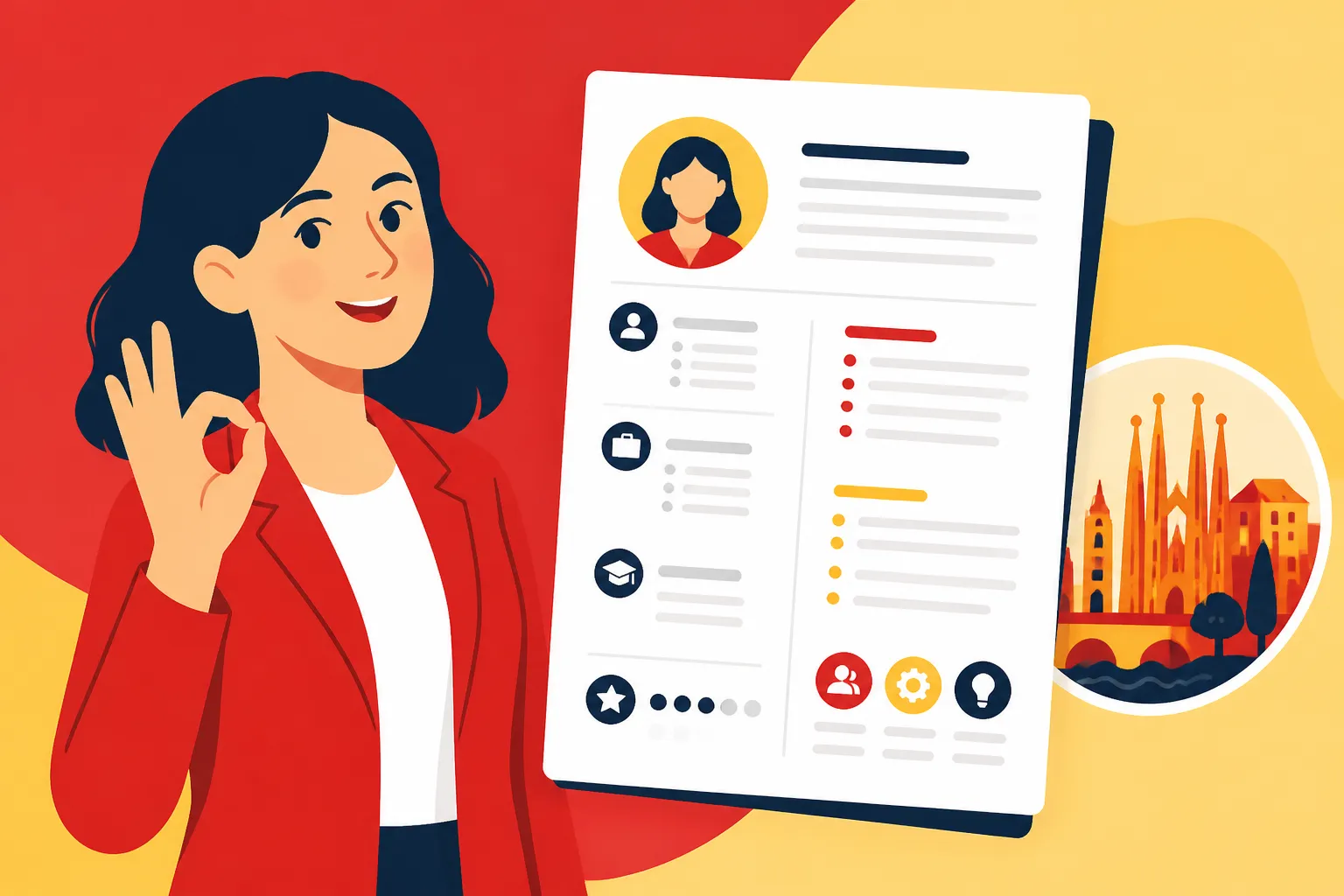
One of the biggest shocks for expats is the requirement of a professional photograph. In many countries, including a photo is a "red flag" for discrimination, but in Spain, it is standard practice. A CV without a photo often looks "incomplete" to a Spanish recruiter. It helps them put a face to the name and makes the application feel more human.
Your photo should be a professional headshot—not a cropped holiday photo or a selfie. Aim for a neutral background, professional attire, and a warm, approachable expression. This photo is often placed in the top right or left corner of the first page. If you are worried about your professional image, remember that this is your first chance to show you understand local norms.
Personal Information (Datos Personales)
This section is more detailed than what is common in other countries. In addition to your name, phone number, and email, you should include your city of residence and, most importantly, your work authorization status. If you have a NIE (Número de Identidad de Extranjero) or a TIE, list it. If you are on a specific visa, mention that you have "permiso de trabajo."
Providing this information upfront saves the recruiter from having to guess if they need to sponsor you. You should also include a link to your LinkedIn profile, ensuring it is fully updated and reflects the same information as your CV. For those moving between regions, it is worth checking How to Register for Healthcare After Moving Between Spanish Regions as your administrative status often impacts more than just your job hunt.
The Professional Profile (Perfil Profesional)
A brief, three-to-five-sentence summary at the top of your CV is essential. This is your "elevator pitch." It should describe who you are, your core expertise, and what you are looking for in Spain. Avoid generic fluff like "hard-working individual." Instead, use specific keywords related to your industry.
If your Spanish isn't quite at a professional level yet, you might consider using a platform like iTalki to practice describing your professional background with a native tutor. Being able to write—and later speak—about your experience in natural-sounding Spanish is a massive advantage. This profile section is the first thing they read after looking at your photo, so make it count.
Navigating the Meat of the CV: Work Experience and Education
The core of your CV remains your experience and education, but the way you present these must align with Spanish expectations. You should use a reverse-chronological format, starting with your most recent role. Spanish employers value stability, so if you have gaps in your CV, be prepared to explain them later, but try to present your timeline as a continuous journey of growth.
Work Experience (Experiencia Laboral)
For each role, list the job title, company name, location, and dates of employment. Underneath, use bullet points to describe your responsibilities and, more importantly, your achievements. In Spain, it is common to see a mix of "tareas" (tasks) and "logros" (achievements). Use action verbs like "Lideré" (I led), "Desarrollé" (I developed), or "Incrementé" (I increased).
If your previous companies are not well-known in Spain, add a one-sentence description of what the company does. For example: "Company X: Leading UK-based fintech specialized in micro-lending." This helps the recruiter understand the context of your experience. Understanding the nuances of Writing a Spanish‑Style CV: Format, Sections, and Examples can help you fine-tune these descriptions for maximum impact.
Education and Training (Formación Académica)
Spain is a very "titled" society. Degrees and official certifications carry significant weight. List your highest degree first, including the institution and the year of completion. If you have a degree from abroad, you may eventually need to look into How to Get Your Foreign Degree Recognized in Spain (Homologación) if you are entering regulated professions like medicine, law, or engineering.
Don't forget to include a "Formación Complementaria" section for workshops, seminars, or online certifications. In the eyes of a Spanish recruiter, continuous learning is a sign of a proactive employee. If you have completed courses relevant to the Spanish market, such as a course on Spanish tax law or local marketing trends, highlight these clearly.
Skills, Languages, and the "Extra" Factor
The final sections of your CV are where you can truly differentiate yourself as an expat. Your international background is a strength, but only if you frame it correctly. You are not just someone who "speaks English"; you are someone with "cross-cultural communication skills" and "global market insight."
Languages (Idiomas)
This is often the most important section for foreign residents. Be extremely clear about your levels using the CEFR scale (A1, A2, B1, B2, C1, C2). Do not just say "Fluent" or "Conversational." If you are a native English speaker, write "Nativo." For your Spanish level, be honest. If you are currently studying, mention it: "Español: Nivel B2 (En proceso)."
As mentioned earlier, using a service like iTalki can help you move from a B1 to a B2 level quickly, which is often the "magic" threshold for many office jobs in Spain. If you speak other languages like French, German, or Mandarin, list them prominently. Many Spanish companies are looking to expand internationally and value polyglots.
Technical and Soft Skills (Habilidades)
Divide this into "Hard Skills" (software, technical tools, specific methodologies) and "Soft Skills" (leadership, teamwork, adaptability). In the Spanish context, "capacidad de adaptación" (adaptability) is highly prized in expats because it suggests you will handle the transition to a Spanish workplace well.
| Feature | Spanish CV Expectation | Typical US/UK Resume |
|---|---|---|
| Photograph | Mandatory / Expected | Generally Avoided |
| Date of Birth | Common / Accepted | Avoided (Age Discrimination laws) |
| Marital Status | Sometimes included (Traditional) | Never included |
| Length | 1-2 Pages | 1 Page preferred |
| Personal Info | Includes NIE/Work Status | Basic Contact only |
| Language Levels | CEFR Scale (A1-C2) | Descriptive (Fluent/Basic) |
Polishing Your Application for the Spanish Market
Once the content is set, you need to ensure the "packaging" is correct. This includes the language of the CV and the supporting documents. A common question is: "Should I write my CV in English or Spanish?" The answer depends entirely on the job ad. If the ad is in Spanish, your CV must be in Spanish. If the ad is in English, you can send an English version, but including a Spanish version as well shows a high level of respect and effort.
The Role of the Cover Letter (Carta de Presentación)
In Spain, the "Carta de Presentación" is still very much alive. It shouldn't just repeat your CV; it should explain why you want to work for that specific company and how your international background solves their local problems. If you are applying for a freelance role or considering starting your own thing, understanding Freelancing and Starting a Business in Spain: Practical Guide is vital. You might even find that using a service like Xolo makes managing the administrative side of freelancing much easier if you decide to go the "Autónomo" route instead of traditional employment.
Salary and Taxes
When you eventually get to the interview stage, which you can prepare for by reading Spanish Job Interviews: Etiquette, Questions, and Follow‑Ups, you will be asked about salary expectations. In Spain, salaries are usually discussed in "Bruto Anual" (Gross Annual). Make sure you understand the difference between your gross and net pay. Services like Taxes for Expats can be helpful for understanding your global tax obligations, especially if you are still earning income from your home country while working in Spain. Additionally, Salary Negotiation in Spain: Cultural Tips and Typical Ranges provides excellent context for what to expect during these conversations.
Final Checklist for Your Spanish CV
Before you hit send, go through this list:
- Is there a professional photo included?
- Is my NIE or work permit status clearly stated?
- Are my language levels listed using the A1-C2 scale?
- Have I used a reverse-chronological format?
- Is the document saved as a PDF with a professional filename (e.g., CV_Name_Surname.pdf)?
- Did I check for spelling errors? (A single "ñ" missing can change the meaning of a word!)
If you are just starting your journey, don't forget to look at the Spain Relocation Checklist: First 30 Days for New Residents to ensure all your other paperwork is in order. A perfect CV won't help if your Padrón or Social Security number isn't ready when the contract offer arrives. You might also want to understand the different Employment Contracts in Spain: Indefinite vs Temporary vs Training to know exactly what you are signing when the time comes.
Writing a CV for the Spanish market is a hurdle, but once you adapt to the local expectations, you'll find that your international experience becomes a major selling point. It takes patience and a bit of "I've-been-there" resilience, but landing that first job in Spain is the key to truly settling into your new life under the sun.
Disclaimer
This guide is intended for informational purposes only. Immigration laws, labor regulations, and recruitment practices in Spain can change frequently. Always consult with a legal professional or a qualified "gestor" regarding your specific residency and work authorization status before entering into employment contracts.