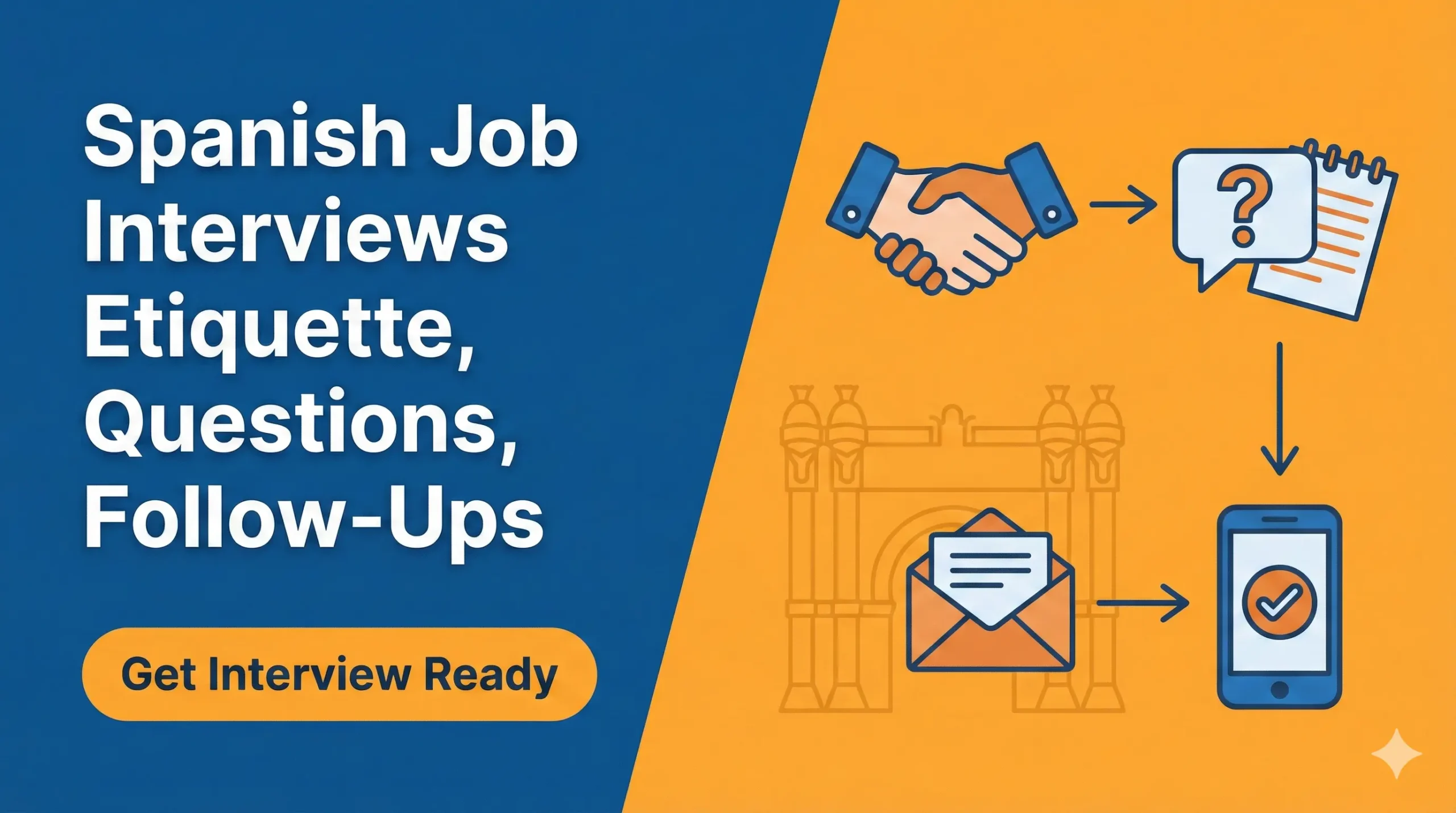
Spanish Job Interviews: Etiquette, Questions, and Follow-Ups
This extensive guide is designed to equip you with the essential knowledge needed to excel in the Spanish job market. We will explore the rigorous preparation required before your interview, break down the specific cultural etiquette you must observe, analyze the most common interview questions with tailored response strategies, and outline the exact protocol for your post-interview follow-up.
Disclosure: This post may contain affiliate links. We may earn a commission at no extra cost to you if you make a purchase through these links. Read full disclosure.
Pre-Interview Preparation and Strategy
Before you even receive a calendar invite for an interview, your preparation must align with Spanish corporate expectations. Spanish recruiters and hiring managers highly value candidates who demonstrate a localized understanding of their specific business environment, rather than a generic global approach.
Researching the Local Market Position
It is insufficient to simply know what a multinational company does on a global scale; you must deeply understand its position within the Spanish market. If you are interviewing for a corporation with its regional headquarters in Madrid, you must research their recent domestic projects, identify their local competitors, and review any recent news regarding their Spanish operations. When you can articulate exactly how your skills will help the company succeed specifically within the Iberian Peninsula, you immediately separate yourself from candidates who treat the interview like any other generic application.
Aligning Your Documents and Portfolio
Although you will have already submitted your digital application to secure the meeting, it is a standard professional courtesy to bring pristine, printed copies of your documents to in-person interviews. Ensure these documents follow local standards implicitly. If you have not already adapted your materials to fit the local mold, you should consult our comprehensive guide on Writing a CV for the Spanish Job Market to ensure your formatting, the inclusion of a professional photo, and the arrangement of your personal details meet local expectations perfectly.
Furthermore, international applicants should be prepared to briefly and confidently discuss their legal right to work in the country. While you do not need to lead the conversation with complex immigration logistics, having a clear, concise answer about your current visa status demonstrates professionalism and reliability. For complete clarity on navigating this topic, review our resources on Spanish Work Visa.
Spanish Job Interview Etiquette and Cultural Norms
Once your interview is scheduled, your focus must immediately shift to presentation and etiquette. First impressions in Spain carry immense, lasting weight, and the way you conduct yourself in the opening minutes of the interaction will dictate the tone for the entire conversation.
Dispelling the Myth of Spanish Punctuality
There is a widespread, persistent global stereotype regarding “Spanish time,” suggesting that lateness is culturally accepted or even expected. While informal social gatherings in Spain might operate on a highly flexible schedule, this absolutely does not apply to the corporate world. In a professional setting, punctuality is a strict indicator of respect, organization, and reliability.
You should plan your commute to arrive exactly five to ten minutes before your scheduled interview time. Arriving thirty minutes early can be seen as an inconvenience to the interviewer, who may feel pressured to accommodate you before they are ready. Conversely, arriving even one minute late without a profound, previously communicated excuse can instantly cost you the job opportunity. Always account for unexpected transit delays in major cities.
Decoding the Regional Dress Code
The Spanish business environment leans heavily toward conservative, polished attire, though this varies slightly depending on the specific industry and region.
In the corporate, financial, and legal sectors of cities like Madrid or Seville, formal business wear remains the absolute standard. This means a tailored suit and tie for men, and a highly professional suit or conservative dress for women.
Conversely, in the tech startups of Barcelona or the creative design agencies of Valencia, the dress code is often described as “smart casual.” However, the golden rule for job interviews in Spain is to always dress one level more formally than the company’s daily dress code. It is infinitely better to be slightly overdressed—which communicates profound respect for the occasion and the interviewers—than to appear underdressed and risk looking uninterested.
Greetings and Professional Body Language
Your physical introduction must strike a delicate balance between interpersonal warmth and corporate professionalism.
- The Handshake: Offer a firm, brief handshake with direct eye contact to every single interviewer in the room. In Spanish social culture, the dos besos (two kisses on the cheeks) is the standard greeting between women, and between men and women. However, in a first-round formal job interview, you should stick strictly to a professional handshake unless the interviewer explicitly initiates the cheek kiss.
- Posture and Presence: Maintain an open, attentive posture throughout the meeting. Slouching, leaning back too casually, or crossing your arms defensively can be interpreted as a lack of engagement or respect.
- Business Cards: If you are handed a business card by an executive, receive it graciously, take a distinct moment to read it, and place it neatly on the table in front of you during the interview. Never shove it directly into your pocket unread.
The Formality Factor Usted versus Tu
If your interview is conducted in Spanish, you must expertly navigate the linguistic minefield of formality. The Spanish language has two distinct words for “you”: the formal usted and the informal tú.
Always, without exception, begin the interview by addressing your counterparts using usted. This demonstrates a fundamental respect for hierarchy, age, and professional boundaries. In Spain (unlike in many Latin American countries where usted is maintained indefinitely), professionals often transition to the informal tú quite rapidly. Wait patiently for the interviewer to invite you to do so with a phrase like, “Por favor, puedes tutearme” (Please, you can use ‘tú’ with me). If they do not explicitly invite you to drop the formal address, continue using usted for the entire duration of the meeting. To further understand these intricate workplace dynamics, you can review our insights on Spanish Business Culture and Office Etiquette.
The Structure of the Interview and the Importance of Small Talk
Anglo-Saxon interviews often launch directly into rigorous competency questions the moment everyone sits down. In Spain, however, the interview will almost certainly begin with a dedicated period of small talk.
Do not mistake this casual conversation for a delay in the interview process; the small talk is the beginning of the interview. The interviewer will likely ask about your journey to the office, the current weather, your impressions of the city, or a harmless observation about your home country. This is a deliberate, calculated assessment of your interpersonal skills, your sociability, and your emotional intelligence.
Respond warmly, smile, and actively engage in the dialogue. A candidate who gives abrupt, one-word answers in an attempt to rush into the “real” interview will be flagged as cold, purely transactional, or a poor cultural fit for a highly collaborative Spanish office environment. Building confianza (trust) in these opening minutes is essential.
Common Job Interview Questions in Spain and How to Answer Them
Once the formal questioning begins, you will encounter a mix of behavioral assessments and standard professional inquiries. While the globally recognized STAR method (Situation, Task, Action, Result) is highly effective in Spain, you must tweak your delivery to match local values.
Spanish corporate culture heavily values collectivism and team harmony over aggressive, cutthroat individualism. When discussing your past achievements, focus more on “We” than “I.” Emphasize your role as a catalyst within a successful team rather than portraying yourself as a solitary hero who saved the day.
Here are the most common questions you will face in a Spanish interview, what the interviewer is actually looking for, and how to structure your response perfectly.
Tell Me About Yourself
Spanish: Háblame de ti.
This open-ended question is not an invitation to recount your childhood or your entire life story. The interviewer wants a concise, highly relevant two-minute professional summary. Highlight your most significant experience, your current professional focus, and crucially, include a brief mention of why you are currently living in Spain or looking to transition to this specific role in this specific city. Keep your tone positive, energetic, and forward-looking.
Why Do You Want to Work for Our Company
Spanish: ¿Por qué quieres trabajar con nosotros?
This is the exact moment where your pre-interview research pays off. Avoid generic answers about “wanting a new challenge” or “looking for growth.” Reference a specific recent project they completed in the Spanish market, their recent sustainability initiatives, or their expansion into a new sector. Show that you have chosen them specifically, not just applied to every open listing on LinkedIn.
What Are Your Greatest Strengths and Weaknesses
Spanish: ¿Cuáles son tus mayores fortalezas y debilidades?
When discussing strengths, choose two specific attributes that align perfectly with the job description and back them up immediately with a brief, measurable example. When discussing weaknesses, avoid cliché, fake weaknesses like “I work too hard” or “I am too much of a perfectionist.” Spanish interviewers value genuine authenticity. Name a real, non-critical area for improvement and quickly pivot to the actionable, concrete steps you are currently taking to overcome it.
Where Do You See Yourself in Five Years
Spanish: ¿Dónde te ves en cinco años?
Spanish employers place a very high premium on long-term commitment and employee loyalty. They want to know that the considerable time and money they invest in training you will not be lost when you jump ship to a competitor in six months. Frame your answer around growing within their specific industry, taking on more complex leadership responsibilities, and deepening your technical expertise within their corporate structure.
Tell Me About a Difficult Situation and How You Resolved It
Spanish: Cuéntame una situación difícil que hayas enfrentado y cómo la resolviste.
Use the modified, team-centric STAR method here. Describe a professional conflict, a difficult client, or a project that went off the rails. Focus heavily on the Action and Result portions of the story. Emphasize exactly how you communicated with your colleagues to resolve the issue constructively, showcasing your high emotional intelligence, resilience, and ability to maintain professional harmony under pressure.
Typical Spanish Interview Questions Breakdown
To help you prepare your talking points, review this table of essential questions and their underlying meaning.
| Spanish Interview Question | English Translation | The Interviewer’s Hidden Intent |
| ¿Háblame de ti? | Tell me about yourself. | Assessing your professional summary, confidence, and communication style. |
| ¿Por qué quieres trabajar aquí? | Why do you want to work here? | Checking if you researched the company and your motivation beyond just needing a paycheck. |
| ¿Cuáles son tus fortalezas y debilidades? | What are your strengths and weaknesses? | Evaluating your self-awareness, authenticity, and commitment to personal growth. |
| ¿Dónde te ves en cinco años? | Where do you see yourself in five years? | Gauging your ambition, realistic expectations, and likelihood of long-term retention. |
| ¿Por qué deberíamos contratarte a ti? | Why should we hire you? | Testing your ability to concisely pitch your unique value proposition against other candidates. |
| ¿Tienes alguna pregunta para nosotros? | Do you have any questions for us? | Verifying your proactive interest in the role and your strategic thinking capabilities. |
Asking the Right Questions
At the conclusion of the interview, the hiring manager will inevitably ask if you have any questions for them. Replying with a simple “No, you covered everything” is a major red flag. It communicates a distinct lack of genuine interest and a passive professional attitude.
You should prepare at least three insightful, strategic questions to ask your interviewers. Excellent topics include the day-to-day realities of the role, the specific dynamics of the team you will be joining, the company’s metrics for success in this position over the first six months, and the structure of their onboarding process.
What Not to Ask in the First Round: Do not ask about salary, vacation days, or flexible working hours during the initial interview. In Spain, bringing up compensation too early can make you appear presumptuous or solely motivated by money rather than the opportunity itself. Wait for the employer to initiate the salary discussion, or save those specific questions for the final negotiation stage. When that time comes, you can rely on our proven strategies in Salary Negotiation in Spain: Cultural Tips and Typical Ranges to secure a fair and lucrative package. Furthermore, to ensure your salary expectations align with your real-world lifestyle needs, it is highly advisable to review the Cost of Living in Spain: Budgeting for Your New Salary.
Post-Interview Follow-Up Etiquette in Spain
The interview process does not end the moment you walk out of the office building. Your actions in the following days can significantly influence the final hiring decision. Follow-up etiquette in Spain requires a highly delicate balance; you must demonstrate enthusiastic interest without appearing desperate, demanding, or overly aggressive.
The Professional Thank You Note
You should send a brief, highly professional thank-you email within 24 to 48 hours of your interview. Timing is critical here—sending it immediately from your phone while still in the lobby seems rushed and disingenuous, but waiting a full week shows a lack of interest and organizational skills.
The email should be sent directly to the hiring manager or the lead interviewer. If the interview was conducted in Spanish, your follow-up email must absolutely be written in flawless, grammatically correct Spanish.
Structure of the Perfect Follow-Up Email:
- Professional Greeting: Use the appropriate formal title (e.g., Estimado [Name] for a man, or Estimada [Name] for a woman).
- Expression of Gratitude: Thank them sincerely for their valuable time and for the opportunity to learn more about the role and the organization.
- Specific Reference: Mention a specific, interesting topic you discussed during the interview that excited you (e.g., “I particularly enjoyed our conversation regarding the upcoming expansion into the Latin American market”). This proves you were actively listening and personalizes the message.
- Reiteration of Fit: Briefly restate, in a single impactful sentence, why your specific skills make you the ideal candidate to help them achieve their corporate goals.
- Professional Sign-off: Use a formal closing such as Atentamente or Un cordial saludo.
The Periodic Check-In
During your interview, you should have politely asked for an estimated timeline for their hiring decision. If they told you they would make a final decision by Friday, and it is now the following Wednesday, it is perfectly acceptable and professional to send a brief check-in email.
Keep this email extremely concise. Simply state that you are following up on the status of your application, reiterate your continued strong interest in the role, and ask if they require any additional information, references, or portfolio samples from you to help them make their decision.
If they respond that the process is taking slightly longer than expected, thank them for the update and step back completely. Do not bombard the recruiter with weekly emails or phone calls. Professional persistence is appreciated; harassment is a guaranteed rejection. Continuing to build your local industry contacts while you wait is always a smart, productive strategy; discover how to expand your circle in our article on Spanish Networking Events: How to Build Professional Connections.
Conclusion
Securing a job in Spain is an intricate exercise in cultural adaptation and professional awareness. The Spanish labor market richly rewards candidates who pair robust, proven technical qualifications with high emotional intelligence, interpersonal warmth, and a deep respect for local business customs.
By mastering the subtleties of appropriate interview attire, executing formal greetings flawlessly, and utilizing strategic small talk to build rapport, you lay an unshakable foundation of mutual respect. When you adapt your interview answers to highlight teamwork and long-term commitment, and follow up with a timely, culturally calibrated thank-you note, you transform yourself from a standard, forgettable applicant into a highly desirable professional asset. Prepare thoroughly, embrace the beautiful nuances of the Spanish corporate world, and approach your next interview with the absolute confidence that you truly understand what the interviewers are looking for.
References
Primary sources (official)
- Spain’s Public State Employment Service (SEPE): https://www.sepe.es/
- Ministry of Inclusion, Social Security and Migration: https://www.inclusion.gob.es/
Other helpful sources
- Spain Internship (The 10 Most Common Spanish Job Interview Questions): https://spain-internship.com/blog/job-interview-questions-spain-internships/
- Y-Axis (Top 10 interview questions for Spain Work Visa): https://www.y-axis.com/blog/what-type-of-interview-questions-are-asked-for-a-spain-work-visa/
- ResumeFlex (Spain Job Interview Cultural Guide): https://resumeflex.com/how-to-prepare-for-spain-job-interview-cultural-guide/
Disclaimer
The information provided in this article is for educational and informational purposes only and does not constitute formal career coaching, recruitment consulting, or legal employment advice. Hiring practices, interview formats, and cultural expectations can vary significantly depending on the specific region in Spain, the industry sector, and individual company policies. We strongly recommend conducting targeted research on the specific organization you are interviewing with to tailor your approach accordingly.