How to Choose a Neighborhood in Spain: A Practical Decision Checklist
Moving into a gorgeous, sunlit apartment in a bustling Spanish plaza feels like a dream until the terrace bars keep you awake until 3:00 AM every single night. I spent my first year in Valencia utterly exhausted because I chose historic aesthetics over practical daily logistics. This guide breaks down exactly how to evaluate a Spanish neighborhood before signing a lease.
Disclosure: This post may contain affiliate links. We may earn a commission at no extra cost to you if you make a purchase through these links. Read full disclosure.
The Daily Logistics of Spanish Barrio Life
When expats begin their housing search, they often romanticize the Casco Antiguo (historic center). Winding cobblestone streets and centuries-old architecture look incredible on Instagram, but living inside a postcard comes with brutal logistical realities that can quickly destroy your quality of life.
Supermarkets and the Sunday Blackout
If you choose a neighborhood deep in the historic center, you must understand that massive, affordable supermarkets do not exist there. You will rely on smaller “express” grocery stores, which carry severe price markups and extremely limited inventory. You will find yourself carrying heavy grocery bags for blocks because you cannot park a car near your building. This daily friction is a massive shock to foreigners used to driving to big-box stores.
Furthermore, Spain strictly enforces Sunday commercial closures. If your neighborhood only has chain supermarkets, you will have nowhere to buy groceries on a Sunday. You must rely on the smaller, independent “Chino” convenience stores, which are heavily overpriced. To bypass the sheer physical exhaustion of hauling heavy goods through pedestrian-only streets, veteran expats immediately start ordering their bulk household items, heavy cleaning supplies, and non-perishables directly from Amazon Spain. To understand how to navigate these strict commercial hours without going hungry, meticulously review What to Expect When a Spanish Store Says ‘Cerrado’ (Closed) — Timing Tips. Factoring these localized grocery markups into your overall financial plan is a critical component explored in Cost of Living in Spain: Budgeting for Expats.
Public Transit and Commuting Realities
Spain operates on walking time, not driving time. When evaluating a barrio (neighborhood), you must physically walk the route from the apartment to the nearest metro or bus stop. An apartment listed as “five minutes from the metro” often means five minutes as the crow flies, completely ignoring steep hills or pedestrian detours.
If you are moving to a suburb (periferia) to save money on rent, you must meticulously check the frequency of the public transit schedule. Living at the end of a commuter rail line (Cercanías) is fantastic during rush hour, but if you want to stay out late on a Saturday, you might be forced to pay exorbitant taxi fares to get home. While you are physically walking these prospective neighborhoods, relying on a robust mobile data plan from an expat-friendly provider like Tiekom ensures you can constantly check transit maps and translation apps without losing your signal in a labyrinth of alleyways.

Assessing the Acoustic Reality
Spain is an objectively loud country. The vibrancy that draws expats here is the exact same force that will drive you insane if you do not actively insulate yourself against it.
Historic Charm vs Modern Insulation
The phrase “charm” in a Spanish real estate listing is almost always code for “completely uninsulated.” Historic buildings in the center frequently feature gorgeous high ceilings and exposed wooden beams, but they also have single-pane windows that let every single decibel of street noise straight into your bedroom.
Furthermore, older Spanish flats are built with hollow interior brick walls. You will hear your neighbor dragging their dining chairs, watching television, and having conversations. When you tour an apartment, you must aggressively look for modern PVC, double-glazed windows (ventanas de climalit). If you choose a neighborhood with older housing stock, understanding exactly what you are paying for structurally is a survival skill heavily detailed in Spanish Apartment Sizes: m², Floor Numbers, and Listing Terms Explained.
The Fiesta and Terrace Culture
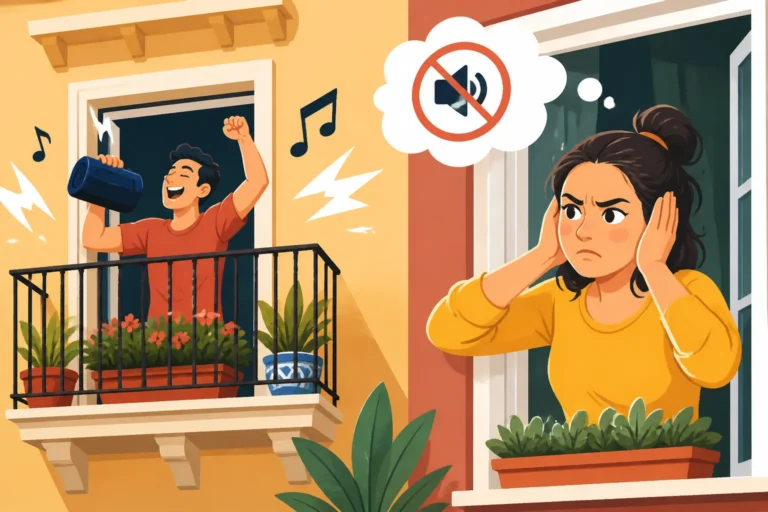
If your potential apartment sits above a plaza, a restaurant, or a bar with an outdoor terrace, you must accept that you will never sleep with your windows open. The Spanish sobremesa and late-night culture mean that outdoor drinking and socializing continue well past midnight, every single night of the week during the summer.
Do not assume you can easily call the police to shut down a loud terrace. The commercial interests of the bars are heavily protected, and local noise ordinances are notoriously complex to navigate. If the noise becomes truly unbearable, you must understand the slow municipal escalation process, which is deeply explored in How to Report Noise Complaints in Spain (Municipal Steps). To protect your sanity in a lively neighborhood, ordering premium noise-canceling earplugs and heavy blackout curtains from Amazon Spain on day one is a mandatory expat defense strategy.
Practical Checklist for the Apartment Viewing
When you finally secure a viewing, you must stop looking at the aesthetics and start ruthlessly testing the apartment’s underlying infrastructure.
Internet Connectivity and Dead Zones
Historic Spanish buildings with their incredibly thick stone walls are notorious for creating massive cellular dead zones. I have toured apartments where I completely lost 4G reception the moment I walked into the master bedroom. If you work remotely, renting a flat in a dead zone is a professional disaster.
During the viewing, you must pull out your phone and check the signal strength in every single room. More importantly, you must ask the landlord if the building is fully wired for fibra óptica (fiber optic internet). If the building only supports outdated ADSL lines, your remote work career will suffer. Securing a reliable home fiber connection through Tiekom guarantees you have the bandwidth necessary to hold high-definition video calls and manage your digital life flawlessly, entirely bypassing the frustrating customer service loops of legacy Spanish monopolies. Setting up this critical infrastructure is the bedrock of your transition, mapped out in Utility Costs in Spain: Electricity, Gas, Water, and Internet.
Heating, Air Conditioning, and Orientation
Spain is a country of extreme microclimates. Inland cities like Madrid experience freezing, damp winters and blisteringly hot summers. When evaluating an apartment, its physical orientation is arguably more important than its size.
An exterior flat facing south will be flooded with natural light and stay significantly warmer in the winter, saving you a fortune on heating. However, that same south-facing flat will transform into an absolute oven during an August heatwave. An interior flat facing a courtyard (patio de luces) will be blissfully quiet, but crushingly dark and cold.
You must manually check the climate control systems. Central heating (calefacción central) is highly coveted because the building shares the cost, but if the apartment relies on individual electric radiators, your winter electric bill will skyrocket. If the flat lacks proper heating or cooling, you will be forced to urgently order energy-efficient space heaters or portable evaporative coolers from Amazon Spain to survive the extreme temperature swings. Managing the massive financial deposits required to secure these highly competitive, climate-controlled flats is an agonizing process explained in Renting in Spain: How to Budget for Deposits, Fees, and Utilities.
Community and Expat Integration
Choosing a neighborhood is not just about the physical apartment; it is about choosing the social ecosystem you want to inhabit.
Local Amenities and Centros Civicos
If you want to escape the transient expat bubble and genuinely integrate into local Spanish society, you must choose a neighborhood that possesses strong communal infrastructure.
Look on Google Maps for the nearest Centro Cívico (Civic Center) or Polideportivo (Municipal Sports Center). These massive, publicly funded buildings are the heartbeat of the barrio. They offer heavily subsidized language classes, yoga, pottery workshops, and municipal swimming pools. Living within walking distance of a civic center gives you immediate, low-cost access to local social networks. To understand how to navigate the intense bureaucratic enrollment lotteries for these centers, read How to Find Local Community Centers (Centro Cívico) in Spain.
Schools and Family Needs
If you are moving to Spain with children, the neighborhood dictates absolutely everything. The Spanish public school system operates on a strict proximity-based point system (Baremo).
You cannot simply choose the best public school in the city; you are heavily prioritized for the schools in the exact zip code where you are officially registered on the municipal census (Padrón). If you rent in a hip, nightlife-heavy neighborhood, you might find that the local public schools are subpar or incredibly overcrowded. You must choose the school zone first, and the apartment second. Preparing for this incredibly complex transition, including shipping familiar items and translating medical records, is deeply covered in Moving to Spain With Kids: Packing and Settling‑In Checklist.
| Neighborhood Type | Ideal For | Major Pros | Major Cons |
| Casco Antiguo (Historic Center) | Singles, young couples, tourists | Stunning aesthetics, extreme walkability, vibrant nightlife | Extremely loud, zero parking, tiny grocery stores, uninsulated |
| Ensanche (Modern Grid) | Professionals, families | Wide sidewalks, good transit, modern grocery stores | Higher rent prices, can feel slightly commercial |
| Periferia (Suburbs) | Families, budget-conscious expats | Larger apartments, green spaces, quiet nights | Requires a car or long commutes, isolated from nightlife |
| Zona Costera (Beachfront) | Retirees, remote workers | Sea views, relaxed lifestyle | Dead in winter, massive tourist crowds in summer |
Finalizing Your Decision
Before you sign the legally binding lease, you must visit your prospective neighborhood at three specific times: at 10:00 AM on a Tuesday, at 11:00 PM on a Friday, and at 2:00 PM on a Sunday.
The quiet, charming street you toured on Tuesday morning might transform into a chaotic, screaming party zone on Friday night. On Sunday afternoon, you will realize exactly how far you have to walk to find an open pharmacy or an operating grocery store. Securing your Tiekom mobile connection ensures you are always digitally connected and can navigate these neighborhoods safely during your trial runs. By aggressively vetting the logistics, the acoustics, and the infrastructure, you ensure your Spanish dream does not become an administrative and sleep-deprived nightmare.
References
Primary sources (official)
- Ministerio de Vivienda y Agenda Urbana – Alquiler: https://www.mivau.gob.es/vivienda/alquila-bien-es-tu-derecho/alquiler
- Portal de la Administración del Gobierno de España: https://administracion.gob.es/
Other helpful sources
- Idealista – Guía para alquilar o comprar casa en España: https://www.idealista.com/news/inmobiliario/vivienda
- Fotocasa – Guía de barrios para vivir en España: https://www.fotocasa.es/es/
Disclaimer
The information provided in this article is for educational and informational purposes only and does not constitute formal real estate, legal, or financial advice. The Spanish rental market, noise ordinances, and municipal school zoning regulations (Baremo) are highly decentralized and vary significantly across different Autonomous Communities and specific town halls (Ayuntamientos). Always personally verify public transit schedules, fiber optic internet availability, and proximity to required local services before signing a legally binding Contrato de Arrendamiento (lease agreement). Consult with a certified real estate agent (Agente de la Propiedad Inmobiliaria) or a relocation specialist to ensure the neighborhood aligns with your specific legal and logistical needs.