School Supplies and Back‑to‑School Costs in Spain: Budget Guide
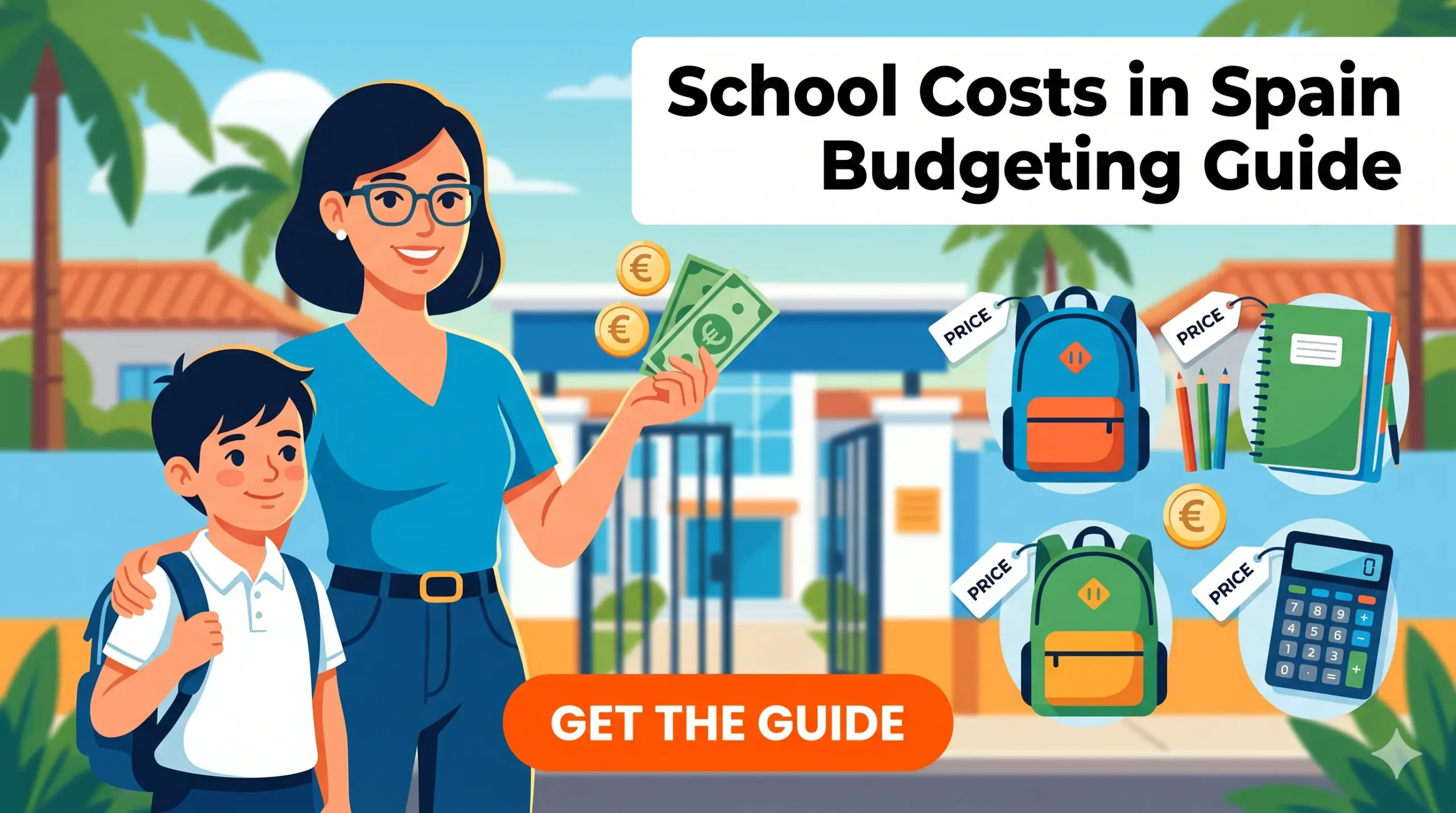
Getting hit with a massive, hyper-specific school supply list in late August while realizing “free” Spanish public education actually costs hundreds of euros is a brutal expat shock. I nearly fainted at the cash register during my first back-to-school season in Madrid. This guide breaks down the hidden costs of Spanish schooling, textbooks, and how to budget effectively.
Disclosure: This post may contain affiliate links. We may earn a commission at no extra cost to you if you make a purchase through these links. Read full disclosure.
Decoding the Material Escolar List
The Shock of Public School Costs
In Spain, public education (colegio público) is tuition-free, but the vuelta al cole (back-to-school) season is absolutely not. Expats often expect to buy a few generic notebooks and pencils, but Spanish schools issue a material escolar list that is staggeringly comprehensive. You are expected to provide everything from reams of printer paper and dry-erase markers to highly specific types of scissors, modeling clay, and watercolor paints. When factoring these sudden September expenses into your broader financial plan, you must thoroughly review Cost of Living in Spain: Budgeting for Expats.
According to the Organization of Consumers and Users (OCU), the average family in Spain spends over 2,500 euros per child annually on education-related expenses. The initial September shock alone accounts for a massive 500-euro hit right out of the gate for basic supplies and clothing.
Strict Brand Requirements and Uniforms
Spanish teachers frequently specify exact brands for supplies—such as Milan erasers, Alpino colored pencils, or Plastidecor crayons. This isn’t just a polite suggestion; it is actively enforced to ensure uniform quality across the classroom so no child feels left out or struggles with subpar, easily breakable materials. Finding these specific items locally in September is a nightmare, as neighborhood papelerías sell out instantly.
Even if your child attends a tuition-free public school, they might still enforce a strict dress code. While formal uniforms are rare in public schools, it is incredibly common for the school to mandate a specific chándal (tracksuit) featuring the school’s logo for physical education days. You must purchase this tracksuit directly from the school’s approved local vendor, and it can easily cost 40 to 60 euros.
For everyday wear, younger children require a babi (a protective smock) to keep their clothes clean during art and lunch. Rather than hunting through local shops with depleted inventory, veteran expats rely heavily on Amazon Spain to bulk-order these exact supply brands and custom-labeled babis. If your child was previously in a Spanish daycare, you already know the drill regarding mandatory labeling, a survival skill covered in Childcare Waitlists in Spain: How to Apply Early. Every single item, from glue sticks to backpacks, must be individually labeled. Ordering customized, waterproof name stickers from Amazon Spain in August saves you hours of writing on tiny pencils with a marker.
Public vs. Concertado vs. Private Costs
While public schools are tuition-free, the OCU highlights that parents choosing a Colegio Concertado (semi-private, state-subsidized school) face significantly higher back-to-school costs. In a Concertado, you will typically pay a monthly “voluntary” donation (usually between 50 and 150 euros) on top of mandatory, formal uniforms that can easily exceed 200 euros per child. If you opt for a fully private international school, the baseline vuelta al cole costs skyrocket to over 7,000 euros annually, before factoring in the expensive proprietary textbooks and mandatory branded tech devices. You must rigorously assess which educational track your family can afford long-term.
The Heavy Burden of Libros de Texto
Why Spanish Textbooks Break the Bank
The single most expensive component of the Spanish back-to-school season is the textbooks (libros de texto). Unlike in the US or UK, where the school provides books that are returned at the end of the academic year, in Spain, parents must purchase them out of pocket.
Because the educational curriculum is heavily decentralized and managed by individual Autonomous Communities, a math book in Valencia might differ completely from one in Andalusia. Furthermore, primary school books are often printed as workbooks (cuadernillos) meant to be written in, meaning you cannot pass them down to younger siblings. A full set of primary school books can easily cost between 150 and 300 euros per child. To prepare your local cash flow to handle this shock, carefully review Student Finances in Spain: Bank Accounts and Budgeting Tips.
Strategies for Sourcing Cheaper Books
Do not wait until the first week of September to buy your books at a local bookstore. The lines literally wrap around the block, and they frequently run out of stock of specific regional editions. You can enter the exact ISBN numbers of your required books into Amazon Spain in July or August to secure them at a slight discount and guarantee delivery before the term starts. Just be mindful of local postal logistics if you are away on holiday; read How Package Pickup Works at Correos (Aviso, ID, Hours) so your expensive books aren’t returned to sender.
Additionally, look into regional loan programs. In Madrid, the Programa ACCEDE allows families in public and concertado schools to borrow textbooks for free, provided they donate their previous year’s set in perfect condition. These regional grants are financial lifesavers, but application windows close early in the summer, requiring immense administrative vigilance on your part.
Navigating Hidden Back to School Expenses
The Comedor and the Spanish School Schedule
The cost of back-to-school in Spain is heavily influenced by the specific timetable your local school operates on. Schools generally follow either a Jornada Continua (continuous day, usually 9:00 AM to 2:00 PM) or a Jornada Partida (split day, usually 9:00 AM to 12:30 PM, and returning 2:30 PM to 4:00 PM). If you are a working expat, picking your child up at 2:00 PM is likely impossible. Therefore, the comedor (school dining hall) becomes a mandatory expense.
The comedor fee typically ranges from 80 to 150 euros per month. This fee doesn’t just cover the hot, Mediterranean diet-approved meal; it covers the monitors who supervise the children during the massive two-hour lunch break. If you cannot pick your child up until 4:00 PM or 5:00 PM, you will also need to enroll them in extraescolares (extracurricular activities) directly after school, adding another 30 to 60 euros per month per activity. To ensure you have the local banking infrastructure ready to set up these mandatory direct debits smoothly, review Opening a Bank Account in Spain as a Non-Resident.
AMPA Fees and Digital Learning
You will also be heavily encouraged to join the AMPA (Asociación de Madres y Padres de Alumnos), which is the Spanish equivalent of the PTA. While technically voluntary, paying the small annual AMPA fee (usually 25 to 40 euros) often grants your family crucial discounts on those extracurricular activities and extended morning care hours (los primeros del cole).
As Spanish schools increasingly digitize their curriculums, many secondary schools now require students to bring a designated tablet or laptop. Furthermore, homework assignments, teacher communications, and grading portals (like Roble or Rayuela) are hosted entirely online. You cannot afford for your home internet to drop while your child is submitting a massive term project or downloading video lectures.
Setting up a highly reliable home fiber connection through an expat-centric provider like Tiekom ensures your household has the uninterrupted bandwidth necessary for multiple devices running educational software simultaneously. Tiekom provides seamless support in English, completely bypassing the frustrating bureaucratic roadblocks legacy Spanish providers impose on foreigners. Properly managing this digital setup is a core part of establishing your home infrastructure, detailed in Utility Costs in Spain: Electricity, Gas, Water, and Internet.
Budgeting and Beating the September Rush
The Vuelta al Cole Strategy
The Spanish back-to-school commercial machine kicks into overdrive in late August. If you wait until the week before school starts, you will face chaotic crowds and empty shelves. Savvy expats start executing their shopping strategy in mid-July.
By utilizing Amazon Spain to fulfill the bulk of the material escolar list and textbook requirements, you bypass the friction of navigating big-box stores in a foreign language. Furthermore, you avoid the dreaded scenario of dragging exhausted children through three different stationary stores simply to find the one highly specific brand of triangular ergonomic pencil the school demanded.
If you are balancing the stress of the back-to-school rush with your own return to the office, understanding how the Spanish work calendar aligns with school holidays is vital. You can explore this dynamic in Spanish Work Culture: Hours, Holidays, and Workplace Etiquette.
Below is a breakdown of the typical costs you should expect per child during the brutal September Vuelta al Cole season in a standard Spanish public school:
| Expense Category | Estimated Cost Per Child (Public School) | Notes |
| Textbooks (Libros de texto) | €150 – €300 | Varies heavily by region and grade level. |
| School Supplies (Material Escolar) | €80 – €120 | Includes specific brands requested by teachers. |
| Clothing / Uniforms / Babis | €100 – €150 | Includes tracksuits (chándal) and indoor shoes. |
| AMPA (PTA) Annual Fee | €25 – €40 | Voluntary, but highly recommended for discounts. |
| Comedor (Lunch) Monthly Fee | €80 – €150 | Recurring monthly cost if not picking up at 2:00 PM. |
| Extracurriculars (Monthly) | €30 – €60 | Football, English, or music lessons at the school. |
References
Primary sources (official)
- Ministerio de Educación, Formación Profesional y Deportes – Ayudas para adquisición de libros de texto y material escolar: https://www.educacionfpydeportes.gob.es/servicios-al-ciudadano/catalogo/general/20/201853/exterior/201853-exterior-2025-26.html
- Comunidad de Madrid – Programa ACCEDE (Préstamo de Libros): https://site.educa.madrid.org/cp.parquelisboa.alcorcon/index.php/secretaria/becas/beca-libros-primaria-accede/
Other helpful sources
- Organización de Consumidores y Usuarios (OCU) – Gastos escolares curso 2023-2024: https://www.ocu.org/consumo-familia/bebes/informe/gastos-vuelta-cole-23
- CaixaBank – Vuelta al cole: cómo superar la cuesta de septiembre: https://www.caixabank.com/es/esfera/content/coste-vuelta-cole-2024-25
Disclaimer
The information provided in this article is for educational and informational purposes only and does not constitute formal financial, educational, or tax advice. Spanish educational costs, including the price of libros de texto and comedor fees, vary drastically between individual Autonomous Communities and between public (público), semi-private (concertado), and private (privado) institutions. Always consult your specific school’s administration or local AMPA representative to verify exact material requirements, uniform mandates, and eligibility for regional grant programs like the Programa ACCEDE before making major purchases.