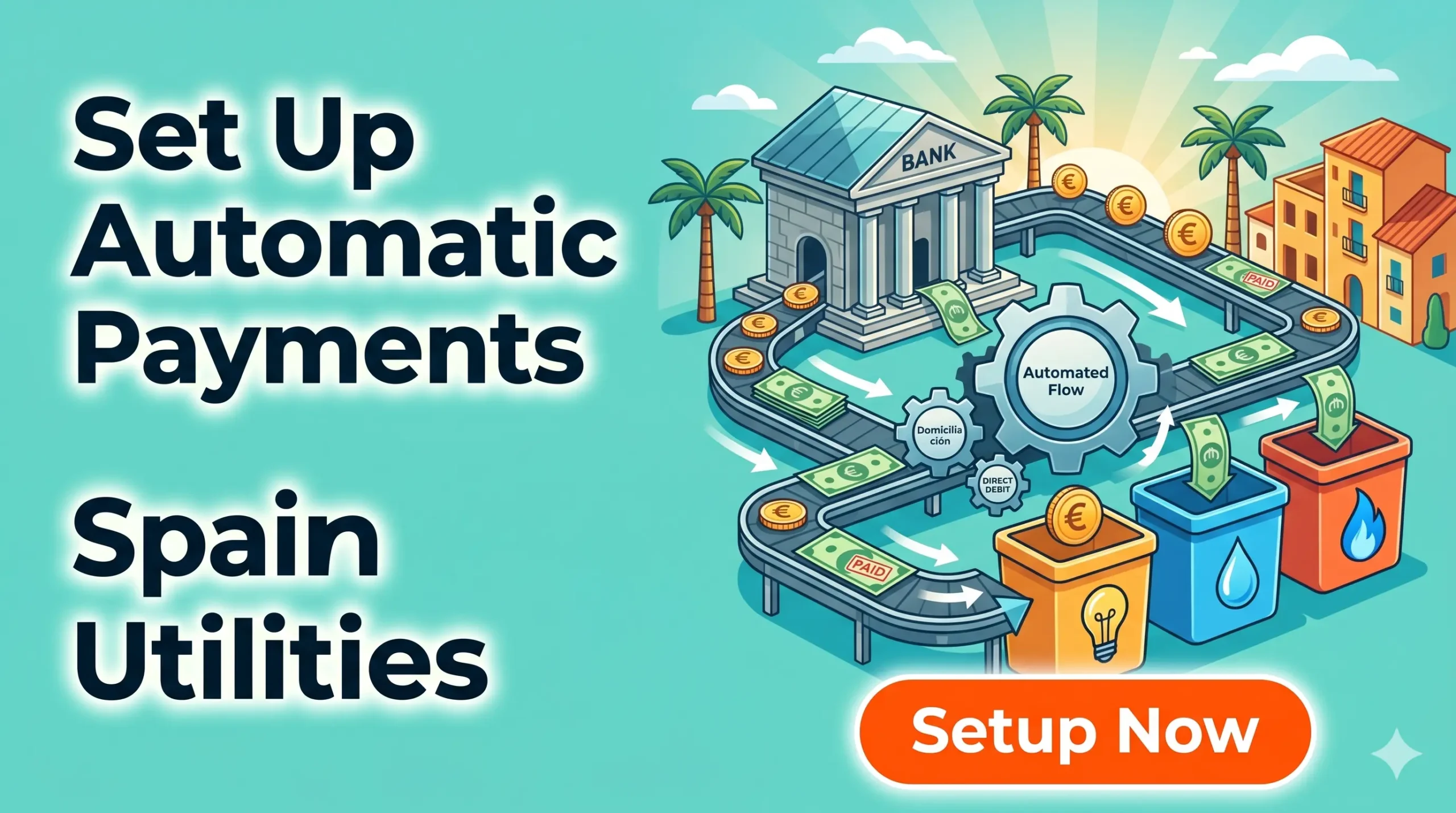
How to Set Up Automatic Utility Payments in Spain: Domiciliación
Arriving in Spain means dealing with utility companies that refuse manual credit card payments and demand direct access to your bank account. I once had my apartment’s electricity shut off mid-summer because I missed a mailed paper bill I didn’t even know existed. This guide explains how to set up domiciliación bancaria so your Spanish bills are paid automatically, safely, and on time.
Disclosure: This post may contain affiliate links. We may earn a commission at no extra cost to you if you make a purchase through these links. Read full disclosure.
The Basics of Domiciliación Bancaria
In many countries, you log into a portal at the end of the month, input your credit card details, and manually pay your water or electricity bill. The Spanish system completely rejects this workflow. Instead, the national standard is domiciliación bancaria (direct debit).
What It Is and Why You Need It
Domiciliación is a financial agreement where you grant a service provider—like your internet company, gas supplier, or gym—the legal right to automatically pull the funds they are owed directly from your checking account on the billing date. You do not push the money to them; they reach in and take it.
If you refuse to set this up, most Spanish utility companies simply will not activate your service. If you manage to get a manual payment exception and forget to pay by the strict deadline, the penalties are ruthless. Spanish utility providers are legally allowed to cut off your service with surprisingly short notice for non-payment. Because water and electricity bills often arrive on erratic bi-monthly schedules, managing them manually is a recipe for an unexpected blackout. You can see just how unpredictable these cycles are by reviewing Typical Utility Bills in Spain: Electricity, Gas, Water (Examples).
Understanding the SEPA Mandate
To establish this automatic pull, you must authorize a SEPA (Single Euro Payments Area) mandate. By signing this mandate—which is almost always done digitally during your initial contract setup—you authorize your bank to honor the utility company’s payment requests.
This system might sound terrifying to expats who are uncomfortable giving companies direct access to their money, but the SEPA framework includes massive consumer protections. If a utility company overcharges you or pulls money without proper notification, Spanish and EU law gives you the absolute right to log into your online banking and “return” the bill (devolver un recibo). For authorized direct debits, you have an 8-week window to reverse the charge, no questions asked. The bank will instantly refund your money while the dispute is settled. Grasping this consumer right helps alleviate the anxiety of this automated system, a topic expanded upon in Spanish Bank Transfer Terms: Transferencia, Bizum, SEPA Explained.
Step-by-Step Guide to Automating Your Bills
Setting up your direct debits requires gathering highly specific Spanish administrative data. Having this ready before you call the utility provider will save you hours of frustration.
Gathering Your Documentation
Whether you are setting up a brand-new connection or taking over the utilities from a previous tenant, the company will demand the following information to establish the domiciliación:
- Your Identification: Your NIE (Foreigner Identity Number) or Passport number.
- The CUPS Number: This is the Código Universal de Punto de Suministro. It is a 20 to 22-character alphanumeric code that permanently identifies the physical electricity or gas meter at your property. It acts like a license plate for your apartment’s energy connection. You can usually find it on an old bill or by asking the landlord.
- Your IBAN: Your International Bank Account Number, which tells them where to pull the money from.
A major point of confusion for expats renting apartments is the difference between the Titular and the Pagador. The titular is the legal owner of the utility contract (often your landlord), while the pagador is the person actually paying the bill (you). You can easily keep the landlord as the titular of the contract while changing the pagador’s bank details to your own IBAN so the money comes out of your account directly. This is the cleanest way to manage utilities when exploring How to Split Household Bills in Spain: Fair Methods for Flatmates.
Executing the Setup
Most major utility companies in Spain (like Iberdrola, Endesa, or Naturgy) have modernized their platforms, allowing you to change your direct debit details entirely online via their customer portal (Área de Cliente). You simply navigate to the billing section, input your new IBAN, and click a box to digitally sign the SEPA mandate.
If the online portal glitches—which is a very common reality of Spanish administration—you will have to call customer service. Be prepared to slowly read your 24-character IBAN over the phone in Spanish. Always ask them to read it back to you, as a single wrong digit means your payment will fail, and your service could be suspended.
Beating IBAN Discrimination and Banking Traps
The biggest hurdle expats face when setting up domiciliación has nothing to do with the utility companies themselves; it is entirely a banking issue.
The Frustration of Non-Spanish Accounts
According to EU Regulation 260/2012, any company operating in Spain is legally required to accept any valid SEPA IBAN for direct debits. If you moved to Spain from France or Ireland and want to use your existing French (FR) or Irish (IE) bank account to pay your Spanish water bill, the utility company must accept it.
In reality, they frequently do not. This illegal practice is known as IBAN discrimination. Many antiquated Spanish utility billing systems are hardcoded to only accept IBANs that start with “ES” (Spain). If you try to input a foreign account, the website will simply display a generic error message. While you can technically file a formal complaint with the Ministry of Consumer Affairs, this takes months to resolve—time you do not have when you need the lights turned on today.
The fastest, most pragmatic solution is to simply acquire a local Spanish IBAN. However, walking into a legacy Spanish bank branch often results in massive quarterly maintenance fees and demands for physical paperwork. To bypass this, opening your daily operational account with N26 is highly strategic. N26 instantly issues a fully recognized local Spanish IBAN directly from your smartphone interface. You can plug this “ES” IBAN into any utility provider’s website, completely dodging IBAN discrimination and legacy bank fees. This seamless integration is exactly why digital banks dominate the Best Low-Fee Bank Accounts in Spain for New Residents. If you are still relying on a foreign account, fixing this via Opening a Bank Account in Spain: Step-by-Step for Foreigners is your next critical move.
Managing Foreign Funds to Pay Your Bills
Once your N26 account is hooked up to the utility providers, you actually have to fund it. If your primary savings or income is still sitting in a bank account in the United States or the UK, you have to move that money into Spain to cover the automatic withdrawals.
If you initiate a standard international wire transfer from your legacy home bank to your new Spanish account, you will be crushed by hidden SWIFT fees and terrible exchange rate markups. You will lose a significant chunk of your living budget simply trying to pay your electricity bill. To protect your capital, you must route your international transfers through Wise. By using Wise, you secure the real mid-market exchange rate and pay a clear, tiny upfront fee. You can instantly transfer those cleanly converted euros via Wise directly into your local account, ensuring your balance is always high enough to cover the domiciliación. The deep math behind avoiding these legacy banking margins is explored in Sending Money to/from Spain: Comparing Banks vs Transfer Services and Spanish IBAN, SEPA, and SWIFT: Sending and Receiving Money Explained.
| Feature | Domiciliación (Direct Debit) | Manual Card Payment |
| Standard Practice in Spain | Yes, absolutely mandatory for most utilities. | No, rarely accepted or requires calling in monthly. |
| Risk of Late Fees | Zero (as long as your account has funds). | Extremely High (easy to forget erratic billing cycles). |
| Consumer Protection | 8 weeks to reverse charges instantly via your bank app. | Must initiate a complex chargeback dispute with card issuer. |
| Setup Friction | One-time setup using your IBAN and digital SEPA signature. | Requires repetitive monthly portal logins. |
Cancelling Debits and Managing Your Wealth
Setting up the direct debit is only the first half of the lifecycle; you also need to know how to stop them when you inevitably move apartments or switch providers to get a better rate.
How to Stop a Direct Debit
When you move out of an apartment, you must formally cancel your utility contracts. However, because Spanish bureaucracy is slow, companies occasionally try to pull one final, erroneous charge from your bank account weeks after you have left.
You have total control over this from your bank app. Through your online banking interface, you can manage your “Recibos.” You can select a specific company and revoke their SEPA mandate entirely (dar de baja la domiciliación). Once revoked, the bank will automatically block any future attempts by that company to pull money from your account.
Automating Your Investments
Once you have automated your domestic life—your rent, electricity, and internet are all paid flawlessly on time—you will hopefully find yourself with surplus monthly income. Leaving your expat savings sitting idle in a local Spanish checking account exposes your wealth to inflation.
However, moving your money into localized Spanish investment products can severely restrict your flexibility if you ever decide to leave the country. To build robust long-term wealth, many veteran expats automate a monthly transfer of their surplus income into a global brokerage account like Interactive Brokers. Utilizing Interactive Brokers allows you to build a multi-currency portfolio that remains entirely portable regardless of your future tax residency. It elegantly separates your long-term wealth building from the chaos of your daily Spanish utility bills, ensuring your financial footprint is as agile as your expat lifestyle.
References
Primary sources (official)
- Banco de España – Domiciliar recibos a través de banca online: https://clientebancario.bde.es/pcb/es/blog/ayuda-a-tus-mayores-con-sus-finanzas-domiciliar-recibos-a-traves-de-banca-online.html
- Banco de España – Adeudos Directos SEPA: https://www.sepaesp.es/sepa/es/faqs/sdd/
Other helpful sources
- Centro Europeo del Consumidor en España – Derechos sobre recibos domiciliados: https://portal-cec.consumo.gob.es/es/comunicacion/noticias/2023/cec-espana-recuerda-que-los-consumidores-que-tengan-recibos-domiciliados
- Portal de la Administración General del Estado: https://administracion.gob.es/
Disclaimer
The information provided in this guide is exclusively for educational and informational purposes and does not constitute official financial or legal advice. Banking regulations, SEPA compliance laws, consumer rights regarding direct debit reversals, and utility billing practices are highly complex and subject to frequent updates by the Banco de España and European Central Bank. While we strive to ensure absolute accuracy, you should always verify the latest direct debit mandates, reversal timelines, and cancellation procedures directly with your chosen financial institution and utility providers.