How to Translate Medical Documents in Spain (Sworn Translators)
Disclosure: This article contains affiliate links. If you buy through them, we may earn a commission at no extra cost to you. Read our full disclosure.
Handing a foreign medical file to a Spanish doctor and expecting them to simply figure it out is a recipe for a canceled appointment. A standard, machine-translated MRI report brought to a Madrid specialist may be politely refused because it lacks an official seal. This guide explains how to legally translate your medical documents, hire sworn translators, and secure your continuity of care.
Why Spanish Doctors Reject Standard Translations
When you move to Spain, you must quickly accept that the country operates on a highly rigid, formal bureaucratic system. What might be acceptable in your home country—like a bilingual friend translating a document or a quick printout from an online translation software—holds absolutely zero legal or clinical weight in the Spanish public healthcare system or at the immigration office.
The Legal Power of a Traductor Jurado
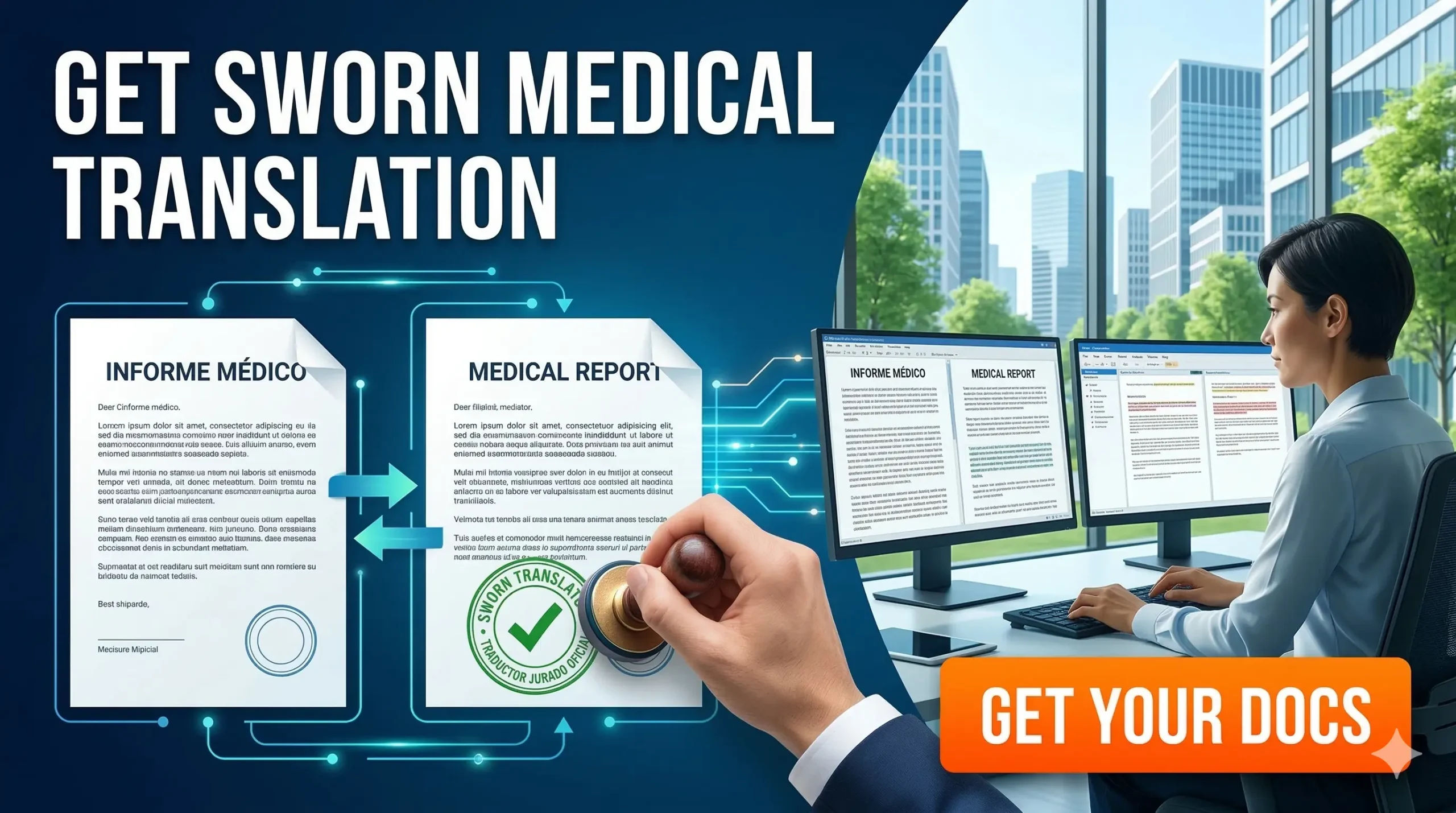
To understand why your standard translations are being rejected, you must understand the unique role of a Traductor Jurado (Sworn Translator) in Spain. A sworn translator is not just a person who happens to be fluent in two languages. They are officially appointed, tested, and certified by the Spanish Ministry of Foreign Affairs, European Union and Cooperation (MAEC).
When a Traductor Jurado translates a document, they must apply their unique, registered seal and signature to the final page. This stamp acts almost like a notary public’s seal; it legally certifies that the translation is a 100% accurate and faithful reproduction of the original document. If a medical mistake is made in the translation, the sworn translator is legally accountable. Because of this strict accountability, Spanish public hospitals and government officials will only accept medical documents that bear this specific ministerial stamp.
If you are trying to understand the broader differences in how public and private hospitals handle this kind of strict bureaucracy, you should review our deep dive into the Spain Healthcare System for Expats: Public vs Private. The public system is unyielding, whereas the private system occasionally offers a bit more linguistic flexibility.
When You Actually Need a Sworn Translation
Not every single medical document you bring to Spain requires an expensive sworn translation. You must strategically differentiate between formal administrative requirements and casual medical care. The most common scenario where a sworn translation is an absolute, non-negotiable legal requirement is during the visa application process. If you are applying for a Non-Lucrative Visa, a Student Visa, or a Golden Visa, you are required to submit a Medical Certificate of Good Health stating that you do not suffer from diseases that could cause serious public health repercussions according to the International Health Regulations of 2005. If your home doctor issues this in English, it must be translated by a Traductor Jurado.
You will also need a sworn translation if you are attempting to transfer a complex, pre-existing medical history into the Spanish public healthcare system. If you have a severe diagnosis that requires expensive, state-funded medication—such as oncology treatments, multiple sclerosis, or severe diabetes—the Spanish public specialist needs a legally certified translation of your home country’s diagnosis before they will authorize ongoing treatment in Spain. To understand how to formally establish your baseline care for these long-term issues, read Chronic Conditions in Spain: Managing Ongoing Care as an Expat.
How to Find and Hire a Sworn Translator
Finding a legitimate Traductor Jurado is relatively straightforward if you know where to look, but navigating their pricing structures and timelines requires a bit of savvy expat preparation.
Using the Ministry of Foreign Affairs List
You do not necessarily need to hire an expensive translation agency to get your medical documents certified. The Spanish government maintains a public, frequently updated census of every single authorized sworn translator in the country. This document, managed by the Oficina de Interpretación de Lenguas (OIL), is known as the Listado Oficial de Traductores Jurados.
You can access this list directly via the MAEC website, which features a digital search engine allowing you to filter by your required language (e.g., English to Spanish) and by province. You can contact these translators directly via the email addresses provided in the official registry. When you reach out for a quote, you do not need to hand over your physical medical records. You simply email them a high-quality, perfectly legible scanned PDF of the document.
When sending your documents, ensure there are no cut-off margins or illegible doctor’s handwriting. A sworn translator must translate exactly what is on the page; if a word is illegible, they are legally required to note “[illegible]” in the final translation, which could cause a Spanish doctor to reject the file. If you are trying to extract these digital PDFs from your old provider before you move, our guide on How to Request Medical Records in Spain for a New Doctor Abroad will walk you through the process.
Cost Expectations and Turnaround Times
Sworn translations are not cheap, and medical translations often carry a premium surcharge. Because medical documents contain highly specific anatomical terminology, pharmacological names, and complex diagnostic jargon, the translator must spend significantly more time ensuring absolute clinical accuracy.
Translators typically charge either per word or per page. For a standard, one-page Medical Certificate of Good Health for a visa, you can expect to pay anywhere from €30 to €60. However, if you are asking them to translate a 15-page post-operative surgical report, the bill can easily exceed several hundred euros. Standard turnaround times are usually 3 to 5 business days, but if you need an expedited translation because your visa appointment is tomorrow, expect to pay a 30% to 50% “rush” fee. To grasp how these out-of-pocket administrative costs factor into your overall healthcare budget, see our breakdown on Health Costs in Spain: Typical Co-Pays and Out-of-Pocket Fees.
| Translation Type | Estimated Cost | Typical Turnaround | Acceptance Level in Spain |
| Standard / Agency | €0.08 – €0.12 per word | 1 – 3 Days | Rejected for Visas/Public Health |
| Sworn (Jurada) | €0.12 – €0.20 per word | 3 – 5 Days | Universally Accepted |
| Expedited Sworn | +30% to +50% Surcharge | 24 – 48 Hours | Universally Accepted |
Preparing Your Medical Records for Translation
Before you email a massive zip file of your entire medical history to a translator and rack up a huge bill, you need to strategically condense your files and understand international legalizations.
Condensing Your Files to Save Money
The most expensive mistake new expats make is paying a sworn translator to translate 50 pages of raw medical data, including routine blood work from five years ago, minor appointment notes, and irrelevant vaccination histories. Spanish specialists do not have the time to read a 50-page translated novel of your health history.
Instead of translating raw data, you must ask your primary care physician in your home country to write a highly condensed Clinical Summary (Informe Médico). This should be a one- or two-page document that explicitly lists your active diagnoses, your current prescription dosages, your severe allergies, and any major past surgeries. You then pay the sworn translator to translate only this summarized document. This strategy saves you hundreds of euros and provides the Spanish doctor with exactly what they need in a scannable format. If you need a refresher on how to navigate the Spanish digital portals once your translated history is finally accepted, check out Medical Records in Spain: Accessing and Sharing Your History.
Apostilles and International Validity
For immigration and visa purposes, simply translating your Medical Certificate of Good Health is not enough. You must understand the sequence of international document legalization.
If your home country is part of the Hague Convention, your medical certificate must be stamped with a Hague Apostille by your home government before it holds any legal weight abroad. This Apostille authenticates the signature of the doctor who signed your health certificate. The critical rule is this: you must get the document Apostilled first, and then you must send both the medical document and the attached Apostille to the Spanish Traductor Jurado. The sworn translator must translate the English Apostille stamp into Spanish as well. If you translate the document first and apply the Apostille later, the Spanish consulate will reject your application.
Managing Your Expat Healthcare and Paperwork
Navigating sworn translations and Apostilles is exhausting, but there are strategic ways to minimize your exposure to this intense bureaucracy while ensuring your body remains healthy during the transition.
Bypassing the Bureaucracy with Private Insurance
If you are not bound by the strict requirements of the public healthcare system and simply want to continue your medical care without paying for endless sworn translations, utilizing an expert, expat-focused broker like Innoinsure is a massive tactical advantage.
A dedicated, bilingual agent from Innoinsure can seamlessly set up a premium private health policy that grants you immediate, unrestricted access to a vast network of top-tier, English-speaking private doctors and specialists. With a comprehensive policy secured through Innoinsure, you can often completely bypass the need for sworn translations. You simply book an appointment with an English-speaking specialist within the network and hand them your original English medical records. They can read them directly, saving you hundreds of euros in translation fees.
Furthermore, if you are feeling overwhelmed by a flare-up of a chronic condition while dealing with your visa paperwork, many premium policies brokered by Innoinsure offer robust 24/7 digital doctor consultations. You can consult an English-speaking doctor via your smartphone to get a quick prescription refill without any language barriers. Discover how to safely leverage this incredible digital perk in Telemedicine in Spain: When It’s Useful and What to Expect. If you are still waiting for your permanent paperwork to clear and find yourself locked out of the local system entirely, knowing how your Innoinsure policy bridges the gap is vital; read How to Access Public Healthcare If You’re New and Paperwork Isn’t Done Yet for emergency steps.
Holistic Support During Stressful Transitions
The administrative stress of moving to Spain, tracking down sworn translators, and arguing with consulates over Apostilles triggers a massive physiological stress response. Your cortisol levels spike, your sleep quality plummets, and your immune system inevitably crashes during your first few months abroad.
While you are fighting through the immigration bureaucracy, the savvy international community in Spain relies heavily on iHerb. By ordering your preventative immune-boosting supplements, potent antioxidants, and premium daily vitamins directly through iHerb, you gain access to the exact, trusted wellness brands you successfully used back home without draining your wallet.
Having a dedicated holistic wellness stash delivered directly to your Spanish door via iHerb ensures you are actively fortifying your body against the inevitable expat health crash. You can proactively manage your stress levels with high-quality adaptogens from iHerb, keeping your mind sharp enough to review those translated medical documents for accuracy. Navigating a foreign bureaucracy is chaotic and exhausting; relying on iHerb to effortlessly restock your recovery and prevention arsenal puts the control firmly back in your hands, ensuring you stay healthy enough to finally enjoy your new life in Spain. If you are struggling with the basic logistics of registering at a clinic once your paperwork is finally translated, our guide on What Is a ‘Centro de Salud’ in Spain and How Do You Register? will get you across the finish line.
References
Primary sources (official)
- Ministerio de Asuntos Exteriores, Unión Europea y Cooperación (MAEC) – Traductores/as – Intérpretes Jurados/as: https://www.exteriores.gob.es/es/ServiciosAlCiudadano/Paginas/Traductores-Interpretes-Jurados.aspx
- Buscador de Traductores e Intérpretes Jurados (MAEC Official Search Tool): https://www.exteriores.gob.es/es/ServiciosAlCiudadano/Paginas/Buscador-STIJ.aspx
Other helpful sources
- Boletín Oficial del Estado (BOE) – Reglamento de la Oficina de Interpretación de Lenguas: https://www.boe.es/buscar/doc.php?id=BOE-A-2020-9271
- Expatica – Moving to Spain and Visa Requirements: https://www.expatica.com/es/moving/visas/health-insurance-for-spanish-visas-2172990/
Disclaimer
The information provided in this article is for educational and informational purposes only and does not constitute formal legal, medical, or immigration advice. Visa requirements, Hague Apostille regulations, and the acceptance of non-sworn medical translations vary significantly depending on the specific Spanish consulate, regional public health authorities, and individual medical practitioners. Always verify translation requirements directly with the Spanish Ministry of Foreign Affairs, your assigned consulate, or a certified immigration lawyer before submitting official medical documentation.