Top Banks in Spain for Expats: Fees, Apps, and Requirements
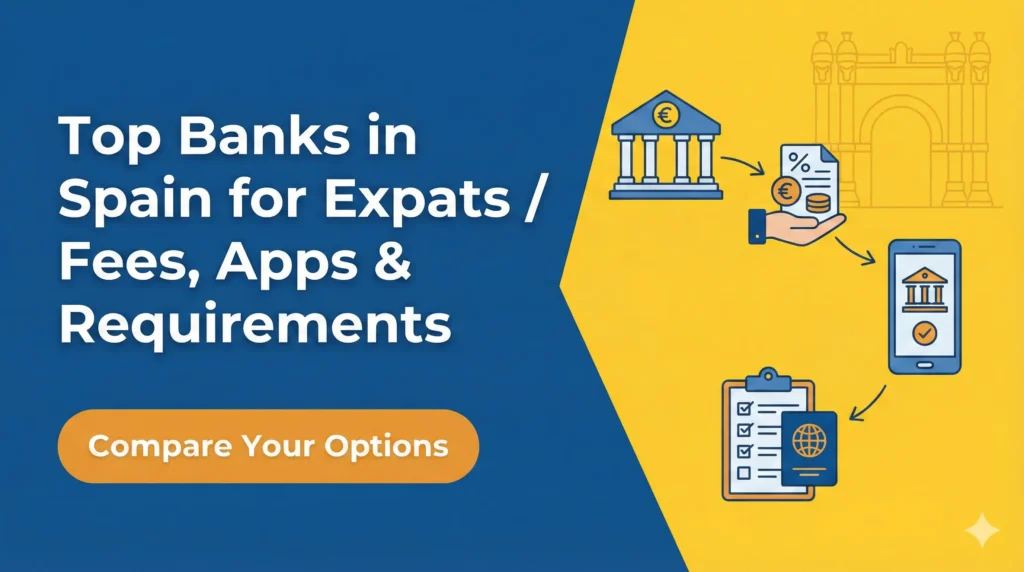
Moving to Spain requires a reliable local bank account. This comprehensive guide explores the best traditional and digital banks for expats, breaking down monthly maintenance fees, mobile app features, application requirements, and the crucial integration of Bizum.
Disclosure: This post may contain affiliate links. We may earn a commission at no extra cost to you if you make a purchase through these links. Read full disclosure.
Why a Spanish IBAN is Absolutely Essential
A common point of frustration for European expatriates is the concept of IBAN discrimination. Under the rules of the Single Euro Payments Area, a Spanish company or utility provider is legally obligated to accept any valid European IBAN (International Bank Account Number) for establishing a direct debit.
However, practice often diverges from the law. Many Spanish municipalities, internet service providers, and local gyms use legacy IT systems that are strictly hardcoded to only accept a Spanish IBAN, which always begins with the letters “ES” followed by twenty-two digits. Without an “ES” IBAN, you will face endless administrative roadblocks when trying to finalize the basic logistics of your new home. For a detailed look at how these domestic direct debits are mandated, you can review our guide on Setting Up Utilities in Spain: Electricity, Gas, and Water Basics.
The Phenomenon of Bizum
Beyond direct debits, a Spanish bank account is required to access Bizum. Bizum is not a standalone application; it is an instant, peer-to-peer payment network built directly into the mobile apps of participating Spanish banks. It is universally used across the country to split restaurant bills, pay for second-hand items, and even make purchases at local markets.
Bizum operates by linking your Spanish bank account to your Spanish mobile phone number. If your bank is not integrated with the Bizum network, your financial and social integration in Spain will be severely handicapped. When choosing a bank, Bizum compatibility is a non-negotiable requirement.
Resident Versus Non-Resident Bank Accounts
Spanish financial institutions categorize customers based on their official residency status, and the application requirements for each pathway differ significantly.
The Non-Resident Bank Account
If you have just arrived in Spain, are visiting to purchase a holiday home, or have not yet completed your immigration paperwork, you must open a non-resident account (Cuenta de No Residente).
This account is specifically designed for foreigners. The primary advantage is that you can open it using only your valid passport. The disadvantage is that non-resident accounts typically carry higher monthly maintenance fees, offer poor exchange rates for international transfers, and do not provide access to credit cards.
To legally maintain this account, banks require a Certificate of Non-Residency (Certificado de No Residente). You can request this document at a Spanish National Police station, though many expat-friendly banks will process this certificate on your behalf for a small administrative fee.
The Resident Bank Account
If you plan to live in Spain for more than 183 days a year, you are considered a resident. Resident accounts (Cuentas de Residente) are the gold standard. They offer significantly lower fees, access to credit facilities, and the ability to apply for local mortgages and investment products.
To open a resident account, you must possess a Foreigner Identification Number. This is the cornerstone of your legal existence in the country. If you have not yet started this process, prioritize it by following our detailed walkthrough on Securing Your TIE and NIE in Spain. Once you transition from a non-resident to a resident, you can easily visit your bank branch to update your status and unlock the benefits of a resident account.
Top Traditional Banks for Expats in Spain
Spain boasts a robust network of traditional, brick-and-mortar banks. These institutions are ideal if you require complex financial services, plan to apply for a mortgage, or simply prefer sitting down face-to-face with a financial advisor.
BBVA
Banco Bilbao Vizcaya Argentaria (BBVA) is globally recognized for having one of the best digital banking apps in the world. They have aggressively modernized their services, making them a top choice for tech-savvy expats. Their “Cuenta Online” (Online Account) is incredibly popular because it completely waives all monthly maintenance fees and debit card fees, provided you complete the signup process digitally. The app offers excellent English-language capabilities and seamless Bizum integration.
Banco Sabadell
Sabadell is heavily favored by British, North American, and Northern European expatriates, particularly those buying property on the Spanish coasts. Their “Key Account” is specifically designed for non-residents and new arrivals. While it does carry a maintenance fee, the bank offsets this by offering free debit cards, translated documentation, and access to dedicated English-speaking customer service representatives in their expat-heavy branches.
Banco Santander
Santander is the largest bank in Spain and has a massive global presence. They are highly accustomed to dealing with international clients and offer specialized accounts like the Santander Mundo Account, tailored for non-residents. Their vast network of ATMs ensures you will rarely pay withdrawal fees inside the country. They are also a premier choice if you are seeking financing for real estate. You can learn more about how financing fits into the broader purchasing timeline in Buying Property in Spain: Offer, Deposit, Notary, and Registry Steps.
CaixaBank
CaixaBank has actively targeted the expatriate and international investor market with its HolaBank program. This account is designed for individuals moving to Spain or buying property, such as Golden Visa applicants. It includes a premium suite of relocation services, including legal assistance in your native language, utility connection services, and emergency home assistance. Due to its premium nature, expect higher maintenance fees unless you meet strict deposit criteria.
Top Digital Banks and Neobanks in Spain
If you despise bureaucratic paperwork and have no need for physical bank branches, the digital banking revolution provides a perfect alternative. Neobanks allow you to open a fully functional bank account entirely from your smartphone in minutes. Crucially, the top tier of neobanks now provides official Spanish IBANs.
N26
This German-licensed digital bank is arguably the most popular choice for digital nomads and young professionals relocating to Spain. You can open an N26 account with just your passport or NIE and a smartphone. Their standard account has zero monthly fees, offers an excellent English-language app, and importantly, is fully integrated with the Spanish Bizum network. It provides the perfect blend of local Spanish utility with sleek, modern fintech design.
Revolut
Originally popular as a travel card for avoiding foreign exchange fees, Revolut now operates as a fully licensed European bank and has successfully rolled out local Spanish IBANs for its customers residing in Spain. Revolut is exceptional if you receive income in multiple currencies and need to convert it to Euros at the mid-market exchange rate. Like N26, the standard tier is completely free.
Bunq
Bunq, a challenger bank from the Netherlands, has gained massive traction among expats in Spain recently. They offer a Spanish IBAN, have successfully integrated Bizum into their platform, and focus heavily on user experience and sustainability. Bunq allows users to open multiple sub-accounts for different budgeting goals, making it highly attractive for freelancers and remote workers managing variable income streams.
Understanding and Avoiding Bank Fees
The traditional Spanish banking system can be highly punitive regarding administrative fees if you do not understand the rules.
Maintenance Fees (Comisiones de Mantenimiento)
Traditional banks frequently charge maintenance fees that can reach up to sixty euros a quarter. However, almost every major bank offers a way to waive these fees through a loyalty program, commonly known as a Cuenta Nómina (Payroll Account).
To waive the maintenance fees, the bank will typically require you to meet specific ongoing conditions:
- Directly deposit your monthly salary or pension into the account (usually a minimum of six hundred to eight hundred euros per month).
- Set up at least three direct debits for household utility bills per quarter.
- Use your debit or credit card for a minimum number of purchases per month.
If you meet these criteria, your banking experience becomes entirely free. If you fail to meet them for even a single month, the bank will instantly deduct the maintenance fee from your balance. To understand how these salary deposits are legally structured and taxed in Spain, review our in-depth article on Working in Spain: Payslips, Social Security, and Benefits Explained.
ATM and Cash Withdrawal Fees
Spain still relies heavily on cash for small purchases in cafes and local markets. If you use a Banco Santander debit card to withdraw cash from a BBVA ATM, you will be charged a cross-network fee, usually between one euro and fifty cents and three euros per withdrawal. Always withdraw cash from your own bank’s specific ATM network, or use a neobank like N26 that offers a set number of free withdrawals at any ATM each month.
Handling International Money Transfers
As an expatriate, you will likely need to move capital between your home country and your new Spanish bank account. Using your traditional home bank to execute a standard SWIFT wire transfer to a traditional Spanish bank is the most expensive mistake you can make.
Traditional banks offer terrible exchange rates, burying hidden margins of two to four percent into the currency conversion, alongside flat international sending and receiving fees.
Instead, always use specialized foreign exchange brokers or multi-currency platforms like Wise (formerly TransferWise) or the aforementioned Revolut. These platforms offer the real mid-market exchange rate and charge a tiny, transparent upfront fee. Properly managing these currency flows is absolutely essential for maintaining your financial health over the long term, a topic explored deeply in our Cost of Living in Spain: Monthly Budget Guide for Expats.
Step-by-Step Guide to Opening Your Account
With your strategy determined, executing the account opening process requires adherence to protocol.
- Choose Your Bank Type: Decide between a traditional brick-and-mortar bank for complex services and mortgages, or a digital neobank for daily convenience and immediate setup.
- Gather Your Documents: Ensure you have your original passport, your NIE (if you have one), proof of your Spanish address (the Padrón certificate), and proof of employment or income (such as an employment contract or recent tax returns from your home country).
- Book an Appointment: If choosing a traditional bank, do not simply walk into a branch. You must book a prior appointment (Cita Previa) via the bank’s website. If choosing a digital bank, simply download the app and begin the verification process.
- Review the Contract: Before signing, explicitly ask the bank manager if the account includes any mandatory life insurance or home insurance tie-ins, as traditional Spanish banks frequently use aggressive upselling tactics.
- Activate Bizum: Once your account is open and your debit card arrives, log into the mobile app and link your Spanish phone number to Bizum immediately.
Comparison of Top Banks for Expats in Spain
To help you make an informed decision, use this comparative table of the top banking options available to foreigners.
| Bank Name | Account Type | Monthly Fee | Spanish IBAN | Bizum Integrated | Best Feature for Expats |
| N26 | Digital Neobank | €0 (Standard) | Yes | Yes | 100% online setup with a passport and fast English app. |
| BBVA | Traditional | €0 (Online Account) | Yes | Yes | Best-in-class mobile app among traditional Spanish banks. |
| Banco Sabadell | Traditional | Up to €16 | Yes | Yes | Dedicated English-speaking support and non-resident accounts. |
| Revolut | Digital Neobank | €0 (Standard) | Yes | No (Uses internal P2P) | Unbeatable mid-market currency exchange rates. |
| Banco Santander | Traditional | Varies by profile | Yes | Yes | Massive ATM network and excellent mortgage lending options. |
Conclusion
Opening a bank account in Spain is the key that unlocks your ability to function seamlessly within local society. While the bureaucratic requirements and the necessity of in-person appointments for traditional banks may feel archaic compared to systems in other nations, the process is highly standardized.
By understanding the vital difference between resident and non-resident accounts, leveraging the convenience of digital neobanks for immediate needs, and arriving at bank branches fully prepared with immaculate documentation, you can bypass the frustration that plagues many new arrivals. Take control of your financial infrastructure early, negotiate away the hidden maintenance fees by linking your payroll, and ensure your chosen app supports Bizum. By doing so, you will be perfectly positioned to manage your wealth efficiently and enjoy the magnificent quality of life that Spain offers to its international residents.
References
Primary sources (official)
- Banco de España (Bank of Spain – Consumer Banking Information): https://www.bde.es/
- N26 Spain (Expat Banking Services): https://n26.com/en-es/expats-bank-account
Other helpful sources
- Moving to Spain (2026 Bank Rankings for Expats): https://movingtospain.com/best-banks-in-spain/
- Idealista (How to open a bank account in Spain in 2026): https://www.idealista.com/en/news/financial-advice-in-spain/2026/01/30/846680-how-to-open-a-bank-account-in-spain
- Expatica (Guide to Banking in Spain): https://www.expatica.com/es/finance/banking/guide-to-banking-in-spain-100438/
Disclaimer
The information provided in this article is for educational and informational purposes only and does not constitute formal financial or legal advice. Banking regulations, monthly maintenance fees, anti-money laundering documentation requirements, and the availability of specific non-resident accounts are subject to frequent changes by individual Spanish banking institutions. We strongly recommend contacting your chosen bank directly to confirm their exact current requirements and fee structures before initiating an international relocation.