What Is ‘FP’ (Vocational Training) in Spain? Options for Foreigners
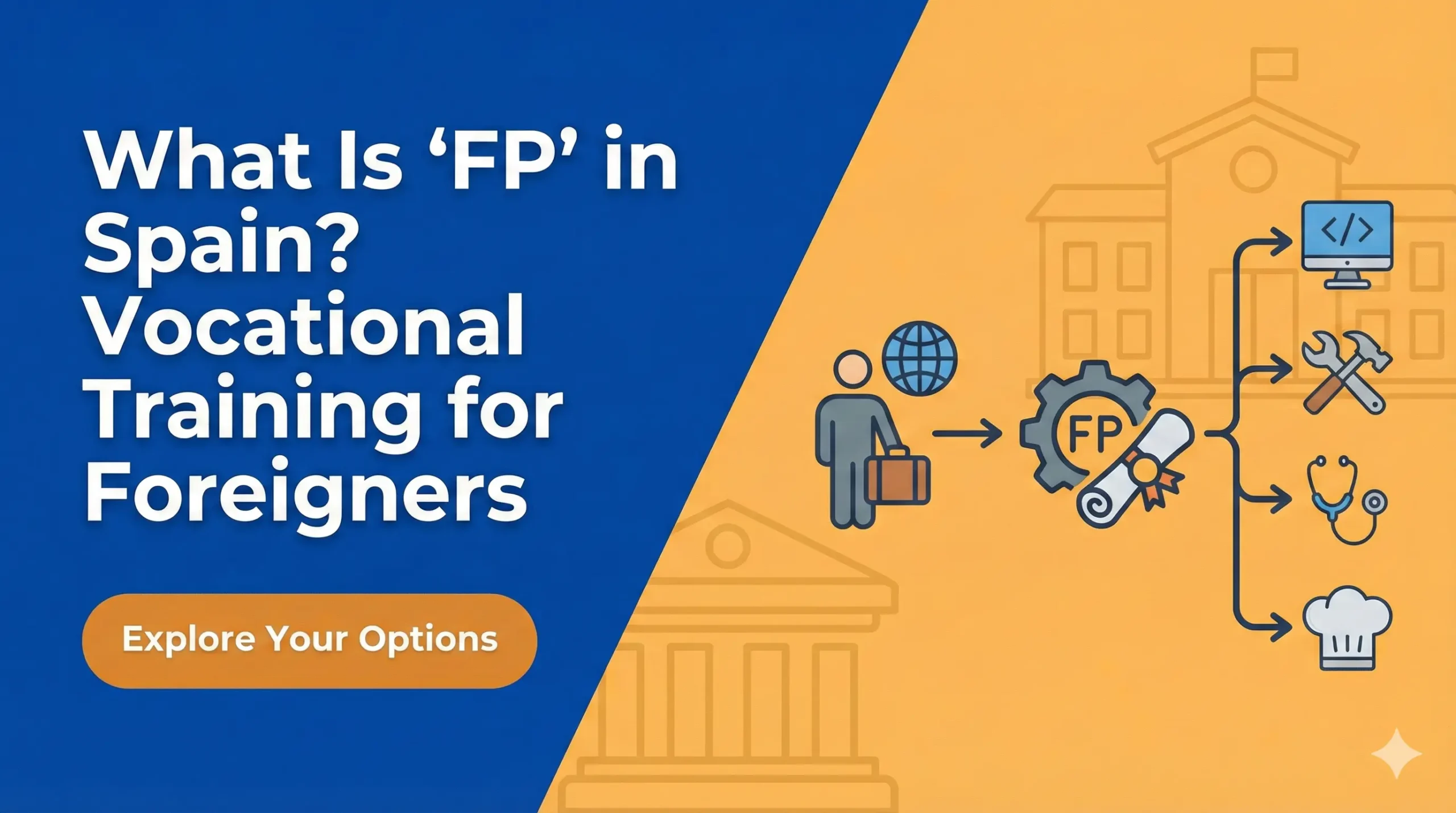
Formación Profesional (FP) offers a practical, job-oriented alternative to university in Spain. This guide explains the differences between Grado Medio and Grado Superior, how foreigners can access these programs, the “Dual” training model, and the visa requirements for international students.
Disclosure: This post may contain affiliate links. We may earn a commission at no extra cost to you if you make a purchase through these links. Read full disclosure.
Understanding the Structure of FP
Spanish Vocational Training is not a monolith; it is divided into three distinct levels, each designed for a different entry profile and career outcome. Understanding these levels is critical because your foreign academic background will determine which one you can access.
1. FP Básica (Basic VET)
- Target: Students aged 15-17 who have not finished compulsory secondary education (ESO).
- Relevance for Foreigners: Generally low. This is primarily a remedial path for local teenagers within the Spanish school system. Most expats will be looking at the next two levels.
2. Grado Medio (Intermediate Level)
- Duration: Typically 2 years (2,000 hours).
- Outcome: You earn the title of Técnico (Technician).
- Academic Equivalent: This is roughly equivalent to a high school diploma with a technical specialization or a UK NVQ Level 2/3.
- Focus: Practical execution. You learn how to do a job (e.g., Assistant Nurse, Administrative Assistant, Electrician).
- Access Requirement: You must have the Spanish Compulsory Secondary Education (ESO) diploma or its foreign equivalent (homologated).
3. Grado Superior (Higher Level)
- Duration: Typically 2 years (2,000 hours).
- Outcome: You earn the title of Técnico Superior (Higher Technician).
- Academic Equivalent: This is a higher education qualification, roughly equivalent to an Associate Degree in the US or a Foundation Degree/HND in the UK.
- Focus: Management, planning, and specialized technical skills. (e.g., Web App Developer, Marketing Manager, Dental Hygienist).
- Access Requirement: You must have the Spanish Bachillerato (High School) diploma or its foreign equivalent (homologated).
Why choose Grado Superior?
For many foreigners, the Grado Superior is the sweet spot. It is officially recognized as higher education. This means credits earned here can often be transferred to a university degree later if you decide to continue studying. Furthermore, the employment rate for Grado Superior graduates in sectors like IT often outpaces that of university graduates.
The “Dual” FP Revolution
One of the most attractive aspects of studying FP in Spain is the FP Dual model. While traditional FP always included a mandatory internship module (FCT – Formación en Centros de Trabajo) at the end of the course, the Dual model integrates work and study from the very beginning.
In Dual FP, you spend a significant portion of your course (often 33% to 50%) working in a company.
- Real Experience: You are trained by the company on their actual equipment and workflows.
- Remuneration: In many Dual programs, students receive a scholarship or a training salary while they learn.
- Hiring Potential: Companies use Dual FP as a recruitment pipeline. It is very common to be hired full-time by the company immediately upon graduation.
If you are concerned about entering the Spanish labor market without local contacts, choosing a Dual program is one of the smartest strategic moves you can make. It solves the classic “no experience, no job” paradox.
For more insights on how to leverage this experience into a career, you can read our guide on Finding a Job in Spain: CV, Interviews, and Networking.
Comparison: Grado Medio vs. Grado Superior
To help you decide which path fits your current profile, here is a quick comparison of the two main options available to international students.
| Feature | Grado Medio (Intermediate) | Grado Superior (Higher) |
| Entry Requirement | Homologated ESO (approx. Grade 10/GCSEs) | Homologated Bachillerato (approx. Grade 12/A-Levels) |
| Duration | 2 Years | 2 Years |
| Title Awarded | Técnico | Técnico Superior |
| Job Level | Operational / Execution | Management / Specialized Technical |
| University Access | No (must do Grado Superior first) | Yes (direct access to related degrees) |
| ECTS Credits | N/A | 120 ECTS (European University Credits) |
Popular FP Families for Foreigners
There are 26 professional families in the FP system, covering everything from Agriculture to Maritime activities. However, for foreigners looking to maximize their employability in Spain or work remotely, specific sectors stand out.
1. Informatics and Communications (Informática)
This is the gold standard for employability.
- DAM: Desarrollo de Aplicaciones Multiplataforma (App Development).
- DAW: Desarrollo de Aplicaciones Web (Web Development).
- ASIR: Administración de Sistemas Informáticos en Red (SysAdmin).Demand for these profiles is insatiable in hubs like Madrid, Barcelona, and Malaga.
2. Healthcare (Sanidad)
While becoming a doctor requires university, many essential roles are FP-based.
- Cuidados Auxiliares de Enfermería: Nursing Assistant (Grado Medio).
- Higiene Bucodental: Dental Hygienist (Grado Superior).
- Imagen para el Diagnóstico: X-Ray/MRI Technician (Grado Superior).
3. Commerce and Marketing (Comercio y Marketing)
Ideal for those with language skills.
- Comercio Internacional: International Trade.
- Marketing y Publicidad: Marketing and Advertising.Because you likely speak English (and perhaps other languages) natively, you will have a competitive advantage in these “international facing” roles compared to local students.
Access Requirements for Foreign Students
This is the bureaucratic hurdle. You cannot simply walk into an institute and sign up; you must prove your previous education meets Spanish standards.
The Homologación Process
To access a Grado Medio, you need your home country’s studies to be legally recognized as equivalent to the Spanish ESO (Compulsory Secondary Education).
To access a Grado Superior, you need your home country’s studies recognized as equivalent to the Spanish Bachillerato.
This process is called Homologación. It involves submitting your diplomas and transcripts to the Spanish Ministry of Education.
- The Problem: Homologación can take months (sometimes over a year) to process.
- The Solution: You can apply for a “Volante de Inscripción Condicional.” This document proves you have started the homologation process and allows you to enroll in the school conditionally while waiting for the final certificate.
For a detailed walkthrough of how this paperwork works, refer to Recognition of Foreign Degrees (Homologación) in Spain: Overview.
Language Requirements
Most public FP centers teach 100% in Spanish. While there is no official “exam” to enter, if you cannot follow the class, you will fail. A B1/B2 level is highly recommended.
- Some private centers offer bilingual programs or courses in English, particularly in Tech and Business, but these are more expensive.
- If you need to prove your language level for a specific program, you might need to take an official exam. Check our article on Language Exams in Spain (DELE/SIELE): What Students Need to see which certification fits your needs.
Entrance Exams (Pruebas de Acceso)
If your foreign studies cannot be homologated (perhaps you didn’t finish high school), there is a backdoor. You can take the Prueba de Acceso.
- This is an exam covering Spanish language, math, and specific subjects related to the course.
- Passing this exam allows you to bypass the academic requirements. However, the exam itself is in Spanish and is rigorous.
Public vs. Private Centers
Just like universities, FP centers come in public and private varieties. Your choice will impact your wallet and your chances of getting a seat.
Public Centers (Centros Públicos)
- Cost: Extremely low. Usually just a small administrative fee (approx. €400/year or less depending on the region).
- Access: Highly competitive. Admission is based strictly on your grade point average (Nota Media) from your previous studies. In popular courses like Web Development, the cut-off mark (nota de corte) can be very high.
- Deadlines: Strict. Pre-registration usually opens in June/July. If you miss the window, you are out.
Private Centers (Centros Privados)
- Cost: Higher. Typically ranges from €2,500 to €5,000 per year.
- Access: Much easier. As long as you meet the minimum legal requirements (homologation), you can usually pay to reserve your spot.
- Facilities: Often have better equipment, smaller class sizes, and stronger partnerships with companies for the internship module.
- Deadlines: Flexible. You can often enroll right up until September if spots remain.
FP and the Student Visa
For non-EU citizens, enrolling in an FP course is a valid reason to apply for a Study Stay (Student Visa). Because FP courses are full-time (20+ hours a week) and lead to an official qualification, they meet the consulate’s criteria perfectly.
Key Visa Advantages with FP
- Work Rights: Under current regulations, students on a valid student visa can work up to 30 hours per week, provided the work hours do not conflict with class hours.
- Long-Term Stay: Since FP courses are typically two years, you get a long-term stay permit (TIE), avoiding the hassle of frequent renewals compared to short language courses.
- Path to Modification: After completing your studies, it is often easier to modify your student permit to a work permit if an employer wants to hire you, or to apply for the “Job Search Visa” (Búsqueda de Empleo).
Before you apply, make sure you understand the documentation required. You can review the step-by-step process in Spain Student Visa: Application Steps and Common Mistakes.
Additionally, if you plan to support yourself while studying, you should understand the limitations and rules regarding employment. Our guide on Working Part-Time on a Spain Student Visa: Hours and Requirements explains exactly what is allowed.
Living as an FP Student
Studying FP is different from the university experience. The schedule is more rigid, resembling a work day (e.g., 8:00 AM to 2:00 PM or 3:00 PM to 9:00 PM daily). Attendance is mandatory; if you miss too many classes, you lose the right to continuous assessment.
Housing
Since FP centers are often located in neighborhoods rather than massive university campuses, your housing options are diverse. You can rent a room in a shared apartment near your institute or look for student residences. When budgeting, remember that big cities like Madrid and Barcelona are significantly more expensive than smaller provincial capitals. For tips on navigating the rental market, check out Student Housing in Spain: Options and Typical Contracts.
Conclusion
Formación Profesional is the unsung hero of the Spanish education system. It offers a pragmatic, cost-effective, and direct route into the labor market, often bypassing the unemployment issues that plague generalist university graduates.
For foreigners, it represents a strategic opportunity. By choosing a high-demand Grado Superior, navigating the homologation process early, and perhaps opting for a Dual program, you can gain a recognized European qualification and valuable local work experience simultaneously. Whether you view it as a stepping stone to university or a launchpad for your career, FP is an option that deserves your serious consideration.
References
Primary sources (official)
- TodoFP (Ministry of Education & Vocational Training): https://www.todofp.es/
- SEPIE (Spanish Service for the Internationalisation of Education): http://sepie.es/
- Ministry of Education (Homologación): https://www.educacionyfp.gob.es/servicios-al-ciudadano/catalogo/gestion-titulos/estudios-no-universitarios/titulos-extranjeros/homologacion-convalidacion-no-universitarios.html
Other helpful sources
- Study in Spain (Official Portal): https://www.spain.info/en/study-spain/
- FP Dual (Dual Vocational Training Info): https://www.somosfpdual.es/
Disclaimer
The information provided in this article is for educational and informational purposes only and does not constitute legal or academic advice. Educational laws, homologation processes, and visa regulations in Spain are subject to change. We recommend consulting with the specific educational center or a qualified immigration lawyer to ensure you meet the current requirements.