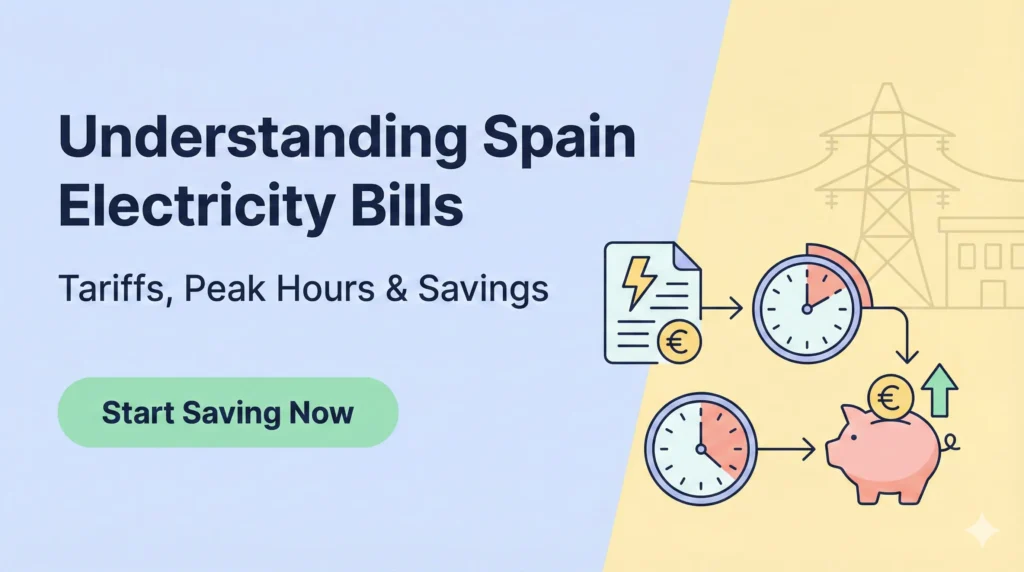
Understanding Spain Electricity Bills: Tariffs, Peak Hours, and Savings
Spanish electricity bills can be baffling, especially with the 2026 updates to the PVPC tariff calculation and fluctuating VAT rates. This comprehensive guide decodes the 2.0TD tariff structure, explains the difference between regulated and free market options, and offers actionable strategies to optimize your “Potencia” and “Energía” costs for maximum savings.
Disclosure: This post may contain affiliate links. We may earn a commission at no extra cost to you if you make a purchase through these links. Read full disclosure.
The Two Markets: Regulated vs. Free
Before you can understand your bill, you must know which market you are in. In Spain, you can buy electricity from two different types of providers. The physical electricity is the same, but the pricing mechanism is entirely different.
1. The Regulated Market (PVPC)
The Precio Voluntario para el Pequeño Consumidor (PVPC) is the government-regulated tariff.
- Who sells it: Only specific “Reference Retailers” (e.g., Energía XXI, Curenergía, Baser). You cannot buy this from the standard commercial brands of Endesa or Iberdrola; you must go to their regulated subsidiaries.
- How price is set: Historically, it was 100% linked to the hourly wholesale market pool. If the wind blew and the sun shone, it was cheap. If gas prices spiked, your bill skyrocketed.
- The 2026 Change: As of this year, the PVPC calculation is no longer 100% volatile. To stabilize prices, the government introduced a “hybrid” formula. In 2026, the price is determined 45% by the daily spot market and 55% by the futures market (forward-looking prices). This makes the PVPC more stable than in previous years, though slightly less responsive to sudden drops in daily prices.
- The Catch: You must be on the PVPC to apply for the Bono Social (subsidized electricity for vulnerable households).
2. The Free Market (Mercado Libre)
This is the Wild West of energy offers.
- Who sells it: Any retailer (Endesa, Naturgy, Repsol, TotalEnergies, Holaluz, etc.).
- How price is set: They set the price. They might offer you a fixed price per kWh for 12 months, a flat monthly fee, or a “cost price + fee” model.
- The Risk: These contracts often include hidden “maintenance fees” (e.g., €5/month for a repair service you didn’t ask for) and may have permanence clauses that penalize you for leaving early.
How to check which one you have:
Look at the header of your bill. If it says “PVPC” or references “Mercado Regulado,” you are on the government tariff. If it has a fancy marketing name like “Tarifa One” or “Plan Estable,” you are in the Free Market.
Anatomy of a Spanish Electricity Bill
Let’s strip down a standard bill to its core components. Regardless of your provider, the invoice generally follows this structure defined by law.
1. Identification and CUPS
At the top, you will find the contract holder’s data and the CUPS (Código Universal de Punto de Suministro).
- What is it? A 20-22 character code starting with “ES”.
- Why it matters: This is your meter’s unique ID (like a VIN number for a car). If you want to switch providers, you will need this code. Never lose it.
2. Facturación por Potencia Contratada (Fixed Term)
This is the “subscription fee” you pay for the capacity to use electricity. It is charged in €/kW/day.
- P1 (Peak Power): The capacity you contract for daytime usage (08:00 – 00:00).
- P2 (Valley Power): The capacity you contract for nighttime/weekend usage (00:00 – 08:00).
- Note: You pay this even if you go on vacation for a month and switch off the main breaker. It covers the maintenance of the grid.
3. Facturación por Energía Consumida (Variable Term)
This is the cost of the actual electricity you used, measured in kilowatt-hours (kWh).
- PVPC Bills: This section will show a breakdown by time period (Punta, Llano, Valle) with different prices for each.
- Fixed Bills: This might show a single price for all usage, depending on your contract.
4. Impuesto sobre la Electricidad (Electricity Tax)
This is a special manufacturing tax on electricity.
- Standard Rate: 5.1127%.
- 2026 Status: During the energy crisis, this was reduced to 0.5% or 2.5%. As of 2026, fiscal normalization has largely returned it closer to the standard rate, though temporary reductions may apply depending on the current inflation decrees. It is calculated on the sum of Potencia + Energía.
5. Alquiler de Equipos (Meter Rental)
Unless you bought your own digital meter (which almost nobody does), you pay a rental fee to the Distributor.
- Cost: Approximately €0.81 – €1.00 per month. This is regulated and non-negotiable.
6. IVA (VAT)
The final tax.
- Standard Rate: 21%.
- Context: In previous years, this dropped to 10% or even 5%. In 2026, the baseline expectation is 21%, unless wholesale prices exceed a specific threshold (often €45/MWh), in which case emergency decrees might trigger a reduction back to 10%. Always check the footer of your bill to see the applied rate.
The 2.0TD Tariff: Understanding Time of Use
Since the 2021 regulatory overhaul, almost all household contracts (up to 15kW) follow the 2.0TD access tariff structure. Even if you have a “flat rate” price, your provider is paying the distributor based on these time slots, which influences the price they offer you.
Understanding the “Traffic Light” system of hours is the single easiest way to lower your bill.
The Three Energy Periods
| Period | Name | Spanish Name | When is it? | Cost Impact |
| P1 | Peak | Punta | 10:00 – 14:00 and 18:00 – 22:00 (Mon-Fri) | (Most Expensive) |
| P2 | Flat | Llano | 08:00 – 10:00, 14:00 – 18:00, 22:00 – 00:00 (Mon-Fri) | $$ (Moderate) |
| P3 | Valley | Valle | 00:00 – 08:00 (Mon-Fri) + All Weekends & Holidays | $ (Cheapest) |
Key Takeaways for Expats:
- The Siesta Window: Note the “Flat” period between 14:00 and 18:00. Electricity is cheaper in the afternoon than in the morning or evening. This aligns with the Spanish lunch break. It is a good time to run the dishwasher if you can’t wait for the night.
- The Weekend Bonus: All day Saturday and Sunday are Valley (P3) hours. This is the cheapest time. Save your heavy laundry, meal prepping, and vacuuming for the weekend.
- The Danger Zones: Avoid high-consumption appliances (oven, dryer) during the 10:00–14:00 and 18:00–22:00 blocks.
The Two Power Periods
Unlike energy, “Power” (Capacity) only has two periods.
- Peak Power: 08:00 – 00:00 (Mon-Fri).
- Valley Power: 00:00 – 08:00 (Mon-Fri) + Weekends.
Strategy: You can contract different power levels for each. For example, you could have 3.45 kW during the day to keep costs low, and boost it to 5.75 kW at night/weekends if you plan to charge an Electric Vehicle (EV).
Potencia: The Silent Budget Killer
Many expats overlook the Potencia Contratada. They focus on turning off lights but pay for 6.9 kW of capacity when they never use more than 3 kW at once.
What is “Potencia”?
It is the maximum amount of electricity you can draw from the grid simultaneously. If you turn on the oven (2 kW), the AC (1.5 kW), and the washing machine (1 kW) at the same time, you are drawing 4.5 kW.
- If your contract is for 3.45 kW, the limitador (breaker) on your smart meter will trip, and the lights will go out.
- If your contract is for 5.75 kW, everything runs fine.
The Cost of Over-Contracting
Every kW of power costs roughly €38 to €45 per year (depending on the period split and taxes).
- If you have 5.75 kW but only need 3.45 kW, you are wasting approx. €90 per year for nothing.
- Many older apartments have high contracted power by default because previous tenants didn’t check.
How to Optimize Potencia
- Check Your Max Demand: Log in to your distributor’s website (e.g., i-DE.es for Iberdrola distribution areas, https://www.google.com/search?q=edistribucion.com for Endesa). You can see a graph of your “Maximum Power Demanded” in the last 12 months.
- Analyze: If your contract is 5.75 kW, but your highest spike in the last year was 3.9 kW, you can safely lower your contract to 4.6 kW or even 4.0 kW (contracts are now flexible in 0.1 kW increments).
- Request the Change: Contact your retailer to request a “Bajada de Potencia.”
- Cost to Lower: approx. €11 (administrative fee).
- Warning: You can generally only change power once per year. If you lower it too much and the breaker keeps tripping, raising it again costs money (~€45/kW).
For details on how to access these distributor websites, refer to the “Distributor vs. Retailer” section in Utilities Setup in Spain: Electricity, Gas, and Water Basics.
The PVPC vs. Free Market Debate in 2026
The eternal question: Is it better to stick with the government price or lock in a fixed rate?
The Case for PVPC (Regulated)
- Pros: Transparent pricing (cost + small margin). No hidden fees. Access to the Social Bonus. The 2026 hybrid calculation smooths out the extreme spikes we saw in 2022.
- Cons: You still feel market fluctuations. The price varies hour-by-hour (though less drastically now).
- Verdict: Historically, PVPC beats fixed rates over the long term. If you are disciplined enough to avoid the “Punta” hours, it is usually the cheapest option.
The Case for Free Market
- Pros: Predictability. You can find “Fixed Price 24h” tariffs where you don’t have to worry about what time you do laundry.
- Cons: Often more expensive per kWh to cover the company’s risk margin. Watch out for CPI (IPC) adjustment clauses that raise the price in January.
- Verdict: Good for risk-averse people or those who work from home during peak hours and cannot shift their usage.
How to Compare:
Use the official CNMC Comparator (Comparador de Ofertas de Energía). It is a government tool where you upload your usage data (via QR code on your bill), and it tells you exactly which offers are cheaper than your current one.
- Link: comparador.cnmc.gob.es
The Social Bonus (Bono Social Eléctrico)
Spain has a robust system to help vulnerable households pay for energy. The eligibility criteria remain broadened following the post-crisis extensions.
What is it?
A direct discount on your electricity bill (and by extension, a heating allowance called Bono Social Térmico).
- Discount 2026:
- Vulnerable Consumers: 40% – 65% discount (depending on current decree extensions, stabilized around 40% standard).
- Severely Vulnerable: up to 80% discount.
Who Qualifies?
- Income Based: If your household income is below a certain multiple of the IPREM (approx. €12,600/year for an individual, higher for families).
- Large Families: (Familias Numerosas) qualify automatically, regardless of income.
- Pensioners: Those on minimum pensions.
- Low Income Workers: Specific thresholds apply.
Crucial Requirement
To get the Bono Social, you MUST have a PVPC contract with a Reference Retailer. You cannot get it with a Free Market contract.
- Application: You must send a form and your documentation (Empadronamiento, Libro de Familia) to the Reference Retailer.
If you think you might qualify based on income, check your status against the Spanish residency income indicators discussed in Cost of Living in Spain: Monthly Budget Guide for Expats.
7 Practical Tips to Slash Your Bill
Beyond choosing the right tariff, behavioral changes yield the biggest savings.
1. The “Eco” Wash
Washing machines use 90% of their energy heating the water. Wash at 30°C or Cold. Run it on Saturday morning (Valley hours).
2. Standby Phantoms
Spanish homes often have older electronics. Devices on standby can account for up to 10% of consumption. Use power strips with switches.
3. Kitchen Management
- Oven: It is the most expensive appliance. Avoid using it during Peak hours (18:00–22:00). Batch cook on weekends.
- Fridge: Keep it full (thermal mass holds cold better) and clean the coils.
4. Climate Control
- Winter: Electric heating is ruinously expensive in Spain due to poor insulation. Use a butane heater or a pellet stove if possible. If using electric, aim for 21°C, not 25°C.
- Summer: Use fans instead of AC whenever possible. If using AC, use “Dehumidify” mode which uses less power than “Cool.”
5. Check Your “Extras”
Look at your Free Market bill. Are you paying for Servicio Mantenimiento or Protección de Pagos? These add €3-€10 a month. Unless you have an old boiler that breaks annually, these insurance policies are rarely worth it. Cancel them.
6. Monitor via Datadis
Datadis.es is a centralized platform (managed by all distributors) where you can see your consumption data regardless of your retailer. Register there to see your usage hourly. It helps you identify “energy leaks.”
7. Optimize for “Solar” (Even without panels)
If you have a balcony, dry clothes outside. Tumble dryers are energy hogs. In Spain, “solar drying” (a clothesline) works 300 days a year.
Summary Table: PVPC vs Free Market 2026
| Feature | PVPC (Regulated) | Free Market (Fixed) |
| Price Stability | Variable (Daily/Hourly changes) | Fixed (usually for 12 months) |
| Time of Use | Mandatory 3 Periods (P1, P2, P3) | Optional (Can choose Flat Rate) |
| Contract Length | No permanence (Leave anytime) | Often 12-month commitment |
| Bono Social | Eligible | Not Eligible |
| Maintenance Fees | None | Common optional add-ons |
| Best For… | Cost-conscious, flexible users | Renters needing predictability |
Conclusion
Understanding your Spanish electricity bill is more than just a financial exercise; it is an adaptation to the Spanish lifestyle. By aligning your heavy energy usage with the Valley hours and ensuring your Potencia matches your actual needs, you can reduce your monthly overhead significantly.
The key is vigilance. The PVPC tariff has become more stable with the new hybrid calculation, making it a safer bet for many, but the aggressive offers from Free Market retailers can still be attractive if you read the fine print.
Don’t let the acronyms intimidate you. Download your distributor’s app, check your peak demand, and take control of the switch.
References
Primary sources (official)
- Red Eléctrica de España (ESIOS – Official PVPC Prices): https://www.esios.ree.es/en
- CNMC (National Commission on Markets and Competition – Comparator): https://comparador.cnmc.gob.es/
- Datadis (Centralized Consumption Data): https://datadis.es/
- Ministry for Ecological Transition (Bono Social Info): https://www.bonosocial.gob.es/
Other helpful sources
- OCU (Organization of Consumers and Users – Electricity Guide): https://www.ocu.org/vivienda-y-energia
- Selectra (PVPC 2026 Updates): https://selectra.es/energia/info/mercado-energetico/pvpc
Disclaimer
The information provided in this article is for educational and informational purposes only and does not constitute financial advice. Electricity tariffs, tax rates (VAT/Electricity Tax), and regulations regarding the PVPC are subject to change by the Spanish government. We recommend consulting the official CNMC comparator for the most up-to-date offers.