Spanish Language Certificates (DELE and SIELE): Which One You Need
Getting stuck in the gears of Spanish bureaucracy is a rite of passage, but nothing stalls your progress like realizing you’ve sat the wrong language exam for your residency or job application. I remember staring at a confusing registration portal in Madrid, wondering if my future depended on four letters or five. This guide clears the confusion between DELE and SIELE so you choose the right path for your life in Spain.
Disclosure: This post may contain affiliate links. We may earn a commission at no extra cost to you if you make a purchase through these links. Read full disclosure.
Decoding the Alphabet Soup: DELE vs. SIELE Explained
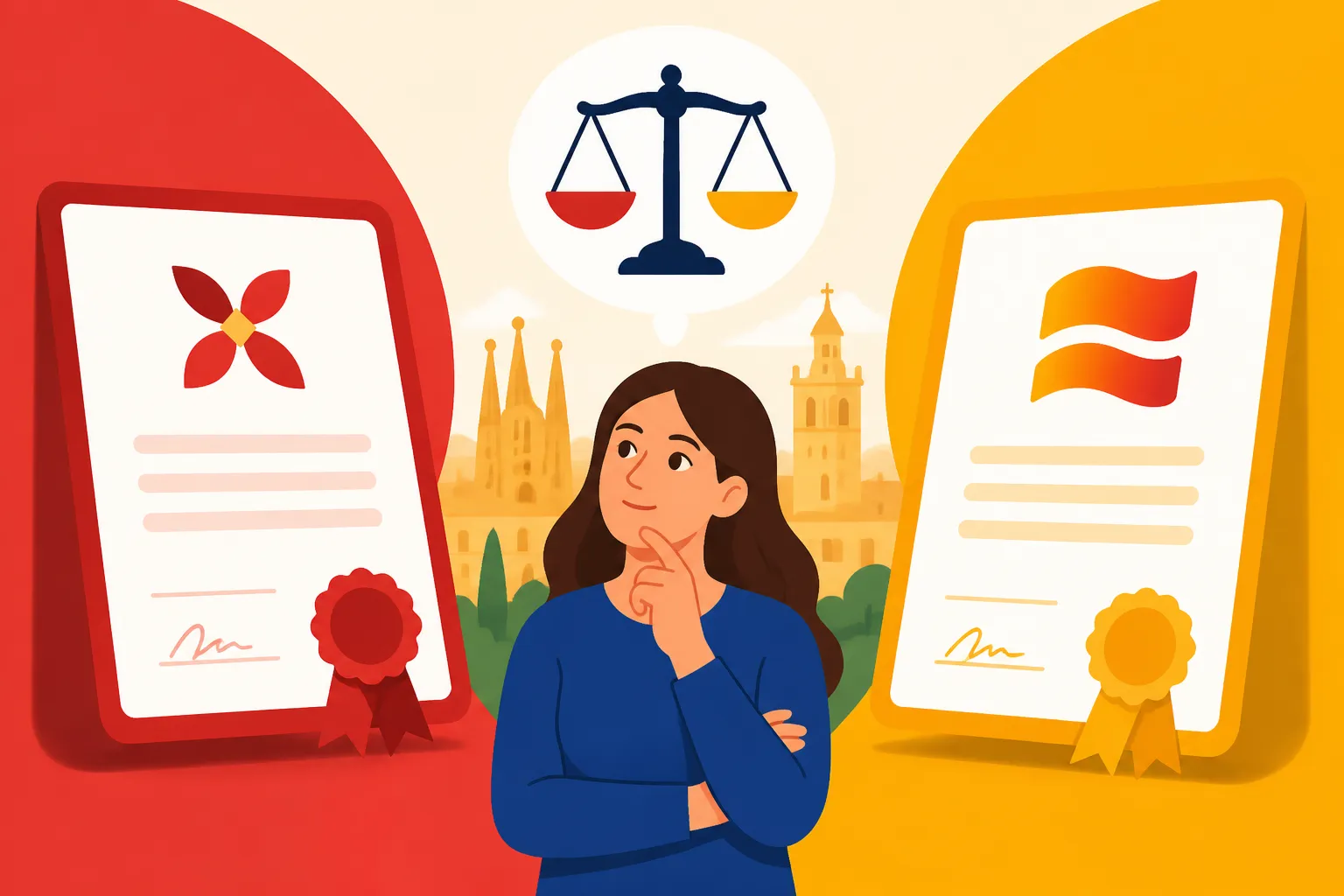
When you first arrive and start looking into Learning Spanish for Work and Study: Fast‑Track Strategy, you will inevitably run into two acronyms: DELE and SIELE. Both are officially recognized by the Instituto Cervantes, the holy grail of Spanish linguistic authority, but they serve very different purposes. Think of it as the difference between a traditional university degree and a modern, modular professional certification. One is designed for permanence, while the other is built for the fast-paced digital world.
What is the DELE?
The DELE (Diploma de Español como Lengua Extranjera) is the "old guard" of Spanish certifications. It has been around since 1989 and is issued by the Spanish Ministry of Education, Culture, and Sport. When you sit for a DELE exam, you are signing up for a traditional, paper-based test (though some levels are moving toward digital) that focuses on a specific level of the Common European Framework of Reference for Languages (CEFR). You must choose your level—say, B2—before you even walk into the room.
The most significant advantage of the DELE, and why many of my fellow expats sweat through it, is that it never expires. Once you have that piece of paper, it is yours for life. If you are planning on Spanish Citizenship: Requirements, Exams, and Application Process, the DELE is often the preferred choice because the authorities know exactly what a "Pass" at the A2 level means without having to look at a date.
What is the SIELE?
The SIELE (Servicio Internacional de Evaluación de la Lengua Española) is the newer, digital-only cousin. Launched in 2016, it was designed to be more flexible and global, incorporating various dialects of Spanish from Mexico, Argentina, and beyond. Unlike the DELE, the SIELE is a single, multi-level exam. You don’t choose a level beforehand; the score you achieve determines whether you are at an A1 or a C1 level. It is conducted entirely on a computer at an authorized center.
However, the SIELE comes with a major caveat: it expires after five years. For someone who just needs to prove their level for a specific master's degree or a one-off job application, this isn't a problem. But if you’re looking at long-term administrative hurdles, like From Temporary to Permanent Residency in Spain: A Roadmap, the expiration date might mean you have to take it all over again down the line.
Key Differences at a Glance
The choice often comes down to your timeline. The DELE is notorious for its slow processing times; I’ve known people who waited eight months just to get their physical certificate in the mail. In contrast, the SIELE results are typically available within three weeks. If you’re in a rush to meet a deadline for a visa or a university application, the digital route is your best friend.
| Feature | DELE (Diploma) | SIELE (Service) |
|---|---|---|
| Validity | Permanent (Never expires) | 5 Years |
| Format | Paper-based (mostly) | 100% Digital/Computer |
| Level Selection | Choose one level (e.g., B2) | Multi-level (score determines level) |
| Results Timeline | 3 to 8 months | Maximum 3 weeks |
| Accents | Mostly Peninsular (Spain) Spanish | International/Global Spanish |
| Best For | Citizenship, Permanent Residency | University Entry, Fast Job Proof |
Which Certificate Do You Actually Need? Scenarios for Expats
Choosing the right exam isn't just about which one is easier; it's about which one the Spanish government or your employer will actually accept. Newcomers sometimes lose hundreds of Euros because they didn't check the fine print of their specific application. Before you book, you need to look at your five-year plan in Spain.
Getting Spanish Citizenship or Permanent Residency
If your goal is to trade your TIE for a Spanish passport, the rules are very specific. The Spanish government requires non-Sefardi applicants from non-Spanish-speaking countries to prove at least an A2 level of Spanish. While they technically accept both, the DELE A2 is the gold standard. Most lawyers will tell you to go for the DELE because it aligns perfectly with the CCSE (the culture and laws test) also managed by the Instituto Cervantes.
I often tell people that if they are already dealing with the stress of Moving to Spain in 2027: Step-by-Step Immigration Checklist, they should aim for the DELE A2 to get it over with forever. You don't want to be in a position where your residency renewal is due, but your language certificate has expired. Companies like Taxes for Expats often remind their clients that keeping your legal and tax paperwork in order is easier when your underlying residency documents are based on permanent qualifications.
Applying for Spanish Universities
Spanish universities are increasingly strict about language requirements for international students. If you are aiming for an undergraduate degree (Grado), most will require a B2 level. Here, the SIELE is a fantastic option because of its speed. If you find a master's program in July that starts in September, you simply do not have time for the DELE's schedule.
The SIELE also allows you to take "modules." If a university only cares about your speaking and writing, you can technically just take those parts of the SIELE (though most schools want the "Global" exam). If you're currently researching Choosing a University in Spain: Admission Requirements for International Students, check if they have a preference. Some traditional public universities in smaller cities like Salamanca or Granada still have a slight bias toward the DELE, so an email to the admissions office is always worth the five minutes.
Professional Credential Recognition and Job Hunting
For those of us working in regulated professions—doctors, lawyers, or engineers—the process of Professional Qualifications in Spain: Recognizing Foreign Degrees (Homologación) usually requires a high level of Spanish proficiency, often C1. In this high-stakes environment, the DELE C1 is almost always the requirement. It proves a level of nuanced understanding that is hard to fake.
If you are a freelancer or starting a business, the certificate might not be legally required, but it is a massive trust-builder. When setting up your business with a service like Xolo, having a B2 or C1 certificate can help you navigate meetings with local suppliers or clients. Even if you work remotely, being able to put a recognized Spanish qualification on your LinkedIn profile sets you apart in the local market. If you are on the Spain Digital Nomad Visa: Requirements, Documents, and Timeline, showing you’ve integrated through a language certificate can also look favorable if you eventually decide to switch to a general residency permit.
Breaking Down the Exam Formats and Scoring
The way you study for these two exams is fundamentally different because of how they are scored. One is a "hurdle" you have to jump over, while the other is a "ladder" that shows how high you can climb. Understanding this dynamic will save you a lot of late-night anxiety.
The DELE Structure: Levels A1 to C2
The DELE is a pass/fail exam. If you sign up for the B2 exam and you fail by one point, you get nothing. There is no consolation prize of a B1 certificate. This makes the stakes feel incredibly high. The exam is divided into four sections: Reading Comprehension, Listening Comprehension, Written Expression and Interaction, and Oral Expression and Interaction.
The oral part of the DELE is usually done face-to-face with a real human examiner. For some, this is terrifying; for others, it's a blessing because you can use body language and clarify questions. I found that having a real person to talk to in my B2 exam helped me relax, as they could see I was trying to communicate, not just reciting a script. It’s a very different vibe than talking to a computer screen in a silent room.
The SIELE Structure: The Global Exam vs. Individual Tasks
The SIELE is a "comprehensive" exam. It also tests the four skills (reading, listening, writing, speaking), but the tasks get progressively harder. You might start with a very easy reading task and end with a complex academic text. Your final score is out of 1000 points, which is then mapped to the CEFR levels. This is much lower pressure because you are guaranteed to get some certificate at the end, even if it's just an A1.
A unique feature of the SIELE is its modularity. There are five types of exams: SIELE Global (all four skills) or four different combinations of skills. For example, if you just want to prove you can speak Spanish for a hospitality job, you can take the S4 exam (Speaking only). This flexibility is great for targeted goals, though for most administrative purposes, you'll need the Global version.
Scoring and Pass/Fail Dynamics
In the DELE, you need to achieve a minimum score in "blocks." Usually, you need a "Pass" in the Reading/Writing block AND a "Pass" in the Listening/Speaking block. You can't be a genius at reading and a total failure at speaking and still pass the exam. This forces a very balanced approach to your studies.
In the SIELE, your total points determine your level. However, if you are using it for something like Work in Spain as a Foreigner: Jobs, Contracts, and Rights, the employer will look at the specific breakdown. If your goal is to eventually move into Freelancing (Autónomo) in Spain: Taxes, Invoicing, and Setup Guide, having a high score in written interaction is arguably more important than listening, as you'll be handling contracts and client emails daily.
Practical Logistics: Booking, Prices, and Centers
You can't just walk into a library and take these tests. They require careful planning, especially since the DELE only happens a few times a year. If you miss a registration deadline, you could be waiting several months for the next opportunity.
Finding an Exam Center in Spain
Both exams are administered through authorized centers. For the DELE, these are often universities or official language schools (EOI). In major cities like Madrid, Barcelona, or Valencia, centers fill up fast. I’ve had friends who had to travel two hours to a different province because they waited too long to book a slot in their own city.
For the SIELE, the availability is much higher. Since it is digital, many private language academies offer it almost every week. You can book it with as little as 48 hours' notice in some cases.Choose one that is easy to reach so you aren't stressed by traffic on the morning of the test.
Understanding the Costs and Waiting Times
The cost of the exams varies slightly depending on the level (for DELE) or the type of exam (for SIELE), but generally, you should budget between €110 and €220. The DELE A2 for citizenship is usually on the cheaper end, while the C2 or the SIELE Global are more expensive.
The real "cost" of the DELE is the wait. You take the exam in May, you get your results in late July, and you get your actual certificate in November. If you are using a gestor or a service like Xolo to handle your visa change, they need to know these timelines. If your visa expires in August, the May DELE results might not come in time to save your application. In that case, the SIELE's three-week turnaround is worth every penny of the fee.
Preparation Strategies for Success
You cannot wing these exams. Even if you speak Spanish fluently on the street, the exams test specific academic "tasks" that have strict rules. I’ve seen native speakers struggle with the DELE because they didn't follow the format of the writing tasks.
Self-Study vs. Tutoring
Self-study is possible if you are disciplined, but the speaking and writing components are hard to grade yourself on. This is where a platform like iTalki becomes invaluable. You can find teachers who specifically specialize in "DELE Preparation" or "SIELE Tasks." Having someone mock-examine you and tell you that you're using too many informal "tú" forms when the task requires "usted" can be the difference between a pass and a fail.
I highly recommend doing at least five sessions with a specialized tutor. They know the tricks, like the specific phrases you should use to transition between ideas in the writing task.
Using Official Resources and Past Exams
The Instituto Cervantes website offers free model exams. Download them. Print them. Do them with a timer. The most common reason people fail is not a lack of Spanish knowledge, but running out of time. In the DELE reading section, the texts are long and the questions are designed to be "tricky," often using synonyms that you might miss if you're rushing.
| Resource Type | Recommended For | Why It Matters |
|---|---|---|
| Model Exams | Both DELE and SIELE | Familiarizes you with the interface and question types. |
| iTalki Tutors | Speaking & Writing | Provides real-time feedback that books can't give. |
| Spanish TV/Radio | Listening | Accustoms your ear to different speeds and regional accents. |
| Grammar Workbooks | DELE (Specific Levels) | Helps master the specific tenses required for each level (e.g., Subjunctive for B2). |
Administrative Impacts: Residency and Beyond
Once you have that certificate in your hand (or your inbox), it becomes a powerful tool. It’s not just about the pride of learning a language; it's about the doors it unlocks in the Spanish system.
If you are a remote worker or freelancer using Xolo to manage your invoices, having a high level of Spanish allows you to understand the nuances of Spanish Salary Basics: Gross vs Net Pay and Common Deductions without needing a translator for every conversation. It gives you an edge in negotiations and makes the local community see you as a long-term resident rather than a transient tourist.
Finally, remember that the "Correct" certificate is the one that satisfies your immediate legal requirement while fitting your long-term goals. If you're in a rush, take the SIELE. If you want a lifetime credential for citizenship, take the DELE. Both are a testament to your commitment to your new life under the Spanish sun.
Disclaimer
The information provided in this guide is for informational purposes only and does not constitute legal or professional administrative advice. Immigration requirements and exam formats in Spain are subject to change. Always verify the latest requirements with the official Instituto Cervantes website or a qualified immigration lawyer before booking an exam or submitting residency applications.