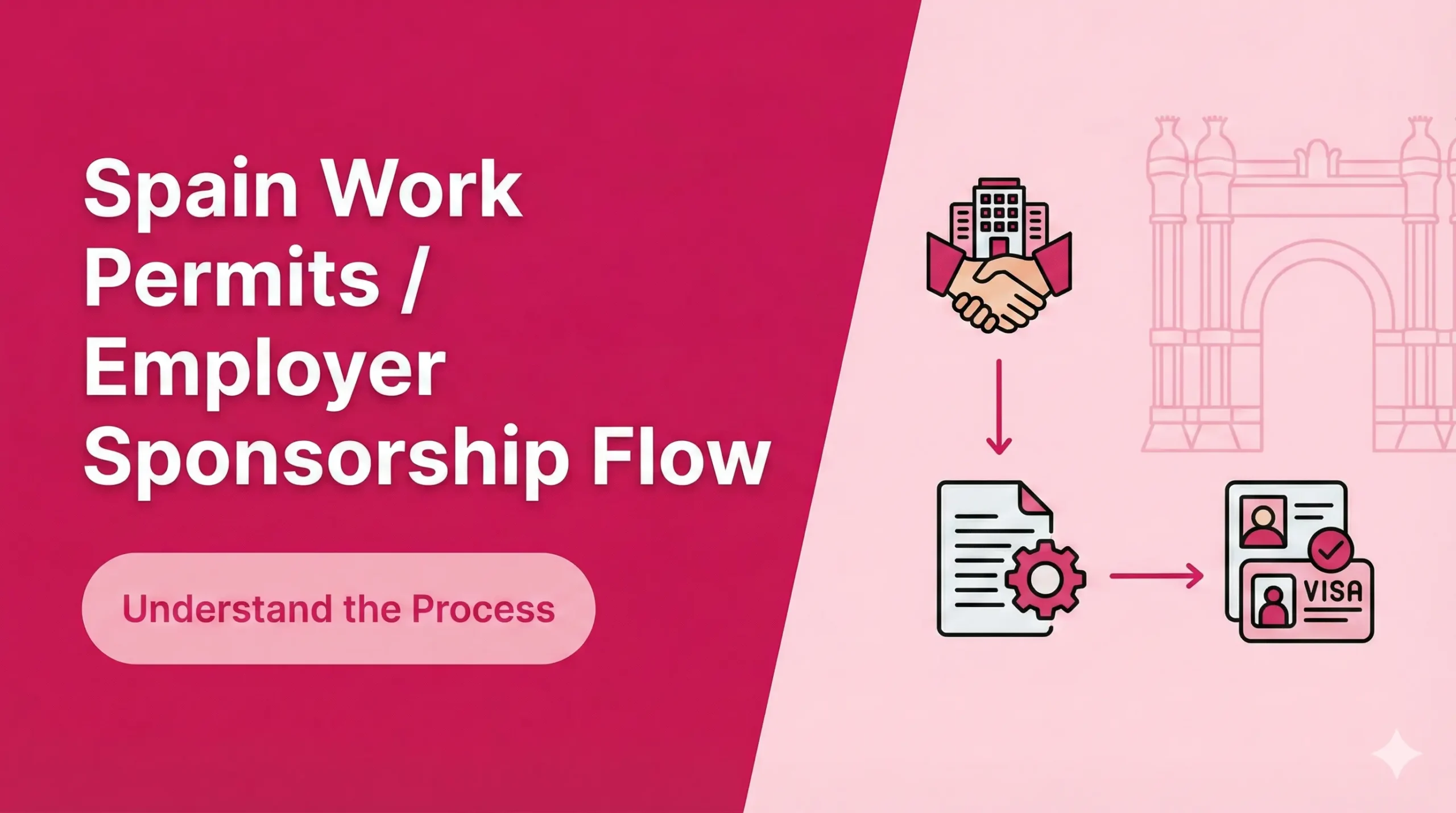
Spain Work Permits: High-Level Employer Sponsorship Flow
Securing employer sponsorship in Spain is a complex but manageable process if you understand the legal pathways. This comprehensive guide details the employer’s obligations, the standard versus fast-track visa routes, required documentation, and the exact step-by-step application timeline.
Disclosure: This post may contain affiliate links. We may earn a commission at no extra cost to you if you make a purchase through these links. Read full disclosure.
Understanding the Spanish Work Permit System
The Spanish government is protective of its domestic labor market. The underlying philosophy of the immigration system is that a job should only be offered to a foreign national if there are no suitable candidates available within Spain or the broader European Union.
Consequently, employer sponsorship in Spain is not a one-size-fits-all procedure. The path your employer must take depends entirely on the nature of the job, the salary being offered, and your professional qualifications. The system is broadly divided into two main tracks: the Standard Work Permit (Regimen General) and the fast-track options under the Entrepreneurs Law, most notably the Highly Qualified Professional Visa.
If you are currently navigating the job market and trying to secure that initial offer, ensuring your resume and networking strategies align with roles that typically offer sponsorship is essential. You can refine your approach by reviewing our comprehensive guide on Finding a Job in Spain: CV, Interviews, and Networking.
The Standard Work Permit Regime
The Standard Work Permit, officially known as the Initial Authorization for Temporary Residence and Work as an Employee, is the traditional route. However, it is also the most difficult and time-consuming path for an employer to take.
The National Employment Situation
The primary obstacle in the standard regime is the National Employment Situation test. Before a Spanish company can sponsor a non-EU citizen for a standard role, they must legally prove that they could not find a suitable Spanish or EU citizen to fill the vacancy.
To do this, the employer must list the job opening with the Spanish Public Employment Service (SEPE). The job must remain posted for a specific period, usually around fifteen days. If SEPE sends candidates, the employer must interview them. If the employer rejects these local candidates, they must provide a valid, objective justification to the government explaining why none of the local applicants were qualified.
Only after SEPE issues a Certificate of Insufficiency—a document confirming that no local workers are available for the role—can the employer submit the work permit application for the foreign national.
The Shortage Occupation List
There is an exception to the SEPE labor market test. The Spanish government publishes a quarterly catalog called the Shortage Occupation List. This list details specific professions where there is a recognized national shortage of talent. If the job you are being offered is on this list, the employer can bypass the SEPE advertising requirement entirely.
Historically, this list was extremely narrow, often restricted to maritime roles or elite professional sports coaches. While it has been slightly expanded to include certain technology and engineering roles, it remains quite restrictive.
Because of the rigorous labor market test and the lengthy processing times (often taking up to six months), most Spanish employers are highly reluctant to use the Standard Work Permit regime unless absolutely necessary.
The Highly Qualified Professional Visa
To attract global talent and boost economic competitiveness, Spain introduced the Entrepreneurs Law (Ley de Emprendedores). This law created the Highly Qualified Professional (HQP) visa, which is the preferred and most efficient route for corporate sponsorship.
Bypassing the Labor Market Test
The greatest advantage of the HQP visa is that it completely bypasses the National Employment Situation test. The employer does not need to advertise the job with SEPE, nor do they need to prove a lack of local talent. If the candidate and the job meet the HQP criteria, the company can apply immediately.
Criteria for the HQP Visa
To qualify for this fast-track sponsorship, the application must meet specific thresholds regarding the applicant’s profile and the role itself:
- Educational Background: The applicant must possess a higher education degree from a recognized university or prestigious business school. Alternatively, if the applicant lacks a formal degree, they must prove a minimum of three to five years of highly relevant professional experience in the same sector.
- Salary Thresholds: The position must offer a salary commensurate with a highly qualified role. While the exact figures are updated annually based on the minimum wage and inflation, the general threshold typically sits above forty thousand euros for technicians and specialists, and above fifty-four thousand euros for managerial or directorial roles. There are some exceptions allowing slightly lower salaries for recent graduates or roles in small and medium-sized enterprises (SMEs) in strategic sectors.
- The Role: The job description must clearly define the position as managerial, directorial, or highly technical. Standard administrative or entry-level roles do not qualify, regardless of the applicant’s education.
The UGE Unit
Applications for the HQP visa are not processed by standard regional immigration offices. Instead, they are handled centrally in Madrid by the Unit of Large Companies and Strategic Collectives (UGE). This specialized unit is designed for efficiency and business support.
The Step-by-Step Employer Sponsorship Flow
Whether the employer uses the standard route or the HQP fast-track, the chronological flow of the sponsorship process remains relatively similar. The fundamental rule of Spanish work permits is that the process must be initiated by the employer in Spain, while the prospective employee is still in their home country.
Step 1: Job Offer and Contract Drafting
The process begins with a formal job offer. The employer and the prospective employee must sign a pre-contract or a full employment contract that includes a specific conditional clause. This clause must state that the validity of the contract is strictly contingent upon the successful approval of the work and residence permit.
At this stage, the employer will usually engage their internal legal department or an external immigration law firm (gestoría) to handle the bureaucratic filings.
Step 2: The Employer Submits the Application
The employer acts as the petitioner. They must gather a comprehensive dossier of documents regarding the company’s financial health and the specific job offer. They combine this with the personal and educational documents provided by the applicant.
The employer submits this entire package electronically to the relevant immigration authority—either the regional Oficina de Extranjería for standard permits or the UGE for Highly Qualified Professionals.
Step 3: The Administrative Processing and Approval
Once the application is submitted, the waiting game begins.
- Standard Permit Processing: Can take anywhere from three to six months. The regional offices are often heavily backlogged.
- HQP Processing: The UGE operates under a legal mandate of “positive administrative silence.” They have twenty working days to issue a decision. If they do not respond within twenty working days, the application is legally considered approved by default. In practice, the UGE is highly efficient and usually issues a formal resolution within this timeframe.
When the application is approved, the government issues a Resolución Favorable (Favorable Resolution). This is the golden ticket. The employer downloads this official document and sends a copy to the prospective employee.
Step 4: The Employee Applies for the Entry Visa
With the Favorable Resolution in hand, the burden of action shifts to the employee. The employee must take this approval document, along with their passport, medical certificates, and police background checks, to the Spanish consulate or embassy in their home country or current country of legal residence.
The consulate verifies the individual’s identity and criminal record. Since the work authorization has already been approved in Madrid, the consulate’s job is simply to issue the physical visa sticker in the passport, which allows the individual to cross the Schengen border to work. This consular step usually takes between two and four weeks.
Step 5: Arrival in Spain and Social Security Registration
Once the visa is stamped in their passport, the employee travels to Spain. Upon arrival, the employer has a strict legal obligation to formally register the new employee with the Spanish Social Security system before they begin their first day of work.
This registration activates the work permit and integrates the employee into the Spanish healthcare and pension systems. If you want to understand how this system identifies you as a taxpayer and worker, review our detailed guide on Getting a Spanish Social Security Number for Work: Steps.
Step 6: Obtaining the Physical Residency Card
The visa stamped in the passport is usually only valid for ninety days. It is merely an entry document. Within the first thirty days of arriving in Spain, the employee must book an appointment at a local national police station to submit their fingerprints and apply for their physical residency card, known as the TIE.
The TIE serves as the definitive proof of your right to live and work in Spain for the duration of your contract. Navigating the police appointment system for this card is a separate bureaucratic challenge entirely. You can find a complete walkthrough of this final step in our guide: How to Get the TIE Card in Spain: Fingerprints, Fees, and Pickup.
Document Checklist for Employers and Employees
A sponsored work permit application is essentially a massive audit of both the company and the individual. If a single document is missing or improperly formatted, the application will be delayed or denied.
Documents the Employer Must Provide
The government wants to ensure the sponsoring company is a legitimate, solvent entity capable of paying the promised salary and taxes. The employer must provide:
- Company Tax ID: The NIF (Número de Identificación Fiscal) of the company.
- Deeds of Incorporation: Public deeds showing the company’s legal registration.
- Proof of Solvency: Corporate tax returns, VAT declarations, or a memorandum outlining the company’s financial capacity to hire.
- Tax and Social Security Certificates: Official certificates proving the company has no outstanding debts with the Spanish Tax Agency or Social Security.
- The Employment Contract: The signed contract detailing the salary, hours, and job description, explicitly tailored to match the visa requirements.
- Representative ID: The DNI or NIE of the company director or HR manager signing the application.
Documents the Employee Must Provide
The applicant must prove they are who they say they are, that they are qualified for the role, and that they pose no security or health risk to Spain.
- Full Passport Copy: Every single page of the passport must be scanned, including blank pages. The passport must be valid for at least one year.
- Proof of Qualifications: University diplomas and academic transcripts. If applying under the experience route, letters from previous employers verifying job titles and dates of employment.
- Criminal Record Certificate: A police background check from any country where the applicant has lived for more than six months during the last five years.
- Medical Certificate: A letter from a doctor stating that the applicant does not suffer from any diseases that could cause severe repercussions to public health, according to the International Health Regulations of 2005.
The Apostille and Translation Requirements
This is where many applicants make costly errors. Spanish immigration authorities will not accept foreign documents as-is.
Any public document issued outside of Spain (such as a university degree, a police background check, or a marriage certificate for accompanying family members) must be legalized. For most countries, this means obtaining an Apostille of the Hague—a specific international certification attached to the original document by the issuing government.
Furthermore, if the documents are not originally in Spanish, they must be translated by a Sworn Translator (Traductor Jurado) who is officially certified and registered with the Spanish Ministry of Foreign Affairs. Standard agency translations will be rejected.
Ensuring your personal identification documents are in order is a recurring theme in Spanish administration. For a broader look at how to manage local bureaucracy once you arrive, consult our guide on Spanish Bureaucracy for Daily Life: Padrón, IDs, and Local Services.
Comparison Table: Standard vs. Highly Qualified Professional Visa
To help visualize the distinct advantages of the fast-track system, here is a comparison of the two primary sponsorship routes.
| Feature | Standard Work Permit (Regimen General) | Highly Qualified Professional (HQP) |
| Labor Market Test | Yes (Must prove no locals available via SEPE) | No (Bypasses the SEPE test entirely) |
| Processing Authority | Regional Immigration Offices | Central UGE Office in Madrid |
| Processing Time | 3 to 6 months | 20 working days (fast-track) |
| Salary Requirement | Minimum wage or collective agreement | Usually >€40k (Tech) or >€54k (Management) |
| Family Inclusion | Family reunification is difficult initially | Joint application for spouse and children |
| Qualification Needed | General skills matching the job | University degree or 3+ years specific experience |
Timelines, Costs, and Corporate Reluctance
Understanding the financial and temporal commitment helps explain why Spanish employers are selective when offering sponsorship.
The True Timeline
While the UGE processing time for an HQP visa is just twenty days, the end-to-end process takes much longer. Gathering apostilled police checks and university degrees can take an applicant a month or more. The consular visa processing adds another month. In a best-case scenario under the HQP route, you are looking at two and a half to three months from the date the job offer is signed until the employee is sitting at their desk in Spain. Under the standard regime, this timeline can easily stretch to seven or eight months.
The Financial Costs
The government application fees for the work permit and the subsequent entry visa are relatively low, usually totaling under one hundred euros.
However, the true cost lies in legal fees. Because the paperwork is complex and the stakes are high, almost all companies hire external immigration lawyers to handle the sponsorship. Corporate legal fees for an HQP visa application typically range from 1,000 to 2,500 euros per applicant. Additionally, the applicant will have to pay for their own apostilles and sworn translations, which can cost several hundred euros.
Addressing Employer Hesitation
If you are interviewing with a company that is open to your profile but hesitant about the visa process, it is your job to educate them. Many smaller Spanish companies incorrectly assume that all visas take six months and require proving no Spaniard can do the job.
If you qualify for the Highly Qualified Professional route, explicitly mention the UGE fast-track and the twenty-day processing time during your interviews. Assuring the employer that the process is streamlined and predictable can often be the deciding factor in securing the sponsorship offer.
Additionally, before the employer begins the formal visa process, they may ask for a preliminary identification number to draft the pre-contract. Understanding how to obtain this number quickly is vital. Check out Getting an NIE for Employment or Study: Practical Overview for strategies on handling this preliminary step.
Changing Employers and Renewals
A common question among sponsored expats is what happens if the job does not work out. Your work permit is tied to your sponsoring employer.
If you are on a Standard Work Permit, changing employers during your first year is extremely difficult and legally complex. Your permit is usually restricted to a specific geographic sector and industry.
If you are on an HQP visa, you have slightly more flexibility. You can change employers, but your new employer must submit a new application to the UGE to take over your sponsorship. The new role must also meet the high salary and qualification thresholds of the HQP visa. If you resign or are terminated and cannot find a new sponsoring employer within the required timeframe, you will lose your right to reside in Spain.
Work permits are generally issued for an initial period of one to three years, depending on the contract and the specific visa category. Renewals are generally much smoother than the initial application, provided you have been consistently employed, your company has paid your social security contributions, and you have not committed any crimes in Spain.
Conclusion
Securing employer sponsorship in Spain is a rigorous, multi-tiered process that demands patience and meticulous organization from both the hiring company and the prospective employee. The Spanish government’s priority is to protect the domestic workforce, making the standard work permit a steep uphill battle.
However, the introduction of the Highly Qualified Professional visa has provided a clear, efficient, and welcoming pathway for international talent. By understanding the strict educational and salary thresholds required to bypass the labor market test, you can effectively position yourself as an ideal candidate.
When you navigate this process successfully, the reward is more than just a job; it is the legal foundation to build a thriving, long-term life in one of Europe’s most dynamic economies. Ensure your documents are apostilled, communicate clearly with your future employer’s legal team, and prepare for the incredible professional journey that awaits you in Spain.
References
Primary sources (official)
- Ministerio de Inclusión, Seguridad Social y Migraciones (UGE-CE): https://www.inclusion.gob.es/
- Servicio Público de Empleo Estatal (SEPE – Shortage Occupation List): https://www.sepe.es/
- Boletín Oficial del Estado (Ley 14/2013 de Apoyo a los Emprendedores y su Internacionalización): https://www.boe.es/
Other helpful sources
- Invest in Spain (ICEX – Guide to Hiring Foreign Talent): https://www.investinspain.org/
- Citizens Advice Bureau Spain (Immigration & Work Visas): https://www.citizensadvice.org.es/
Disclaimer
The information provided in this article is for educational and informational purposes only and does not constitute formal legal or immigration advice. Spanish immigration laws, salary thresholds for the HQP visa, and UGE processing times are subject to frequent legislative updates. We strongly recommend consulting with a certified Spanish immigration lawyer (abogado de extranjería) or the official consulate before initiating any employment sponsorship procedures.