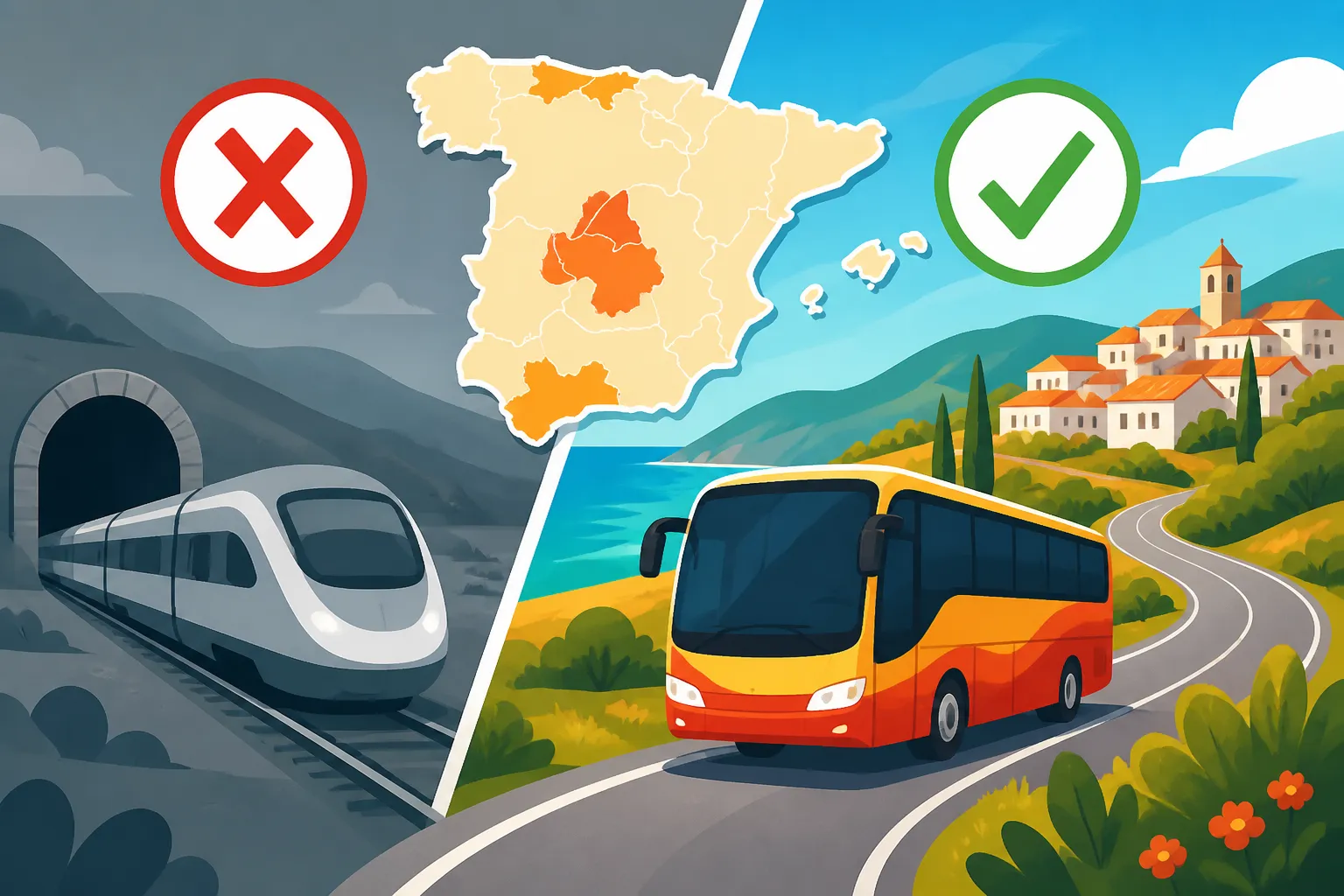
When Buses Beat Trains in Spain: Routes Where Rail Doesn’t Reach
Oh, the romantic idea of zipping through Spain on a high-speed train! It’s what many of us dream of when we picture expat life or a grand tour, right? But after years of living here and exploring every nook and cranny, I can tell you there are countless times that the humble bus will absolutely save your sanity (and your wallet) when a train simply doesn't go where you need it to, or the journey is just far too convoluted. This guide is all about embracing the bus, understanding its undeniable advantages, and making your travels across Spain far smoother and more authentic.
Disclosure: This post may contain affiliate links. We may earn a commission at no extra cost to you if you make a purchase through these links. Read full disclosure.
The Undeniable Appeal of the Bus for Spanish Exploration
When you first arrive in Spain, it's easy to get caught up in the allure of the high-speed AVE trains. They're sleek, they're fast, and they connect major cities with impressive efficiency. But here's the kicker: Spain is huge and incredibly diverse, with vast stretches of rural landscapes, charming smaller towns, and coastal gems that the main rail lines simply bypass. This is precisely where the bus system shines, becoming not just an alternative, but often the superior, and sometimes only, option.
The truth is, while the train network is fantastic for connecting capitals like Madrid, Barcelona, and Seville, it quickly becomes sparse when you venture off the beaten track. Imagine trying to get from a bustling city center to a picturesque village nestled in the mountains, or a hidden cove on the coast. Often, the nearest train station might be an hour away by taxi, or require multiple slow regional train changes that stretch a simple journey into an epic saga. Buses, on the other hand, have a far more extensive capillary network, reaching into places that trains can only dream of. They offer direct routes to countless smaller municipalities, dropping you right in the heart of town, usually at a convenient bus station. This accessibility is a game-changer for anyone wanting to experience the real Spain, beyond the typical tourist circuit. Whether it's the cost savings, the directness of the route, or simply the ability to reach a destination where tracks just don't run, the bus is your unsung hero for true Spanish exploration.
Reaching Remote Villages and Natural Parks
Spain is dotted with stunning natural parks, a myriad of "pueblos blancos" (white villages), and historical hamlets perched atop hills, many of which proudly declare they've never seen a train track. While these places offer some of the most authentic and breathtaking experiences, their charm often lies in their isolation. This isolation, however, becomes a logistical headache if you're relying solely on trains.
Let's take, for example, the gorgeous white villages of Andalusia like Ronda, Grazalema, or Setenil de las Bodegas. While Ronda has a train station, direct routes from major cities are often limited, and getting to the surrounding pueblos usually necessitates a car or, more commonly, a bus. Similarly, for exploring the Picos de Europa National Park in the north, or the Sierra Nevada in the south, buses provide crucial links from larger towns to smaller park entrances or villages nestled within. If you're planning a trip to the picturesque Alpujarras region, south of Granada, you'll quickly discover that the local bus lines are the lifeblood for residents and visitors alike. They wind through the valleys, connecting tiny villages like Pampaneira, Bubión, and Capileira, offering stunning views and a flexible schedule that a train simply couldn't provide. Searching on a platform like Omio for these less-traveled routes will immediately show you how robust the bus offerings are, providing a direct and often more scenic way to immerse yourself in Spain's wilder side. It's truly a revelation when you realize how much more of Spain opens up with a bus ticket in hand.
Accessing Coastal Towns and Beaches Beyond Major Cities
Ah, the Spanish coast! Everyone flocks to the big names like Barcelona or Málaga, but the country boasts thousands of kilometers of incredible coastline, from the rugged cliffs of the Costa Brava to the golden sands of Cádiz. While some major coastal cities are well-connected by train, many of the most charming beach towns and secluded coves remain tantalizingly out of reach if you're sticking to the rail network.
Think about the Costa de la Luz in Andalusia, famous for its incredible surfing beaches and laid-back vibe in towns like Tarifa or El Palmar. While you can get a train to Cádiz, reaching these specific surf havens or smaller fishing villages is almost exclusively done by bus. Imagine hauling your surfboard (or just your beach bag) from a train station that's miles inland, only to then figure out a local taxi or secondary bus. It’s a trek. But hop on a bus from Seville or Jerez, and you’ll likely be dropped off within walking distance of the beach or your accommodation. The same goes for many hidden gems along the Cantabrian coast or the quieter stretches of the Mediterranean. If your dream involves discovering smaller, authentic coastal villages or specific beaches rather than just the large resort towns, the bus is your best friend. It offers that crucial direct connection, saving you time and the hassle of multiple transfers. For example, if you want to visit Nerja's famous Balcón de Europa or its stunning caves, a direct bus from Málaga is far more practical and efficient than trying to piece together a train journey to the nearest station and then finding onward transport. When you're planning your coastal escape, definitely check Omio to see the direct bus routes that unlock these sun-drenched destinations.
Cost-Effectiveness and Convenience: Why Buses Save You Money and Hassle
Let's be brutally honest: moving to or traveling around Spain can be expensive, especially if you're always opting for the fastest or most "glamorous" transport options. While high-speed trains are fantastic for certain journeys, they often come with a price tag that can make your eyes water, particularly if you're booking last minute or during peak seasons. This is where buses truly shine, offering a consistently more affordable alternative without necessarily sacrificing much in terms of comfort or speed, especially on routes where trains don't dominate.
Beyond the ticket price, consider the overall convenience. Many train stations, particularly those serving high-speed lines in major cities, are located a bit outside the city center, often requiring an extra metro, bus, or taxi ride to reach your final destination. Bus stations, however, are frequently more centrally located, or at least have excellent local transport connections that are easier to navigate. This means less faffing about with luggage, fewer transfers, and a more direct route from point A to point B. For budget-conscious travelers or expats looking to save a few euros here and there (and who isn't?), opting for the bus can make a significant difference to your overall travel expenses, freeing up funds for that extra tapas and caña! It's not just about getting there; it's about getting there efficiently and economically.
Significantly Cheaper Fares, Especially for Last-Minute Travel
The difference in price between a train ticket and a bus ticket in Spain can be quite staggering, often tipping the scales heavily in favor of the bus. This becomes even more apparent when you're making spontaneous travel plans or need to travel during peak holiday periods. Train fares, particularly for high-speed routes, tend to skyrocket closer to the departure date, making last-minute trips a costly affair. Regional trains might be cheaper, but they are often agonizingly slow and can involve multiple changes.
Buses, on the other hand, typically maintain more consistent pricing, and even their "premium" services rarely reach the cost of a standard train ticket. For instance, a bus journey from Madrid to Granada might cost you around €20-30, whereas a train ticket for the same route could easily double or even triple that, especially if you haven't booked weeks in advance. If you're on a tight budget, or just appreciate value for money, choosing the bus is almost always the smarter financial move. This is particularly true for longer distances that might otherwise warrant a pricey train ride. Think of the savings you can accumulate over multiple trips! It’s not just about getting there; it’s about getting there without breaking the bank. Using a platform like Omio allows you to quickly compare these prices across different modes of transport, proving just how much you can save by going with the bus. It's a real eye-opener for many new arrivals.
Direct Routes to City Centers and Tourist Hotspots
One of the often-overlooked advantages of bus travel in Spain is the strategic placement of bus stations. Unlike many major train stations, which can sometimes feel like they're on the outskirts of town (hello, Madrid Atocha if you're trying to get to the other side of the city!), bus stations are frequently located right in the heart of cities, or at least with very easy access to local transport networks. This means less time spent navigating sprawling metro systems or hailing expensive taxis just to get to your accommodation or the main tourist attractions.
Imagine arriving in a city like Seville. The main bus station, Plaza de Armas, is incredibly central, a short walk from the historic center and the Guadalquivir river. Similarly, in many smaller towns, the bus station is the town center. This direct access saves you precious time and energy, especially after a long journey, and is incredibly convenient if you're lugging suitcases. For tourist hotspots that aren't major cities, like Toledo or Salamanca, bus services from Madrid are not only frequent but also drop you off much closer to the historic core than any train would. This can make all the difference, particularly for day trips where every minute counts. When you book through Omio, you'll often see the exact drop-off points, giving you a clear picture of how close you'll be to your final destination, which is invaluable when planning your itinerary. It truly simplifies your arrival and onward journey within a new place. For more tips on navigating local transport, check out our guide on Getting Around Spanish Cities: Metro, Bus, Tram, and Bikes.
Navigating the Spanish Bus System: Booking and Providers
Alright, so you're convinced that the bus is often the unsung hero of Spanish travel. Now, how do you actually navigate this system and get yourself a ticket? Don't worry, it's far less daunting than trying to decipher some of Spain's more obscure bureaucratic processes. The Spanish bus network is extensive, well-organized, and generally very efficient. While there are many regional bus companies, a few major players cover the vast majority of intercity routes, making booking quite straightforward.
The key is knowing where to look and how to compare your options. You'll find that many of these bus operators have modern fleets, complete with amenities like Wi-Fi, reclining seats, and even onboard entertainment on longer journeys. So, it's not exactly roughing it! The booking process itself has become incredibly user-friendly over the years, with online platforms making it easy to search, compare, and purchase tickets from the comfort of your home, or even on the go via your smartphone. Gone are the days of deciphering obscure timetables at a dimly lit bus station!
Major Bus Companies and Their Networks
Spain's bus network is primarily operated by several large companies, each with its own routes and specialties. Knowing a few of the main players can help you understand the landscape, although using a comparison site often aggregates these for you.
- ALSA: This is arguably the biggest and most recognizable bus company in Spain. ALSA operates an incredibly extensive network, covering routes across almost the entire country, from high-frequency connections between major cities to services reaching smaller towns and villages. They also offer international routes. Their fleet is modern, often equipped with Wi-Fi, power outlets, and comfortable seating. You'll find different service levels, from "Standard" to "Supra Economy" or "Supra +" which offer extra legroom, individual screens, and even onboard catering on some premium long-distance services. ALSA is your go-to for many key intercity connections.
- Avanza Bus: Another major player, Avanza Bus serves a significant portion of central Spain, including routes from Madrid to cities like Salamanca, Ávila, and Valencia. They also have a strong presence in the Levante region and parts of Extremadura. Like ALSA, Avanza offers comfortable coaches with amenities, and they are a reliable choice for many popular routes.
- HIFE: This company is prominent in the eastern regions, particularly connecting cities in Catalonia, Valencia, and Aragon, as well as the Ebro Delta area. If you're exploring this part of Spain, HIFE will likely be one of your best options.
- Damás: Primarily serving Andalusia, Damás is essential for travel within this southern region, connecting cities like Seville, Cádiz, Huelva, and the smaller towns along the Costa de la Luz.
- Socibus: This company specializes in longer routes, particularly connecting Madrid with cities in Andalusia, such as Seville, Cádiz, and Córdoba.
While these are the main ones, there are numerous regional and local companies (e.g., Arriva for Galicia, Sagalés in Catalonia) that fill in the gaps. For me, the easiest way to navigate this patchwork of operators is by using a comprehensive booking platform like Omio. It pulls together schedules and prices from all these different companies, allowing you to compare options side-by-side without having to visit each operator's website individually. It truly simplifies the process of finding the best bus for your journey, saving you time and ensuring you don't miss a convenient route.
The Ease of Online Booking with Omio
In the digital age, booking bus tickets in Spain has become incredibly simple and intuitive, and honestly, platforms like Omio have revolutionized the experience for expats and tourists alike. Gone are the days of queuing at a bus station ticket counter, trying to communicate your destination in fractured Spanish, and hoping you understand the schedule correctly. Now, you can manage your entire journey from the palm of your hand.
Omio, in particular, is a fantastic tool because it aggregates information from all the major Spanish bus companies (and trains, and even flights!) onto one user-friendly platform. This means you don't have to jump between ALSA's website, then Avanza's, then Socibus's to find the best route and price. You simply enter your departure and arrival points, your dates, and Omio does all the heavy lifting for you. It displays all available options, clearly showing departure times, journey durations, prices, and even the operating company. This comparison feature is incredibly useful, especially when some routes might be served by multiple operators with varying schedules and comfort levels.
Once you’ve found your ideal bus, booking is a breeze. You can pay securely online, and your tickets are typically sent directly to your email or are accessible within the Omio app. This means you can often just show your phone to the driver or attendant when boarding, which is a lifesaver if you're like me and prone to misplacing paper tickets. The convenience extends to customer support and managing your bookings, all centralized in one place. Whether you're planning a grand tour or a quick weekend escape to a smaller town, using Omio really takes the stress out of Spanish bus travel. It's truly become my go-to for checking travel options and securing my seat, especially when I’m trying to figure out if the bus or the train is the better bet for a specific journey.
Practical Tips for Bus Travel in Spain
Now that you're armed with the knowledge of why buses are so great and how to book them, let's talk about some practical tips to make your actual bus journey as smooth and stress-free as possible. A few tips can make a big difference when travelling Spain by bus, especially if you're new to the system.
From understanding luggage allowances to knowing what amenities to expect, being prepared can turn a potentially confusing experience into a comfortable adventure. Spanish bus culture is generally relaxed, but a little bit of foresight can go a long way in ensuring you have a pleasant trip, whether you're heading for a bustling city or a quiet corner of the countryside. So, let's dive into the nitty-gritty details that will have you traveling like a seasoned local in no time.
Luggage Allowances and Onboard Comforts
When you're packing for a trip, especially if you're traveling light or relying on public transport, luggage allowances are a big deal. With Spanish buses, you generally have a pretty generous allowance, which is a huge relief compared to some budget airlines. Most major bus companies like ALSA and Avanza typically allow one large piece of luggage (up to 25-30 kg) to be stowed in the undercarriage, and one smaller piece of hand luggage to bring with you onboard. If you have extra bags, there’s usually an option to pay a small additional fee, but it’s rarely exorbitant. Just make sure to clearly label your checked luggage with your name and destination, just in case!
As for onboard comforts, modern Spanish buses are surprisingly well-equipped. Many coaches, especially those on longer routes, feature comfortable reclining seats, individual air conditioning vents, and reading lights. You’ll often find free Wi-Fi, although signal strength can vary, especially in rural areas. Power outlets are increasingly common, usually one per seat or shared between two, which is fantastic for keeping your devices charged. Some premium services even offer individual entertainment screens with movies and music. For those longer journeys, a stop at a service station (typically 20-30 minutes) is common, allowing you to stretch your legs, grab a coffee, and use the facilities. While not all buses have onboard toilets, many do, and the service station breaks provide reliable alternatives. Bringing your own snacks and drinks is always a good idea, as options at service stations can be limited or pricey. For a truly comfortable journey, pack a neck pillow, an eye mask, and some headphones – you’ll be snoozing or enjoying the scenery in no time. You can often see the specific amenities offered for each bus when booking through Omio, which helps you choose the option that best suits your needs.
How to Find Your Bus Station and Avoid Delays
One of the slight quirks of bus travel, especially for new expats, can be locating the bus station itself. While many are centrally located, some larger cities might have multiple bus stations, or their main station might be a little off the beaten path. My best advice here is to always double-check the exact address of your departure station when you book your ticket. Don't just assume "Madrid Bus Station" – specify if it's Estación Sur (Méndez Álvaro) or Avenida de América, for example, as they serve different regions. Using Google Maps to pinpoint the exact location and plan your route to get there is crucial, whether by local bus, metro, or taxi. Aim to arrive at least 20-30 minutes before your scheduled departure, especially if you need to check luggage into the hold, as this process can sometimes take a little time.
As for avoiding delays, bus travel in Spain is generally reliable, but like all forms of transport, unexpected hold-ups can occur. Traffic, particularly around major cities, is the most common culprit. While you can't control traffic, you can plan for it by checking real-time traffic updates on your phone before you head to the station. During peak holiday seasons, like Easter or the height of summer, expect roads to be busier and journeys potentially longer. These are times when it's even more important to build in buffer time if you have onward connections. The beauty of booking through a platform like Omio is that it often provides updates directly, and if you have questions, their support can sometimes offer insights. However, for real-time information on the day, always keep an eye on your specific bus company's app or website. Being prepared for slight variations in schedule will save you a lot of stress. For more general travel logistics, take a peek at our guide on Travel Logistics in Spain: Money, Safety, and Connectivity.
Specific Routes Where Buses Excel Over Trains
Alright, let's get down to some real-world examples! While Spain's high-speed rail network is expanding, there are still a plethora of routes where, for various reasons, the bus remains the champion. Often, these are routes that take you off the well-trodden tourist path, into areas rich with local culture, breathtaking scenery, or simply places that were never deemed important enough for a major rail line.
From connections between vibrant regional capitals to routes that weave through historic landscapes, buses often offer a more direct, frequent, and cost-effective journey. Forget the multi-leg train trips that require you to backtrack or make inconvenient changes; these bus routes cut straight to the chase, delivering you closer to your destination with less fuss. Let's look at some prime examples where choosing the bus isn't just a good idea, it's often the best idea.
Inter-Regional Travel Beyond Major Hubs
When you're trying to travel between two significant cities that aren't Madrid or Barcelona, or perhaps between a regional capital and a provincial town, the train network can often be surprisingly inefficient. While you might eventually get there by train, it often involves a lengthy detour through a major hub like Madrid, increasing both travel time and cost. This is precisely where the bus truly shines, offering direct and frequent connections that simply don't exist by rail.
Consider, for example, traveling between Seville and Granada. While both are popular tourist destinations and regional capitals in Andalusia, a direct high-speed rail link has only recently improved, and historically, or for certain schedules, the bus has been the go-to for speed and convenience. It’s often just as quick, more direct, and far cheaper. Similarly, if you're looking to connect cities like Salamanca and Cáceres in Extremadura, or Pamplona and San Sebastián in the Basque Country, buses provide the most sensible and direct routes. A train journey between these pairings might involve multiple transfers, slower regional lines, or even a lengthy detour through Madrid, turning a few-hour bus ride into an all-day train odyssey. These are the kinds of journeys where Omio comes in incredibly handy, allowing you to instantly compare the convoluted train options (if they even exist) against the straightforward bus alternatives. It helps you see at a glance that the bus is clearly the superior option for inter-regional travel that avoids the main high-speed corridors. It's a lifesaver for truly exploring diverse regions of Spain. If you're planning a multi-city trip, understanding High-Speed Trains in Spain (AVE): Routes, Booking, and Savings might be helpful for some legs, but don't overlook the bus for others.
Coastal Connections Off the Main Rail Lines
Spain’s coastlines are incredibly diverse, from the rugged beauty of the Atlantic to the sun-drenched Mediterranean, and while some major port cities have good train links, many of the most charming seaside towns and villages are best, or only, reached by bus. The rail network often follows historical industrial routes or flat plains, leaving the more undulating coastal areas to bus lines.
Take the Costa de la Luz in southern Andalusia, for instance. Towns like Conil de la Frontera, Zahara de los Atunes, or even the bustling surf hub of Tarifa, are absolute gems. You can get a train to Cádiz or Algeciras, but from there, you'll need a bus to reach these specific destinations. The bus routes along this coast are frequent and scenic, winding through pine forests and past expansive beaches. Similarly, if you're exploring the more remote parts of the Costa Brava in Catalonia, beyond the main hubs like Girona (which does have a train station), buses are your primary mode of transport to places like Cadaqués, Pals, or Tossa de Mar. They drop you directly in the village or near the beach, avoiding the need for further transfers. On the northern coast, connecting places like Santander and Oviedo often sees the bus as the more direct option, cutting through the green landscape rather than taking a longer inland rail route. These coastal bus routes are not just practical; they offer stunning views that you might miss on an inland train journey. Using Omio to plan these coastal adventures means you’ll easily find these direct connections, letting you soak up the sun and sea without transport worries.
Exploring Historic Cities and UNESCO Sites
Spain is a treasure trove of history, boasting countless historic cities and UNESCO World Heritage Sites that draw visitors from around the globe. While some of these, like Toledo or Ávila, are popular day trips from Madrid and have decent train connections, for many others, the bus provides a more convenient, flexible, and often more direct route right into the heart of the historic center.
Consider destinations like Cuenca, with its dramatic "hanging houses." While there's an AVE station, it's located a few kilometers outside the old town, requiring a local bus or taxi to reach. The bus, however, often drops you much closer to the historic core, making for an easier transition. Or imagine visiting Mérida in Extremadura, famous for its incredible Roman ruins. While it has a train station, direct connections from major cities can be sparse, and bus services from Seville or Madrid are often more frequent and straightforward, depositing you right where you need to be to start exploring. Even for popular spots like Segovia, while the train is an option, the bus from Madrid is often preferred by many due to its direct drop-off in the city center.
When your itinerary involves immersing yourself in ancient architecture and winding cobblestone streets, minimizing the hassle of getting to and from a distant train station is paramount. Buses excel at this, often having routes specifically designed to serve these culturally significant locations. This ease of access means more time for sightseeing and less time figuring out logistics. Definitely check Omio for bus routes when planning your visits to Spain's historic marvels; you might be surprised at how much simpler and more direct your journey can be. For more inspiration on historical sites, our guide on Spain's UNESCO World Heritage Sites: A Visitor's Guide is a fantastic resource.
Comparing Bus and Train: A Quick Glance
To truly drive home the point, let's put it into perspective with a quick comparison table. This isn't exhaustive, of course, as routes and prices fluctuate, but it gives you a general idea of why you might choose one over the other for certain journeys. Remember, the 'best' option always depends on your specific needs, budget, and desired destination.
| Feature / Route Example | Train (General) | Bus (General) | Why Bus Excels Here |
|---|---|---|---|
| Madrid – Valencia | High-speed AVE, ~1.5 – 2 hrs | ALSA/Avanza, ~4 – 4.5 hrs | Train is faster, but bus is often much cheaper and drops more centrally in Valencia for some routes. |
| Seville – Granada | MD/AVE, ~2.5 – 3 hrs | ALSA/Socibus, ~3 – 3.5 hrs | Comparable travel times, but bus offers more frequent, direct, and significantly cheaper options, especially for spontaneous travel. |
| Madrid – Toledo | AVANT train, ~30 mins | ALSA bus, ~1 hr | Train is faster, but bus drops directly at city gate (Estación de Autobuses), avoiding extra transport from train station. Bus also more frequent and cheaper. |
| Malaga – Nerja | No direct train, requires local train + bus | ALSA bus, ~1 – 1.5 hrs | Bus is the only direct and sensible public transport option. Drops you in the heart of Nerja. |
| Seville – Ronda | Regional train, ~2.5 – 3 hrs (often indirect) | Avanza bus, ~1.5 – 2 hrs | Bus is significantly faster and more direct, taking scenic mountain roads. |
| Barcelona – Cadaqués | No direct train, requires train to Figueres + bus | Sarfa bus, ~2.5 – 3 hrs | Bus is the only direct public transport link to this popular Costa Brava town. |
As you can see, while trains are kings of speed on specific high-speed corridors, buses often win on cost, directness, and accessibility, particularly for journeys that don't fit neatly into the major rail network. When you’re looking at options on Omio, this table can help you quickly assess if the bus might just be your best bet for a particular leg of your journey.
Embracing the Bus for Authentic Spanish Travel
So, there you have it. While the high-speed trains certainly have their place in Spanish travel, don't make the mistake of overlooking the incredibly extensive, efficient, and cost-effective bus network. Many newcomers get frustrated trying to force train travel onto routes where it simply doesn't make sense, racking up unnecessary costs and wasted time. The bus, my friends, is your true companion for unlocking the vast, diverse, and authentic corners of Spain that lie beyond the gleaming rail tracks.
From the rugged Picos de Europa to the hidden coves of the Costa de la Luz, and from ancient Roman ruins to charming white villages, the bus is often the easiest, cheapest, and most direct way to get there. It’s not just about getting from A to B; it’s about the journey, the local interactions, and the peace of mind knowing you’ve chosen the smartest transport option. So, next time you're planning an adventure across this beautiful country, do yourself a favor: open up Omio, compare your options, and embrace the bus. You might just find it becomes your favorite way to travel. Happy travels, and ¡Buen viaje!
Disclaimer
The information provided in this guide is intended for general informational purposes only and is subject to change. While we strive to keep the content up-to-date and accurate, transport schedules, prices, and routes can vary. Always verify the latest information directly with transport providers or official booking platforms like Omio before making travel arrangements.