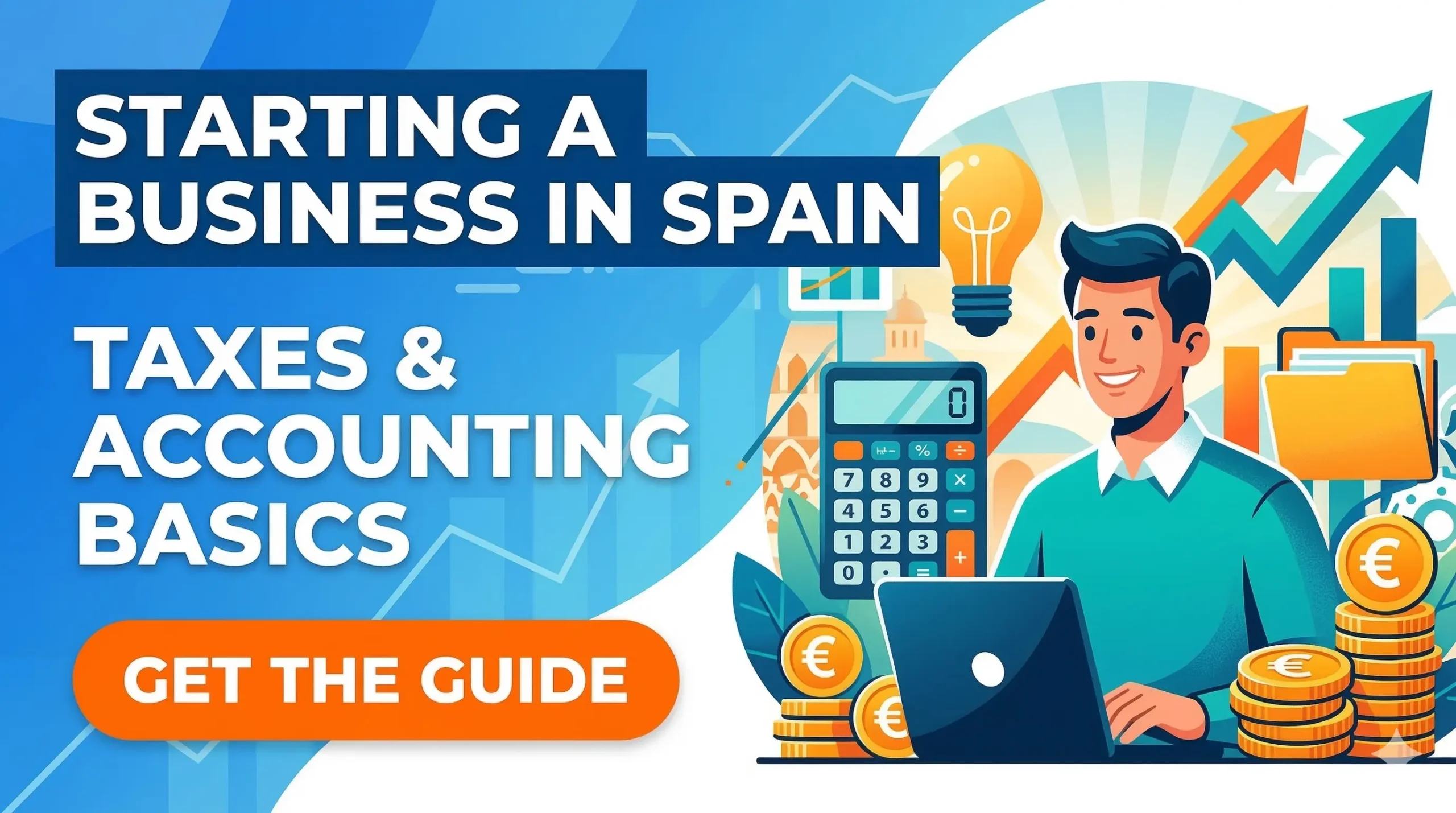
Starting a Business in Spain: Taxes and Accounting Basics
Staring at a mountain of Hacienda tax forms, I was once completely paralyzed by the fear of accidentally committing corporate fraud in my second language. Navigating Spanish bureaucracy as a new entrepreneur feels like walking through an administrative minefield. This guide breaks down the complex taxes and accounting basics of starting a Spanish business so you can operate legally and profitably.
Disclosure: This post may contain affiliate links. We may earn a commission at no extra cost to you if you make a purchase through these links. Read full disclosure.
Choosing the Right Legal Structure for Your Spanish Business
When you decide to launch a business in Spain, your very first administrative hurdle is choosing your legal entity. The structure you select dictates your personal financial liability, the complexity of your daily accounting, and exactly how the Spanish government taxes your hard-earned profits.
The Autonomo Route as a Sole Trader
The vast majority of expat entrepreneurs in Spain begin their journey as an autónomo (sole trader or freelancer). This is the fastest, cheapest, and most administratively straightforward way to legally begin invoicing clients. You do not need to draft complex corporate bylaws, hire an expensive commercial lawyer, or inject thousands of euros in share capital to get your operations off the ground.
Furthermore, simply existing as an autónomo costs money every single month, regardless of whether you earn a single euro. You are legally required to register with the RETA system and pay a monthly social security contribution (cuota de autónomos). While new registrants usually benefit from a heavily discounted “flat rate” (tarifa plana) for their first twelve months, this monthly fee eventually scales up based on your net income, easily exceeding three hundred to five hundred euros a month. Before you commit to this path, reviewing the step-by-step registration process in The Autonomo System in Spain: How to Register as a Freelancer is absolutely critical to avoid costly initial missteps.
The Sociedad Limitada SL Route
If you are launching a business with high overhead, planning to hire employees, or seeking outside investment from angel investors, operating as a sole trader is far too risky. You need to establish a Sociedad Limitada (SL), which is the Spanish equivalent of a Limited Liability Company (LLC) in the United States or a Private Limited Company (Ltd) in the United Kingdom.
The primary advantage of an SL is that your personal assets are completely shielded from corporate failure. If the company goes bankrupt or faces a devastating lawsuit, your liability is strictly limited to the capital you injected into the business. Historically, starting an SL required a mandatory upfront capital injection of three thousand euros. Recently, the Spanish government introduced the “Crea y Crece” law, theoretically allowing you to form an SL with just a single euro of share capital to encourage startup growth.
Weighing the Risks Autonomo versus SL
The decision between remaining an autónomo and incorporating a Sociedad Limitada usually boils down to pure mathematics and personal risk tolerance. Expats frequently ask their advisors at what specific revenue point they should upgrade to an SL to optimize their tax burden.
The general consensus among Spanish tax advisors is that once your net annual profit consistently exceeds the forty thousand to fifty thousand euro mark, the progressive personal income tax rates applied to an autónomo begin to vastly outpace the flat corporate tax rate applied to an SL. At this specific financial threshold, the heavy accounting costs of running a formal corporation are firmly justified by the massive tax savings.
| Feature | Autónomo (Sole Trader) | Sociedad Limitada (SL) |
| Setup Cost & Time | Free or Low; 1 to 3 Days | €1,000+; 3 to 6 Weeks |
| Personal Liability | Unlimited (Personal assets at risk) | Limited strictly to share capital |
| Tax Regime | Progressive IRPF (Scales up to 47%) | Flat Corporate Tax (25%, sometimes 15%) |
| Accounting Rules | Simplified income/expense bookkeeping | Strict, formal double-entry accounting |
| Best Suited For | Solo freelancers, low-risk digital services | Tech startups, retail storefronts, high revenue |
Demystifying the Spanish Income Tax System
Understanding exactly how you are taxed is the difference between building a highly profitable enterprise and working exclusively to fund the Spanish welfare state. The specific tax you pay depends entirely on the legal structure you chose during your incorporation phase.
Personal Income Tax IRPF for Autonomos
If you are operating as an autónomo, your business profits are considered your personal income. You are taxed under the Impuesto sobre la Renta de las Personas Físicas (IRPF), which is Spain’s highly progressive personal income tax system.
The more money your business makes, the higher the percentage the government takes, with top marginal rates frequently reaching forty-five to forty-seven percent depending on your specific autonomous community. To prevent you from owing a massive, unpayable sum at the end of the calendar year, Hacienda requires you to pay estimated taxes every three months using the Modelo 130 form. This means you must aggressively surrender twenty percent of your net quarterly profit to the government as a mandatory advance payment.
If your clients are other Spanish businesses (B2B transactions), the system shifts the burden of collection. Your corporate clients are legally required to withhold a portion of your invoice—usually fifteen percent—and pay it directly to Hacienda on your behalf. This retention acts as a direct credit toward your annual IRPF bill. Navigating these progressive brackets, retentions, and estimated prepayments is terrifying for new arrivals; to understand the overarching calendar, read How to File a Tax Return: A Guide for Expats IRPF.
Corporate Tax Impuesto de Sociedades for Companies
If you operate a Sociedad Limitada, your company’s profits are strictly legally separated from your personal wealth. The SL does not pay IRPF; instead, it pays the Impuesto de Sociedades (Corporate Tax).
The standard corporate tax rate in Spain is a flat twenty-five percent on net profits. However, to encourage entrepreneurship and foreign investment, the Spanish government offers a heavily reduced rate of fifteen percent for newly created companies during their first two years of profitability. This flat rate is incredibly attractive compared to the punishing upper brackets of the IRPF system, allowing startups to aggressively reinvest their early revenues into growth.
The Threat of Wealth and Solidarity Taxes
If your Spanish business becomes highly successful, scales rapidly, and accumulates massive corporate value, you must become hyper-aware of Spain’s Wealth Tax (Impuesto sobre el Patrimonio) and the national Solidarity Tax.
Spain actively taxes the total net value of your global assets if you are a resident. However, there is a crucial, legally complex exemption for family businesses. If your SL constitutes your primary source of income, and you are actively involved in its daily management, the total value of your company shares may be completely exempt from your personal Wealth Tax calculation.
This corporate exemption is incredibly strict and frequently audited. If your company hoards too much passive cash that is not actively used for daily business operations, Hacienda will classify your enterprise as a passive holding company, strip the business exemption away, and tax you heavily on the retained corporate cash. To fully understand how these heavy asset taxes threaten your hard-earned net worth, you must review Wealth Tax and Solidarity Tax in Spain: Overview for Foreigners.
Mastering Value Added Tax IVA Mechanics
Beyond managing your own income tax, every business owner in Spain acts as an unpaid tax collector for the state through the Impuesto sobre el Valor Añadido (IVA), which is Spain’s strict Value Added Tax system.
Acting as an Unpaid Tax Collector
When you sell a product or provide a service to a Spanish client, you must legally add twenty-one percent IVA to the final invoice. If your base rate for a consulting project is one thousand euros, your client must pay you one thousand two hundred and ten euros.
The two hundred and ten euros absolutely does not belong to you. You are legally obligated to hold that money in trust and remit it to Hacienda at the end of the quarter using the Modelo 303 form. The greatest psychological trap for new business owners is seeing their checking account balance artificially inflated by collected IVA, mistakenly believing they are highly profitable, and accidentally spending the government’s money. When the quarterly tax deadline inevitably hits, they are forced to take out high-interest personal loans just to pay Hacienda. To understand exactly how these percentages scale across different consumer goods and services, review VAT IVA in Spain: How It Affects Prices and Businesses.
The Strict Rules for Deductible Expenses
Fortunately, you do not have to pay the government every single euro of IVA you collect from your clients. You are legally allowed to subtract the IVA you paid on your legitimate business expenses (like buying a work laptop, renting an office space, or paying for business internet).
A full invoice must explicitly state your full legal name, your registered business address, your NIE/CIF (tax ID), and clearly separate the base price from the IVA percentage on distinct lines. If a supplier or restaurant refuses to put your NIE on the receipt, the IVA is legally entirely un-deductible, and that money is lost forever. Furthermore, trying to deduct personal meals or a family car as a business expense is the fastest way to trigger a targeted tax inspection.
Cross Border Billing and the Reverse Charge
If you are a digital nomad, a software developer, or a freelance consultant, your clients likely live outside of Spain. Billing across international borders changes the IVA rules completely, often to your massive financial advantage.
If you bill a business client located in another European Union country (for example, a marketing agency in Germany or a tech firm in France), you do not charge them the Spanish twenty-one percent IVA. Instead, you utilize the EU “Reverse Charge” mechanism, issuing the invoice at zero percent IVA. However, to do this legally, both you and your European client must be formally registered in the Registro de Operadores Intracomunitarios (ROI/VIES database).
Essential Accounting and Financial Infrastructure
Operating a profitable business in Spain requires rigid, uncompromising financial discipline. Mixing your personal savings with your collected corporate tax liabilities is the fastest way to bankrupt your project during your very first year of operation.
Setting Up a Compliant Local Bank Account
To pay your quarterly IVA and income taxes, Hacienda heavily prefers pulling funds via direct debit (domiciliación bancaria) directly from an account with a Spanish IBAN (starting with “ES”). Attempting to use a foreign European account often results in rejected tax payments, system timeouts, and compounding late fees.
However, traditional Spanish high-street banks are incredibly hostile to new, small businesses. They charge exorbitant quarterly maintenance fees, demand endless stacks of physical paperwork, and often stubbornly refuse to open corporate accounts unless you agree to buy their overpriced business insurance policies.
To completely bypass this legacy nightmare, savvy expat entrepreneurs immediately open their business accounts with N26. Because N26 operates as a fully licensed digital European bank, you can open a dedicated freelance or business account and receive an official Spanish IBAN directly from your smartphone. N26 allows you to create sub-accounts, making it incredibly easy to drag and drop the twenty-one percent IVA you collect into a locked, hidden folder. This visual segregation ensures you never accidentally spend the government’s money, while completely avoiding the bureaucratic friction of a traditional local branch manager. If you are struggling with the basic documentation required to navigate local banking, read Opening a Bank Account in Spain as a Non Resident.
Managing International Cash Flow and Exchange Rates
If you followed the strategic advice above and secured high-paying clients in the United States or the UK to avoid charging IVA, you now face a massive, hidden currency exchange problem that can destroy your profit margins.
If you invoice an American client for ten thousand dollars and allow them to wire that money directly into a traditional Spanish high-street bank account, you will be financially crushed. Traditional banks hide massive profit margins in terrible currency exchange rates and charge exorbitant international receiving fees simply to process the wire. You could easily lose five hundred dollars on a single invoice simply in the conversion process to euros.
To protect your corporate revenue, you must use a dedicated currency specialist like Wise. By opening a Wise business account, you can effortlessly provide your US clients with local ACH routing numbers and your UK clients with local sort codes. Your clients pay you natively in their local currency with zero international friction. You can then use Wise to instantly convert those funds into euros at the true, mid-market exchange rate. This total transparency ensures that the money you legally shielded from IVA isn’t instantly lost to predatory banking fees. To understand how optimizing these transfers impacts your overall living budget, review Cost of Living in Spain Budgeting for Expats.
Protecting and Growing Corporate Profits
Once you have meticulously paid your quarterly IVA, settled your corporate tax, and paid yourself a legal salary, the remaining net profit belongs entirely to your business. Leaving surplus corporate cash sitting in a standard Spanish checking account exposed to local inflation is a terrible wealth-building strategy.
To actually protect and grow your retained corporate earnings, veteran expat business owners utilize global brokerage platforms like Interactive Brokers. By transferring your corporate profits into an institutional account with Interactive Brokers, you gain direct access to low-cost, globally diversified ETFs, corporate bonds, and equities. You completely bypass the high-fee traps of the Spanish retail banking sector. Using Interactive Brokers allows your company to build a highly portable, tax-efficient corporate treasury that compounds wealth globally, ensuring your hard work generates long-term financial security. If you are trying to understand how this global wealth is treated under international treaties, check out Double Tax Treaties Avoiding Double Taxation as a Spain Resident.
The Administrative Burden of Hiring a Gestor
In many Anglo-Saxon countries, small business owners use simple software to file their own taxes at the end of the year over a weekend. In Spain, attempting to execute “Do-It-Yourself” corporate accounting is akin to administrative suicide.
What is a Gestor and Why You Need One
The Spanish tax code is incredibly convoluted, the digital platforms are actively hostile to users, and the financial penalty for making a minor clerical error is exceptionally high. Because of this harsh reality, the entire Spanish SME (Small and Medium Enterprise) economy runs entirely on the backs of gestores.
A gestoría is a professional administrative agency that acts as an intermediary between you and the government. They handle your monthly bookkeeping, draft your invoices to ensure they are legally compliant, process your employee payroll, and physically submit your complex tax forms to Hacienda. A basic gestor handles data entry and filing, while an asesor fiscal (tax advisor) provides high-level strategic advice on how to legally minimize your overall tax burden. As an expat, hiring a bilingual gestor the very moment you decide to start a business is not an optional luxury; it is a mandatory, non-negotiable operational expense.
Surviving the Relentless Quarterly Tax Cycle
The primary, overarching reason you need a gestor is to survive the relentless, unforgiving pace of the Spanish tax calendar. You do not simply file taxes once a year and forget about them.
If you are an autónomo or an SL, your entire life revolves around a strict quarterly cycle. In April, July, October, and January, your gestor must rapidly reconcile your books and file a barrage of government forms. You must file the Modelo 303 to pay your collected IVA, the Modelo 130 (or 202 for SLs) to make estimated income tax prepayments, and potentially the Modelo 111 to pay the income tax you legally withheld from your employees or subcontractors.
If you miss the 20th of the month deadline for these quarterly filings by even a single day, Hacienda applies immediate, compounding financial surcharges (recargos), which quickly escalate into formal embargoes where the government directly freezes your business bank accounts without warning.
Securing Your Digital Certificate
To allow your gestor to file these myriad taxes on your behalf, you must secure a Certificado Digital (Digital Certificate). This is a highly secure cryptographic file issued by the Spanish Royal Mint that acts as your legally binding, unforgeable digital signature.
Your gestor will physically install this certificate on their office computers to log into the Hacienda portal masquerading as you. Because this certificate grants them the ultimate power to sign legally binding documents and authorize massive tax payments directly from your bank account, you must only work with highly reputable, fully certified accounting firms. Securing this digital identity requires navigating a Kafkaesque bureaucratic maze of physical appointments and browser errors. To ensure you don’t miss a crucial tax deadline simply because you cannot log into the portal, carefully follow the setup instructions in Cl@ve and Digital Certificate Accessing AEAT Tax Agency Online well before your first business quarter ends.
References
Primary sources (official)
- Agencia Tributaria (AEAT) – Alta en el Censo de Empresarios, Profesionales y Retenedores: https://sede.agenciatributaria.gob.es/Sede/procedimientoini/G322.shtml
- Seguridad Social – Alta en el Régimen Especial de Trabajadores Autónomos (RETA): https://www.seg-social.es/wps/portal/wss/internet/Trabajadores/Afiliacion/10817/31190/572
- Portal de la Administración Electrónica (PAE) – Creación de Empresas: https://pae.ipyme.org/es-ES/CreacionEmpresas/Paginas/creacion-empresas.aspx
Other helpful sources
- Expatica – Starting a business in Spain: https://www.expatica.com/es/working/setting-up-a-business/starting-a-business-in-spain-471596/
Disclaimer
The information provided in this article is for educational and informational purposes only and does not constitute formal financial, accounting, or legal advice. Spanish corporate tax legislation, IVA deductibility rules, and the exact requirements for establishing a Sociedad Limitada under the “Crea y Crece” law are subject to frequent legislative updates. Always consult directly with a certified Spanish tax advisor (asesor fiscal) or a corporate lawyer regarding your specific business model, international billing practices, and legal liability before commencing commercial operations or filing quarterly tax returns.