Do You Need a Spanish Bank Account for Work Contracts?
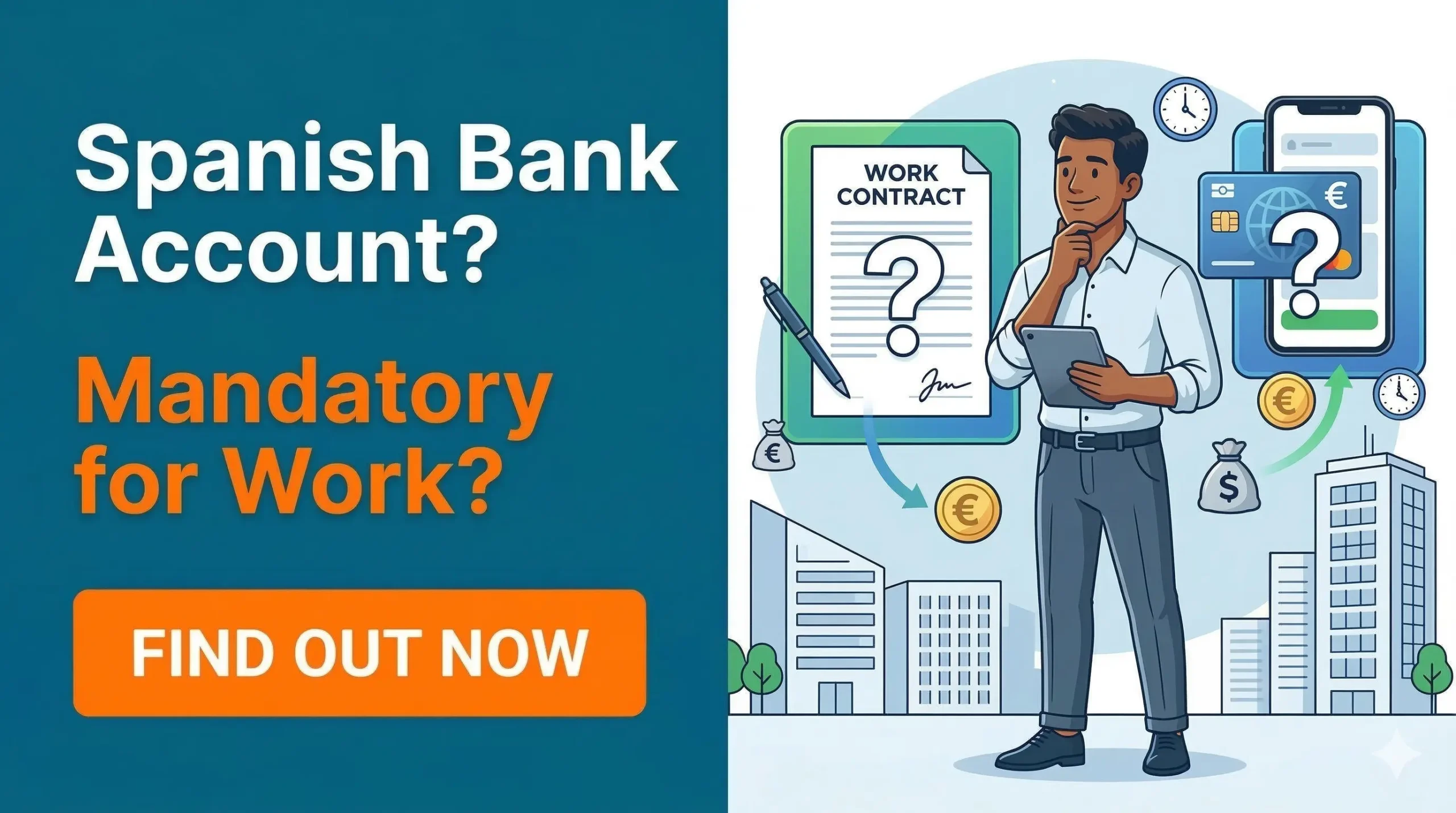
You finally land a job in Madrid, but HR halts your onboarding because your bank account doesn’t start with “ES.” I nearly lost my first teaching contract because the administration flat-out rejected my perfectly valid French bank account. This guide decodes Spanish payroll banking requirements, illegal IBAN discrimination, and how to successfully navigate stubborn HR bureaucracy without losing your paycheck.
Disclosure: This post may contain affiliate links. We may earn a commission at no extra cost to you if you make a purchase through these links. Read full disclosure.
The Legal Reality Versus HR Bureaucracy
When you navigate the Spanish job market, you will quickly discover a massive chasm between what the European federal law dictates and what local corporate administrators are actually willing to accept.
Understanding IBAN Discrimination Laws
If you already possess a Euro-denominated bank account from another European country—such as France, Germany, or Ireland—you might logically assume you are ready to work and receive a salary in Spain. Under European Union law, specifically Article 9 of the SEPA Regulation (EU No 260/2012), this assumption is 100% legally correct.
The Single Euro Payments Area (SEPA) mandates that any employer, utility company, or landlord within the Eurozone must accept any valid SEPA IBAN for direct debits and payroll transfers. Refusing to pay your salary simply because your IBAN begins with “FR” (France) or “IE” (Ireland) instead of “ES” (Spain) is a direct, punishable violation of European federal law, formally known as IBAN discrimination. The Banco de España explicitly condemns this practice and allows you to file formal administrative complaints against offending entities. To understand how this local income fits into your overall compensation package, review Spanish Salary Basics: Gross vs Net Pay and Common Deductions.
Why Spanish Employers Still Demand a Local Account
While the law is undeniably on your side, the reality on the ground in Spain is vastly different. If you confidently quote EU Regulation 260/2012 to a stressed Spanish HR clerk, they will likely just shrug, cite “company policy,” and withhold your contract.
The issue is rarely malicious; it is structural. The vast majority of Spanish companies use archaic, highly localized payroll software systems (such as A3Nom or Sage) that are literally hardcoded by developers to only accept a 24-character IBAN starting strictly with “ES.” Furthermore, corporate accountants are terrified of the Agencia Tributaria (the Spanish tax authority). They falsely believe that paying into a foreign account will trigger a corporate tax audit or complicate your social security deductions.
Fighting this bureaucratic ignorance via the Bank of Spain can easily take six months, which is time you do not have when you need to pay your rent next week. For a deeper look at how local taxes impact your take-home pay, read How to Estimate Net Salary in Spain From a Job Offer.
Navigating the Onboarding Catch-22
Because fighting HR is usually a losing battle, most expats concede and decide to simply open a local account. However, this plunges you into one of the most infamous, infuriating paradoxes of Spanish immigration.
The Nightmare of Opening a Legacy Account
If you walk into a traditional high-street bank—like Santander, BBVA, or CaixaBank—to open a local account, the teller will refuse to open a standard resident checking account for you unless you hand them a signed, legally binding Spanish employment contract (nómina). But your HR department refuses to give you the signed contract until you hand them a Spanish IBAN. You are entirely trapped.
Legacy banks enforce this rule ruthlessly due to strict Anti-Money Laundering (AML) laws. They view undocumented, unemployed foreigners as massive compliance risks. If you try to force the issue, they will push you into an expensive, fee-heavy “non-resident” account that requires police certificates and sworn translations to open. To fully grasp this systemic friction and the associated costs, read Opening a Bank Account in Spain as a Non-Resident and How to Open a Spanish Bank Account Without a Long-Term Address.
How Digital Banking Solves the Paradox
To completely bypass the hostility of legacy bank branches and the stubbornness of Spanish HR departments, savvy expats universally utilize modern digital platforms. By opening a dedicated account with N26, you instantly break the catch-22.
N26 is a fully licensed European digital bank that offers an incredibly streamlined onboarding process. Because they do not rely on the archaic paperwork demands of the legacy system, you can open an account directly from your smartphone using just your passport and a temporary mailing address. Most importantly, N26 provides you with a recognized, official Spanish “ES” IBAN.
You can generate a PDF proof of this IBAN within minutes of downloading the app, hand it to HR, and sign your employment contract the exact same day. This fluid, digital-first approach provides immense peace of mind and saves you from the administrative terror of local branches. You can see how this integrates into your broader budgeting strategy by reading Student Finances in Spain: Bank Accounts and Budgeting Tips.
Managing Your Salary Once You Are Paid
Once you successfully secure your Spanish IBAN and your first paycheck finally clears, your financial management must shift from local survival to global efficiency.
Repatriating Funds and Avoiding Exchange Fees
Many expats have lingering financial obligations in their home country, such as paying a mortgage in the United Kingdom or servicing massive student loans in the United States.
If you attempt to use a traditional Spanish bank to wire a portion of your monthly salary back home, you will be financially crushed. Legacy banks hide aggressive, punitive profit margins in terrible currency exchange rates and charge exorbitant international wiring fees. You could easily lose fifty euros of your hard-earned salary simply trying to move it across borders.
To fiercely protect your capital, you must bypass the legacy banking system entirely and use a dedicated currency specialist like Wise. By linking your Spanish N26 account to a Wise transfer, you successfully secure the true, transparent mid-market exchange rate. You completely eliminate the hidden bank markups, ensuring your salary safely reaches your home country untouched. To fully grasp how these invisible spreads destroy your purchasing power, review Sending Money to/from Spain: Comparing Banks vs Transfer Services and understand the typical timelines in Spanish Payroll Calendar: When Salaries Are Typically Paid.
Protecting Your Wealth from Spanish Inflation
If you are a high earner or managed to secure the lucrative Beckham Law tax exemption, a large gross salary naturally means generating substantial surplus net wealth. Leaving thousands of euros of surplus salary sitting idle in a zero-interest Spanish checking account exposed to high European inflation is a devastating financial error.
Furthermore, holding significant capital locally can unnecessarily complicate your tax profile with the aggressive Spanish tax agency, which notoriously applies wealth taxes on large domestic balances. To actively protect and safely grow the wealth you are not spending on daily living expenses, veteran expats route their surplus capital to highly secure, global brokerage platforms like Interactive Brokers.
By transferring your savings into an institutional-grade account with Interactive Brokers, you manage your liquid wealth securely outside the direct-debit-heavy Spanish retail banking ecosystem. This allows your salary to compound efficiently in globally diversified ETFs. To navigate how managing this global wealth interacts with strict Spanish reporting laws once you establish residency, carefully review How to File a Spanish Tax Return: Guide for Expats and Wealth Tax and Solidarity Tax in Spain: Overview for Foreigners.
| Account Type | Accepted by Spanish HR | Setup Friction | Monthly Fees | Best Expat Use Case |
| Foreign SEPA IBAN (e.g., FR, DE) | Technically Legal, Practically Rejected | None (Already possess it) | Varies | Temporary bridging before securing a local job. |
| Legacy Spanish Bank (Santander, BBVA) | Widely Accepted | Extremely High (Requires contract first) | High (Unless conditions met) | Securing a Spanish mortgage years down the line. |
| Digital Spanish IBAN (N26) | Universally Accepted | Very Low (Passport & smartphone) | Zero (Standard accounts) | Bypassing the HR paradox and securing immediate payroll. |
References
Primary sources (official)
- Banco de España – Discriminación de IBAN: https://clientebancario.bde.es/pcb/en/blog/discriminacion-de-iban-que-es-y-como-actuar-si-me-ocurre.html
- European Commission – IBAN discrimination: https://finance.ec.europa.eu/consumer-finance-and-payments/payment-services/payment-services/iban-discrimination_en
- European Central Bank – Single Euro Payments Area (SEPA): https://www.ecb.europa.eu/paym/retail/sepa/html/index.en.html
Other helpful sources
- Wise – IBAN discrimination: What to do if a company doesn’t accept your IBAN: https://wise.com/gb/blog/iban-discrimination
Disclaimer
The information provided in this article is for educational and informational purposes only and does not constitute formal financial, banking, or legal employment advice. Spanish banking regulations regarding Anti-Money Laundering (AML) compliance, the application of SEPA Article 9 regarding IBAN discrimination, and corporate payroll software limitations are highly complex and subject to specific corporate policies. Always verify current onboarding requirements directly with your company’s HR department and consult a certified Spanish labor advisor (graduado social) before formally filing an IBAN discrimination complaint with the Banco de España.