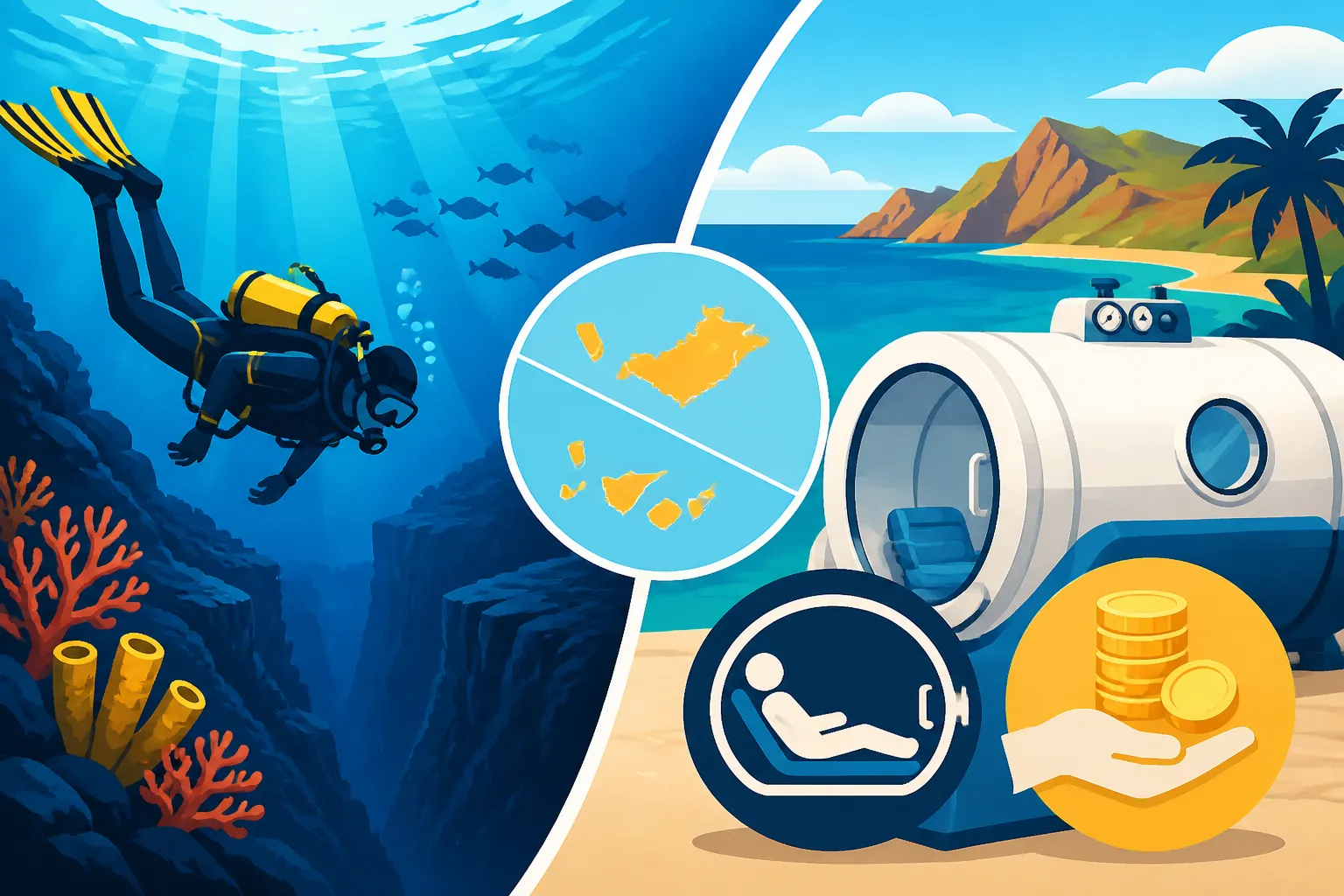
Diving in the Canaries and Balearics: Depth Limits and Chamber Costs
Picture this: you're planning your dream dive trip to the stunning depths of the Canary or Balearic Islands, envisioning vibrant marine life and crystal-clear waters. It's easy to get swept away by the beauty, but there's a serious side to diving that every expat and tourist needs to understand: the risks of decompression sickness and the truly terrifying financial burden if something goes wrong. This isn't just about a ruined holiday; it's about potential life-altering costs. This comprehensive guide will walk you through the essential depth limits, what to do in a dive emergency in Spain, and, crucially, how to protect yourself from the astronomical costs of decompression chamber treatment with reliable dive insurance like SafetyWing.
Disclosure: This post may contain affiliate links. We may earn a commission at no extra cost to you if you make a purchase through these links. Read full disclosure.
Navigating Depth Limits and Best Practices for Diving in the Canary and Balearic Islands
Diving in Spain’s archipelagos offers some truly unforgettable experiences, from the volcanic reefs of the Canaries to the vibrant Posidonia meadows of the Balearics. But with great beauty comes great responsibility, especially when it comes to respecting depth limits and adhering to best practices. Many divers, myself included, have been tempted to push limits, but in unfamiliar waters, that can be a fast track to trouble.
Understanding Recreational Dive Limits
For recreational divers, there are well-established guidelines from certification agencies like PADI and SSI that define safe depth limits based on your training. For an Open Water Diver, the limit is typically 18 meters (60 feet). With an Advanced Open Water certification, that extends to 30 meters (100 feet). If you've gone all the way to Deep Diver Specialty, you might be certified for up to 40 meters (130 feet). Now, these aren't just arbitrary numbers; they are scientifically determined limits based on nitrogen absorption and the risks of decompression sickness (DCS).
It's crucial to understand that these are maximum limits. Just because you can go to 30 meters doesn't mean you should on every dive, especially if the conditions aren't ideal, or if it's your first dive after a long break. Always dive within your comfort zone and current skill level, not just your certification limit. Local dive centers in the Canaries and Balearics are generally very good at enforcing these, and they often have their own internal policies that might be even stricter, depending on the site. If you're doing an introductory dive, expect to stay very shallow, typically no more than 12 meters, always under direct supervision. These limits are for your safety, plain and simple, and should never be seen as a challenge to be overcome.
Environmental Factors and Meticulous Dive Planning
The unique underwater environments of the Canary and Balearic Islands present distinct challenges and require careful planning. The Canaries, situated in the Atlantic, are known for their volcanic rock formations, dramatic drop-offs, and occasionally strong currents. Water temperatures can be cooler than the Mediterranean, ranging from around 18-24°C (64-75°F), meaning thicker wetsuits are often preferred. Visibility is usually excellent, but currents can change quickly, making drift diving common in some areas. Always check the local conditions and listen intently to your dive master's briefing.
The Balearics, nestled in the Mediterranean, boast incredible biodiversity, particularly around the UNESCO-protected Posidonia seagrass meadows. Water temperatures here are generally warmer, especially in summer, often exceeding 25°C (77°F). While currents are typically milder than in the Atlantic, they can still be a factor, particularly around channels and headlands. Regardless of the location, proper dive planning isn't just about reviewing a map; it's about understanding the specific entry and exit points, emergency procedures, bottom times, safety stops, and air consumption rates. Never skip your buddy check, and ensure all your gear is in perfect working order. Going with a reputable dive center that prioritizes safety and local knowledge is absolutely key to a safe and enjoyable experience in either archipelago.
Decompression Sickness (DCS) and Spain's Emergency Response for Divers
Decompression sickness, often called "the bends," is a diver's worst nightmare. It occurs when dissolved gasses (primarily nitrogen) come out of solution and form bubbles in the body during ascent, due to a too-rapid decrease in ambient pressure. Even experienced divers can get it, and recognizing its symptoms and knowing how Spain's emergency services operate can literally be a lifesaver.
Recognizing and Responding to DCS Symptoms
The insidious thing about DCS is that its symptoms can vary wildly and might not appear immediately after a dive. Sometimes it's a nagging joint pain that feels like a strain; other times, it's extreme fatigue, skin rashes, or numbness and tingling. In more severe cases, divers can experience dizziness, paralysis, difficulty breathing, vision problems, or even loss of consciousness. It’s a wide spectrum, which makes it tricky.
The golden rule is: if you suspect DCS, even faintly, seek medical attention immediately. Don't try to "sleep it off" or dismiss it as simple tiredness. Time is of the essence when treating DCS, as delays can lead to permanent damage. Inform your dive buddy, your dive center, and anyone else around you. They will be critical in getting you the right help. Remember, your health is not something to gamble with, especially thousands of kilometers from home.
Activating Emergency Services and Hyperbaric Chambers
Should you or a dive buddy experience symptoms of DCS, the first and most critical step in Spain is to call 112, the universal emergency number. This connects you to emergency services (ambulance, police, fire) in any of Spain’s autonomous communities, including the Canaries and Balearics. When you call, be prepared to clearly state your location, the nature of the emergency (diving accident, suspected DCS), and the victim's symptoms and condition. Speaking a bit of Spanish will greatly assist, but they usually have English-speaking operators available. For more general medical advice or if you just need to find a doctor, learning some Spanish Medical Terminology: Common Words Expats Should Know could prove incredibly useful.
The primary treatment for DCS is recompression in a hyperbaric (decompression) chamber. These specialized facilities simulate increased pressure, forcing the nitrogen bubbles back into solution, and then slowly decompress the patient. Spain is well-equipped with several such chambers, especially in popular diving destinations. In the Canary Islands, you'll find hyperbaric units in major hospitals in Tenerife (like Hospital Universitario Nuestra Señora de Candelaria and Hospital Quirónsalud Costa Adeje) and Gran Canaria (Hospital Universitario de Gran Canaria Doctor Negrín, Hospital San Roque Maspalomas), as well as smaller units in Lanzarote and Fuerteventura. In the Balearic Islands, Mallorca has prominent facilities (such as Hospital Universitario Son Espases and Hospital Quirónsalud Palmaplanas), and Ibiza also has one at Policlínica Nuestra Señora del Rosario. The speed with which a diver can be transported to one of these chambers is paramount. This might involve a rapid ambulance transfer, or in remote island locations, even a helicopter evacuation. This highlights why having a solid emergency plan and the right medical support is so incredibly important for anyone engaging in adventure sports abroad.
The Financial Black Hole: Decompression Chamber Costs in Spain
Now, let's talk about the uncomfortable truth that many divers often overlook until it's too late: the exorbitant costs associated with treating decompression sickness. This isn't just a minor inconvenience; it can be a financial catastrophe that leaves you in crippling debt.
Uninsured Costs of DCS Treatment
Imagine you're diving off Fuerteventura, enjoying the beautiful underwater world, and suddenly you start feeling off after surfacing. You get to a local clinic, and they confirm suspected DCS. Now the clock starts ticking, and so does the meter.
First, there's the emergency transport. If you're on a smaller island or a remote part of a larger one, you might need an emergency ambulance to the nearest medical facility. If the symptoms are severe, or if the local clinic can't handle it, you could be looking at a helicopter evacuation to a major hospital with a hyperbaric chamber on Tenerife or Gran Canaria. An emergency helicopter evacuation in Spain can easily run into the tens of thousands of euros. We're talking €10,000 to €20,000 or more, just for the ride.
Once you arrive at the hospital, there are initial assessments, consultations, and stabilization costs. Then comes the hyperbaric chamber treatment itself. A single recompression session can cost anywhere from €500 to €1,500 per hour, and a typical treatment protocol might involve multiple sessions over several days, sometimes even weeks, depending on the severity of the DCS. On top of that, you have hospital stays, medication, follow-up consultations with neurologists or dive doctors, and potentially rehabilitation if there's any residual damage. All told, a severe case of DCS requiring hyperbaric treatment and medical evacuation could easily accumulate bills upwards of €30,000 to €60,000, or even more, if long-term care is needed. This is not pocket change; this is a mortgage-level expense that can destroy your finances. This is why having robust Health Insurance in Spain: Options for Residents, Students, and Families is so crucial, but for diving, you need something extra.
Let's look at some hypothetical cost breakdowns:
| Service | Estimated Cost (EUR) | Notes |
|---|---|---|
| Emergency Ambulance | €500 – €2,000 | Depends on distance and complexity |
| Helicopter Evacuation | €10,000 – €25,000+ | Highly variable, critical for remote locations |
| Initial Hospital Assessment/Stabilization | €1,000 – €3,000 | Tests, doctor fees, basic care |
| Hyperbaric Chamber Session (per hour) | €500 – €1,500 | Multiple sessions common; total cost depends on treatment length |
| Hospital Stay (per day, beyond treatment) | €500 – €1,500 | Post-treatment observation, general ward or ICU |
| Follow-up Specialist Consultations | €150 – €300 (per visit) | Neurology, dive medicine specialists |
| Rehabilitation/Physical Therapy | €100 – €200 (per session) | If long-term recovery is needed |
| Total for Severe Case | €30,000 – €60,000+ | This is a conservative estimate for an uninsured, severe incident |
Why Your Regular Travel Insurance Might Not Be Enough
Here's where many people make a critical mistake. They assume their bog-standard travel insurance policy, or even their basic private health insurance, will cover them for everything. Think again. Most standard travel insurance policies explicitly exclude "extreme" or "adventure" sports, and diving beyond a certain depth (often 18m or 30m) or involving specific equipment (like mixed gas or rebreathers) frequently falls into this category. You might be covered for a scraped knee, but a multi-thousand-euro helicopter ride and days in a decompression chamber? Probably not. You’ll find that when you scrutinize the small print, many policies have clauses that leave divers high and dry, quite literally. This leads to the painful reality of having to foot these bills out-of-pocket, which for most people is simply not an option.
Even if you have Private Health Insurance for Spain Visas: What Policies Must Include, it's vital to check if it has specific provisions for dive-related emergencies. Many Spanish private insurers offer excellent general medical coverage but may have limits or exclusions when it comes to high-risk activities like deep diving or specialized treatments like hyperbaric therapy. The default is often not to cover it unless specifically added. This gap in coverage is a gaping hole in your financial safety net, and it’s one that must be addressed before you even think about getting in the water.
Your Lifeline in the Deep: Comprehensive Dive Insurance with SafetyWing
Given the potentially catastrophic costs and the common exclusions in typical insurance policies, having specialized dive insurance isn't a luxury; it's an absolute necessity. For those exploring the depths of the Canary and Balearic Islands, or anywhere in Spain, a robust solution like SafetyWing can provide that vital peace of mind.
The Peace of Mind SafetyWing Offers
SafetyWing isn't just another travel insurance; it's designed with the modern nomad and adventurer in mind, offering flexible and comprehensive coverage that genuinely understands the realities of living and traveling abroad. Critically, for divers, SafetyWing provides coverage for hazardous sports, which typically includes recreational scuba diving up to 30 meters. This is a game-changer because it directly addresses the very exclusions that trip up most standard policies.
What does this mean in practice? If you were to suffer from decompression sickness after a dive in the Canaries, SafetyWing could cover the costs of your emergency medical treatment, including that potentially life-saving hyperbaric chamber therapy. Beyond that, it covers emergency medical evacuation, which, as we've discussed, can be an astronomical expense, especially when you're on a remote island. Think about it: an ambulance ride to a local clinic, then potentially a helicopter transfer to a specialized hospital in Tenerife or Mallorca, followed by multiple recompression sessions – all of these major costs are what SafetyWing is designed to mitigate. It means you can focus on your recovery rather than stressing about how you're going to pay for it all. For expats, knowing that you have this level of protection while pursuing your passions is truly invaluable.
How SafetyWing Works for Divers in Spain
One of the great advantages of SafetyWing for those living in or visiting Spain is its simplicity and broad coverage. You can purchase it even if your trip has already started, which is incredibly useful for last-minute decisions or for those who simply forgot to sort out their insurance before they hopped on a plane. The policy is flexible, designed for continuous travel, and can be renewed monthly, making it ideal for longer stays or for expats who regularly take dive trips.
In the event of a dive emergency, like suspected DCS, your first call should still be to 112 for immediate medical assistance. Once you're stable and receiving care, you (or a designated contact) would then contact SafetyWing's 24/7 assistance line. They can help guide you through the process, confirm your coverage, and potentially even arrange for direct billing with the medical facility, alleviating immediate financial stress. While nothing can truly eliminate the stress of a medical emergency, having a comprehensive plan like SafetyWing significantly reduces the financial burden and logistical nightmare. So, before you grab your fins and mask for that next incredible dive in the Balearics or Canaries, make sure you've got your SafetyWing policy sorted. It's the smartest investment you can make in your underwater adventure.
Disclaimer
The information provided in this guide is for general informational purposes only and does not constitute medical, legal, or financial advice. While we strive to provide accurate and up-to-date information, local regulations, medical practices, and insurance policies can change. Always consult with a qualified medical professional, dive instructor, and your chosen insurance provider to confirm coverage details and ensure your safety and compliance with all applicable laws and guidelines for diving in Spain.