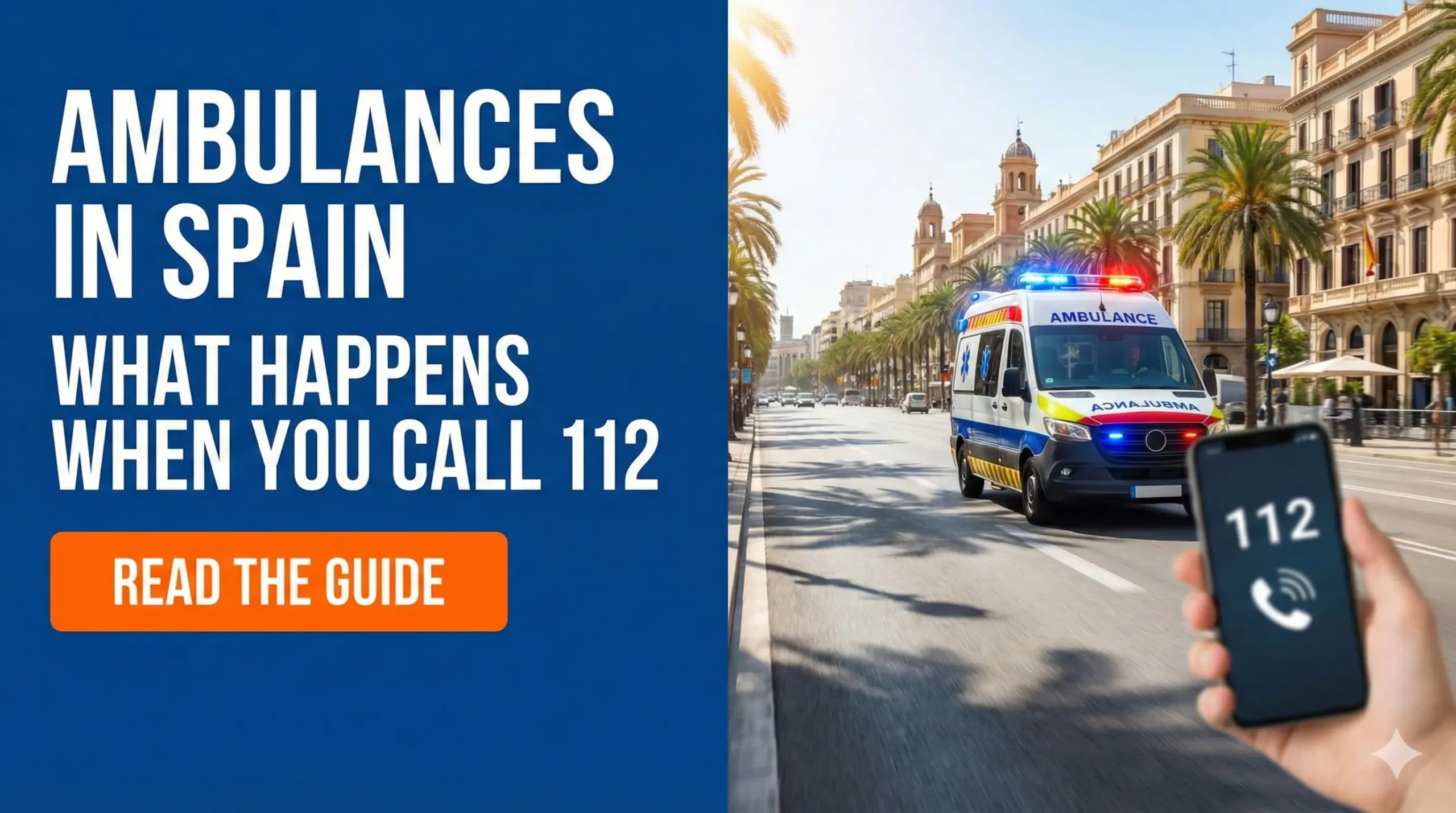
Ambulances in Spain: What Happens When You Call 112
Discover exactly what happens when you call 112 for a medical emergency in Spain. This comprehensive guide covers the dispatch process, advanced versus basic ambulance types, language support, and potential costs for expats, tourists, and residents navigating the Spanish healthcare system.
Disclosure: This post may contain affiliate links. We may earn a commission at no extra cost to you if you make a purchase through these links. Read full disclosure.
The Universal Emergency Network 112
If you remember nothing else from this guide, remember this number: 112.
The number 112 is the universal emergency telephone number established across all member states of the European Union, including Spain. It is the exact equivalent of dialing 911 in the United States or 999 in the United Kingdom. In Spain, the 112 system is a centralized dispatch hub. When you dial this number, you are not calling a specific hospital or a local police station; you are calling a massive, highly integrated regional emergency coordination center.
Technical Accessibility and Geolocation
The 112 service is designed to be accessible under almost any circumstance.
- Free of Charge: Calling 112 is completely free from any public payphone, landline, or mobile phone.
- No SIM Card Required: You can dial 112 from a mobile phone even if it does not have a SIM card inserted, provided there is a signal from any available network carrier.
- Locked Screens: You can dial the emergency number from a locked smartphone without needing the passcode or facial recognition.
- Network Roaming: If your specific mobile carrier does not have coverage in the area where you are experiencing the emergency, your phone will automatically piggyback on the strongest available network from a competitor to connect the 112 call.
Furthermore, Spain utilizes Advanced Mobile Location technology. When you call 112 from a smartphone, the device automatically sends an incredibly precise GPS location to the emergency dispatch center. While you must still verbally confirm your address, this technology ensures that if the call drops or the caller falls unconscious, the ambulance can still be routed to the exact geographic coordinates.
Language Support and The Language Barrier
One of the most profound fears for foreigners experiencing a medical emergency in Spain is being unable to communicate their symptoms to the dispatcher. The Spanish emergency system is acutely aware of its massive tourist industry and its large expatriate population, and the dispatch centers are equipped to handle this reality.
When the operator answers the phone, they will typically say, “112 Emergencias, ¿dígame?” If you do not speak Spanish, you should immediately state the language you do speak, for example, “English, please.”
The major 112 coordination centers in regions with high foreign populations—such as Madrid, Catalonia, Andalusia, the Balearic Islands, and the Canary Islands—have permanent operators on staff who speak fluent English, French, and German. If an English-speaking operator is not immediately available to take your call, the system utilizes a real-time tele-translation service. Within seconds, a professional translator is conferenced into the call to relay your information to the Spanish dispatcher. You will not be denied help simply because you cannot speak the local language.
The Dispatch Process and Triage Protocols
When you connect to a 112 operator, they are trained to follow a strict, algorithmic protocol designed to gather the most critical information in the shortest amount of time.
The operator is not a doctor, but rather a highly trained emergency coordinator. Their primary goal is to determine the location of the emergency and the severity of the medical threat to dispatch the correct resources. To better understand how this initial phone call fits into the broader timeline of urgent medical interventions, you should review our guide on Emergency Healthcare in Spain: 112, Urgent Care, and What to Expect.
The Questions You Will Be Asked
To expedite the dispatch of the ambulance, try to remain as calm as possible and answer the operator’s questions clearly. The typical sequence of questions includes:
- What is the exact location? The operator will ask for the province, the municipality, the street name, the building number, the floor, and the door number. If you are on a highway, look for the nearest kilometer marker.
- What is the phone number you are calling from? They need this in case they need to call you back for updates or if the ambulance driver cannot find the address.
- What is the emergency? Keep your description brief and objective. (e.g., “My husband is experiencing severe chest pain and cannot breathe,” or “There has been a car accident and a pedestrian is unconscious.”)
- Is the patient conscious? This is a critical triage question.
- Is the patient breathing normally? This dictates the type of ambulance dispatched.
- Is there severe bleeding? Depending on your answers, the 112 operator will immediately route the request to the regional medical dispatch center. Often, while the ambulance is already on its way, the operator will transfer your call to a coordinating medical doctor (médico coordinador). This doctor will stay on the line with you to provide vital first-aid instructions, such as how to perform CPR or how to position an unconscious patient safely, until the physical help arrives.
Regional Variations in Ambulance Names
While you only need to dial 112, the ambulance that ultimately arrives at your location might display different branding depending on where you are in Spain. Healthcare is decentralized and managed by the autonomous communities, resulting in different acronyms for the local emergency medical services.
If you are in Madrid, for example, you might see a bright yellow ambulance branded as SUMMA 112 (the regional service) or SAMUR (the specific municipal service for the city center). In Catalonia, the ambulances are branded as SEM (Sistema d’Emergències Mèdiques). In Andalusia, they operate under the banner of 061. Regardless of the acronym painted on the side of the vehicle, they all operate under the same strict national medical standards and are dispatched seamlessly through the 112 hub.
Types of Spanish Ambulances SVB vs SVA
In many countries, an ambulance is simply a transport vehicle staffed by paramedics. The Spanish system is much more stratified. The 112 medical coordinator evaluates the severity of your reported emergency and decides exactly what level of medical technology and personnel is required.
There are two primary categories of emergency ambulances in Spain. Sending the right type is crucial; sending an advanced unit to a minor injury wastes critical resources, while sending a basic unit to a cardiac arrest can result in tragedy.
Soporte Vital Básico
The Soporte Vital Básico, frequently abbreviated as SVB, is the Basic Life Support ambulance. This is the most common type of emergency vehicle on Spanish roads.
The SVB is staffed by two highly trained Emergency Medical Technicians. These technicians are equipped to handle trauma stabilization, basic airway management, oxygen therapy, automated external defibrillation, and the safe immobilization and transport of patients. If you call 112 for a broken leg, a mild allergic reaction, or a severe but non-life-threatening infection, an SVB unit will be dispatched to transport you to the hospital.
Soporte Vital Avanzado
The Soporte Vital Avanzado, abbreviated as SVA and commonly referred to as a UVI Móvil (Mobile Intensive Care Unit), is the heavy artillery of the Spanish emergency medical system.
Unlike the basic units, an SVA is a miniature rolling hospital. More importantly, it is staffed by a specialized emergency physician, an emergency nurse, and a driver technician. Because there is a licensed medical doctor on board, the SVA crew can perform highly complex, life-saving interventions at the scene of the emergency. They can administer intravenous narcotics, perform emergency surgical airways, interpret complex electrocardiograms, and utilize mechanical ventilators before the patient ever reaches the hospital doors. SVAs are dispatched for cardiac arrests, major strokes, severe multi-vehicle traumas, and massive hemorrhages.
Ambulance Type Comparison Table
To help clarify the distinctions, the following table breaks down the capabilities of the two main emergency vehicles.
| Feature | Soporte Vital Básico (SVB) | Soporte Vital Avanzado (SVA / UVI Móvil) |
| English Equivalent | Basic Life Support (BLS) | Advanced Life Support (ALS) / Mobile ICU |
| Primary Staffing | 2 Emergency Medical Technicians | 1 Doctor, 1 Nurse, 1 or 2 Technicians |
| Medical Authority | Basic first aid, AED use, oxygen delivery | Complex diagnostics, surgical interventions |
| Medication Capacity | Very limited (e.g., oxygen, basic analgesics) | Full mobile pharmacy (IV drips, narcotics, anesthetics) |
| Typical Dispatch | Broken bones, non-critical injuries, stable illnesses | Cardiac arrest, severe trauma, respiratory failure |
In addition to these emergency units, you will also see Ambulancias No Asistenciales on the roads. These are non-emergency patient transport vehicles. They are used exclusively to move stable patients between hospitals or to transport elderly or disabled patients to scheduled medical treatments, such as dialysis or chemotherapy. They are not dispatched for 112 emergency calls.
Arrival and Destination Decisions
When the ambulance crew arrives at your location, their immediate priority is to assess and stabilize the patient. The paramedics or the onboard doctor will take vital signs, gather a brief medical history, and provide initial treatment.
Once the patient is stable enough to be moved, a critical decision must be made regarding the destination. You cannot simply demand that the ambulance take you to a specific hospital because you prefer the cafeteria there. The ambulance crew, in communication with the regional dispatch center, will transport the patient to the nearest appropriate public hospital that is equipped to handle the specific medical issue.
If you are suffering a major trauma, the ambulance might bypass a smaller local hospital to take you to a major regional trauma center. If you are a foreigner trying to decide whether you actually need an ambulance or if you should just take a taxi to a local clinic, reading our breakdown on Urgent Care vs Emergency Room in Spain: When to Use Each will provide clarity on where to direct yourself for non-critical ailments.
The Cost of an Ambulance in Spain
A major point of anxiety for expatriates and tourists is the potential financial ruin associated with emergency medical transport. In countries like the United States, an ambulance ride can cost thousands of dollars, causing some individuals to refuse necessary medical transport. The situation in Spain is vastly different, but the cost depends entirely on your residency and insurance status.
Residents and the Public Healthcare System
If you are an expatriate who is living and working legally in Spain and contributing to the Spanish Social Security system, you are fully covered by the public healthcare network. For residents integrated into the public system, emergency ambulance transport dispatched by 112 is completely free of charge. There are no copayments, hidden fees, or invoices sent after the fact. The cost is entirely subsidized by the state. To ensure your paperwork is in order to claim this right, review our detailed explanation of Who Can Access Public Healthcare in Spain? Eligibility Basics.
Tourists from the European Union
If you are visiting Spain from another country within the European Union, the European Economic Area, or Switzerland, you are protected by the European Health Insurance Card. If you experience a medical emergency and call 112, the public ambulance will transport you to a public hospital, and the costs will be covered under the reciprocal EHIC agreements. You must present your valid EHIC card to the hospital administration upon arrival.
Non-EU Tourists and Unregistered Expats
If you are a tourist from outside the European Union (such as the United States, Canada, or Australia) or an expat who has not yet registered for public healthcare or private insurance, the situation is different.
The emergency services will absolutely respond to your call. A Spanish ambulance will never deny you life-saving transport or treatment based on your inability to pay upfront. However, the public hospital will eventually generate an invoice for the services rendered, including the ambulance dispatch.
Compared to American prices, the bills are highly reasonable but still significant. A standard SVB ambulance ride for a tourist might generate a bill ranging from €150 to €400, depending on the distance and the autonomous community. If a highly specialized SVA mobile intensive care unit is dispatched, the cost can escalate significantly. If an emergency medical helicopter is required for a mountain rescue or island transfer, the bill can easily exceed €5,000. It is the patient’s responsibility to pay this invoice and seek reimbursement from their personal travel insurance provider.
Public vs Private Ambulances
Spain operates a dual healthcare system, featuring both a robust public sector and a thriving private medical industry. This dual system applies to ambulances as well.
If you hold a private health insurance policy—which is a strict legal requirement for many foreign residents securing non-lucrative or student visas—your policy likely includes private emergency transport. The major private insurance providers, such as Sanitas, Adeslas, and DKV, operate their own dedicated emergency phone numbers and contract their own fleets of private ambulances.
If you experience a medical issue that requires transport but is not an immediate life-or-death crisis, you can call your private insurer’s emergency hotline. They will dispatch a private ambulance to transport you directly to a private hospital within their network. This allows you to bypass the crowded public hospital waiting rooms. To understand the broader differences in service and wait times between these two sectors, you can explore our comparison of the Spain Healthcare System for Expats: Public vs Private.
However, there is a critical caveat. In the event of a catastrophic, life-threatening emergency—such as a massive heart attack, a severe car accident, or an active stroke—you should always dial 112, regardless of your private insurance status. The public 112 network has a vastly superior geographical density of highly equipped SVA mobile ICUs and trauma helicopters. Your primary goal in a life-or-death scenario is surviving the next hour, and the public 112 system is the fastest way to secure advanced medical intervention. If you are currently evaluating which private policy best suits your lifestyle and visa needs, referencing our guide on Health Insurance in Spain: Options for Residents, Students, and Families is highly recommended.
What to Do While Waiting for the Ambulance
Once you have hung up the phone with the 112 operator, the minutes waiting for the sirens to arrive can feel like hours. To ensure the paramedics can act as quickly as possible upon arrival, take the following steps:
- Do Not Move the Patient: Unless the patient is in immediate physical danger (such as inside a burning building or in the middle of a busy highway), do not attempt to move them, especially if a neck or spinal injury is suspected.
- Clear the Pathway: Unlock the front door of your home or apartment building. Turn on all the exterior lights if it is nighttime. Move furniture out of the hallway to ensure the paramedics can easily bring a stretcher into the room.
- Secure Pets: Lock dogs and cats in a separate room. Even the friendliest pets can become aggressive or get underfoot when strangers rush into the house during a stressful situation.
- Send Someone Outside: If there are multiple people present, send one person down to the street level to flag down the ambulance and guide the crew directly to the patient.
- Gather Documentation: While waiting, collect the patient’s passport or identification card, their public health card or private insurance card, and a list of any medications they are currently taking. Handing this directly to the doctor upon arrival saves vital diagnostic time.
Conclusion
Navigating a medical emergency in a foreign country requires preparation, composure, and a clear understanding of the local infrastructure. The Spanish 112 emergency network is a highly sophisticated, multilingual lifeline designed to dispatch the right level of medical care to your exact location in minutes.
By understanding the difference between a basic transport unit and an advanced mobile intensive care unit, knowing how to communicate effectively with the dispatchers, and ensuring you have the appropriate healthcare coverage in place, you can face the unexpected with confidence. In Spain, no matter where you are or what language you speak, life-saving help is always just three digits away.
References
Primary sources (official)
- 112 Emergency Services Portal Spain: https://www.112.es/
- Ministerio de Sanidad (Spanish Ministry of Health): https://www.sanidad.gob.es/
- Dirección General de Protección Civil y Emergencias: https://www.proteccioncivil.es/
Other helpful sources
- Citizens Advice Bureau Spain (Healthcare and Emergency Guides): https://www.citizensadvice.org.es/
- UK Government Official Guide to Healthcare in Spain: https://www.gov.uk/guidance/healthcare-in-spain
Disclaimer
The information provided in this article is for general informational and educational purposes only and does not constitute formal medical or legal advice. Emergency response protocols, regional ambulance branding, and specific billing structures can vary significantly depending on the autonomous community and your specific insurance provider. Always dial 112 immediately if you or someone else is experiencing a severe medical emergency. Do not delay seeking professional medical care based on information read online.