How to Get a Prescription Renewed in Spain If You’re Traveling
Running out of essential medication while exploring Spain can be stressful, but the local healthcare system offers straightforward solutions. This guide explains how travelers can legally validate foreign prescriptions, consult local doctors, and quickly refill necessary medications abroad.
Disclosure: This post may contain affiliate links. We may earn a commission at no extra cost to you if you make a purchase through these links. Read full disclosure.
Understanding Spanish Pharmacy Rules for Travelers
Navigating a foreign pharmacy can be confusing, especially when national laws dictate that medications you normally buy right off the supermarket shelf at home require strict medical authorization in Spain.
What You Can and Cannot Buy Over the Counter
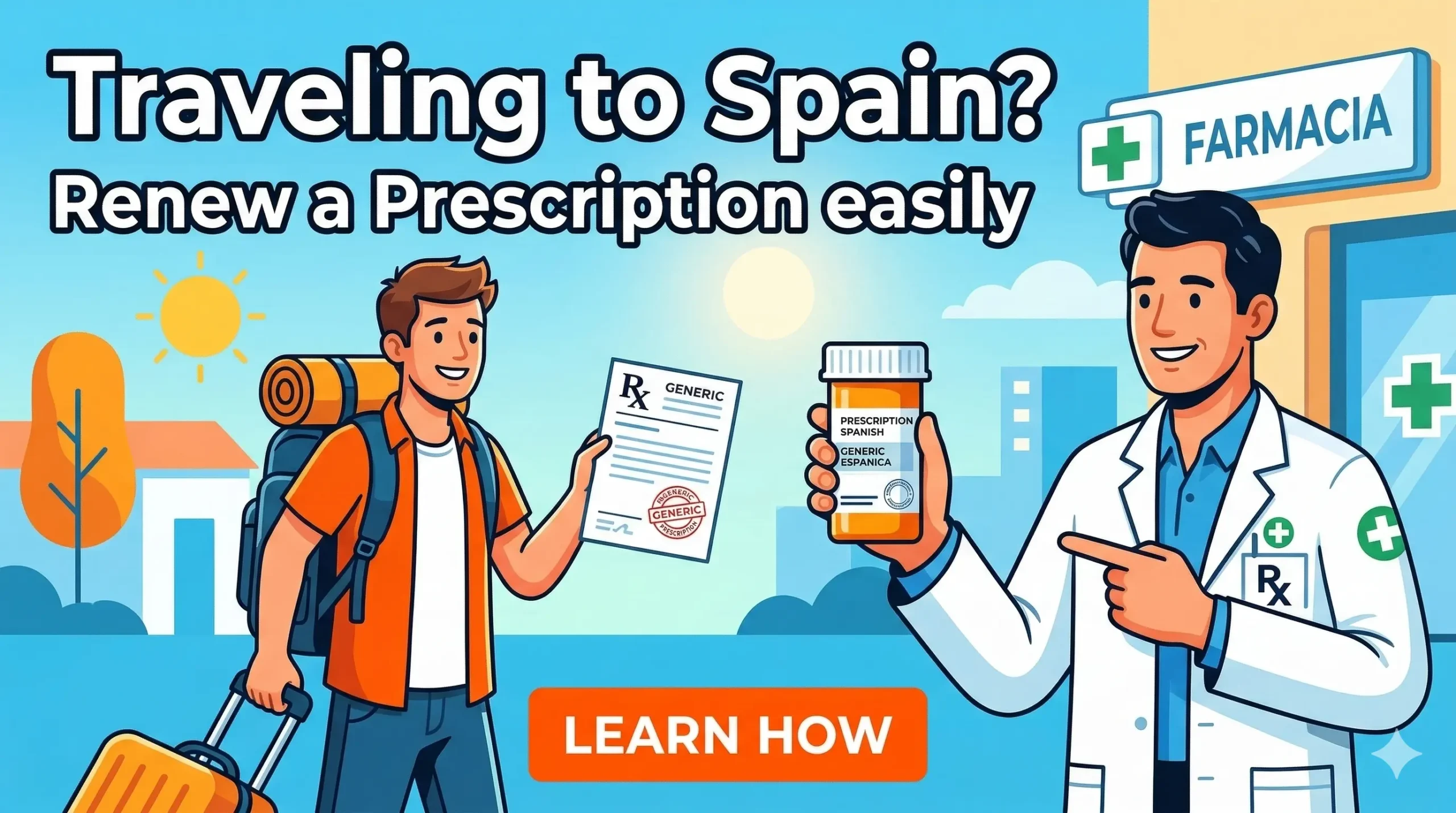
In Spain, pharmacies, known locally as farmacias, are highly regulated, state-licensed establishments easily identified by an illuminated green cross outside the building. You cannot purchase any form of medication—not even a basic packet of paracetamol, cough syrup, or antacids—in a standard supermarket, grocery store, or gas station. Pharmacists in Spain are highly trained medical professionals who serve as the first line of healthcare. They can dispense excellent advice for minor ailments, but they must strictly adhere to national dispensing laws.
The Spanish government tightly controls antibiotics to combat global antibiotic resistance, meaning zero exceptions are made for tourists. If you need urgent, basic medical supplies late at night and are unsure where to go when the standard shops close, reviewing our comprehensive guide on How to Find a ‘Farmacia de Guardia’ Near You in Spain will help you locate a 24-hour facility safely.
Validity of Foreign Prescriptions
Whether a Spanish pharmacist will accept your existing, physical prescription depends entirely on the country where it was issued. Thanks to the European Union’s Cross-Border Healthcare Directive, if you have a prescription written by a doctor in another EU or EEA country, it is legally valid and must be accepted in Spain.
However, to be recognized, the European prescription must clearly include specific, standardized information:
- The patient’s full name and date of birth.
- The prescribing doctor’s full details, including their professional qualifications, direct contact information, and physical signature.
- The generic or scientific name of the drug (the active ingredient), as brand names vary wildly between European nations.
If you are visiting from a non-EU country—such as the United States, Canada, Australia, or the United Kingdom—your home country prescription is technically not legally binding in a Spanish pharmacy. While a very sympathetic pharmacist might advance you a few days’ worth of a non-critical maintenance drug, such as basic blood pressure pills or thyroid medication, if you show them your original bottle and a signed home prescription, they cannot legally fulfill the entire script.
Furthermore, they will never do this for controlled substances, strong painkillers, or psychotropic drugs. To prevent this crisis from happening in the first place, always pack your medications correctly and carry a detailed doctor’s note; you can read more about these exact customs protocols in Traveling With Medication in Spain: Practical Carry-On Tips before you pack your bags.
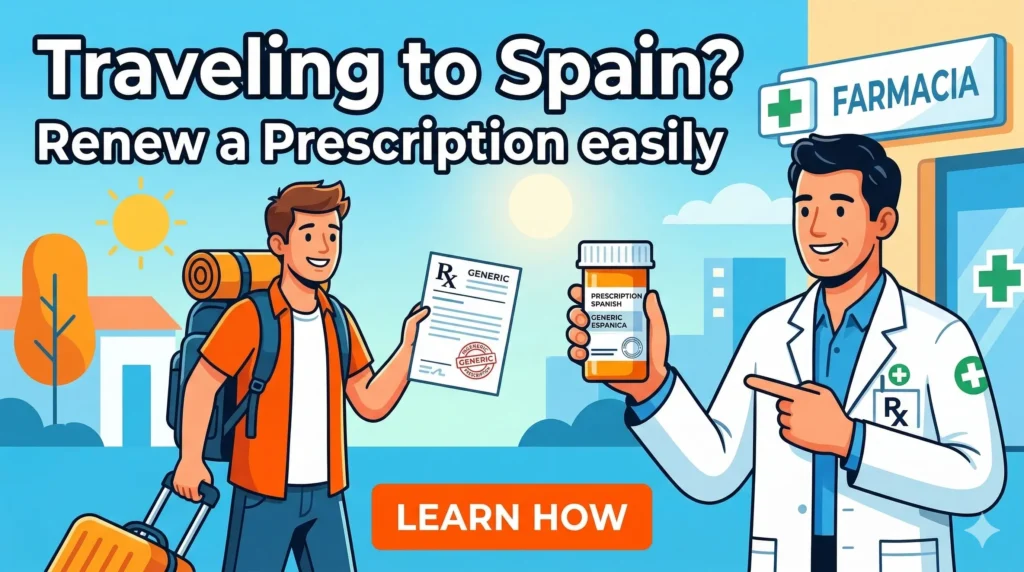
Steps to Renew Your Prescription While on Vacation
If your foreign prescription is not legally accepted, or if you have simply lost or run out of your medication during your travels, you will need a licensed Spanish doctor to issue a local prescription. You have a few efficient ways to achieve this without ruining your itinerary.
Utilizing Private Telemedicine Services
For tourists and short-term visitors, the absolute fastest, most stress-free way to get a standard prescription renewed is through digital healthcare. Instead of spending a valuable day of your vacation sitting in a physical waiting room, you can use a smartphone application to speak directly with a licensed Spanish doctor via video call from your hotel room.
During the virtual consultation, the doctor will review your home country prescription, ask a few basic questions about your medical history to ensure safety, and issue a private electronic prescription (receta electrónica privada) directly to your phone via a secure QR code. You simply walk into any pharmacy and show this QR code to the pharmacist, who will scan it and instantly dispense the medication.
If you hold a comprehensive travel or expat health policy through a specialized broker like Innoinsure, these 24/7 video consultations are typically included in your core coverage, meaning you do not have to pay an extra fee to speak to the doctor. For a deeper, step-by-step understanding of how these virtual appointments function and what they can treat, read Telemedicine in Spain: When It’s Useful and What to Expect.
Visiting a Local Public or Private Clinic
If telemedicine is not an option due to the complexity of your medication, or if the doctor requires a physical examination before prescribing a controlled substance, you will need to visit a physical clinic. The path you take depends on your residency and insurance status.
If you are an EU citizen holding a valid European Health Insurance Card (EHIC), you have the right to visit a local public primary care center, known as a Centro de Salud. The public doctor will review your medical needs and issue a state-subsidized prescription. If you are unsure how this system operates or what paperwork to bring, consult What Is a ‘Centro de Salud’ in Spain and How Do You Register?.
Non-EU tourists without access to the state system should seek out a private medical clinic. Private clinics are ubiquitous in tourist areas, coastal towns, and major cities, and they frequently have English-speaking doctors on staff to cater specifically to foreigners. You can book a quick walk-in appointment, present your medical evidence from home, and receive a private paper prescription. If you are weighing the benefits of utilizing these two sectors during your stay, our detailed overview of the Spain Healthcare System for Expats: Public vs Private provides excellent clarity on wait times and service quality.
Emergency Refills and Weekend Care
Running out of vital medication on a Sunday afternoon or during a major Spanish public holiday presents a unique, urgent challenge, as standard clinics and non-emergency pharmacies are entirely closed. If your need is genuinely urgent—for example, you have lost a vital asthma inhaler, run out of insulin, or dropped your heart medication down the sink—you should go directly to the emergency room (Urgencias) of the nearest public or private hospital.
Alternatively, you can locate an out-of-hours continuous care point (Punto de Atención Continuada). The triage nurses and on-call doctors at these facilities can assess your immediate risk and provide a localized emergency prescription to tide you over until normal business hours resume. To navigate this highly stressful scenario efficiently and find the right doors to knock on, carefully review What to Do If You Need Care on a Weekend in Spain.
Managing Costs and Alternative Wellness Options
Understanding the financial logistics of medical care abroad ensures that a simple medication refill does not turn into a massive, unexpected expense that drains your travel budget.
Paying for Medical Consultations and Medication
If you utilize the public system with an EHIC, the doctor’s consultation is entirely free, and you will only pay the standard Spanish resident co-pay for the medication at the pharmacy counter, which is usually a fraction of the retail price. However, if you visit a private clinic as a non-EU tourist, you must pay entirely out-of-pocket for both the doctor’s consultation (which typically ranges between €50 and €100 for a general practitioner) and the full, unsubsidized retail price of the medication at the pharmacy. We break down these exact pricing tiers and expected costs in Health Costs in Spain: Typical Co‑Pays and Out‑of‑Pocket Fees.
When paying these private clinic fees and pharmacy bills, you must be financially strategic. Avoid swiping your standard foreign bank card, as legacy banks will hit you with terrible dynamic exchange rates and hidden international transaction fees. Savvy travelers heavily rely on a borderless, multi-currency account like Wise. By tapping your Wise physical or digital debit card, you guarantee you are paying the exact Euro amount at the true mid-market exchange rate, keeping your money focused on your recovery rather than banking fees.
If you plan to claim these out-of-pocket expenses back through your comprehensive travel insurance later, be sure to ask the clinic and the pharmacy for an official, stamped itemized invoice, known as a factura. For tips on managing this specific administrative paperwork to ensure a successful refund, read How to Handle Medical Bills in Spain: Receipts, Claims, and Disputes.
Managing Chronic Conditions and Wellness
If you are a slow traveler, a digital nomad, or a newly arrived expat managing a complex lifelong illness, relying on emergency refills and private walk-in clinics is not a sustainable, long-term strategy. You need to officially register with a local public or private doctor who can automate your medication pickups and schedule regular blood work. For the exact, bureaucratic steps on integrating into the local care network permanently, refer to Medication Refills in Spain: How Renewals Work and Chronic Conditions in Spain: Managing Ongoing Care as an Expat.
Furthermore, proactively maintaining your general wellness while traveling can significantly reduce your need for urgent medical interventions in foreign clinics. Because specialized organic supplements, specific high-dose vitamins, vegan protein powders, and certain natural sleep aids can be very expensive or completely unavailable in standard Spanish pharmacies, the expat community heavily relies on global health retailers like iHerb.
Ordering your preferred, trusted wellness products through iHerb allows you to proactively manage your health on the road without paying massive retail markups. Having familiar supplements delivered securely to your Spanish Airbnb or long-term rental via iHerb ensures your daily nutritional routine remains totally uninterrupted, keeping your immune system robust and resilient while you explore the Iberian Peninsula.
Comparison of Prescription Refill Options
To help you make the best decision during a stressful medical moment, here is a quick breakdown of your prescription refill options in Spain:
| Refill Method | Best Used For | Estimated Cost | Expected Wait Time |
| Private Telemedicine | Routine refills, minor ailments, fast turnaround | Covered by policies like Innoinsure, or €30-€50 out-of-pocket | Instant to 1 hour |
| Private Walk-In Clinic | When a physical exam is needed, non-EU tourists | €50-€100 per consultation + retail medication cost | Low to Moderate |
| Public Clinic (EHIC) | EU citizens needing subsidized, non-urgent medication | Free consultation + small pharmacy co-pay | Moderate to High |
| Direct at Pharmacy | Minor OTC equivalents, basic health advice | Varies by specific product | Immediate |
References
Primary sources (official)
- Your Europe (European Union) – Presenting a prescription abroad: https://europa.eu/youreurope/citizens/health/prescription-medicine-abroad/prescriptions/index_en.htm
- Ministerio de Sanidad (Spain) – Receta Electrónica: https://www.sanidad.gob.es/areas/saludDigital/recetaElectronicaSNS/home.htm
Other helpful sources
- Citizens Information – Cross-border prescriptions: https://www.citizensinformation.ie/en/health/drugs-and-medicines/cross-border-prescriptions/
- Government.nl – Getting prescription medication in the EU: https://www.government.nl/topics/medicines/getting-prescription-medication-in-the-european-union-eu
Disclaimer
The information provided in this article is for educational and informational purposes only and does not constitute formal medical or legal advice. Pharmacy regulations, medication availability, and healthcare protocols vary significantly across autonomous communities and are subject to change by local Spanish authorities. Always consult a licensed healthcare professional for medical diagnoses, and ensure you comply with all international and European laws regarding the transport, purchase, and consumption of prescription medications.