Health Apps in Spain: Booking, Records, and Telemedicine Options
Disclosure: This article contains affiliate links. If you buy through them, we may earn a commission at no extra cost to you. Read our full disclosure.
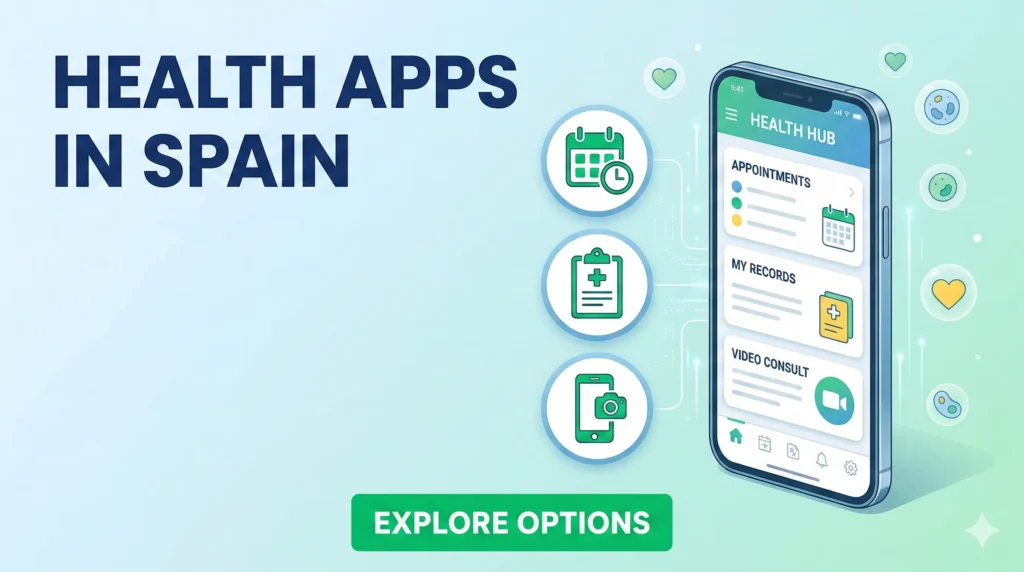
Managing your healthcare in Spain has become remarkably efficient thanks to a robust network of digital tools. From booking public GP appointments to accessing private specialist telemedicine, these essential health applications allow expats to navigate the Spanish medical system directly from their smartphones.
The Digital Transformation of Spanish Healthcare
Public Versus Private Health Ecosystems
Spain boasts a highly digitized healthcare infrastructure, but expats must first understand the fundamental divide between the public and private sectors. The public system, the Sistema Nacional de Salud (SNS), offers mobile applications focused primarily on administrative efficiency and patient record centralization. These public apps allow residents to manage primary care appointments, access long-term clinical histories, and track state-subsidized electronic prescriptions. They are designed to manage population health at scale, ensuring that your public medical data is securely stored and accessible to state medical professionals.
In contrast, the private healthcare sector treats its digital platforms as premium customer service tools. Private insurance applications from major providers prioritize speed, user experience, and on-demand access. These private apps often feature sleek interfaces that allow you to bypass primary care gatekeepers and book specialists directly. They also integrate advanced features like instant video consultations, digital authorization requests for complex diagnostic imaging, and direct messaging with customer support.
For expats, choosing which ecosystem to prioritize depends entirely on your residency status and health coverage. Many long-term residents utilize a hybrid approach, using their regional public app for ongoing chronic care and vaccinations, while maintaining a private app for rapid specialist access. If you are currently deciding how to structure your medical coverage, reviewing our foundational guide on the Spain Healthcare System for Expats: Public vs Private will provide the necessary context for setting up these digital tools.
Understanding Regional Fragmentation
One of the most confusing aspects of public digital health in Spain is its profound regional fragmentation. The Spanish healthcare system is decentralized, meaning that each of the 17 autonomous communities independently manages its own public health network and, consequently, its own proprietary mobile application. There is no single “Spanish National Health App” for daily medical management.
To bridge this gap, the Spanish national government developed the Mi Carpeta Ciudadana (My Citizen Folder) app. This national platform aggregates data from various state departments and includes access to the Historia Clínica Digital del Sistema Nacional de Salud (HCDSNS). While it does not allow you to book a daily GP appointment, it enables a doctor in Andalusia to securely pull your clinical reports from your time living in Madrid, ensuring that your core medical history remains interoperable across regional borders.
Security and Data Privacy Standards
Medical data is universally classified as highly sensitive information, and Spain enforces some of the strictest data privacy regulations in the world. All Spanish health applications must comply rigorously with the European Union’s General Data Protection Regulation (GDPR) and Spain’s domestic Organic Law on Data Protection and Guarantee of Digital Rights (LOPDGDD).
This stringent legal framework ensures that your virtual medical history is heavily encrypted. Public and private health apps use advanced secure socket layer (SSL) protocols and require robust two-factor authentication for access. Your medical data cannot be legally shared with your employer, third-party marketers, or immigration authorities without your explicit, written consent. The systems also maintain comprehensive audit trails; patients have the legal right to request a log showing exactly which medical professionals have accessed their digital files and when.
Navigating Public Health Applications
Booking Primary Care Appointments
The most frequently utilized feature of any regional public health app is the appointment booking system (Cita Previa). Gone are the days when patients had to queue outside a local Centro de Salud (Health Center) at 8:00 AM simply to secure a time slot with their doctor. The digital transition allows you to manage your schedule with a few taps on your smartphone.
When you open your regional app, you can seamlessly request an appointment with your assigned general practitioner (médico de cabecera), your designated primary care nurse, or the administrative desk. The system displays an interactive calendar with available time slots, allowing you to choose between a physical in-person visit or a telephone consultation (cita telefónica). The app also provides automatic reminders and allows you to cancel or reschedule appointments instantly, freeing up the slot for another patient.
Accessing the Virtual Health Card
Historically, accessing public healthcare in Spain required carrying a physical plastic card, known as the Tarjeta Sanitaria Individual (TSI or SIP card). Today, the majority of regional health applications feature a “Virtual Health Card” function, fundamentally transforming how you interact with clinics and pharmacies.
The virtual card displays your name, your unique patient identification number (CIP), and a secure, scannable barcode or QR code. For expats, the virtual health card is particularly useful during the interim period of renewing residency documents. If your physical card is lost or expired, the digital version often updates automatically once your social security status is verified in the backend, allowing your healthcare access to continue uninterrupted while you wait for a new plastic card to arrive in the mail.
Managing Electronic Prescriptions
Spain operates a highly advanced, nationwide electronic prescription system (receta electrónica). When your public doctor prescribes a medication, they no longer hand you a signed slip of paper. Instead, the prescription is digitally attached to your health profile and instantly synchronized with the central pharmaceutical database.
Because public prescriptions are heavily subsidized by the state based on your income bracket, the out-of-pocket copayment is usually minimal. However, if you are managing small administrative fees or paying for over-the-counter additions at the pharmacy, utilizing a Wise multi-currency card is a highly effective way to manage these daily Euro transactions without incurring hidden conversion fees from your home bank.
Top Regional Health Apps for Expats
La Meva Salut in Catalonia
Catalonia’s public health application, La Meva Salut (My Health), is widely considered one of the most comprehensive and feature-rich portals in the country. Serving the massive expat populations of Barcelona and the wider region, the app provides deep access to clinical reports, surgical discharge summaries, and a comprehensive timeline of administered vaccines.
The standout feature of La Meva Salut is the eConsulta service. This secure, asynchronous messaging tool allows patients to communicate directly with their assigned primary care doctor or nurse. Expats can use eConsulta to ask non-urgent medical questions, request renewals for chronic prescriptions, or even attach photos of mild skin rashes for a preliminary assessment. This often entirely eliminates the need for a physical appointment, saving significant time for both the patient and the doctor.
The app also allows users to link the profiles of their children or legal dependents, creating a centralized family health dashboard. To understand how to best utilize this feature for tracking childhood immunizations and navigating the Catalan pediatric system, review our specialized guide on Pediatric Care in Spain: Choosing a Pediatrician.
Tarjeta Sanitaria Virtual in Madrid
The Community of Madrid heavily upgraded its digital infrastructure with the launch of the Tarjeta Sanitaria Virtual (Virtual Health Card) app. Initially developed as a simple digital ID and a repository for EU Digital COVID Certificates, the application has evolved into a robust healthcare management tool for the capital’s residents.
A major recent addition to the Madrid app is the integration of video consultation capabilities. While still primarily used for specific follow-ups rather than initial primary care triage, this feature bridges the gap between traditional telephone appointments and physical visits. The app also features a dedicated section for informed consents, allowing patients to digitally sign required legal documentation before undergoing minor procedures.
ClicSalud Plus in Andalusia
Andalusia takes a slightly different architectural approach to digital health, utilizing a hub-and-spoke model. The central web portal is ClicSalud+, which provides deep access to clinical history, laboratory tests, and tracking for surgical waiting lists. On mobile devices, this is aggregated through the Salud Andalucía application.
The Salud Andalucía app acts as a central repository that houses several highly specialized, standalone applications. To book an appointment, users interact with the integrated Salud Responde module. To manage electronic prescriptions and medication alarms, they use the Mi Prescripción module. While this modular approach can feel slightly fragmented to new users, it allows the regional government to push specialized updates rapidly.
Private Health Insurance Portals
Streamlined Specialist Booking
For expats holding comprehensive private health insurance, the digital experience is drastically different. Applications provided by massive private healthcare groups—such as Sanitas, Adeslas, DKV, and Mapfre—are designed to empower the patient as a consumer. The most significant advantage of these private portals is the complete elimination of the primary care gatekeeper.
When you open your private insurance app, you are presented with a searchable medical directory (cuadro médico). You can filter this directory by specialty, geographic location, and clinic rating. Crucially for expats, many of these apps allow you to explicitly filter doctors by the languages they speak. If you need to see a cardiologist who speaks fluent English, you can find them and book an appointment directly into their digital calendar within seconds.
This immediate, friction-free access to specialized care is the primary reason many expats opt for private coverage. If you are currently evaluating private insurance options to secure this level of digital convenience, utilizing a specialized international broker like Innoinsure ensures you are matched with a provider that offers top-tier, English-friendly mobile applications.
Requesting Medical Authorizations
In the private healthcare sector, complex diagnostic procedures (like MRI or CT scans), specialized physical therapy sessions, and surgical interventions require prior approval from the insurance company. Historically, obtaining this autorización (authorization) was a tedious process involving phone calls, faxes, or visiting a physical branch office.
Modern private health apps have entirely digitized this workflow. When your private specialist writes a physical or digital order for an MRI, you simply open your insurance app, navigate to the authorizations section, and use your smartphone camera to photograph the doctor’s request. The app uploads the document securely to the insurer’s medical board.
Centralized Digital Medical Records
Private hospital groups excel at centralizing your medical data within their specific walled gardens. If you are a patient exclusively within the Quirónsalud network, their dedicated patient portal will house incredibly high-resolution copies of your radiological imaging, extensive surgical reports, and detailed blood work analyses.
However, it is vital to understand that this data does not automatically synchronize with the public regional health apps, nor does it sync with competing private hospital networks. The digital wall between these entities is absolute. If you are managing a complex, ongoing health issue that requires coordinating between a private specialist and a public primary care doctor, you must act as the manual courier of your own digital data.
Expats must routinely download PDFs from their private apps and physically or digitally present them to their public doctors to ensure their central public file remains accurate. To master the intricacies of curating, translating, and sharing these documents across different Spanish medical systems, review our comprehensive strategies in Medical Records in Spain: Accessing and Sharing Your History. If you are managing long-term health issues, see Chronic Conditions in Spain: Managing Ongoing Care as an Expat for further advice on coordinating multiple providers.
Telemedicine and Virtual Care Platforms
On-Demand Video Consultations
The global shift toward remote work has been mirrored by the rapid normalization of telemedicine in Spain. Private health insurance applications are at the forefront of this movement, featuring prominent “24/7 Video Consultation” services. These platforms are designed for immediate medical triage, allowing you to connect with a general practitioner via a high-definition video link within minutes.
Telemedicine is incredibly effective for visual or highly descriptive minor ailments. If you develop a mild sinus infection, a superficial skin rash, or require a routine prescription renewal, a video call is usually the fastest route to relief. The virtual doctor can visually assess your physical state, review your digital medical history, and issue a legally valid private electronic prescription (receta privada) directly to your smartphone.
This immediate access acts as a phenomenal safety net, preventing you from unnecessarily clogging up physical emergency rooms (Urgencias) for non-critical issues. It also allows you to receive professional medical guidance without leaving the comfort of your home when you are feeling unwell. For a complete understanding of when virtual care is the best option, consult our guide on Telemedicine in Spain: When It’s Useful and What to Expect.
Finding English Speaking Doctors
One of the most intimidating aspects of seeking healthcare abroad is the language barrier. Discussing nuanced physical symptoms or complex medical histories in a second language can lead to dangerous clinical misunderstandings. While Spanish public doctors are exceptionally well-trained, English fluency is not a requirement, and public telephone consultations are almost exclusively conducted in Spanish. Read our guide on How to Find an English‑Speaking Doctor in Spain to know how to find English-speaking doctor.
Standalone Telehealth Services
For tourists, short-term visitors, and digital nomads who do not possess comprehensive Spanish private health insurance or access to the public system, standalone telehealth applications offer a vital lifeline. Platforms like Mobi Doctor or Doctorsa cater specifically to the international community, allowing you to book a video consultation for a flat, transparent fee (usually between €20 and €45).
You do not need a subscription or a Spanish residency card to use these services. You simply create an account, pay the fee, and speak to an English-speaking doctor who can issue a private digital prescription. For digital nomads traversing Spain, managing the unpredictable costs of these out-of-pocket medical services is crucial. Securing flexible, globally mobile coverage from providers like SafetyWing ensures that your emergency digital health consultations and unexpected medical crises are financially covered while you travel.
Setting Up Your Digital Identity
Obtaining a Digital Certificate
To access the deep medical data stored in the public regional and national portals, simply creating a username and password is insufficient. The Spanish government requires robust, state-verified digital identification. For power users and long-term expats, the most secure method is installing a Certificado Digital (Digital Certificate) issued by the Fábrica Nacional de Moneda y Timbre (FNMT).
This certificate is an encrypted file installed directly into your computer’s web browser, acting as your unforgeable electronic signature. Securing it involves a strict bureaucratic process: you must request a configuration code online, and then you must legally verify your identity in person (acreditación de identidad) by booking an appointment at an authorized public registry office, presenting your original Foreigner Identity Card (TIE) or green NIE certificate.
Navigating the Clave System
If installing browser-specific digital certificates seems overly technical, the Spanish government offers a highly popular, user-friendly mobile alternative known as the Cl@ve system. Cl@ve is a unified electronic identity platform designed specifically for everyday access to public services via your smartphone.
For daily health management—such as logging into your regional health app to check a lab result—the Cl@ve Permanente option is the most convenient. It utilizes a permanent password chosen by the user, reinforced by a unique SMS security code sent to your registered Spanish mobile number every time you attempt to log in to a sensitive health portal.
Troubleshooting Common Expat Hurdles
The most significant hurdle for newly arrived expats is that securing either a Digital Certificate or Cl@ve access requires possessing a Foreigner Identity Number (NIE). Because obtaining your physical TIE card or official residency documentation can take several months due to immigration backlogs, you may find yourself locked out of your digital public health records during your initial transition period.
During this administrative limbo, accessing your medical history requires relying on physical paperwork requested in person at your local Centro de Salud. Many expats choose to hire a local administrative agent (gestor) to help navigate the appointment booking process required to expedite their TIE and Digital Certificate applications. Utilizing an agile financial tool like Wise is the most cost-effective way to pay these local professional fees via direct bank transfer, bypassing the exorbitant exchange rates charged by traditional foreign banks.
Managing Specialized Health Needs Digitally
Tracking Pediatric Care and Vaccines
For expat families, managing the healthcare logistics of children is a top priority. Spanish regional health apps excel at facilitating pediatric care. Once your child is officially registered under your social security number and assigned a pediatrician, you can link their health profile directly to your own mobile application.
This multi-user functionality allows parents to switch seamlessly between their own profile and their child’s dashboard. You can book pediatric appointments, review growth charts, and most importantly, download the official digital vaccination record (Carnet de Vacunación). Having instant access to verified PDF documents of your child’s immunizations is incredibly useful for navigating Spanish school enrollments or international travel requirements.
Ordering Supplements and Pharmacy Goods
While Spanish health apps are phenomenally integrated with the national electronic prescription system, they are strictly limited to pharmaceutical medications authorized by the state. The Spanish public system does not subsidize, nor do the apps track, over-the-counter dietary supplements, specialized organic vitamins, or holistic wellness products.
If your virtual doctor recommends a specific high-dose vitamin D regimen or specialized probiotics to complement your medical treatment, you will quickly find that these items carry massive retail markups in local Spanish farmacias. To manage these holistic health needs cost-effectively, the expat community relies heavily on global e-commerce platforms like iHerb. Utilizing these specialized health retailers allows you to source a vast array of high-quality, international wellness brands and have them shipped directly to your Spanish address, perfectly supplementing the care you manage through your local health apps.
Comparison of Public vs. Private Health Apps in Spain
| Feature / Capability | Public Regional Apps (e.g., La Meva Salut) | Private Insurance Apps (e.g., Sanitas) |
| Primary Care Booking | Yes (often requires wait times) | Yes (immediate access) |
| Specialist Access | No (requires GP referral) | Yes (direct booking available) |
| Telemedicine / Video | Limited (mostly telephone triage) | Extensive (24/7 video consults) |
| Electronic Prescriptions | Yes (State subsidized medications) | Yes (Private retail price applies) |
| Diagnostic Approvals | Managed internally by public system | Instant digital authorizations via app |
| Authentication Required | Strict (Cl@ve, Digital Certificate, SIP) | Simple (Passport/NIE and Policy Number) |
References
Primary sources (official)
- Ministerio de Sanidad – Access to the National Electronic Health Record Service (HCDSNS) through Carpeta Ciudadana: https://www.sanidad.gob.es/en/areas/saludDigital/historiaClinicaSNS/CarpetaCiudadana.htm
- Comunidad de Madrid – Tarjeta Sanitaria Virtual features and EU Digital COVID Certificate: https://madridsalud.es/internacional-health-centre/
- Generalitat de Catalunya – CatSalut “La Meva Salut” features and accessibility: https://ticsalutsocial.cat/en/app/la-meva-salut/
- Junta de Andalucía – ClicSalud+ App and Health Information System: https://www.sspa.juntadeandalucia.es/servicioandaluzdesalud/ciudadania/clicsalud
Other helpful sources
- Livv Health – How to get your health data in Spain across all autonomous communities: https://livv.health/knowledge/health-data-spain
- Student Experience – Where to get medical help in Spain and Private App overviews: https://studentexperience.com/news/587/where-to-get-medical-help-in-spain
Disclaimer
The information provided in this article is for educational and informational purposes only and does not constitute medical, legal, or technical advice. The functionalities of Spanish public and private health applications, digital identification requirements, and data protection protocols are subject to frequent updates by regional and national authorities. Always verify current procedures with your local health authority or your private insurance provider. In the event of a severe medical emergency in Spain, bypass applications entirely and immediately dial 112.