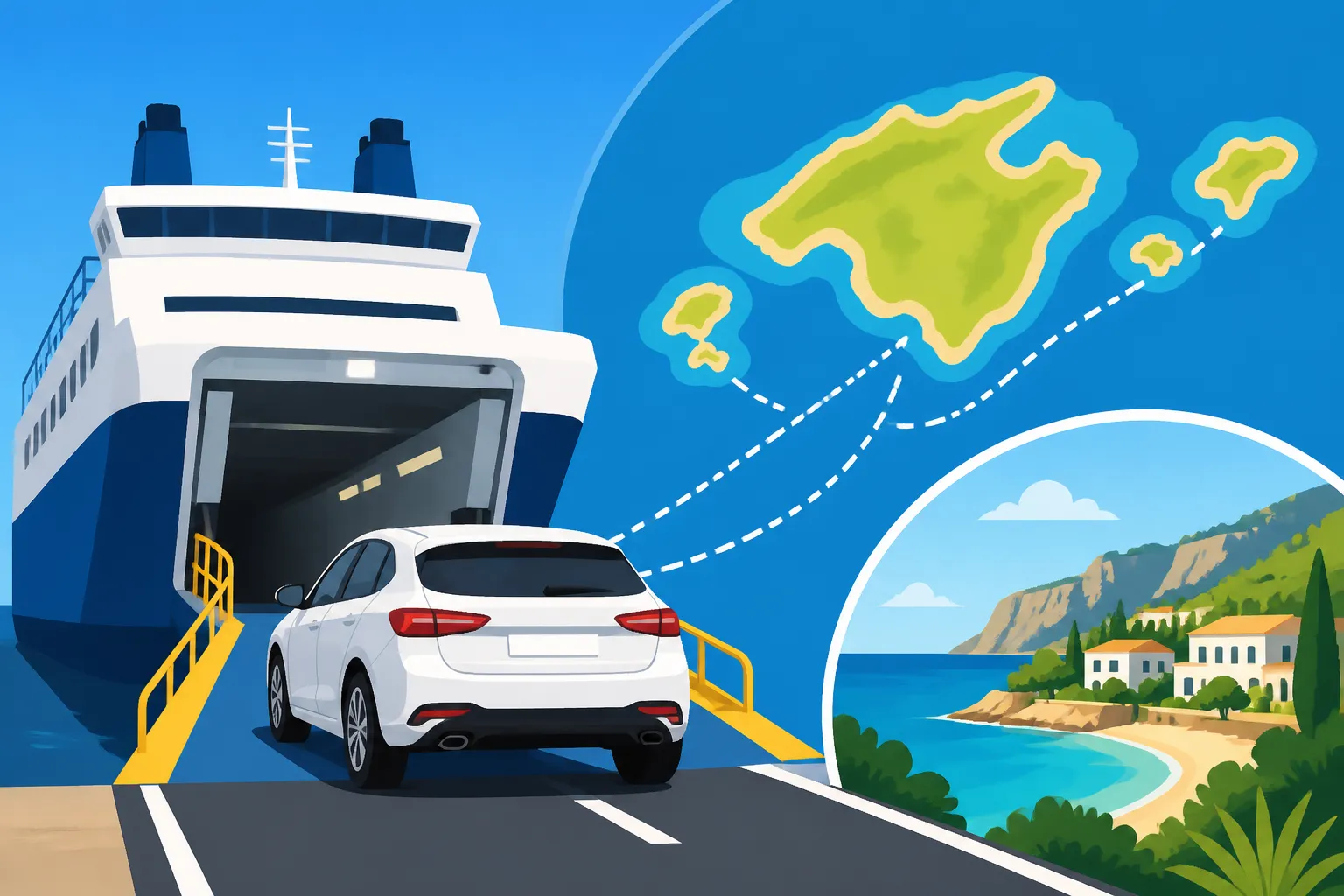
Taking a Car to the Balearics: Ferry Operators, Routes, and Vehicle Fares
Disclosure: This article contains affiliate links. If you buy through them, we may earn a commission at no extra cost to you. Read our full disclosure.
Deciding to bring your car to the Balearic Islands can feel like tackling a whole new level of Spanish bureaucracy and logistics. You've weighed the pros and cons of car rentals, the freedom of having your own wheels, and the sheer effort of getting it all figured out. This guide is here to cut through the confusion, helping you understand the ferry operators, the routes, and the real cost of taking your vehicle to these stunning islands, making sure you embark on your adventure with confidence, especially when booking through platforms like Omio.
Why Take Your Car to the Balearic Islands? The Freedom vs. the Faff
Ah, the Balearics! Mallorca, Menorca, Ibiza, Formentera. Each one a gem, offering everything from bustling cities and tranquil coves to rugged hiking trails and legendary nightlife. But the big question for many of us expats, or even seasoned tourists, is: do I really need my car there? And if so, how on earth do I get it across the water? The short answer is, it depends on your travel style and how long you plan to stay.
Advantages of Bringing Your Own Vehicle
Let’s be honest, having your own car offers unparalleled freedom. You’re not beholden to bus schedules that might only run a few times a day to that idyllic, secluded beach you saw on Instagram. You can pack all your beach gear, the kids’ toys, or even your mountain biking equipment without a second thought about luggage limits or rental car restrictions. Imagine spontaneously driving to a hidden cala on Mallorca's coast or exploring the lesser-known villages of Menorca without having to worry about an expensive taxi ride back. For families, especially those with young children, it's a game-changer. No car seat hassles, no fitting everything into a tiny rental car, just the comfort and familiarity of your own vehicle. This is particularly appealing if you’re planning a longer stay or if your trip involves a lot of varied activities across the island. The thought of managing a full itinerary on public transport or expensive local taxis can be a major stressor, and bringing your own car truly alleviates that. It's an investment in convenience and flexibility.
The Realities and Potential Downsides
While the freedom is intoxicating, let's not sugarcoat it – bringing your car isn't without its challenges. Firstly, there’s the cost. Ferry fares for vehicles can add up, especially if you have a larger car or are travelling during peak season. Then there’s the time commitment: ferry crossings from the mainland can be long, often overnight, meaning you're spending a significant chunk of your travel day at sea. While a night ferry can save on accommodation, it also means a potentially restless night if you don't splurge on a cabin.
Parking on the islands can also be a nightmare, particularly in popular spots during summer. Imagine driving around Palma de Mallorca for an hour looking for a spot, only to give up and pay for an underground car park. Smaller towns and villages might have limited spaces, and sometimes you just end up parking miles away and walking back. Roads can be narrow and winding, especially on smaller islands like Formentera, which are often better explored by scooter or bicycle. Plus, if you’re only planning a short trip or mainly sticking to one major city like Palma, the expense and hassle of the ferry might outweigh the benefits. For some, the idea of Renting a Car in Spain: Requirements, Insurance, and Driving Tips might be a more practical and less stressful alternative.
Choosing Your Ferry Operator and Route to the Balearics
Once you’ve decided that your faithful vehicle is making the journey with you, the next step is to figure out how to get it there. This involves choosing your departure port, your destination island, and, crucially, your ferry operator. There are a few key players in the game, and knowing your options is half the battle. This is where a platform like Omio really shines, as it allows you to compare all these options in one go, saving you a ton of hassle.
Major Mainland Departure Ports
Your journey to the Balearics will almost certainly start from one of three major ports on mainland Spain:
- Barcelona: This bustling port city is a popular choice for those coming from further north in Spain or other parts of Europe. It offers frequent connections to Mallorca, Menorca, and Ibiza. Crossings from Barcelona tend to be longer, often overnight, but they give you the chance to relax and wake up refreshed on the islands. Think of it as a mini-cruise for your car.
- Valencia: Situated further south, Valencia is another excellent departure point, offering routes primarily to Mallorca, Menorca, and Ibiza. Ferries from Valencia often provide a good balance between journey time and price, making it a solid choice for many travellers.
- Dénia: This smaller port town, located between Valencia and Alicante, is an absolute gem for reaching the Balearics, particularly Ibiza and Formentera. It boasts the shortest ferry crossings, making it ideal if you want to minimise your time at sea. If you’re heading to Formentera, Dénia is often the most direct and fastest route.
Each port has its own vibe and logistics, so consider your starting point on the mainland and which island you're ultimately aiming for. If you're coming from the south of Spain, for instance, Valencia might make more sense than driving all the way up to Barcelona.
Key Ferry Operators and Their Routes
Several companies dominate the ferry routes to the Balearic Islands, each with its own fleet, service levels, and pricing structures.
- Baleària: This is arguably one of the most well-known and comprehensive operators, offering a vast network of routes connecting Dénia, Valencia, and Barcelona to all four main Balearic Islands: Mallorca, Menorca, Ibiza, and Formentera. Baleària is renowned for its modern fleet, including fast ferries that significantly cut down travel times on some routes. They often have amenities like restaurants, shops, and even cinemas onboard. I've personally used them multiple times, and their service is generally excellent.
- Trasmed (formerly Trasmediterránea): Trasmed is another major player, operating routes from Barcelona and Valencia to Mallorca, Menorca, and Ibiza. They tend to offer more traditional ferry experiences, often with a focus on comfortable overnight crossings. Their vessels are typically larger, providing a stable journey even in choppier seas. If you're looking to book a cabin for an overnight trip, Trasmed is a strong contender.
- Grandi Navi Veloci (GNV): GNV also provides services from Valencia and Barcelona to Mallorca and Ibiza. While perhaps not as ubiquitous as Baleària, GNV offers competitive pricing and often has attractive deals, especially if you book in advance. They operate large cruise ferries that offer a wide range of onboard facilities.
Trying to navigate each operator's website, compare prices, and check schedules manually can quickly become a headache. This is precisely why I recommend using a platform like Omio. Omio acts as your one-stop shop, pulling in all the available routes and prices from these different operators. Instead of opening a dozen browser tabs, you can input your desired route and dates, and Omio will present you with all the options, allowing you to easily compare journey times, prices, and even specific vessel amenities. It's incredibly user-friendly and cuts down on so much of the pre-travel stress, letting you find the best deal for your car and yourself. Seriously, don't try to do this manually; use Omio. For more details on exploring these islands, check out our guide on The Balearic Islands: Choosing Between Mallorca, Menorca, and Ibiza.
Booking Platforms: The Omio Advantage
In the past, booking ferries meant trawling through individual operator websites, comparing schedules and prices manually. It was a tedious process, fraught with the risk of missing a better deal or an earlier departure time. Thankfully, times have changed. Platforms like Omio have revolutionized the way we plan inter-city and inter-country travel, and this includes ferries.
Omio stands out because it aggregates information from all the major ferry operators in Spain, including Baleària, Trasmed, and GNV. This means when you search for a route like "Valencia to Mallorca," Omio will show you all the available crossings, their prices, and the operators. You can filter by price, departure time, and even journey duration, making it incredibly easy to find the option that best suits your budget and schedule. Imagine being able to see a direct comparison between a fast daytime ferry with Baleària and a more leisurely, cheaper overnight crossing with Trasmed, all on one screen. This transparency is a lifesaver, especially when you're trying to manage the added complexity of vehicle fares.
Booking your ferry through Omio is also incredibly straightforward. The interface is intuitive, guiding you through the process of selecting your vehicle type and any additional passengers or cabins. Plus, Omio often has excellent customer support, which can be a huge relief if you encounter any issues or need to make changes. It simplifies what can otherwise be a frustrating part of travel planning. Don't forget, using Omio means you're more likely to snag the best price because you're seeing all the options laid out clearly.
Understanding Vehicle Fares and Costs
Now, let's talk numbers, because bringing your car on a ferry isn't quite as simple as just buying a passenger ticket. The cost can vary wildly depending on several factors, and it’s crucial to understand these to avoid any nasty surprises. Budgeting for transport, including ferry costs, is a significant part of any trip, and it's something many expats might overlook in their initial planning.
Factors Influencing Your Vehicle Ferry Fare
The price you pay for your car on the ferry isn't static; it's a dynamic beast influenced by several key elements:
- Vehicle Type and Size: This is perhaps the biggest factor. A small city car will always be cheaper than a large SUV, a van, or a campervan. Motorcycles also have their own pricing category, usually less than a car. When booking, you'll be asked to specify your vehicle's make, model, and sometimes its dimensions (length and height). Be honest here; ferry staff can and do check, and discrepancies could lead to delays or extra charges at the port. My friend once tried to list his slightly oversized SUV as a regular car and got pulled aside, costing him both time and money!
- Route and Operator: As we discussed, different routes have different price points. A shorter crossing from Dénia to Ibiza will typically be less expensive than a longer, overnight journey from Barcelona to Menorca. Each ferry operator also has its own pricing structure, so comparing via Omio is essential to find the best value for your specific route.
- Time of Year and Demand: This is pure supply and demand. Unsurprisingly, booking a ferry in July or August (peak summer season) will be significantly more expensive than travelling in, say, March or November. Weekends and public holidays also drive up prices. If you have flexibility, travelling outside these peak times can save you a substantial amount. Think shoulder seasons like late spring or early autumn for better weather and lower costs.
- Booking in Advance: Just like flights, ferry tickets for vehicles tend to get more expensive as the departure date approaches. Booking several weeks or even months in advance can secure you much better rates, especially if you're travelling with a larger vehicle or during a popular period. Don't leave it to the last minute!
- Flexibility and Ticket Type: Some operators offer different fare classes, similar to airlines. A more flexible ticket that allows changes or cancellations might cost more upfront but can save you if your plans shift unexpectedly. A non-refundable, fixed-date ticket will be cheaper but offers no wiggle room. Consider your travel certainty when choosing.
Typical Price Ranges for Vehicles
Providing exact prices is tricky because of all the variables, but I can give you a general idea. For a standard car (e.g., a Seat Ibiza or a Volkswagen Golf), you might expect to pay anywhere from €70 to €250+ each way for the vehicle itself, on top of passenger fares.
- Shorter routes (e.g., Dénia to Ibiza/Formentera): Expect the lower end of the spectrum, maybe €70-€150 for a standard car in off-peak.
- Longer routes (e.g., Barcelona/Valencia to Mallorca/Menorca): Prices will be higher, potentially €150-€250+ for a standard car, especially during peak season or for overnight crossings where a cabin might also be considered.
- Larger vehicles (SUVs, vans, campervans): These will cost significantly more, often starting at €200 and easily going over €400-€500 for popular routes during peak times.
Remember, these are just estimates, and the best way to get an accurate price is to input your specific details into Omio. The platform will give you real-time quotes, including any promotions or discounts that might be available. While this might seem like a lot, consider the overall Cost of Living in Spain: Realistic Budgets and Savings Tips and how this fits into your travel plans.
Strategies for Saving Money on Ferry Fares
Even with the variables, there are definitely ways to keep costs down. My number one piece of advice, as I've already stressed, is to use a comparison tool like Omio. This is your secret weapon. By instantly comparing prices across multiple operators for your specific dates and routes, you’re guaranteed to see the most competitive fares available.
Beyond that, here are some tried-and-true strategies:
- Be Flexible with Dates: If your travel dates aren't set in stone, play around with different days of the week or even different weeks/months. Mid-week travel in the shoulder seasons (May-June, September-October) often yields significantly cheaper fares than weekends or high summer.
- Book Well in Advance: I can't stress this enough. Ferry companies, like airlines, reward early birds. As soon as your travel plans are firm, head to Omio and lock in your tickets.
- Consider Overnight Ferries (without a cabin): While not for everyone, if you're on a tight budget and don't mind roughing it a bit, a seat on an overnight ferry can be cheaper than a day crossing plus a night's accommodation. However, for longer journeys or if you need to be fresh for driving the next day, a cabin is a worthwhile splurge.
- Check for Package Deals: Sometimes operators like Baleària or Trasmed offer packages that combine vehicle and passenger fares, or even offer discounts if you're booking return tickets. Omio will highlight these options for you.
- Evaluate Vehicle Necessity: Really consider if you need your car for the entire trip. For example, if you're spending a week on Mallorca but only planning a couple of days exploring by car, it might be more cost-effective to leave your car on the mainland and rent one for those specific days on the island. While not always the cheapest option, it's worth exploring, especially with options for Car Costs in Spain: Insurance, Taxes, Maintenance, and Fuel constantly fluctuating.
By being savvy and leveraging tools like Omio, you can significantly reduce the financial impact of bringing your car to the Balearics.
Practical Tips for Your Ferry Journey to the Balearics
You've booked your ferry through Omio, you've got your car packed, and you're ready to roll. But wait, there are a few more practical nuggets of wisdom that can make your actual ferry experience smoother and less stressful. Having navigated these waters myself, I've picked up a few pointers that can really help.
Before You Depart: The Nitty-Gritty Details
Preparation is key, my friends. Don't just show up at the port expecting everything to magically fall into place.
- Check-in Times and Arrival at Port: This is crucial. Ferry operators usually require vehicles to check in and be in the boarding lane well in advance of the departure time, often 60-90 minutes. Miss this window, and you might miss your ferry, no matter how much you paid. Always double-check the exact requirements on your Omio booking confirmation or the operator's website. Arriving early also gives you buffer time for unexpected traffic or finding the right terminal in a large port like Barcelona.
- Documents, Documents, Documents: Ensure you have all your documents readily accessible. This includes your ferry ticket (printed or on your phone via the Omio app), your passport or ID, your driver's license, and your vehicle's registration papers (Permiso de Circulación and Ficha Técnica). You'll need to show these at check-in. Don't bury them at the bottom of a suitcase!
- Packing Essentials for the Journey: If you’re on an overnight ferry, pack a small bag with essentials you’ll need on board – toiletries, a change of clothes, any medications, snacks, entertainment (books, fully charged devices). You won’t be able to access your car once it’s parked in the cargo hold. Trust me, rummaging through a big suitcase in a small cabin or a public lounge isn't fun.
- Vehicle Preparation: Give your car a once-over. Ensure tire pressure is correct, and fuel is adequate for getting off the ferry and to your destination on the island. You won't be able to refuel on board, obviously!
The Onboard Experience
Once you're on the ferry, it's time to settle in. The experience can range from a functional commute to a mini-cruise, depending on the operator and vessel.
- Parking Your Car: Follow the instructions of the crew diligently. Parking on a ferry can be tight, with cars often packed in closely. Note where you parked your car – seriously, take a photo of the deck number or a landmark, as all cars look the same when you're trying to find yours again in a dimly lit cargo hold!
- Finding Your Accommodation: If you’ve booked a cabin, head there to drop off your hand luggage and get comfortable. If you’re in a reclining seat or just a general passenger area, find a spot and settle in. Wander around, explore the ship. There are usually cafeterias, restaurants, and bars. Some larger ferries even have shops, play areas for kids, or outdoor decks where you can enjoy the sea breeze.
- Amenities and Services: Take advantage of what's on offer. Wi-Fi might be available, often for a fee, but it can be spotty at sea. Consider bringing your own entertainment rather than relying on onboard options. For overnight trips, the quiet zones are your friends if you didn't spring for a cabin.
Arrival and Disembarkation
The moment you've been waiting for! Seeing the island on the horizon is always a fantastic feeling.
- Getting Back to Your Car: Approximately 30-45 minutes before arrival, an announcement will usually be made for vehicle passengers to return to their cars. Head straight to the cargo deck. It can get crowded and a bit chaotic, so stay alert and patient.
- Driving Off the Ferry: Again, follow the crew's instructions. They will direct you off the ship in an orderly fashion. Be mindful of other vehicles and pedestrians. Take your time, especially if you're unfamiliar with driving off a ferry ramp.
- First Steps on the Island: Congratulations, you and your car have made it! You’re now free to explore. If you’re not sure where to head first, having a pre-planned route or your GPS ready is a great idea. Just remember, driving on the islands can sometimes involve narrow roads and different parking rules than the mainland. For tips on driving in Spain, including local nuances, check out our guide on Driving in Spain: Road Rules, Fines, and What Surprises Expats.
Taking your car to the Balearics is an adventure, and with a bit of planning and the help of tools like Omio, it can be a smooth and enjoyable part of your Spanish journey. You’ll be cruising those island roads with your own wheels in no time! For further exploration within Spain, knowing about options like Traveling Around Spain: Trains, Buses, Flights, and Car Hire can enhance your overall travel experience. If you plan to hop between islands, our guide on How to Travel Between Spanish Islands by Ferry is an absolute must-read.
Disclaimer
Please remember that travel information, especially regarding ferry schedules, prices, and visa regulations, can change rapidly. While every effort has been made to provide accurate and up-to-date information, it is essential to verify details directly with the ferry operators and relevant authorities before making any travel plans. This guide is for informational purposes only and does not constitute professional advice.