Holding Euros, Pounds, and Dollars in One Account: What Converting Costs
Living in Spain is a dream for so many of us, but let's be honest, the reality of managing money across borders can quickly turn into a bureaucratic nightmare. You’re earning in one currency, paying rent in euros, and maybe still have financial ties in pounds or dollars back home. The constant ping-pong between accounts and the dread of seeing those conversion fees eat into your hard-earned cash is a familiar frustration. This guide is designed to cut through the confusion, expose those hidden costs, and highlight a truly transparent, cost-effective solution for handling euros, pounds, and dollars all in one place, making your financial life in Spain a whole lot simpler.
Disclosure: This post may contain affiliate links. We may earn a commission at no extra cost to you if you make a purchase through these links. Read full disclosure.
The Multi-Currency Headache: Why Traditional Banking Falls Short
When you first arrive in Spain, setting up a local bank account feels like a monumental achievement. You're thinking, "Great, I've got my Spanish IBAN, now all my money problems are solved!" But then reality hits. Your salary still lands in your old UK or US account, or maybe you're regularly sending money to family abroad. Suddenly, you're looking at bank statements that show significant chunks of your money vanishing in "conversion fees" or, even worse, through murky exchange rate markups you can't quite decipher. It’s a recurring pain point for almost every expat here.
The Hidden Costs of Currency Conversion in Spain
Let's talk about those sneaky fees. Many traditional banks in Spain, and indeed worldwide, will claim "no commission" on currency exchanges. Sounds fantastic, right? But what they don't tell you upfront is that they make their profit by applying an inflated exchange rate – a rate significantly worse than the actual market rate you'd see on Reuters or Google. This difference, often a few percentage points, is their profit margin, and it comes directly out of your pocket. For instance, if you're transferring a few thousand pounds to euros for rent or groceries every month, those few percentage points add up alarmingly quickly.
Imagine you're transferring £2,000 from your UK account to your Spanish one to cover rent and living expenses. Your bank might tell you there's no fee for the transfer. But instead of giving you, say, €2,340 based on the real mid-market rate, they might only give you €2,290. That €50 difference isn't a fee; it's a hidden cost baked into their exchange rate. Over a year, this could easily cost you hundreds of euros, money that could have been spent on enjoying the vibrant culture, a weekend trip, or even just a few extra rounds of tapas. It’s a frustrating reality that often only becomes clear after multiple transfers, leaving you feeling short-changed.
Managing Funds Across Borders: The Expat Reality
The typical expat financial setup often involves a patchwork of bank accounts. You have your home country account, your Spanish account, maybe even another one if you're juggling freelance income from different clients. This fragmented approach isn't just a logistical headache; it's an open invitation for more fees and less transparency. Each time you move money between these accounts, you're likely subjected to conversion costs, whether explicit or implicit.
Beyond the fees, there's the constant anxiety about exchange rates. Do you transfer now, or wait a few days hoping the rate improves? It's like playing a mini stock market game every month, and most of us don't have the time or expertise for that. Plus, traditional international bank transfers can be notoriously slow, taking several business days to clear, which can be a real problem when you have bills to pay or need immediate access to funds. The sheer inconvenience of logging into multiple banking apps, navigating different interfaces, and constantly tracking multiple balances can be exhausting. It’s a significant drain on your mental energy, which could be better spent adapting to your new life in Spain or even just enjoying a leisurely afternoon walk.
Understanding Currency Exchange: The Mechanisms and the Markup
To truly appreciate the value of a transparent multi-currency solution, it helps to understand how traditional currency exchange actually works and where those hidden costs come from. It's not always a straightforward process, and banks often rely on customer ignorance to boost their bottom line.
How Banks and Traditional Services Convert Your Money
When you exchange money through a traditional bank or even many high-street money changers, they operate on what's called a "retail exchange rate." This is distinct from the "interbank rate" or "mid-market rate," which is the true rate at which banks trade currencies among themselves. The retail rate offered to you, the customer, is always less favorable than the interbank rate. The difference between these two rates is known as the "spread," and this spread is where banks make their profit. It's a fundamental part of their business model.
Think of it like this: a bank might buy euros at 1.17 from another bank but then sell them to you at 1.15. That 0.02 difference per euro adds up exponentially when you're dealing with large sums. This system isn't inherently evil, but the lack of transparency is what frustrates so many of us. Banks often bury this spread within their terms and conditions, or simply present the less favorable rate without much explanation, leading customers to believe they're getting a fair deal, especially when they advertise "zero commission." It’s vital to look beyond the flashy promises and dig into the actual exchange rate being offered. If you're comparing services, always check the exact amount you'll receive after conversion, not just the "fee."
Spotting the True Cost: Exchange Rates, Fees, and Transparency
The key to avoiding unnecessary costs is understanding transparency. A truly transparent service will always show you the real mid-market exchange rate – the one you find on independent sources like Google or Reuters – and then clearly itemize any fees on top of that. This way, you know exactly what you're paying for the service, rather than having a hidden charge embedded in a poor exchange rate. Services like Wise, for example, have built their entire business model on this principle, advocating for fair and transparent international money transfers.
When you're trying to figure out the true cost of converting your money, don't just ask about fees. Ask what the exact exchange rate they are applying to your transaction is, and compare it against the mid-market rate. You can easily do this with a quick search online. If a bank or service is cagey about this or only provides a vague "indicative rate," that's a red flag. Also, be aware of dynamic currency conversion (DCC) when using your card abroad. If a terminal offers to charge you in your home currency (e.g., GBP instead of EUR in Spain), always decline. You'll almost certainly get a worse exchange rate than if you let your card issuer or a service like Wise handle the conversion at a better rate. Being diligent and informed can save you a surprising amount of money over time. When considering your options for managing foreign currency, always look for services that champion clarity. This focus on transparency is a game-changer when sending money to/from Spain: Comparing Banks vs Transfer Services.
The Solution: Seamless Multi-Currency Accounts with Wise
After navigating the murky waters of traditional banking, many expats discover a lifeline in multi-currency accounts. These aren't just another bank account; they're a financial hub designed specifically for people living global lives, like us here in Spain.
What is a Multi-Currency Account and How Does it Work?
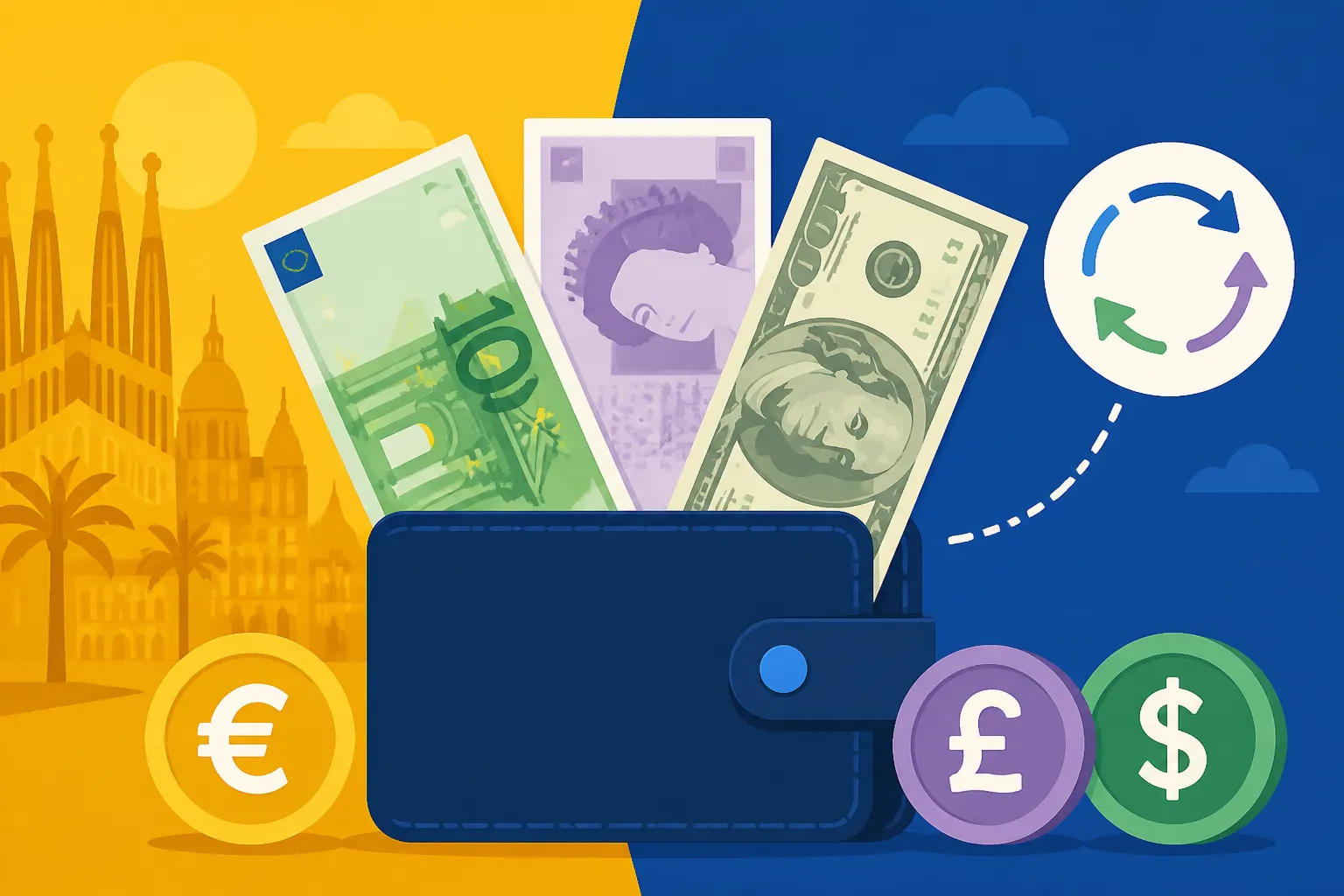
Imagine having one single account where you can hold money in dozens of different currencies simultaneously – euros, British pounds, US dollars, Canadian dollars, Australian dollars, you name it. That's essentially what a multi-currency account offers. Instead of needing a separate bank account in the UK for your GBP income and another in Spain for your EUR expenses, you simply manage all these balances from one central place. When you receive money in GBP, it goes into your GBP balance. When you need to spend EUR, you can either convert a portion of your GBP to EUR within the same account or simply spend directly from your EUR balance if you have one.
The real genius lies in the ability to convert between these currencies at a moment's notice, often with far more transparent and favorable rates than traditional banks. Many multi-currency accounts, like the one offered by Wise, also come with local bank details for various currencies. This means you can receive payments in GBP, EUR, or USD as if you had a local bank account in those countries, often avoiding international transfer fees entirely for the sender. For anyone managing expenses or income across different currencies, whether for work or personal life, it dramatically simplifies your financial footprint. It removes the need for multiple banking relationships and streamlines the entire process of managing your global finances, whether you're paying for rent, utilities, or enjoying the local markets.
Zeroing in on Wise: Transparency and Real Exchange Rates
This is where Wise (formerly TransferWise) truly shines as the hero of multi-currency management for expats. Wise built its entire reputation on a commitment to radical transparency and fair exchange rates. Unlike traditional banks that use marked-up retail rates, Wise uses the real mid-market exchange rate – the one you see on Google – and then charges a small, upfront fee that is clearly displayed before you even confirm a transaction. There are no hidden spreads, no surprising deductions, just plain, simple maths. This fundamental difference means you always know exactly how much money will arrive and what you're paying for the service.
With the Wise multi-currency account, you can hold over 40 different currencies, including EUR, GBP, and USD, all in one place. What's even better for those of us navigating life in Spain is that you get local bank details for 10 currencies, including a UK account number and sort code, a European IBAN, and a US account number and routing number. This feature is incredibly powerful. It means your UK employer can pay you in GBP directly into your Wise account as if it were a local UK bank, and you can receive payments from European clients directly into your EUR balance. This often completely bypasses international transfer fees for the sender and ensures you get your money without losing chunks to unfavorable exchange rates. It's a game-changer for anyone trying to streamline their finances while living abroad, whether it's for paying bills in Spain or receiving payments from clients overseas.
Practical Benefits for Expats and Travelers in Spain
For anyone living, working, or even just regularly visiting Spain, the practical benefits of a Wise multi-currency account are immense.
First, imagine paying your monthly rent in Spain. Instead of transferring GBP from your old UK bank account and losing money on the conversion rate, you can simply convert funds within your Wise account at the mid-market rate and then make a local EUR transfer to your landlord. This directly impacts your Cost of Living in Spain: Realistic Budgets and Savings Tips. Similarly, if you're a freelancer receiving payments from clients in the US, they can pay you directly into your USD balance using your Wise US account details, avoiding international wire fees. Then, when you need euros, you convert them when the rate looks good, saving significant amounts compared to traditional banks.
Secondly, for travelers, the Wise debit card linked to your multi-currency account is incredibly useful. You can spend directly from any currency balance you hold, and if you don't have enough of the local currency, Wise automatically converts from another balance at the lowest possible fee. This means no more worrying about carrying large amounts of cash or getting ripped off at airport exchange booths. It works seamlessly whether you're exploring the bustling streets of Barcelona or relaxing on a beach in Mallorca. It integrates well with how many of us handle Mobile Payments in Spain: Bizum, Apple Pay, and Alternatives, offering a versatile payment solution. Managing your funds this way means less financial stress and more freedom to enjoy your life in Spain.
Here's a quick comparison of what converting money typically looks like:
| Feature | Traditional Bank (Hypothetical) | Wise Multi-Currency Account |
|---|---|---|
| Exchange Rate | Marked-up (Retail Rate) | Mid-Market (Real Exchange Rate) |
| Transparency | Often opaque, hidden in rate | Fully transparent, clear fees |
| Conversion Fee | Often "zero commission" but hidden markup | Small, explicit fee |
| Speed | 1-5 business days | Often instant, usually within 24 hours |
| Holding Currencies | Separate accounts, limited | 40+ currencies in one account |
| Local Bank Details | Limited to home country | 10 currencies (EUR, GBP, USD, etc.) |
| Debit Card Usage | FX fees, poor rates | Spend from balances, low conversion |
| Receiving Foreign Income | Costly international wires | Free to receive in local currencies |
Making the Switch: Getting Started with Wise
Ready to ditch the traditional banking headaches and embrace a more transparent, flexible way to manage your money in Spain? Making the switch to a multi-currency account like Wise is surprisingly straightforward.
Opening Your Wise Account: A Simple Process
Opening a Wise account is incredibly user-friendly, a welcome change from some of the complex Spanish bureaucracy we’re all used to! You can start the process online or through their intuitive mobile app. You'll need some basic personal information, just like you would for any financial account. Typically, this involves providing your name, address, email, and phone number. Then comes the verification step, which is crucial for security and compliance. You'll usually be asked to upload a photo of your ID (like your passport or TIE card) and sometimes a proof of address (like an Empadronamiento certificate or utility bill).
The good news is that Wise is designed for international users, so they are well-versed in verifying documents from different countries. The entire process is usually digital and can often be completed within a few days, sometimes even hours, once your documents are submitted and reviewed. Compared to the lengthy processes of setting up a traditional bank account in Spain, getting your Wise account up and running is a breath of fresh air. Once verified, you can immediately start adding balances in different currencies and even order a Wise debit card to use for your daily spending and travels. This simplifies everything from receiving your salary to paying for groceries.
Managing Your Money Across Currencies with Ease
Once your Wise account is open, you’ll find that managing your money across different currencies is incredibly intuitive. The Wise app and website provide a clear overview of all your currency balances, making it easy to see exactly what funds you have in euros, pounds, dollars, or any of the other 40+ currencies you can hold. You can initiate transfers and conversions with just a few taps, locking in the mid-market rate and seeing the exact fee upfront.
For expats, this means a huge reduction in financial stress. Imagine having your salary paid into your Wise GBP balance and then, with a simple click, converting just enough to cover your rent and Spanish utility bills when the exchange rate is favorable. You can also easily send money to friends and family abroad, or receive payments from international clients, all with the same transparent pricing. The Wise debit card seamlessly connects to all your balances, automatically converting at the best available rate if you don't have enough of the local currency. This makes managing your international finances as simple as managing a single local account, freeing you up to focus on enjoying your Spanish life, rather than constantly worrying about currency conversions and hidden bank fees. It's truly a powerful tool for anyone living or working internationally, providing a seamless solution for everything from your Spanish IBAN, SEPA, and SWIFT: Sending and Receiving Money Explained to budgeting for your daily life.
Disclaimer
The information provided in this article is intended for general guidance and informational purposes only. While we strive to provide accurate and up-to-date content, financial regulations, exchange rates, and service offerings can change. It is always advisable to conduct your own research and consult with financial professionals for advice tailored to your specific situation. This guide should not be considered as financial or legal advice.