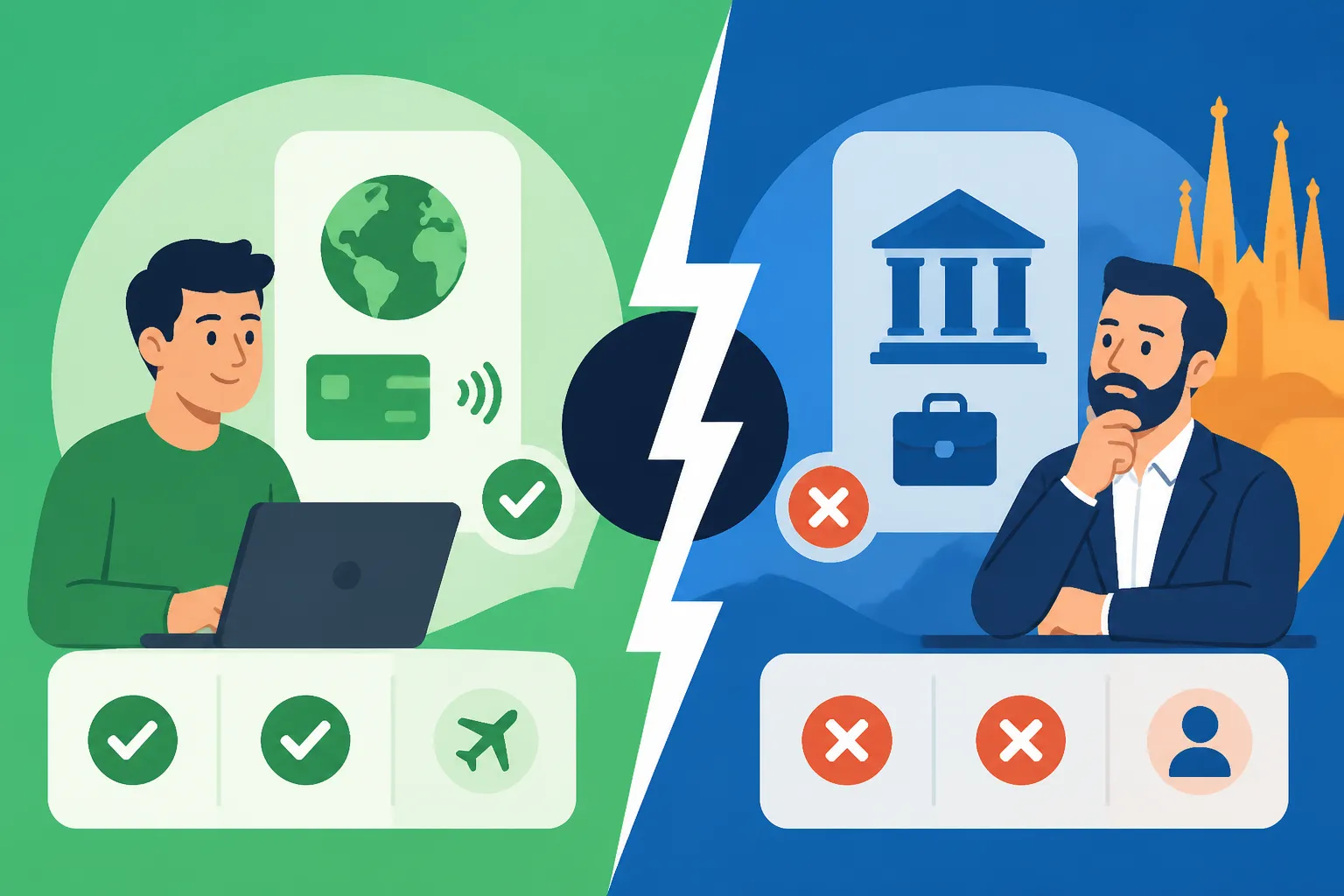
Wise Business vs Spanish Corporate Accounts: What Each Can and Cannot Do
Picture this: your Spanish SL has just landed its first big client in London, the invoice is in pounds, and your branch manager in Valencia is quoting a conversion and transfer process that eats into the margin and takes days. Meanwhile, the gestor says you need a Spanish account for taxes anyway. This guide explains exactly what Wise Business can and cannot do compared with a Spanish corporate account, and how to run both without friction.
Disclosure: This post may contain affiliate links. We may earn a commission at no extra cost to you if you make a purchase through these links. Read full disclosure.
Why Choosing a Business Account in Spain Feels So Confusing
I set up my first Spanish business account sitting across a desk from a very polite bank employee who printed roughly forty pages for me to sign. I left with an account, a card that arrived two weeks later, a bundle of “recommended” insurance products I had not asked for, and no clear idea what any of it would cost me once a client in New York started paying me in dollars. If you have had a similar morning, you are not imagining the complexity. Spanish business banking was built for domestic companies that sell to Spanish customers, pay Spanish suppliers and borrow from Spanish lenders. A foreign founder with clients in three currencies does not fit that mould.
The other half of the confusion comes from the newer financial platforms. They look like banks, they issue IBANs and cards, and they move money quickly, but they are regulated differently and offer a different set of tools. Comparing them line by line with a traditional Spanish account is the only way to see where each fits. Before we get to that, it helps to be precise about what each option actually is.
What a Spanish Corporate Account Actually Is
A Spanish corporate account, called a cuenta de empresa or cuenta para autónomos depending on your structure, is a current account held at a licensed credit institution. That means a bank authorised to take deposits and lend money. When you open one, you get a Spanish IBAN starting with ES, access to the bank’s online banking and app, usually a debit card, and the option to add products like overdrafts, credit lines, card payment terminals, leasing, guarantees and payroll services.
Deposits held at a Spanish bank fall under the national deposit guarantee scheme, the Fondo de Garantía de Depósitos, up to the legal limit per depositor per institution. Banks are also, in most cases, entidades colaboradoras with the Spanish Tax Agency, which matters more than you might expect when quarterly filings come around. If you have not set one up yet, see How to Set Up a Business Bank Account in Spain for the document list and the branch process.
The trade-off is that a Spanish bank sells you a relationship. Pricing is often bundled, conditions depend on how much other business you bring, and international payments are rarely the product they are trying to win you over with.
What Wise Business Actually Is
Wise Business is a multi-currency account run by an electronic money institution rather than a bank. You can hold balances in many currencies at once, receive payments through local account details in several major currencies, convert between them at the mid-market rate with a separately shown fee, and send money abroad. You also get debit cards for yourself and your team, multi-user access with permissions, batch payments and integrations with common accounting software.
Because it is an e-money institution, it does not lend your money out and it cannot offer credit. Customer funds are safeguarded, meaning they are held separately from the company’s own money, but they are not covered by a deposit guarantee scheme the way bank deposits are. That is a structural difference, not a flaw, and it shapes everything else in this comparison.
Onboarding is fully online. You upload company documents, verify the directors and beneficial owners, and describe your business activity. For an SL or an autónomo with international clients, it is often the fastest way to get a working account capable of receiving foreign currency.
What Wise Business Does Better Than a Spanish Bank
This is where the specialist account earns its place. If your business touches more than one currency, the difference shows up on the very first invoice, and it keeps showing up every month after that.
Receiving Payments From Overseas Clients
Here is the scenario I lived through for years. A client in Manchester pays my Spanish company in pounds. With a traditional Spanish account, that money arrives as an international transfer, and the bank converts it to euros at its own exchange rate before it lands. The margin is baked into the rate, so it never appears as a fee line, and on top of that there may be a receiving charge. I would invoice a round number and receive an odd, smaller euro amount, and my gestor would ask me every quarter why the figures did not reconcile.
With local receiving details in pounds, the client pays me as if I were a UK supplier, using a domestic transfer on their side. The money sits in a pound balance. I decide when to convert, and the conversion uses the mid-market rate with a transparent fee shown before I confirm. The same works for US dollars and several other currencies. For a deeper look at exactly where the money leaks in the traditional route, see Getting Paid by Overseas Clients as an Autonomo: Where the FX Margin Disappears.
There is a softer benefit too. Clients in the US or UK are far happier paying a local account than navigating a SWIFT form to a Spanish IBAN. I have had invoices paid days faster simply because the accounts payable team did not need to ask anyone for help.
Paying Contractors, Suppliers and Software Abroad
The outgoing side is just as important. If your SL pays a developer in Poland, a designer in Argentina, and a cloud hosting bill in dollars, a Spanish bank will typically treat each one as an international transfer with its own charges and its own exchange rate. Batch payments in a multi-currency account let you upload a spreadsheet and pay dozens of people in their own currencies in one go, using the balances you already hold or converting at the moment of payment.
Software and advertising spend deserve a special mention. Many founders put SaaS subscriptions and ad platforms on a Spanish company card that charges in dollars, and the card’s conversion margin quietly adds up across dozens of small payments. A card linked to a dollar balance avoids converting each charge separately. For a practical breakdown, see Paying for Overseas SaaS and Ads From Spain: Cutting FX Markup.
If you pay a team abroad regularly, the comparison between the two routes is covered in Paying Overseas Contractors From a Spanish Company: Wise vs Bank Transfer, including what records to keep for each payment.
Opening an Account Without a Branch Appointment
I cannot count the number of times I have queued at a branch only to be told the person who handles business accounts works Tuesday and Thursday mornings. Spanish banks generally want to see the original company deeds, the escritura de constitución, the CIF or NIF of the company, the NIE and passport of each administrator, and evidence of the business activity. Some will open remotely, but many still prefer an in-person signature, and the compliance review for a foreign-owned company can drag.
The online onboarding route avoids the branch entirely. That is genuinely useful in two situations. First, when you are setting up from abroad and not yet in Spain. Second, when your Spanish bank’s compliance team is taking weeks to review your file and you have client payments waiting. Do not expect it to be instant, though. Verification still requires accurate company documents and identity checks for every relevant person, and a vague description of your business activity will slow things down just as it would at a bank.
What a Spanish Corporate Account Does That Wise Business Cannot
Now for the part that matters just as much. A multi-currency platform does not replace a Spanish bank for every business, and pretending otherwise would set you up for a frustrating surprise at exactly the wrong moment.
Credit, Overdrafts, Guarantees and Financing
Because an e-money institution does not lend, there is no overdraft, no credit line, no business loan, no leasing and no bank guarantee. That last one, the aval bancario, catches people out. If you rent commercial premises in Spain, many landlords ask for a bank guarantee instead of, or in addition to, a cash deposit. Public tenders and some supplier contracts also require guarantees. Only a bank or similar institution can issue one.
Financing products tied to cash flow, such as confirming for paying suppliers and factoring for advancing receivables, are also bank territory. So are lines linked to official credit programmes, which are channelled through Spanish banks. If your business plan involves borrowing at any point, you want an established relationship with a Spanish bank long before you need the money. Banks lend to customers whose account history they can see.
Consider a small import business in Málaga bringing ceramics from Portugal and selling them in a shop. It needs a stock financing line before the summer season and a guarantee for the shop lease. The multi-currency account cannot help with either. The bank is not optional for that owner.
Card Terminals, Cash Deposits and Domestic Retail
If customers pay you in person, you need a card terminal, called a TPV or datáfono. Spanish banks provide these, with settlement into your Spanish account. The multi-currency account is not a merchant acquiring service, so a shop, bar or clinic will need a bank or a separate payments provider for in-person card sales.
Cash is the other gap. There is no way to deposit coins and notes into an e-money account. Any business that takes cash, from a café in Granada to a language academy collecting monthly fees from parents who still prefer paying in person, needs a bank account where the takings can go. Spanish businesses also still occasionally encounter cheques and pagarés, promissory notes, particularly in traditional sectors like construction and agriculture. Those require a bank.
Tax Payments, Social Security and Official Paperwork
This is the area where I see the most stress, so let me be specific. The Spanish Tax Agency collects payments through its collaborating entities, which are banks. When you file quarterly returns such as Model 303 for IVA or Model 111 for withholdings, and choose direct debit, the account must be held at one of those collaborating entities. A non-Spanish e-money account is not on that list. The practical options are explained in How to Pay Taxes in Spain Online: AEAT Payment Options.
Social security contributions through the Tesorería General de la Seguridad Social, including your monthly autónomo quota or company payroll contributions, are usually paid by SEPA direct debit. EU rules prohibit refusing a SEPA debit simply because the IBAN comes from another member state, but in practice you want a payment that never bounces. Setting these up from a Spanish account is the low-risk choice.
Then there is incorporation. When you form an SL, the notary typically expects a bank certificate confirming the share capital contribution, and in practice that comes from a Spanish bank. Some public bodies, subsidy programmes and large Spanish clients also request a certificado de titularidad bancaria for the account they will pay into, and they may insist on a Spanish bank. A multi-currency account can provide account confirmation documents, but always check whether the specific requester will accept them before you rely on it.
Side-by-Side Comparison of Capabilities
Having lived with both for a long time, I find it helps to see everything in one place. The table below compares what each type of account can do for a Spanish SL or autónomo. It describes capabilities rather than pricing, because pricing changes and depends on your plan. Check each provider’s own pricing page for current figures before deciding.
Capability Comparison Table
| Capability | Wise Business | Spanish Corporate Account |
|---|---|---|
| Hold balances in many currencies | Yes, many currencies in one account | Usually euros only, with foreign currency accounts as a separate product |
| Local receiving details for GBP, USD and others | Yes, for several major currencies | No, foreign clients send international transfers |
| Currency conversion | Mid-market rate with a separately shown fee | Bank’s own rate with the margin built in |
| Batch international payments | Yes, via spreadsheet upload | Possible on some business banking platforms, often with per-payment charges |
| Fully online onboarding | Yes | Varies, often requires a branch visit |
| Spanish ES IBAN | Do not assume, check the account details issued | Yes |
| Overdraft, loans, credit lines | No | Yes, subject to approval |
| Bank guarantees for leases and tenders | No | Yes |
| Card terminals for in-person sales | No | Yes |
| Cash and cheque deposits | No | Yes |
| Direct debit of Tax Agency payments | No, not a collaborating entity | Yes, at collaborating banks |
| Social security direct debits | Check with the provider and TGSS | Yes |
| Share capital certificate for SL formation | No | Yes |
| Deposit guarantee scheme cover | No, funds are safeguarded instead | Yes, up to the legal limit |
| Team debit cards with spending controls | Yes | Varies by bank |
| Accounting software integrations | Yes, with common platforms | Varies by bank |
Reading the Table for Your Business Type
The table makes one thing obvious. These two accounts are not really competitors. One is a currency and cross-border payments engine. The other is a domestic banking relationship with credit and official plumbing attached. The question is not which one wins, but which jobs each should do in your business.
If you are a solo autónomo selling services to foreign clients, with no premises, no cash and no borrowing plans, you could run most of your daily activity through the multi-currency account and keep a basic Spanish account mainly for tax and social security. If you are a retailer or restaurant with mostly Spanish customers, the bank is your main account and the multi-currency side might only handle the occasional foreign supplier. Most foreign-founded SLs sit somewhere in the middle, and that is where a deliberate two-account setup pays off.
If you are still deciding on your legal structure, the banking needs of each differ. See Business Structures in Spain (Autónomo vs SL): Which Is Right? for how that decision plays out.
The Two-Account Setup That Works for Most Expat Businesses
After a few years of trial and error, I settled on a simple rule: foreign money comes in and goes out through Wise Business, and anything Spanish, official or credit-related stays with the Spanish bank. Every month, a single planned transfer moves euros from one to the other to cover taxes, social security and local costs. It sounds almost too simple, and that is the point.
How to Set Up Both Accounts Step by Step
- Open the Spanish corporate account first if you are forming an SL, because you will likely need the share capital certificate for the notary. Autónomos can open in either order.
- Register the Spanish account with the Tax Agency and social security for direct debits of quarterly returns and monthly contributions.
- Open the multi-currency business account online, using the company deeds, tax ID and identity documents of each director and beneficial owner.
- Describe your business activity clearly during verification, naming your main client countries and currencies.
- Activate local receiving details for the currencies your clients pay in, and add them to your invoice template.
- Move your SaaS subscriptions, ad spend and foreign supplier payments onto a card or balance in the matching currency.
- Set a monthly calendar reminder to convert what you need and transfer euros to the Spanish account ahead of tax deadlines and social security debits.
- Export statements from both accounts each quarter and send them to your gestor together.
Real Scenarios From the Expat Business Community
Take Hannah, a German UX designer registered as an autónomo in Barcelona. Most of her clients are in Germany and the Netherlands, so they pay in euros, and she also has one American client paying in dollars. She keeps her Spanish account for her monthly autónomo contributions and her IVA payments, and receives the American client’s dollars through local US details. She converts only when the rate suits her budget. Her Spanish bank barely sees any activity beyond the monthly top-up and the official debits, and that is fine. For a deeper look at how an autónomo structures this, see Wise Business for Autonomos in Spain: Setup and What It Replaces.
Then there is Marcus, a British founder running a small software consultancy SL in Madrid with four contractors in three countries. Payroll for his one Spanish employee runs through the Spanish bank, along with corporate tax and social security. His UK clients pay into pound details, and the contractors are paid by batch from the multi-currency balances on the same day each month. When he wanted a credit line to bridge a slow quarter, his Spanish bank looked at two years of steady account history and approved it. Had he moved everything to the e-money account, that history would not have existed.
Finally, Sofía, an Argentine chef who opened a tapas bar in Seville. Her business is almost entirely domestic: card terminal sales, cash takings, local suppliers, and a lease guaranteed by her bank. She uses the multi-currency account for very little, mainly sending money to family in Buenos Aires from her personal side. For her, the Spanish bank is the business, and that is the right call.
Keeping Your Bookkeeping Clean Across Two Accounts
Two accounts means two sets of statements, and gestors in Spain vary widely in how comfortable they are with foreign-currency records. Agree a process early. Export statements from both accounts at the end of each quarter, label the conversions clearly, and make sure every foreign-currency invoice has a matching receipt in the same currency. For which statement formats tend to be accepted, see Bookkeeping With Wise in Spain: Statements Your Gestor Will Accept.
Invoices in foreign currencies have their own requirements for IVA purposes, including how you record the euro equivalent. Foreign-Currency Invoices and Spanish VAT: Record-Keeping for Freelancers walks through the record-keeping in detail. If your current gestor seems uneasy with multi-currency activity, it may be time to look for one with international clients; see How to Choose an Accountant Gestor in Spain: Pricing and Red Flags.
Practical Checks Before You Commit
Every business is different, and I would rather you spend twenty minutes checking a few details now than spend a frantic afternoon in June chasing a bounced payment.
Questions to Ask Your Spanish Bank
Spanish business account pricing is rarely as simple as a single monthly fee. Banks often waive maintenance charges if you meet conditions such as a minimum monthly income, a number of card payments, payroll domiciled with them or insurance products held with them. Ask the branch to put the conditions in writing, and ask specifically about the following:
- The charge for receiving international transfers in foreign currencies, and how the exchange rate is set
- The maintenance fee and the exact conditions that waive it
- Whether the account can be opened and managed fully online after the initial visit
- Whether they issue the share capital certificate for SL formation and how long it takes
- What card terminal, guarantee and credit products they offer, and their eligibility criteria
- Whether any insurance or other product is a condition of opening the account
Do not be shy about walking out. Competition among Spanish banks for small business customers is real, and conditions differ significantly from one entity to the next. For a side-by-side look at the main banks, see Wise vs BBVA, Santander, and CaixaBank: Fees for Foreign Residents.
What to Check on the Multi-Currency Side
Before you put your main client payments through the multi-currency account, confirm a few things on the provider’s own website and in your account dashboard. Pricing and features vary by region and plan, so always look at the current page rather than relying on anything you read elsewhere.
- Which currencies offer local receiving details for business customers registered in Spain
- What the euro account details look like, including the country prefix, and whether your Spanish clients and public bodies will accept them
- Any setup charge for the business account, and the conversion fees for your main currency pairs
- Transfer and balance limits that apply to your verification level
- Which accounting software integrations are available and what data they sync
- What documents you can download for proof of account ownership
Limits deserve a closer look if you receive large client payments or move significant sums at once. Wise Transfer Limits for Spain: Caps, Thresholds, and Verification Tiers covers how those thresholds work and what triggers extra checks.
Common Pain Points and How to Prevent Them
The first one I learned the hard way: never leave too little in the Spanish account before a quarterly tax deadline. The Tax Agency direct debit will not wait for you to remember a transfer. Move funds a few days early and keep a buffer.
Second, keep your business activity description consistent across both providers. If your Spanish bank thinks you run a local consultancy and the multi-currency platform sees payments from a dozen countries, either compliance team may ask questions. Being clear from the start avoids frozen payments and long email threads.
Third, be thoughtful about how much you hold where. Because e-money funds are safeguarded rather than covered by the deposit guarantee scheme, many owners keep operating balances in the multi-currency account and larger reserves in a bank. That is a personal risk decision, but it is worth making consciously rather than by accident.
Finally, if you hold multiple currencies, decide on a conversion habit. Some founders convert immediately to avoid exchange rate exposure, others hold foreign balances to pay foreign costs. For how the conversion side works, see Holding Euros, Pounds, and Dollars in One Account: What Converting Costs.
If your business earns or spends in more than one currency, open Wise Business alongside your Spanish account and route your next foreign invoice through local receiving details. You will see the difference on the very first payment. Keep the Spanish bank for the things only a bank can do, and let the multi-currency account handle the rest.
Disclaimer
This article is for general informational purposes only and does not constitute professional advice. Laws, prices and regulations vary by location and change over time. Consult a qualified professional for guidance on your specific situation.