Staying Connected on the Camino de Santiago: eSIM Coverage Across Northern Spain
Disclosure: This article contains affiliate links. If you buy through them, we may earn a commission at no extra cost to you. Read our full disclosure.
Embarking on the Camino de Santiago is a deeply personal and often transformative journey, but let's be real: navigating a foreign country while focusing on your pilgrimage can be daunting. One of the biggest anxieties I hear from fellow expats and tourists is about staying connected, especially when you're trekking through remote Spanish villages and majestic mountains. This guide is here to walk you through the very best way to ensure reliable phone coverage throughout Northern Spain, so you can focus on your walk, not your signal bars.
The Unique Connectivity Challenges of the Camino de Santiago
The Camino de Santiago isn't just a walk; it's an immersion into rural Spain. While incredibly beautiful, this also means you're often far from urban centers and the robust infrastructure that comes with them. Relying on your home mobile plan or hoping for Wi-Fi can lead to a lot of unnecessary stress, and trust me, you don't need that when your feet are already screaming at you.
Spotty Signal and Remote Paths
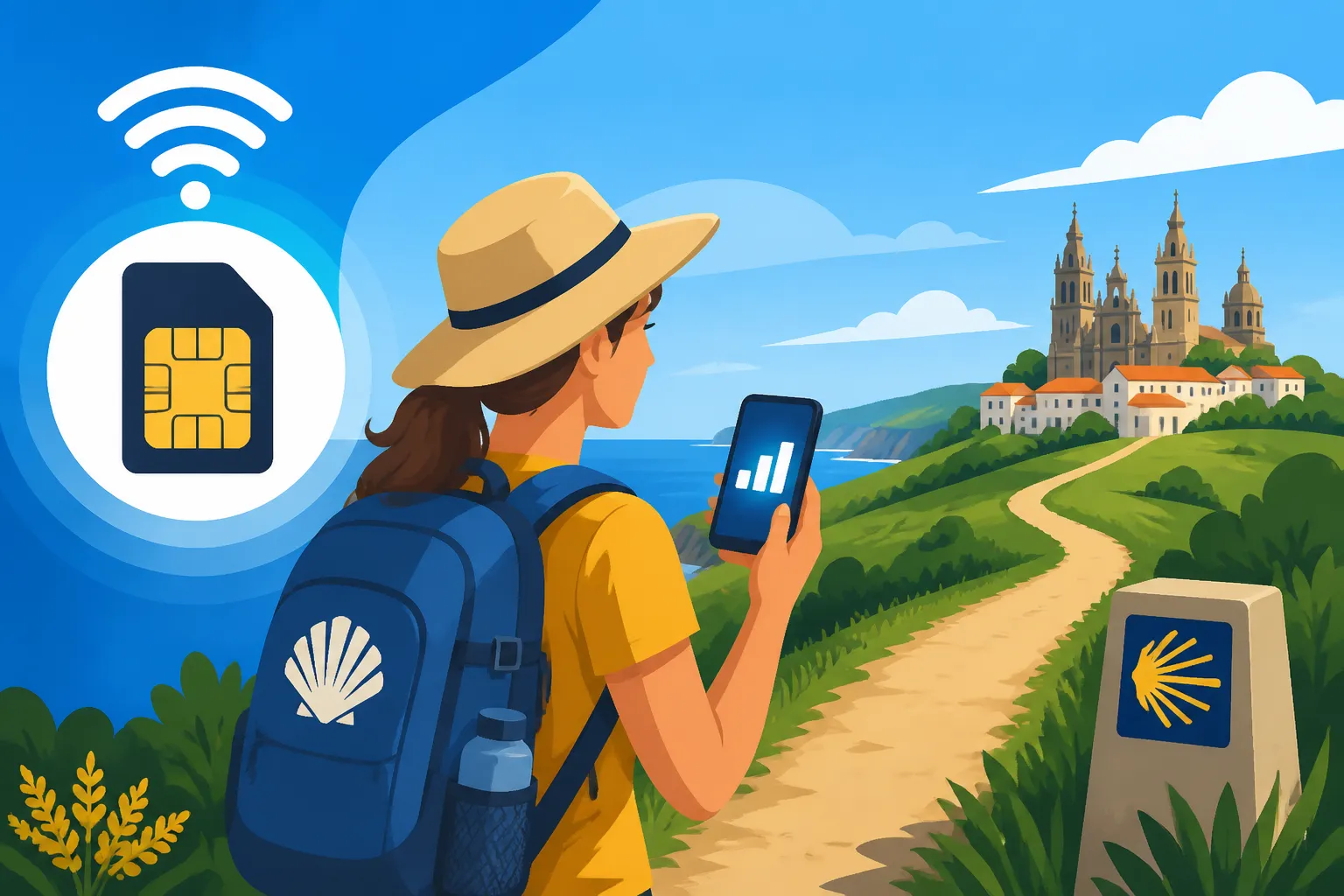
Imagine this: you've been walking all day, you're a bit lost, and your trusty navigation app suddenly goes blank. Or perhaps you've finally reached a breathtaking viewpoint and want to share it with loved ones, but there's no signal. This isn't an uncommon scenario on the Camino. Many sections, particularly on routes like the Camino Francés that traverse the Pyrenees or the mountainous regions of Galicia, will take you through areas where traditional cellular coverage can be, shall we say, a bit temperamental.
Local networks generally do a decent job, but when you're hiking through valleys or remote forest paths, even the best local providers can struggle. What you need is a solution that is flexible and leverages the strongest available networks, rather than being tied to one specific physical SIM that might not perform optimally everywhere. This is crucial not just for posting those stunning photos but for vital things like checking your albergue booking, finding a local pharmacy, or, heaven forbid, needing to contact emergency services. For more on ensuring your safety, check out our guide on Staying Safe in Spain: Practical Safety Tips for New Residents.
Navigating Language Barriers and Local SIMs
Another hurdle, and one that often catches new arrivals off guard, is the language barrier when trying to sort out local essentials. Picking up a traditional physical SIM card in Spain usually involves finding a phone store, navigating the various plans in Spanish, potentially dealing with paperwork, and then the fiddly process of swapping out your existing SIM. While it's certainly doable, it adds another layer of administrative hassle that, frankly, you don't want when you're meant to be enjoying the spiritual journey of the Camino.
I remember once trying to help a friend get a prepaid SIM in a tiny village in Galicia. The shop owner was lovely, but my friend's Spanish was basic, and the explanation of data limits and top-up procedures got lost in translation. They walked away with a plan that wasn't quite right for their needs, and it took a few days to sort out. Plus, there's always the risk of losing that tiny little piece of plastic from your home country when you swap it out – a headache you absolutely don't need mid-pilgrimage.
Why an eSIM is Your Pilgrim's Best Friend on the Camino
When I talk to new pilgrims, especially those who are a bit tech-savvy, the first thing I recommend for connectivity is an eSIM. It's truly a game-changer for international travel, and even more so for a journey like the Camino, where convenience and reliability are paramount.
The Convenience and Flexibility of eSIMs
So, what exactly is an eSIM? Think of it as a digital SIM card embedded directly into your phone. Instead of a physical chip you have to swap, you simply download a "profile" from an eSIM provider. This means no more hunting for local phone shops, no more fumbling with tiny plastic cards, and no more worrying about losing your home SIM. You can purchase and activate an eSIM plan from pretty much anywhere – your sofa at home before you leave, or even from a café in Saint-Jean-Pied-de-Port just before you start walking!
The convenience extends beyond just installation. Many modern smartphones support dual SIM functionality, meaning you can keep your home physical SIM active for calls and texts, while using your eSIM for all your data needs in Spain. This is incredibly liberating. You can receive calls from family without them incurring international charges, while your mapping app, WhatsApp, and social media run seamlessly on your dedicated Spanish data plan. It gives you the best of both worlds, providing the digital freedom you need on the trail. This modern solution truly makes managing your mobile data in Spain incredibly straightforward.
Now, when it comes to picking an eSIM provider, Airalo is a popular option worth considering. Their app is super intuitive, making the process of finding and activating a plan for Spain unbelievably easy. You just choose a plan that fits your trip duration and data needs, follow a few simple on-screen steps, and voilà – you're connected. It really takes the stress out of the equation, leaving you free to focus on the journey ahead. For more general advice on staying connected, our guide on Mobile Data and eSIMs for Travel in Spain has even more tips.
Superior Coverage and Network Access in Northern Spain
One of the biggest advantages of using an eSIM, especially one from a reputable provider like Airalo, is often the superior network access it grants you. Instead of being locked into one local network, many eSIMs partner with multiple major providers in a given country. This means your phone can automatically switch to whichever network offers the strongest signal in a particular area.
Consider the diverse terrain of Northern Spain along the Camino routes. You'll move from the bustling cities like Pamplona or León, through the flat plains of the Meseta, into the rugged mountains of Asturias and Galicia, and along the beautiful coastline. A traditional physical SIM from one provider might be great in one region but struggle in another. An eSIM, by leveraging multiple networks, often provides more consistent and reliable coverage throughout your journey.
For instance, Airalo typically partners with major Spanish networks like Movistar, Vodafone, and Orange. These are the big players, and having access to their combined infrastructure significantly boosts your chances of staying connected, even in those charming, but often isolated, villages along the Camino. This broader network access is a huge comfort when you're relying on your phone for navigation, communication, and even just a bit of distraction after a long day of walking. You won't have to stress about dead zones as much, which is priceless peace of mind.
Choosing the Right eSIM for Your Camino Journey
Selecting the perfect eSIM isn't a one-size-fits-all situation, especially when you're planning for something as unique as the Camino de Santiago. You need to consider your personal usage habits, the length of your pilgrimage, and, of course, your budget.
Factors to Consider: Data, Duration, and Cost
First, let's talk data. Are you a heavy user who needs constant access to social media, video calls, and streaming, even on the trail? Or are you a minimalist, mainly needing data for maps, WhatsApp messages, and quick searches? Most pilgrims find they need a moderate amount of data. Remember, you'll likely have Wi-Fi available at many albergues and cafés, so you won't be solely reliant on your mobile data. However, having enough to get you through those long stretches between towns, or for emergencies, is non-negotiable.
Next, consider the duration of your Camino. Are you walking the full Francés (30-35 days), a shorter section like the Portuguese Way (10-15 days), or maybe just a week-long experience? eSIM providers like Airalo offer various packages tailored to different durations, from 7-day plans to 30-day or even longer options. Choosing a plan that aligns with your estimated pilgrimage length prevents you from running out of data too soon or paying for days you won't use. Always factor in an extra couple of days, just in case your journey takes a little longer than expected, or you decide to extend your stay in a charming town.
Finally, the cost. While you might be tempted by the cheapest option, remember that reliability on the Camino is truly worth a few extra euros. Compare the cost per gigabyte and the overall package price. Often, buying a slightly larger package upfront can be more cost-effective than having to constantly top up. What you’re looking for is a balance of good value and dependable service that gives you peace of mind.
Step-by-Step: Activating Your eSIM for Spain
Activating an eSIM is surprisingly simple, especially with user-friendly platforms. I highly recommend doing this before you leave home or at least while you have stable Wi-Fi, rather than waiting until you're already in Spain and potentially stressed.
Here’s a general rundown of how it works, using Airalo as an example:
- Download the App: Get the Airalo app from your smartphone's app store.
- Choose Your Destination: Search for "Spain" or "España" within the app.
- Select a Plan: Browse the available plans, noting the data allowance, validity period (e.g., 1GB for 7 days, 5GB for 30 days), and price. Pick one that suits your Camino length and data needs.
- Purchase the Plan: Follow the prompts to buy your chosen eSIM plan.
- Install the eSIM: This is where it gets digital! Airalo provides clear instructions. Usually, you'll either scan a QR code or manually enter some details into your phone's cellular settings. Your phone will guide you through adding the cellular plan. It might look a little different depending on whether you have an iPhone or an Android, but the core process is similar.
- Activate the eSIM: Once installed, you’ll typically need to enable the eSIM line in your phone’s settings. Make sure data roaming is turned on for your new eSIM line. Some eSIMs activate immediately upon installation, while others only start their validity period when they connect to a supported network in the destination country. Check your specific Airalo plan details for this.
A pro tip: label your new eSIM line something like "Spain Data" in your phone settings. This makes it easy to switch between your home line and your data line, and to monitor data usage. Remember to activate it before you hit the trail – perhaps at the airport or your first night in Spain while you have a good Wi-Fi connection. This smooth setup means you’ll be connected from the moment you truly begin your pilgrimage. For those who want more details on general Spanish communication, our guide on Spanish Language and Everyday Communication for Visitors can help with basic phrases.
Practical Connectivity Tips for the Trail
Beyond just having an eSIM, there are a few other tricks to maximize your connectivity and battery life on the Camino.
- Conserve Battery: Navigation apps and constant signal searching are battery hogs. When you don't need active navigation, consider putting your phone in airplane mode or low power mode. Download offline maps (many Camino apps offer this) so you're not constantly streaming data. A portable power bank is an absolute must-have for the Camino. You'll often go hours without access to an outlet.
- Leverage Wi-Fi: While albergue Wi-Fi can be hit or miss, it's usually good enough for checking emails, uploading photos, or making video calls back home. Use these opportunities to download anything large you might need, or to back up your photos. Even small cafés in towns along the way often offer free Wi-Fi, so keep an eye out for those "WiFi Gratuito" signs.
- Emergency Preparedness: No matter how good your eSIM coverage, always know the local emergency number (112 in Spain) and how to communicate basic needs in Spanish. Our guide on How to Call 112 in Spain: What to Say and What Happens Next is a good resource. Have a list of important phone numbers written down somewhere safe, just in case your phone dies or gets lost.
Real-World Experiences and Common Worries
Having walked parts of the Camino myself, and having spoken to countless pilgrims over the years, I've gathered some insights into the common connectivity pitfalls and how a reliable solution can genuinely enhance your experience.
Don't Rely Solely on Wi-Fi or Your Home Provider
It's tempting to think, "Oh, I'll just use Wi-Fi at the albergues," or "My home provider's international roaming package can't be that bad." Let me tell you, this is a path to frustration. While many albergues do offer Wi-Fi, it's often slow, unreliable, and sometimes only accessible in a common area where everyone else is also trying to connect. Trying to load a map or find urgent information when the Wi-Fi is crawling at a snail's pace can be incredibly exasperating after a long day of walking.
As for home provider roaming, while some plans offer decent international rates now, they can still be prohibitively expensive, especially for extended travel. Data limits are often small, and exceeding them leads to eye-watering charges. Plus, the network prioritization for roaming customers might not be as good as for local users, potentially leading to slower speeds or weaker signals. Investing in a dedicated plan through an eSIM like Airalo means you're not constantly checking your data usage or hunting for the next Wi-Fi hotspot; you have the freedom to use your phone as needed, when needed. If you're comparing other options, check out our piece on Mobile Phone Plans in Spain: Prepaid vs Contract for Foreigners.
Keeping Your Devices Charged and Safe
A great eSIM plan is useless if your phone battery is dead! The Camino is an incredible experience, but it’s also physically demanding. You’ll be walking for hours, often without access to power outlets. So, besides your Airalo eSIM, you need a robust charging strategy.
Always carry a fully charged power bank, and ideally, one with enough capacity for at least two full phone charges. European plugs (Type F/E) are standard in Spain, so ensure you have the correct adapter for your chargers. Charging points in albergues can be limited, especially if you’re staying in a communal dorm, and you often have to be quick to claim a spot. Consider investing in a small, multi-port USB charger so you can charge several devices at once if you're lucky enough to find an outlet.
Security is another consideration. While the Camino is generally very safe, leaving your phone unattended while charging in a crowded albergue could lead to it being misplaced or worse. Keep an eye on your devices, or use a small lock if you have a locker. It's always better to be safe than sorry when it comes to your valuable electronics. Our guide on Travel Logistics in Spain: Money, Safety, and Connectivity also touches upon general travel safety.
The Peace of Mind a Good Connection Brings
Ultimately, having reliable connectivity on the Camino de Santiago isn't just about practicalities; it's about peace of mind. The Camino is a journey of self-discovery, but that doesn't mean you have to be completely cut off from the world. Being able to quickly look up the opening hours of the next albergue, check the weather forecast for tomorrow's hike, or send a quick "I'm okay" message to family back home can significantly reduce stress and enhance your overall experience.
For me, the ability to rely on my phone for maps, information, and communication meant I could fully immerse myself in the present moment of the walk, knowing that a lifeline was just a tap away if I needed it. Airalo played a huge part in that. It removes a layer of logistical worry, allowing you to focus on the breathtaking landscapes, the camaraderie with fellow pilgrims, and the personal reflections that make the Camino so special. It's one less thing to worry about, letting you embrace the true spirit of the journey.
| Feature | Traditional Physical SIM (Local Spain) | International Roaming (Home Provider) | eSIM (e.g., Airalo) |
|---|---|---|---|
| Ease of Setup | Requires physical store visit, paperwork | Automatic (if activated) | Digital purchase & activation via app/QR code |
| Physical Card | Yes, requires swapping | None (uses home SIM) | None |
| Data Costs | Generally affordable | Often very expensive | Competitive, clear upfront pricing |
| Network Access | Limited to one provider's network | Varies by agreement, often slower | Often leverages multiple local networks for better coverage |
| Home Number | May be inactive if physical SIM removed | Active | Active (if dual SIM phone) |
| Flexibility | Limited, tied to one local plan | Limited, tied to home plan | High: easy to switch plans, top-up, keep home number |
| Ideal For | Long-term residents, heavy users | Short, infrequent usage | Travelers, pilgrims, short/mid-term stays |
Disclaimer
Please note that while we strive to provide accurate and up-to-date information, regulations, services, and product offerings can change. Always verify the latest details directly with service providers and official sources. This guide offers general advice and personal insights based on typical expat experiences in Spain.