Road Freight vs Sea Freight to Spain: When Each One Makes Sense
Disclosure: This article contains affiliate links. If you buy through them, we may earn a commission at no extra cost to you. Read our full disclosure.
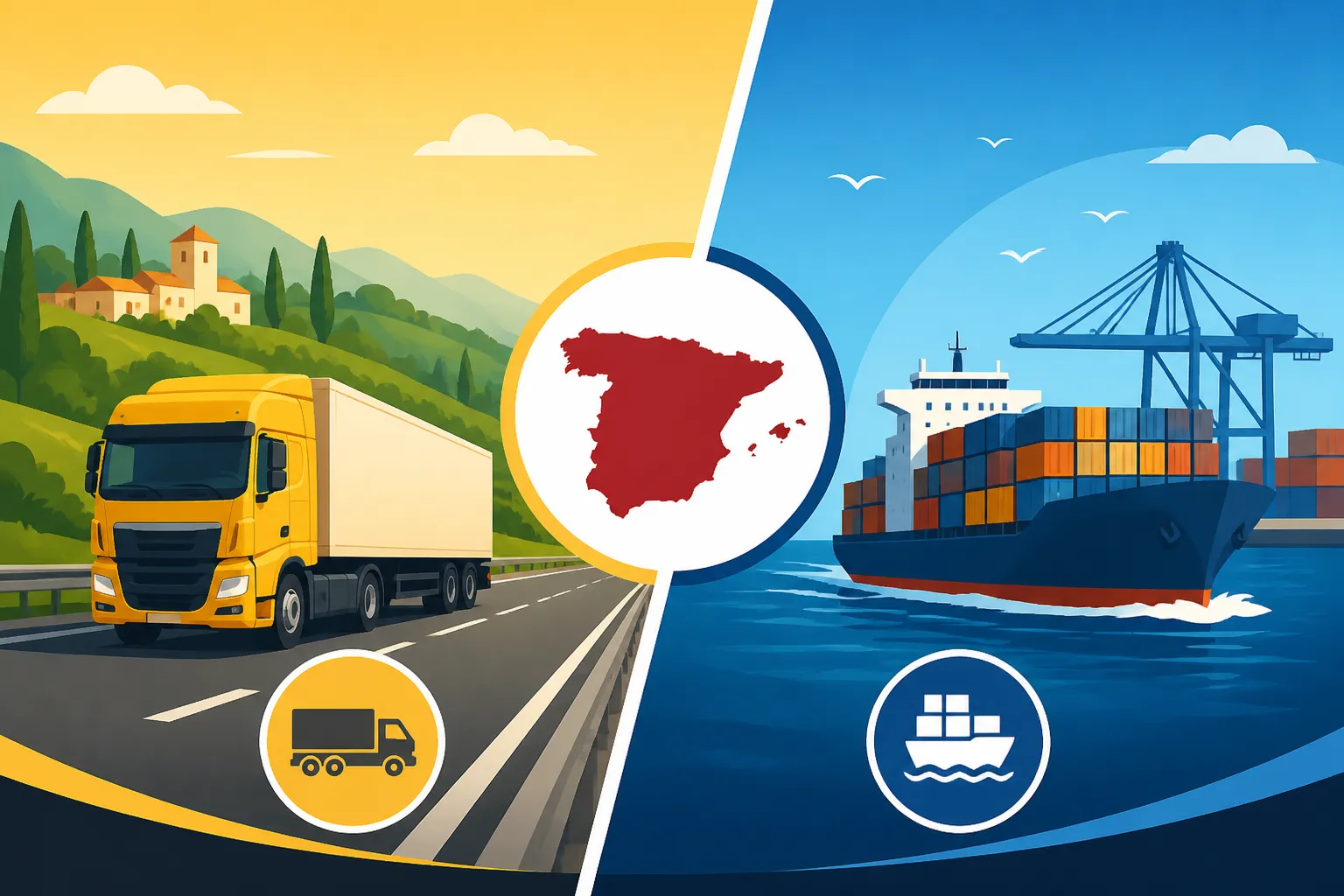
Picture three months of work packed into boxes, two quotes in your inbox, and no idea whether your sofa should cross the Pyrenees on a truck or cross an ocean in a steel box. Choosing the wrong freight method for a move to Spain wastes money, weeks and patience. This guide explains when road freight wins, when sea freight wins, and how to compare real quotes with confidence.
How Road Freight and Sea Freight Actually Work for a Move to Spain
Before comparing anything, it helps to know what physically happens to your belongings under each method. When I moved my own household to Spain, I treated “freight” as one category and assumed the mover would pick the sensible option. That was a mistake. The two methods involve different handling, different paperwork, different points where things can go wrong, and a very different cost structure. Once you see the mechanics, most decisions make themselves.
Road Freight: Removal Trucks Across the Pyrenees
Road freight is the simplest thing to picture. A removal crew packs your home, loads a truck at your door, and that truck, or a connecting one, drives to Spain. From most of continental Europe, the truck enters through one of two main gateways. On the eastern side, traffic comes down through France and crosses at La Jonquera into Catalonia, then follows the Mediterranean corridor south towards Barcelona, Valencia, Alicante and the Costa del Sol. On the western side, trucks cross near Irún in the Basque Country and fan out towards Bilbao, Madrid, Castilla y León and Galicia.
The key feature of road freight is continuity. In a dedicated move, the same crew that loads your furniture in Lyon or Düsseldorf may be the crew that unloads it in Sevilla. Your belongings stay on one vehicle or move between a small number of vehicles at a depot. There is no port, no crane lifting a container onto a ship, and no waiting for a vessel schedule. The fewer the handovers, the fewer the chances for a box to be dropped, misrouted or left behind.
There is a catch. Road freight works only where roads connect. Anything coming from outside Europe cannot travel this way for the whole journey, and moves from the UK and Ireland involve a ferry or the Channel Tunnel. A truck that boards a ferry is still road freight in practical terms, since the vehicle and its load stay together, but it adds a booking element and some exposure to weather and sailing delays.
Sea Freight: Containers, Ports and the Long Middle Stretch
Sea freight is a chain with more links. Your goods are packed at home, loaded into a shipping container (either at your door or at the mover’s warehouse), trucked to a port, lifted onto a vessel, sailed to a Spanish port, unloaded, cleared through customs, trucked again to a local depot or directly to your new address, and finally unloaded by a Spanish delivery crew. Valencia and Algeciras are the big container gateways, with Barcelona, Bilbao and Vigo also handling a lot of traffic, and your destination region usually decides which port your mover favours.
That middle stretch is where sea freight earns its reputation for being slow but economical for large volumes. A ship carries thousands of containers, so the cost of moving yours is spread across a vast cargo. The trade-off is that you lose control over timing. Vessels have fixed schedules, transhipment hubs can add stops, and port congestion or customs checks can hold a container for days without anyone telling you much.
When I helped a friend move from Toronto to Málaga, the most stressful part was not the ocean crossing. It was the silence between “your container has been loaded” and “your container is available for delivery”. Building that waiting period into your housing plans is the single most important thing you can do with a sea shipment.
Where the Two Methods Overlap
The two methods are not always rivals. Almost every sea freight move includes road legs at both ends, and some road moves include short sea crossings. From the UK and Ireland in particular, you may see quotes for “road freight” that use freight ferries into Bilbao or Santander, and quotes for “sea freight” that put your goods in a container on a ship. The labels can sound alike while the service is very different.
There is also the question of how much space you buy. Both methods offer a dedicated option, where the truck or container is reserved for you, and a shared option, where your goods travel alongside other households’ belongings. Shared road loads are usually called groupage or part-load, and shared sea loads are often called LCL, meaning less than container load. For a deep dive on the shared-versus-dedicated question by volume, see Full Load vs Groupage to Spain: Cost Break-Even by Cubic Metre.
The practical takeaway is to look past the word “road” or “sea” in a quote and ask what actually happens to your boxes, step by step. That is where comparing several movers side by side becomes so valuable, and it is exactly what a comparison platform like Sirelo is designed to help with.
Road Freight vs Sea Freight Head to Head
Once you understand the mechanics, you can compare the two methods on the things that matter to a household: cost shape, speed, predictability, handling and paperwork. Neither method is universally better. Each one has a sweet spot, and the goal is to find out which sweet spot your move falls into.
| Factor | Road Freight | Sea Freight |
|---|---|---|
| Typical origin | Mainland Europe, UK and Ireland via ferry or tunnel | North and South America, Asia, Africa, Oceania, Middle East |
| Cost driver | Distance driven, volume, crew days, tolls, fuel | Container size or shared volume, port charges, customs handling, trucking at both ends |
| Speed | Days rather than weeks for most European routes | Weeks, shaped by vessel schedules and port processing |
| Predictability | High for dedicated loads, lower for groupage waiting on other customers | Moderate, with exposure to vessel delays and port congestion |
| Handling points | Few, often the same crew door to door | Many, including port cranes, customs inspection and depot transfers |
| Customs at the Spanish end | None for intra-EU moves | Import clearance required for non-EU origins |
| Best for | Medium to large households within Europe, urgent moves | Large households crossing oceans, budget-conscious long-distance moves |
| Weak spot | Becomes uneconomical over very long distances | Slow, with a long period without your belongings |
Cost Shape: What You Are Really Paying For
Road freight pricing is strongly tied to distance and labour. A truck driving from Hamburg to Murcia burns fuel, pays tolls on French and Spanish autopistas, and keeps a crew on the road for multiple days. That cost exists whether your truck is half full or packed to the roof, which is why a dedicated truck makes sense for a full household and becomes poor value for a few pieces of furniture.
Sea freight pricing works differently. The ocean leg is often a smaller slice of the total than people expect. A lot of the cost sits at the ends: packing, trucking to the origin port, terminal handling, customs clearance in Spain, trucking from the port and delivery labour. That means a sea shipment from somewhere relatively close, say the UK by container, can end up costing in the same range as a road move, while a sea shipment from far away can be surprisingly reasonable for the distance covered.
Because the cost drivers differ, you cannot judge road and sea quotes on a single headline number. You need to know what each one includes. A good primer on the gap between the two common service levels is Door-to-Door vs Port-to-Port Moves to Spain: What Each Quote Includes, which is especially relevant for sea freight, where cheaper port-to-port quotes leave you to organise the final leg yourself.
Speed and Predictability
Speed matters more than people expect. Every day your belongings are in transit is a day you might be sleeping on an air mattress, renting furnished accommodation, or buying duplicate kitchen items. Road freight from within Europe usually arrives quickly, and a dedicated truck can often be booked for a specific delivery date. That precision is enormously helpful when you are coordinating with a landlord’s handover in Valencia or a notary completion date in Marbella.
Sea freight requires a different mindset. You plan around a delivery window rather than a delivery day. The vessel might depart later than planned, the container might be routed through a transhipment hub, and Spanish customs might select it for physical inspection. None of this is unusual, and none of it is anyone’s fault in particular, but it means you should never book the removal truck out of your old home and the start of your new lease as if they were one event.
Groupage by road sits in the middle. Your goods wait until the truck heading towards your part of Spain is full enough to depart, then the truck makes several drops along its route. If you are flexible, groupage can be excellent value. If you need certainty, a dedicated load is worth comparing.
Handling, Damage Risk and Insurance
Every time someone lifts your belongings, there is a small chance something goes wrong. Road freight with a dedicated truck minimises handling: the load goes on once and comes off once. Sea freight with door-to-door container loading also keeps handling relatively low, since the container is sealed at your home and opened at your new address, unless customs inspects it. Shared sea freight and groupage involve more handling, since goods are consolidated in warehouses and repacked into vehicles or containers.
Sea freight introduces its own environmental risks. Containers sit on docks in sun and rain, cross oceans with temperature swings, and can build up condensation inside. Wooden furniture, artwork, pianos and electronics deserve proper wrapping and sometimes moisture absorbers. Road freight is not immune to heat, especially on a summer drive through Andalusia, but the exposure is shorter.
Whichever method you choose, check what protection is included and what an upgraded policy would cover. The standard liability built into many removal contracts is limited, and full-value cover is a separate decision. For valuation methods, exclusions and how to claim, see Moving Insurance for Shipments to Spain: Coverage, Valuation, and Claims.
When Road Freight Makes Sense
Road freight is the natural choice for a large share of moves to Spain, simply because so many people relocate from elsewhere in Europe. But “you are in Europe, so take a truck” is too blunt. Distance, volume and timing all shape the decision, and there are borderline cases where sea freight competes.
Moving From Mainland Europe
If you are moving from France, Germany, the Netherlands, Belgium, Switzerland, Austria, Italy or Portugal, road freight is almost always the starting point. There is no customs clearance for EU-origin household goods, the routes are well established, and many removal companies run regular services into Spain. Switzerland is outside the EU, so a Swiss move involves customs formalities even though it travels by road, which is worth confirming with any mover you shortlist.
Consider a hypothetical family I will call the Weber household, moving from a three-bedroom house near Munich to a townhouse outside Alicante. They have a full household, two children starting school in September, and a fixed rental start date. A dedicated truck lets them load on a Monday, drive down to their accommodation, and receive their furniture within days. Sea freight would mean trucking everything to a North Sea or Mediterranean port, waiting for a vessel and clearing a container, which adds handling and time without any real benefit for an intra-European route. For route-specific detail, see Moving to Spain from Germany: Road Freight Costs and Transit Times.
Portugal is an interesting edge case. The distance to Galicia, Extremadura or Andalusia is short enough that some people consider renting a van and doing it themselves. That can work for a small flat, but for a full household the labour, fuel, insurance and risk of injury add up quickly. Getting professional road quotes is still worth doing, if only to know what you are comparing your DIY plan against.
UK and Ireland: The In-Between Case
The UK and Ireland are where road and sea freight genuinely compete. A removal truck can cross by ferry or tunnel and drive through France, or it can board a long freight ferry directly into northern Spain. Alternatively, your goods can go into a container and ship to a Spanish port. Each route has its fans, and the right answer depends on where in Spain you are going, how much you are moving and how much time you have.
Take a hypothetical couple, Priya and Tom, moving from Manchester to a flat in Madrid. With a modest one-bedroom load, they are likely to get competitive quotes for groupage by road, since many UK movers run regular part-load trucks to Spain. If they were moving a large family home to Galicia instead, a container through Vigo or a direct ferry route into Bilbao or Santander might come out ahead. The only way to know is to request quotes for both methods and compare like with like.
Since Brexit, UK moves also involve customs paperwork, because the UK is now outside the EU. That applies whether your goods travel by truck or container. Relief from import duty is available for qualifying household goods when you transfer your residence, but the documents must be in order before the goods arrive. For the UK specifics, see Moving to Spain from the UK After Brexit: Customs, Costs, and ToR Relief, and for Irish routes, Moving to Spain from Ireland: Sea and Road Routes Compared lays out the options in detail.
Partial Loads and Groupage by Road
Not everyone is moving a whole house. Students, young professionals and people who have decided to sell most of their furniture often have a fraction of a truckload. Here, groupage by road is frequently the sweet spot. You pay for the space you use, and the mover combines your goods with other customers heading in a similar direction.
The trade-off is flexibility. Groupage trucks leave when they are full or on a set schedule, and they drop goods along a route. If your new home is in a well-served area like the Costa Blanca, Barcelona or Madrid, you may find frequent departures. If you are moving to a village in inland Teruel or the mountains of Asturias, you may wait longer or pay more for the final drop. Asking each mover how often they run trucks to your specific province is one of the most useful questions you can ask.
For very small moves, groupage is not always the cheapest option. A handful of boxes and a bicycle might be better suited to excess baggage, air freight or a courier. Those alternatives have their own limits and costs, explained in Excess Baggage vs Air Freight vs Courier: Sending 50-200kg to Spain.
When Sea Freight Makes Sense
Sea freight dominates as soon as an ocean separates your old home from Spain. It also has a role in a few European scenarios, particularly for very large loads and island destinations. The challenge with sea freight is less about whether to use it and more about how: dedicated container or shared space, and which size.
Intercontinental Moves to Spain
From the United States, Canada, Latin America, South Africa, the Gulf states, India, Australia or New Zealand, sea freight is the only realistic way to move a full household. Air freight exists, but for anything beyond a few suitcases’ worth of essentials, it is priced for urgency rather than volume. Most intercontinental movers combine a sea shipment for furniture with a smaller air shipment or extra baggage for the things you need on day one.
Imagine a hypothetical retiree, Linda, moving from Florida to a villa near Jávea. Her container would typically sail into Valencia, clear Spanish customs, and travel the short distance down the coast by truck. The sea leg is long, but it is not the whole story. Packing, trucking to a US port, export paperwork, terminal handling in Valencia and import clearance all take time and cost money. Linda’s best move is to request door-to-door quotes from movers experienced on the US-to-Spain route, so the price includes everything up to her front door. For the route specifics, see Moving to Spain from the US: Container Costs, Ports, and Timelines.
At the far end of the scale, moves from Australia and New Zealand involve some of the longest shipping routes in the world, often with transhipment in Asia or the Middle East. These moves reward careful planning more than any other. The detailed breakdown is in Moving to Spain from Australia and New Zealand: The Longest Route Priced Out.
Full Container or Shared Container
Once you have decided on sea freight, the next choice is how much container you need. A dedicated container is loaded at your home, sealed and shipped. Nobody else’s goods share the space, handling is minimal, and the container can usually go straight from the Spanish port to your address once cleared. The two standard sizes are 20-foot and 40-foot, with the 20-foot container generally suited to a smaller household and the 40-foot to a larger family home.
A shared container, often called LCL or groupage by sea, puts your goods alongside other households’ shipments. You pay for your share of the volume, which can be very economical for a partial load. The downside is time and handling: your goods may wait at the origin warehouse until the container is full, and at the Spanish end they wait again while the container is unpacked and individual shipments are separated and cleared.
The size decision is easier if you do an honest inventory and get a proper survey, ideally by video or in person. Spanish apartments, especially in older city centres, are often smaller than homes in North America or Northern Europe, and many people ship furniture that simply does not fit. Before you pay to ship a sectional sofa across the Atlantic, see Will Your Furniture Fit? Spanish Apartment Layouts vs Northern European Homes. For help choosing between container sizes, see 20ft vs 40ft Container to Spain: Which Load Size Fits Your Home.
The Balearic and Canary Islands
Islands change the equation, even for moves within Europe. If you are moving to Mallorca, Menorca or Ibiza, your truck will typically board a ferry from Barcelona, Valencia or Dénia. That is still effectively road freight, but ferry bookings add cost and scheduling constraints, especially in summer when sailings are busy with holiday traffic.
The Canary Islands are a different case altogether. They lie off the coast of Africa, far from the mainland, and household goods arrive by sea, either in a container or as part of a groupage service shipped from the mainland, often via Cádiz or Huelva. The Canaries also sit outside the EU VAT area and apply their own indirect tax, IGIC, instead of the mainland IVA. That means goods sent to the Canaries go through customs formalities even when they come from mainland Spain or elsewhere in the EU. A mover experienced with Canary moves will know the drill; one who is not may underestimate it.
Ceuta and Melilla, the Spanish cities on the North African coast, have their own customs arrangements too. If your destination is anywhere other than the mainland or the Balearics, ask every mover directly how they handle customs and whether their quote includes it.
The Spanish End: Customs, Delivery and Timing
Whichever method you choose, the move is not finished until your boxes are inside your new home. The Spanish end of the journey is where paperwork, narrow streets and timing collide. Planning for this stage separates a smooth arrival from a fortnight of phone calls in imperfect Spanish.
Customs Paperwork for EU and Non-EU Origins
For moves from within the EU, household goods travel freely and there is no import clearance. That is one of road freight’s biggest practical advantages within Europe. For moves from outside the EU, which includes the UK, Switzerland and every intercontinental origin, your goods must be cleared by Spanish customs before delivery.
Relief from import duty and VAT is available for personal belongings when you transfer your normal residence to Spain, under what is commonly called the cambio de residencia procedure. To qualify, you generally need to show that you are genuinely moving your residence, that the goods are for personal use, and that you have owned and used them for a required period before the move. The detailed requirements, and the documents customs expects, are covered in Cambio de Residencia Exemption: The Paperwork That Waives Import Duty. The broader contrast between EU and non-EU arrivals is explained in EU vs Non-EU Moves to Spain: Why Customs Treats Them Completely Differently.
This is where the order of events gets tricky. Customs clearance for non-EU goods typically requires Spanish identifiers, such as your NIE, and evidence of your new residence. If your container lands before you have these, it may sit in port while you scramble. For a step-by-step approach to this timing problem, see Getting Your NIE and Padron Before Your Container Lands: The Sequencing Problem. Some items are restricted or prohibited regardless of method, so checking your inventory against the rules before packing saves trouble at the border.
The Last Mile in Spanish Streets
The final delivery is where Spain’s charm can become a logistical headache. Historic centres in Sevilla, Granada, Toledo, Cádiz and Barcelona’s Gothic Quarter have streets too narrow for a large truck. Many older buildings have small lifts or none at all. Some municipalities require a permit to park a removal vehicle or to reserve space on the street, and some restrict delivery hours.
For road freight, the large truck that crossed the Pyrenees may not be able to reach your door. The mover may need to transfer your goods to smaller vans, a process called a shuttle, or use an external furniture lift through a balcony. For sea freight, a 40-foot container on a trailer is an even bigger challenge in a historic street. Either way, these extras should appear on your quote, not as a surprise on delivery day.
A good mover will ask detailed questions about access: floor number, lift size, street width, parking and whether the building has a portero or community rules about deliveries. If a quote does not mention access at all, ask. For the common extras and how they show up on invoices, see Hidden Costs in Spanish Moving Quotes: Access Fees, Permits, and Stairs. For the practical choreography of the day itself, see Delivery Day in a Spanish Building: Narrow Streets, Lifts, and Permits.
Sequencing Freight With Your Keys and Storage
The best freight method in theory can still go wrong if it does not match your housing timeline. Road freight is fast enough that you can often time delivery to coincide with your key handover. Sea freight usually requires a buffer, either because your goods arrive before you have a place to put them or because you arrive weeks before your goods.
Storage is the usual bridge. Many movers offer warehouse storage at either end, and Spain has a wide market for trasteros, the self-storage units common in Spanish cities. Storing at the origin can make sense if you are not sure where in Spain you will settle. Storing in Spain makes sense if your goods arrive before your rental starts. Each option has implications for handling, insurance and cost. For a comparison, see Storage While You Relocate: Home-Country Units vs Spanish Trasteros.
If you are going to be in Spain for a while before your goods arrive, plan your temporary housing carefully. A furnished aparthotel or mid-term rental can bridge the gap without forcing you to buy duplicate furniture. For practical guidance on that interim period, see Bridge Accommodation: Where to Stay Between Landing and Getting Keys. And for a full timeline that slots freight booking, packing, customs and delivery into one plan, see An International Move to Spain: The 12-Week Planning Calendar.
Choosing the Right Freight Method With Sirelo
By now you have a sense of which method probably fits your situation. The final step is turning that sense into a concrete booking with a reliable mover at a fair price. This is where I strongly recommend using Sirelo, a moving comparison platform that connects people relocating internationally with removal companies that handle moves into Spain. Instead of chasing individual movers one by one, you describe your move once and receive several quotes you can compare side by side.
How to Request and Compare Quotes
The process is straightforward, and it is the part of my own move I wish I had started earlier.
- Write a rough inventory of what you plan to take, room by room, and flag bulky or fragile items such as pianos, artwork, large wardrobes and appliances.
- Note your origin address, your destination area in Spain, and any access details you already know, such as floor number and whether the building has a lift.
- Decide your preferred moving window, and whether you have flexibility for groupage or need a fixed date.
- Go to Sirelo, enter your move details in the request form, and specify the volume or the size of your home.
- Receive quotes from several international removal companies, and read their review profiles on Sirelo to see how past customers rated them.
- Arrange a survey, by video or in person, with your shortlisted movers so the volume estimate is based on your actual home rather than a guess.
- Ask each mover to quote both road and sea where both are realistic, such as from the UK or Ireland, so you can see the difference in black and white.
- Compare the final offers line by line, confirm insurance and access arrangements, and book the mover that offers the best combination of reliability, inclusions and price.
The reason this works so well is that it removes the guesswork. When I relied on a single recommendation, I had no benchmark and no way of telling whether a quote was fair. Comparing several movers through Sirelo gives you that benchmark instantly, and it also gives you leverage: a mover who knows you have other quotes is more likely to be precise and competitive.
Reading Road and Sea Quotes Side by Side
Once quotes arrive, resist the temptation to sort by the bottom-line number. A cheaper sea freight quote may be port-to-port, leaving customs clearance, port charges and delivery to you. A cheaper road quote may be groupage with an open-ended departure date. To compare fairly, check each quote against the same list of inclusions.
| Item to Check | Why It Matters for Road Freight | Why It Matters for Sea Freight |
|---|---|---|
| Packing and materials | Determines how well goods survive a long drive | Critical for moisture and long transit |
| Dedicated or shared space | Affects departure flexibility and delivery date | Affects waiting at warehouses on both ends |
| Origin and destination handling | Usually included door to door | Port and terminal charges may be excluded |
| Customs clearance | Needed only for non-EU origins such as the UK or Switzerland | Needed for all non-EU origins, often a separate line |
| Delivery access | Shuttle vans, lifts and permits in narrow streets | Same, plus container trailer access at the address |
| Insurance | Basic liability vs full-value cover | Same, with attention to water and condensation damage |
| Storage | Short-term storage if keys are delayed | Often needed while waiting for clearance or housing |
| Delivery date or window | Usually a specific date for dedicated loads | Usually a window, dependent on vessel schedules |
If one quote lists a line that another omits, ask the second mover whether it is included. A quote that looks cheaper only because it leaves out port charges or delivery access is not cheaper at all. For a deeper look at the line items that inflate final bills, see Comparing International Removal Quotes for Spain: Line Items That Hide Costs. Bringing that checklist to the quotes you receive through Sirelo turns a confusing pile of PDFs into a clear decision.
Questions to Ask Before You Book
Even after comparing quotes, a short conversation with your top two movers can reveal a lot. These are the questions I would ask every time, whether the move is road or sea:
- How often do you run trucks or ship containers to my province in Spain, and what is the realistic delivery window?
- Is my quote for a dedicated load or a shared one, and what happens if the shared truck or container is not full on time?
- Who handles customs at the Spanish end, and which documents do you need from me and by when?
- Does your Spanish delivery partner know my street, and have you included a shuttle, a furniture lift or a parking permit if access is tight?
- What is covered by your standard liability, and what does full-value insurance add?
- If my keys are delayed, where would my goods be stored, and is that storage insured?
- Who is my single point of contact from packing day to delivery day?
The answers tell you as much about the mover’s experience as about the logistics. A mover who answers confidently and specifically about delivering to a third-floor walk-up in Sevilla’s Santa Cruz quarter, or clearing a container through Valencia, has done it before. A mover who is vague may be subcontracting the Spanish end to someone they barely know. Reading the reviews on Sirelo before the call helps you spot patterns, such as consistently praised communication or recurring complaints about late deliveries.
To pull everything together, here is a quick decision guide for typical scenarios.
| Your Situation | Usually Best Method | What to Compare |
|---|---|---|
| Full household from Germany, France or the Benelux | Dedicated road freight | Delivery date certainty and access extras |
| Small flat from mainland Europe, flexible timing | Road groupage | Departure frequency to your province |
| Family home from the UK or Ireland | Road or sea, depending on destination | Ferry-based road quotes vs container quotes |
| Full household from North America | Dedicated sea container | Door-to-door inclusions and customs handling |
| Partial load from outside Europe | Shared sea container | Waiting time at warehouses on both ends |
| Move to the Balearics | Road freight with ferry crossing | Ferry scheduling and summer capacity |
| Move to the Canary Islands | Sea freight | Customs formalities and IGIC handling |
| A few boxes and a bike | Courier, air freight or extra baggage | Weight limits and per-item handling |
Whatever your route, the decision gets dramatically easier once you have real numbers from real movers in front of you. If you are still unsure whether road or sea freight suits your move to Spain, request quotes for both through Sirelo, compare them line by line using the checklists above, and let the specifics of your inventory, route and timeline make the choice. Your future self, unpacking in a sunny Spanish living room on schedule, will thank you.
Disclaimer
This article is for general informational purposes only and does not constitute professional advice. Laws, prices and regulations vary by location and change over time. Consult a qualified professional for guidance on your specific situation.