How to Visit the Mezquita of Córdoba Respectfully
Many travelers arrive at the Mezquita-Catedral de Córdoba expecting a standard museum visit, only to feel the immediate weight of local disapproval when they accidentally wander into a live mass or realize their summer attire is vastly inappropriate for a consecrated space. This guide solves the common friction between tourist curiosity and local religious practice, ensuring your visit is culturally sensitive, logistically smooth, and deeply meaningful.
Disclosure: This post may contain affiliate links. We may earn a commission at no extra cost to you if you make a purchase through these links. Read full disclosure.
Understanding the Dual Identity of the Mezquita-Catedral
The Mezquita-Catedral is not just a relic of the past; it is a living, breathing paradox that sits at the very heart of Spanish identity. For an expat living in Spain, you quickly realize that the locals do not just see this as a UNESCO World Heritage site; they see it as their primary place of worship. The building has undergone several dramatic shifts, from a Visigothic church to one of the most magnificent mosques in the Islamic world, and finally back to a Catholic cathedral in 1236. This layered history is explored in depth in our guide to Moorish Spain: Alhambra, Mezquita, and Al-Andalus Heritage.
When you step inside, you are effectively walking through centuries of tension and co-existence. The red-and-white double arches of the mosque section are breathtaking, but they lead directly into the high-Gothic and Renaissance nave of the cathedral. This architectural "collision" requires a specific mental shift from the visitor. You are not just in a gallery of arches; you are in a sanctuary. Validating the frustrations of many newcomers, it can be confusing to know which set of rules to follow. Is it a mosque? Is it a church? Technically, it is a Catholic cathedral, and the Diocese of Córdoba maintains strict control over conduct within its walls.
The Significance of Consecrated Ground
Because the site is a functioning cathedral, religious services are held daily. This is where many tourists trip up. If you arrive during a scheduled mass, certain areas of the central cathedral will be cordoned off. It is vital to remember that for the people praying there, you are a guest in their spiritual home. Respecting the silence is the most significant hurdle for large groups. Sound carries exceptionally well under the forest of 856 columns, and even a whispered conversation can echo into the choir stalls where locals may be in prayer.
Understanding the Spanish Customs, Etiquette, and Social Life will help you realize that while Spaniards are generally loud and boisterous in the streets, the interior of a church is a place of absolute solemnity. Shushing is common, and the security staff will not hesitate to ask you to leave if your group is too loud. This is not just about being polite; it is about honoring the "consecrated" status of the building, which is a point of deep pride for the Cordobés people.
Navigating the Transition from Patio to Prayer Hall
Before you even enter the building, you pass through the Patio de los Naranjos. This was originally the courtyard for ablutions (ritual washing) during the Islamic era. Today, it serves as a transitional space. You can talk freely here, take photos of the fountain, and enjoy the shade of the orange trees. However, as you approach the doors of the Mezquita, you should begin to quiet down and check your attire.
Many visitors make the mistake of treating the Patio like a park. While it is beautiful, it is still part of the religious complex. If you are visiting as part of Seville, Granada, and Córdoba: Andalusia's Great Cities, you will notice that each city has its own vibe, but Córdoba is perhaps the most protective of its central monument's dignity. Transitioning your mindset in the Patio ensures that by the time you cross the threshold, you are in the right headspace for a respectful visit.
Practical Conduct and the Unwritten Dress Code
One of the most frequent administrative hurdles for tourists in Spain is the "modesty check" at the entrance of major cathedrals. The Mezquita-Catedral is no exception. While there isn't a "uniform" per se, there is a very clear expectation of what constitutes respectful clothing. If you are coming from a hot afternoon in the Judería (the old Jewish quarter), you might be tempted to wear tank tops and short-shorts. Don't do it. You will likely be stopped at the door, or at the very least, you will receive uncomfortable glares from the staff and worshippers.
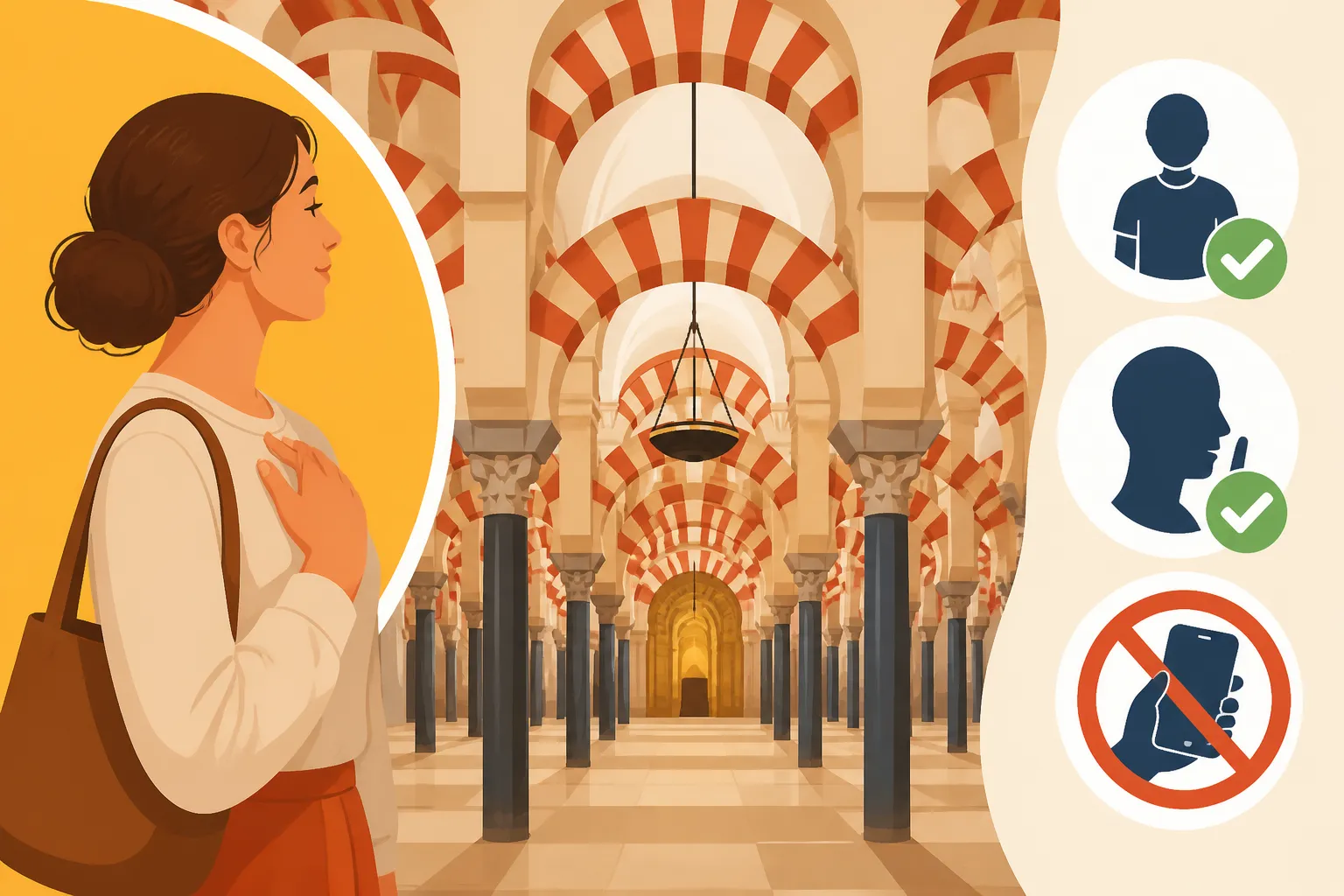
The general rule is that shoulders and knees should be covered. This applies to both men and women. If you are wearing a sleeveless top, carry a light pashmina or scarf in your bag that you can throw over your shoulders before entering. Men should avoid wearing hats or caps inside the building. It sounds like a small detail, but removing your hat is a sign of profound respect in Spanish Catholic tradition. For more on how to navigate these environments, check out our tips on How to Visit Spanish Cathedrals as a Non-Religious Traveler.
Photography Ethics and Quiet Zones
Photography is permitted inside the Mezquita-Catedral, but with significant caveats. Using a tripod or a flash is strictly forbidden without prior written authorization from the Bishopric. Flash photography is particularly disruptive in a space where the lighting is designed to be dim and atmospheric. Moreover, you should never take photos of people in prayer. This is a major point of contention between locals and tourists. Aiming a lens at someone during confession or mass is considered highly offensive.
There are also specific "quiet zones" near the Capilla Mayor and the Parroquia del Sagrario. In these areas, even the click of a heavy camera shutter can be seen as intrusive. If you are using a professional camera, try to use a silent shutter mode. If you are using a smartphone, ensure your "shutter sound" is turned off. These small adjustments make a world of difference in how you are perceived by the local community. It is all part of the broader Spanish Social Customs: Greetings, Kisses, and Personal Space—recognizing when to give people their spiritual distance.
Managing Large Groups and Guided Tours
If you are traveling with a large family or a group of friends, the temptation to gather around a single column and discuss the architecture is high. However, large huddles can block the flow of worshippers and other visitors. It is better to move through the forest of columns in smaller clusters. If you have booked a tour through GetYourGuide, your guide will likely provide you with "whisper" headsets. These are mandatory for most groups because they allow the guide to speak at a low volume while everyone hears clearly, preventing the "wall of noise" that often plagues historic sites.
Using a service like GetYourGuide is often the best way to ensure you don't miss the nuanced history while remaining respectful, as professional guides are well-versed in the house rules. They will tell you exactly where you can stand and when to keep your voice down. This is especially helpful during the busier midday hours when the contrast between the bustling city and the quiet interior is at its peak.
Planning Your Logistics for a Seamless Visit
Córdoba is a popular day-trip destination, but rushing in and out often leads to a stressful and less respectful experience. To truly appreciate the Mezquita, you need to plan your timing. Most visitors arrive via the high-speed AVE train from Madrid or Seville. You can easily compare schedules and prices on Omio to find the best connection. Using Omio helps you avoid the headache of navigating various Spanish-only transport websites, ensuring you arrive in Córdoba with plenty of time to spare before your ticket slot.
Once you arrive at the station, the Mezquita is about a 20-minute walk or a short taxi ride away. If you can, try to stay overnight. Booking a hotel through Booking.com in the Judería neighborhood allows you to visit the Mezquita during the quieter morning hours or experience the "Alma de Córdoba" night show. Booking.com offers a range of boutique options that put you right at the doorstep of the monument, which is a major advantage if you want to be the first in line for the free entry hour.
Understanding Ticket Options and Free Entry
There is a little-known "life hack" for visiting the Mezquita-Catedral: entry is free from 8:30 AM to 9:30 AM, Monday through Saturday (except on feast days). However, there is a catch. This hour is strictly for "silent individual visit." Groups are not allowed, and guides are prohibited from speaking. This is the most respectful time to visit because the building is at its most peaceful. If you choose this option, you must be prepared to leave promptly at 9:30 AM so the staff can prepare for the daily mass and the general tourist opening.
For those who prefer a more structured visit, purchasing a general admission ticket is necessary. You can find these on the official website or via platforms like GetYourGuide, which often bundle the Mezquita with a tour of the Alcázar or the Jewish Quarter. Avoid buying tickets from unauthorized street vendors; they are often overpriced and may not be valid.
| Visit Type | Time | Cost | Best For |
|---|---|---|---|
| Early Morning (Free) | 8:30 AM – 9:30 AM | Free | Budget travelers and silence seekers |
| General Admission | 10:00 AM – 7:00 PM | ~13 Euros | Standard sightseeing and photography |
| Night Visit (Alma de Córdoba) | Varies by Season | ~20 Euros | Atmospheric lighting and history |
| Bell Tower Climb | Every 30 minutes | ~3 Euros | Panoramic views of the city |
Transport and Accommodation Tips
If you are traveling from further afield, such as Barcelona or Valencia, the train remains the most efficient way to get to Córdoba. The High-Speed Trains in Spain (AVE): Routes, Booking, and Savings guide can give you a better idea of how the rail system works. Using Omio to book your tickets in advance is highly recommended, as prices for the AVE can spike significantly if you buy them on the day of travel.
For accommodation, look for places that capture the essence of the city. Booking.com has several "Casa-Patio" style hotels that are traditional to Córdoba. Staying in one of these gives you a deeper appreciation for the local culture beyond just the Mezquita. It also allows you to enjoy the city after the day-trippers have left, which is when Córdoba truly shines. You can find more on planning your movement in our guide to Traveling Around Spain: Trains, Buses, Flights, and Car Hire.
Beyond the Arches: Contextualizing Your Visit
To visit the Mezquita respectfully, you should also understand the world that exists outside its walls. The city of Córdoba was once the most advanced city in Europe, a center of learning where scholars of different faiths worked side-by-side. Walking through the narrow streets of the Judería before your visit helps set the stage. You can see the small statue of Maimonides or visit the ancient Synagogue, one of the few remaining in Spain. This broader context is part of Seville, Granada, and Córdoba: Andalusia's Great Cities.
After your visit, your brain will likely be buzzing with history. This is the perfect time to sit down for a meal. Cordobés cuisine is unique—try the salmorejo (a thick, cold tomato soup) or the flamenquín (pork roll). Understanding Spanish Food and Drink: A Practical Culture Guide will help you navigate the local menus. Remember that meal times in the south are late; lunch usually starts at 2:00 PM. If you try to eat at noon, you’ll find most authentic places are still closed.
Tipping and Local Interaction
When you're interacting with the people of Córdoba, remember that a little politeness goes a long way. Use "Buenos días" when entering a shop or the ticket office. While tipping isn't mandatory in Spain, leaving a bit of change after a coffee or a meal is appreciated. For a breakdown of the norms, see Tipping in Spain: When, Where, and How Much. Spaniards value personal connection, and being a "respectful tourist" extends to how you treat the waiter, the taxi driver, and the person sitting next to you in the pew.
If you find yourself overwhelmed by the bureaucracy of planning or the sheer volume of history, take a breath. Living in or visiting Spain is about the "slow" experience. Don't try to see the Mezquita, the Alcázar, and the Roman Bridge in three hours. Give the Mezquita the time it deserves. Sit in the Patio de los Naranjos for twenty minutes just to watch the light change on the stone walls. That stillness is, in itself, a form of respect.
Important Disclaimer
The information provided in this guide is for educational and informational purposes only. While we strive to provide the most up-to-date details regarding opening hours, ticket prices, and cultural norms, these are subject to change by the Diocese of Córdoba and local authorities. Always check the official website of the Mezquita-Catedral de Córdoba before your visit to confirm current regulations and schedules.