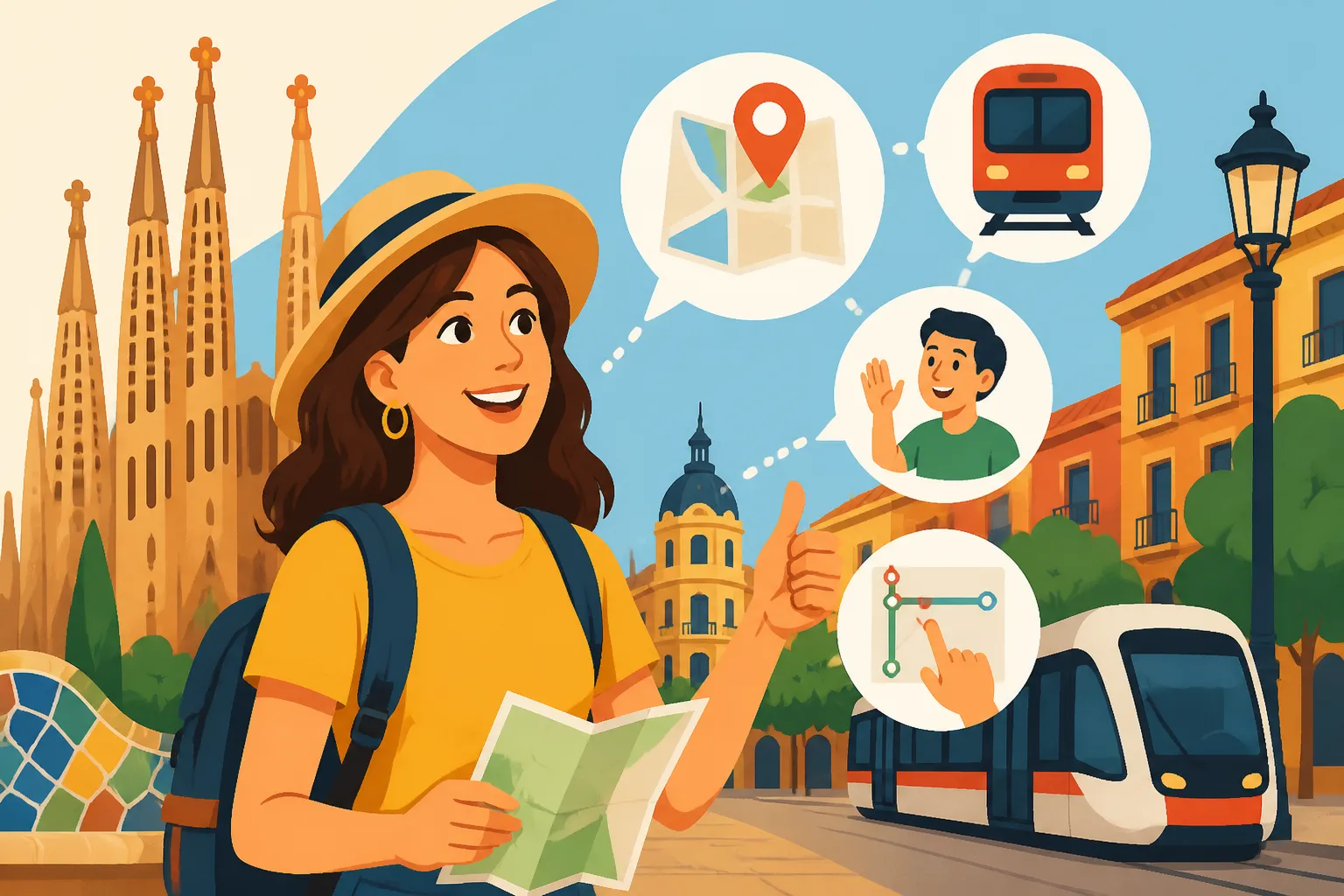
How to Get Around a Spanish City Without Speaking Spanish
Stepping off the plane or train into a bustling Spanish city can be an exhilarating rush, but that excitement can quickly turn into a flutter of panic when you realize you need to figure out how to get to your accommodation, and your Spanish isn't quite up to snuff. Trust me, I’ve been there – standing at a bus stop, trying to decipher a schedule filled with unfamiliar words, feeling like I’d landed on another planet. This guide is designed to empower you with the tools and confidence to navigate any Spanish city like a seasoned local, even if your vocabulary extends no further than hola and gracias.
Disclosure: This post may contain affiliate links. We may earn a commission at no extra cost to you if you make a purchase through these links. Read full disclosure.
Mastering Public Transportation with Minimal Spanish
Public transport in Spanish cities is generally excellent, efficient, and well-connected. The trick, when you don't speak the language, is understanding the system's logic and leveraging visual cues and digital aids. It’s all about preparation and embracing the technology available to you.
The Metro and Tram: Your Best Friends
For many new arrivals, the metro (subway/underground) and tram systems are often the easiest forms of public transport to master without speaking a lick of Spanish. They operate on fixed routes, making them highly predictable. Look for clearly marked stations with the distinct metro symbol (often a red diamond or a stylized 'M'). Inside, maps are almost always color-coded and numbered, which is universally understandable. You don’t need to know the Spanish word for "northbound" if you know you need to take the green line to a certain station that’s clearly marked on the map.
Purchasing tickets is also straightforward. Most cities use automated machines that typically offer language options, including English. You can select your destination or opt for a multi-journey card. For example, in Madrid, you can buy a Tarjeta Multi which you then top up with single tickets or a 10-trip pass (Metrobús). Barcelona has the T-casual for 10 journeys. Simply follow the prompts on the screen, insert your payment (card or cash), and you’re good to go. Once you have your ticket, tap it at the turnstile and head to the correct platform. Always check the dirección (direction) of the train – it will be the name of the last station on that line, which you can easily match to your map.
Bus Travel: A Bit More Challenging, But Doable
Buses can feel a little more daunting than the metro because the routes aren't always underground, and you might need to interact slightly more. However, they're fantastic for seeing the city above ground and reaching areas not served by rail. The first rule of bus travel is to find the parada (bus stop). These are clearly marked with a sign indicating the bus numbers that stop there and often include a route map. You'll need to know your bus number and destination.
When the bus arrives, flag it down! Otherwise, it might just drive past. If you’re paying on board, usually with cash, have small bills or coins ready. A €5 note for a single €1.50 fare is generally fine, but don't try to pay with a €50 note. Many city buses, like those operated by EMT Madrid or TMB Barcelona, now accept contactless card payments, making it even easier. Once aboard, keep an eye on the electronic display, if available, which shows the next stop. If not, Google Maps is your best friend (more on that below). When your stop is approaching, press the "stop" button (usually marked parada or stop) to signal to the driver. Don't be shy; it's expected!
Utilizing Transport Apps and Digital Resources
In this digital age, your smartphone is your ultimate travel companion. Google Maps is indispensable for public transport in Spain. Simply input your destination, select the public transport icon, and it will give you real-time routes, including bus numbers, metro lines, and estimated journey times. It even tells you when the next bus or train is due. I’ve leaned on Google Maps countless times to verify I was indeed heading in the right direction. For broader travel planning, especially if you're looking at intercity buses or trains, platforms like Omio can be incredibly helpful for comparing routes and booking tickets in advance.
Beyond Google Maps, many Spanish cities have their own dedicated transport apps. For instance, the official Madrid Metro app provides detailed maps and real-time information, while the TMB App for Barcelona offers similar functionality for its metro and bus network. Moovit is another excellent app that aggregates public transport information across many cities worldwide, including in Spain, providing live updates and step-by-step guidance. Make sure you download these before you head out, and a strong mobile data plan or eSIM for travel in Spain will keep you connected.
Taxis and Ride-Sharing: When You Need a Direct Route
Sometimes, you just want to get from A to B without the fuss of deciphering routes. Taxis and ride-sharing services offer that convenience, and they're generally reliable across Spanish cities.
Hailing a Taxi: The Basics
Spanish taxis are typically white with a green light on top when they’re libre (free). You can hail them on the street, find them at designated taxi stands (often outside train stations, airports, or major plazas), or call for one. When you get in, the most crucial part is communicating your destination. The simplest way is to have the exact address written down or, even better, pulled up on your phone’s map. You can simply say "Por favor, a esta dirección" (Please, to this address) and show them your phone.
Most taxis use meters (taxímetro), but there might be fixed fares for certain routes, like from the airport to the city center in Madrid or Barcelona. Always make sure the meter is running or confirm the fixed price before setting off to avoid surprises. While many taxis now accept card payments, it's always a good idea to have some cash on hand, just in case their card machine is "out of order" (a classic move, sometimes!).
Ride-Sharing Apps: Convenience in Your Pocket
For ultimate ease, ride-sharing apps like Uber, Cabify, and Bolt are incredibly popular in larger Spanish cities like Madrid, Barcelona, Valencia, and Seville. The beauty of these apps is that you input your destination directly, the fare is calculated and agreed upon before you even get into the car, and payment is handled through the app, eliminating any language barrier or cash fumbling.
Cabify is a Spanish-founded company and often has a strong presence and competitive pricing in Spain. Using these apps is pretty straightforward: open the app, enter your pick-up and drop-off locations, choose your vehicle type, and confirm. You’ll see the driver’s name, car model, license plate number, and their rating. This level of transparency offers a great sense of security, especially if you’re traveling solo or late at night. However, do check the availability of these services in smaller cities or towns you might visit; they’re not ubiquitous everywhere.
Communication with Drivers
Even with ride-sharing apps, a tiny bit of interaction might be necessary. The app usually translates messages, but for quick questions or confirmations, a basic phrase can help. If a driver calls you (which they might do if they can't find you), your translation app with voice input will be invaluable. You can show your destination on your phone with the words "A esta dirección, por favor," and they'll understand. Don't stress too much; Spanish drivers are very accustomed to tourists who don't speak Spanish and are generally patient and helpful.
Exploring on Foot or Two Wheels
Sometimes the best way to soak in the atmosphere of a Spanish city, especially the older districts, is without the confines of a vehicle. Walking and cycling offer freedom and a chance for serendipitous discoveries.
Walking: The Ultimate Way to See a City
There’s truly no better way to get intimately acquainted with a Spanish city than by walking. Many city centers, especially the historic quarters, are pedestrian-friendly, with narrow winding streets that are often inaccessible to cars. With Google Maps as your guide, you can confidently navigate these charming labyrinths. Just pop in your destination, hit the walking icon, and follow the blue dot. The app will even tell you if you're about to walk into a pedestrian-only zone.
While walking, remember to be aware of your surroundings, particularly in crowded tourist areas where pickpocketing can be an issue. Always keep an eye on your belongings. Beyond safety, walking allows you to stumble upon hidden plazas, vibrant street art, and local eateries that you might miss otherwise. It’s also a fantastic way to engage with the rhythm of daily life and practice a few of your new Spanish phrases like "¡Perdón!" if you accidentally bump into someone, or "Hola!" to a shopkeeper.
Cycling and Scooter Rentals: Eco-Friendly Options
For covering more ground than walking but still enjoying the open air, cycling and electric scooters have become popular options in many Spanish cities. Major cities like Madrid and Barcelona have public bike-sharing programs, such as BiciMad and Bicing, respectively. These usually require registration, often through an app, and sometimes a local Spanish ID, but some services offer short-term passes for tourists. You pick up a bike from a docking station and return it to another.
Private companies like Lime, Voi, and Bolt also offer electric scooter and bike rentals through their apps. You download the app, find a scooter nearby on the map, scan a QR code to unlock it, and off you go. Payment is per minute or per ride, and you just leave the scooter responsibly when you’re done. Remember to follow local traffic laws, wear a helmet if required, and stick to bike lanes where available. It’s a fun, eco-friendly way to cover distances and take in the city sights. You can often book guided bike tours through platforms like GetYourGuide, which come with an English-speaking guide and are a great way to explore without worrying about navigation.
Essential Spanish Phrases and Translation Tools
While you can certainly get by without speaking Spanish, having a few key phrases in your pocket and knowing how to use translation tools will make your experience much smoother and more enjoyable.
Key Phrases for Getting Around
Even uttering a few words in Spanish can make a big difference, showing respect and often eliciting a warmer response from locals. Here are some indispensable phrases for navigating public spaces:
- Hola / Buenos días / Buenas tardes / Buenas noches: Hello / Good morning / Good afternoon / Good evening. A polite greeting goes a long way.
- Gracias / Por favor: Thank you / Please. Essential manners.
- Perdón / Lo siento: Excuse me (to get attention or move past someone) / I'm sorry.
- ¿Dónde está [la estación de tren / la parada de autobús / el metro]?: Where is [the train station / the bus stop / the metro]? You can point to your map as you ask.
- ¿Cuánto cuesta?: How much does it cost?
- Un billete, por favor: One ticket, please. (You can also hold up one finger).
- A esta dirección, por favor: To this address, please (while showing your phone).
- No entiendo: I don't understand.
- ¿Habla inglés?: Do you speak English? (Always good to ask politely).
- No hablo español: I don't speak Spanish. (Often followed by a helpful gesture).
- Salida / Entrada: Exit / Entrance. You'll see these signs everywhere.
- Cerrado / Abierto: Closed / Open. Useful for shops and attractions.
You can find more helpful phrases in our guide on Survival Spanish for Travelers: Key Phrases to Learn First.
Relying on Digital Translation
For anything more complex than a simple phrase, digital translation apps are your best friend. Google Translate is the most popular and incredibly versatile. You can:
- Type text: For short messages or questions.
- Use voice input: Speak into the app, and it will translate your words into Spanish (and vice versa). This is invaluable for conversations with drivers or service staff.
- Use the camera function: Point your phone's camera at a sign, menu, or instruction, and the app will provide an augmented reality translation overlay. This is a lifesaver for bus schedules or cryptic signs.
Other excellent translation apps include DeepL, known for its nuanced translations, and Microsoft Translator. Always download the Spanish language pack for offline use, just in case you lose signal. And trust me, always keep your phone charged – a portable power bank is non-negotiable when relying on your phone for navigation and communication.
Visual Cues and Non-Verbal Communication
When words fail, visuals and gestures can often bridge the gap. Don't be afraid to point to your destination on a map, use hand gestures to indicate numbers or directions, or even mimic an action (like hailing a taxi). Spaniards are generally very expressive and accustomed to non-verbal communication, especially with tourists.
Learning to read basic signs is also incredibly helpful. Beyond Salida and Entrada, knowing Hombres (Men) and Mujeres (Women) for restrooms, or Farmacia (pharmacy) will come in handy. Don't underestimate the power of a smile and a confident demeanor. Most people are willing to help, and a friendly attitude goes a long way, even without a shared language. Remember, the goal isn't to become fluent overnight, but to confidently navigate and enjoy your time.
No matter where your adventures in Spain take you, remember that millions of people visit and live here every year without perfect Spanish. With a little preparation, a good smartphone, and a willingness to try, you'll be navigating the streets of Madrid, the metro of Barcelona, or the buses of Seville like a pro. For more in-depth information, check out our guide on Traveling Around Spain: Trains, Buses, Flights, and Car Hire or Money for Travel in Spain: Cards, Cash, and ATMs. If you're planning a trip from a specific airport, we also have guides like How to Get From Madrid Airport to the City Center and How to Get From Barcelona Airport to the City Center. And for general safety, don't miss our tips on Staying Safe in Spain: Practical Safety Tips for New Residents.
Disclaimer
The information provided in this guide is for general informational purposes only and is subject to change. While we strive to keep the content up-to-date and accurate, transportation rules, app availability, and pricing can vary. Always check official local transport websites and app stores for the most current information.