Spanish Language and Everyday Communication for Visitors
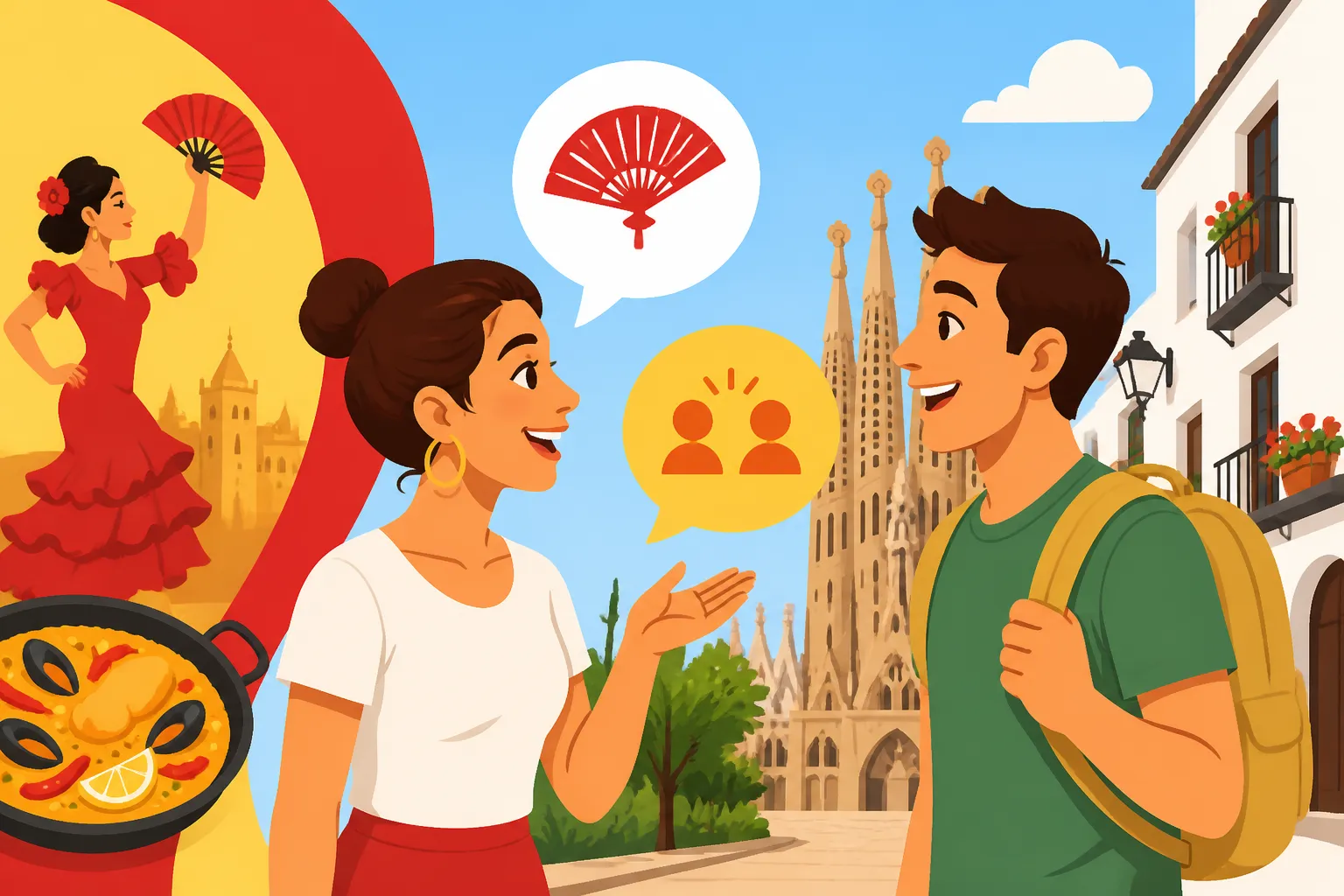
Landing in Spain often feels like stepping into a beautiful, high-speed conversation that you aren't quite invited to join yet. I remember my first week in Madrid, standing paralyzed in a crowded bakery because I couldn't remember the word for "napkin" while crumbs cascaded down my shirt. This guide solves the "deer in the headlights" moment by giving you the linguistic and cultural tools to navigate daily interactions with genuine confidence.
Disclosure: This post may contain affiliate links. We may earn a commission at no extra cost to you if you make a purchase through these links. Read full disclosure.
The Mindset Shift: Understanding Spanish Communication
Stepping off the plane, many visitors expect that a few years of high school Spanish will carry them through. However, the reality of communication in Spain is less about grammar and more about the "vibe" and speed of the exchange. Spaniards are famously direct, often discarding the "pleases" and "thank yous" that English speakers use as social padding. This isn't rudeness; it is efficiency and a sign of familiarity. When I first arrived, I felt slighted by the lack of "Could I possibly have…" until I realized that a simple "Me pones un café" was the standard way to show you were part of the community.
The key is to embrace the noise. Spanish social life is loud, overlapping, and deeply passionate. If you wait for a polite silence to speak, you might never say a word. Learning to jump into the flow of conversation is a rite of passage. You have to accept that you will make mistakes, your accent will be wonky, and you will definitely use the wrong verb tense at some point. The locals generally appreciate the effort far more than the accuracy. They know their language is fast and their regional accents are thick, so a smile and a "lo siento, ¿puedes repetir?" (I’m sorry, can you repeat that?) goes a very long way in softening the edges of a linguistic stumble.
Confidence is your best vocabulary word. Even if you only know ten phrases, saying them with a clear voice and direct eye contact will get you much further than whispering perfect grammar into your chest. Spanish communication is a contact sport; it requires you to be present, observant, and willing to laugh at yourself when you accidentally tell the waiter you are "pregnant" (embarazada) instead of "embarrassed" (avergonzado). Taking that first step toward Survival Spanish for Travelers: Key Phrases to Learn First is about building that initial bridge of trust between you and the person behind the counter.
Essential Phonetics and the Sounds of Spain
One of the most frustrating hurdles for English speakers is the "th" sound, known as the ceceo or distinción, which is prevalent in central and northern Spain. If you’ve practiced Latin American Spanish, hearing "Grathias" instead of "Gracias" can be jarring. This isn't a lisp; it is a distinct phonetic rule where the 'c' (before 'e' or 'i') and the 'z' are pronounced like the English 'th' in 'thing'. I spent my first month trying to correct people before realizing I was the one out of step with the local rhythm. Mastering this sound immediately signals that you are tuned into the local culture.
Vowels in Spanish are your best friends because they never change. Unlike English, where 'a' can sound like five different things, a Spanish 'a' is always "ah." This consistency is the secret weapon for any visitor. If you can lock down the five pure vowel sounds—A (ah), E (eh), I (ee), O (oh), U (oo)—you are 70% of the way to being understood. Spend time practicing the "double L" (ll), which sounds like a 'y', and the 'j' (jota), which is a throaty 'h' sound that feels a bit like you’re clearing your throat. It feels exaggerated at first, but without that friction, words like "Jerez" or "jamón" lose their identity.
The 'r' and 'rr' are the ultimate boss levels of Spanish phonetics. The single 'r' is a quick tap of the tongue against the roof of the mouth, similar to the 'dd' in the American pronunciation of "ladder." The double 'rr' requires a trill that many find impossible. Don't let the trill stop you. Even if you can't roll your 'r's like a flamenco singer, a strong, single tap will usually suffice. The goal is to avoid the English "er" sound, which is the biggest giveaway of a foreign accent. Understanding these nuances helps when you are Ordering Food and Drinks in Spanish: A Practical Phrasebook because it ensures the waiter knows exactly which wine or dish you are asking for without a game of charades.
Navigating the Spanish Daily Rhythm and Social Etiquette
Communication in Spain isn't just about what you say; it's about when you say it. The daily schedule here is a language of its own. If you try to run errands or have a serious conversation between 2:00 PM and 5:00 PM, you’re speaking to a ghost town. This is the sacred time for lunch and the subsequent sobremesa—the period of sitting and talking long after the food is gone. Tourists can get visibly frustrated because a shop is closed in the afternoon, but understanding this rhythm is essential for smooth communication.
When you enter a small shop, a pharmacy, or a local bar, it is mandatory to say "¡Buenos días!" or "¡Buenas tardes!" to the room. It’s a collective acknowledgement. If you skip this, you’re effectively invisible. This social grease makes the rest of the interaction much easier. Similarly, when leaving, a simple "¡Hasta luego!" (See you later) is much more common than the formal "Adiós." I used to say "Adiós" until a friend told me it sounded like I was leaving forever or going to join a monastery. "Hasta luego" keeps the social door open, reflecting the transient, breezy nature of Spanish daily life.
Physicality is another layer of communication. Spaniards have a smaller bubble of personal space than many Northern Europeans or Americans. Expect a hand on your shoulder, a pat on the arm, or the famous "dos besos" (two kisses) when being introduced to someone in a social setting. As a visitor, you might feel a bit overwhelmed by the proximity, but it’s a sign of warmth and inclusion. If you pull away, it can be interpreted as coldness. Learning the Spanish Customs, Etiquette, and Social Life involves embracing this physical vocabulary, which often says more than a perfectly conjugated verb ever could.
| English Phrase | Spanish Equivalent | Phonetic Guide | Context of Use |
|---|---|---|---|
| Hello / Good morning | ¡Hola! / ¡Buenos días! | Oh-la / Bway-nos dee-as | Standard greeting until 2 PM |
| Good afternoon / evening | ¡Buenas tardes! | Bway-nas tar-des | From 2 PM until dark |
| Please / Thank you | Por favor / Gracias | Por fah-bor / Grah-thee-as | Essential politeness |
| The bill, please | La cuenta, por favor | Lah kwayn-tah por fah-bor | When finishing a meal |
| I don't understand | No entiendo | No en-tyen-do | To signal a language barrier |
| Where is the toilet? | ¿Dónde está el baño? | Don-day es-tah el ban-yo | Crucial in bars and cafes |
| A beer / A coffee | Una caña / Un café | Oo-na kan-ya / Oon kah-fay | Standard drink orders |
The Art of Ordering and Dining Communication
Eating is the primary social activity in Spain, and the bar counter is the stage. To the uninitiated, a Spanish bar at 9:00 PM looks like chaos, but it’s actually a choreographed dance. To get the waiter's attention, you don't need to wave frantically; a simple "¡Perdona!" (Excuse me) or a raised eyebrow when they catch your eye is enough. Don't be afraid to be assertive. If you wait for them to come to you with a menu and a smile, you might go hungry. The bar is a place for quick, direct exchanges.
When it comes to the specifics of the menu, there is a whole sub-language for portions. A tapa is a small bite, a media ración is a half-portion, and a ración is a full plate intended for sharing. I remember ordering three raciones for myself once and the waiter looking at me like I was preparing for a winter hibernation. Shared eating is the default. If you’re at a cafe, you’ll need to know How to Order Coffee in Spain Like a Local because simply asking for "a coffee" will result in a flurry of follow-up questions about milk, temperature, and glass type.
Tipping also has its own silent language. Unlike in the US, where it’s a calculated percentage, in Spain, it’s much more casual. For a coffee or a quick beer, leaving the small change is standard. For a nice dinner, a few Euros is plenty. It’s not an obligation, but it’s appreciated. If you want to know more about the "why" behind this, checking out Tipping in Spain: When, Where, and How Much will save you from the awkwardness of overtipping or undertipping in various scenarios. Remember, the goal of dining communication is to show you enjoy the food and the atmosphere—a simple "¡Todo muy rico!" (Everything was delicious) is the best tip you can give a chef.
Regional Languages: Navigating Beyond Castilian
One of the biggest surprises for many visitors is that Spanish (Castilian) isn't the only language spoken in the country. If you find yourself in Barcelona, San Sebastián, or Santiago de Compostela, the signs on the street and the chatter in the markets will look and sound very different. In Catalonia, you’ll hear Catalan; in the Basque Country, Euskara; and in Galicia, Galego. These are not dialects; they are distinct languages with their own histories and proud speakers.
In Catalonia, for instance, seeing "Sortida" instead of "Salida" (Exit) can be confusing. While everyone speaks Castilian Spanish fluently, using a few words of the regional language is the ultimate sign of respect. Saying "Bon dia" instead of "Buenos días" in Barcelona can change the entire tone of your interaction. I’ve found that even a butchered attempt at "Eskerrik asko" (Thank you in Basque) in a Bilbao tavern often leads to a free tapa or at least a much wider smile from the bartender. It shows you’ve done your homework and recognize their unique cultural identity.
However, don't feel pressured to learn four languages. Castilian is the bridge that connects the entire country. The key is awareness. If you’re traveling through different areas, take a moment to look at Regional Languages in Spain: Catalan, Basque, and Galician to understand the linguistic landscape. It helps you realize that the "strange" words you see on a menu in Galicia aren't typos, but part of a rich, ancient Galego tradition. This awareness prevents misunderstandings and enriches your travel experience as you realize that Spain is more of a collection of distinct nations than a single, uniform block.
Digital Tools and Practical Connectivity
While immersion is the goal, let’s be honest: we all rely on our phones to bail us out of tricky situations. Having a reliable data connection is the foundation of modern travel communication. When you’re trying to decipher a complex menu or find your way to a hidden plaza, having a local eSIM or a roaming plan is a lifesaver. It is wise to advise that the first thing travellers should do after dropping their bags at a hotel booked via Booking.com is to ensure their data is working. Without it, you’re cut off from the real-time translation tools that make life so much easier.
Google Translate is the obvious choice, but for Spain, DeepL often provides more "natural" sounding translations that account for local idioms. The "Camera Translate" feature is particularly useful for reading handwritten daily specials on chalkboards, which are notoriously hard to read. If you’re feeling more ambitious, a quick session on an app can help you brush up on Spanish Slang and Everyday Expressions for Visitors before you head out for the evening. Technology shouldn't be a crutch that prevents you from speaking, but a safety net that gives you the confidence to try.
For logistics, apps are the primary way to communicate with service providers. If you’ve booked a train through Omio, having the app ready avoids the stress of trying to explain your booking in broken Spanish at the station. Most high-speed trains and buses now use digital QR codes, reducing the need for verbal back-and-forth. Similarly, if you’ve booked a guided walking tour through GetYourGuide, the app provides a direct line to your guide, often in English, which can be a massive relief if you’re struggling with the local pace. Just remember to use How to Use a Translation App Offline in Spain so you aren't stuck if you hit a dead zone in a medieval alleyway.
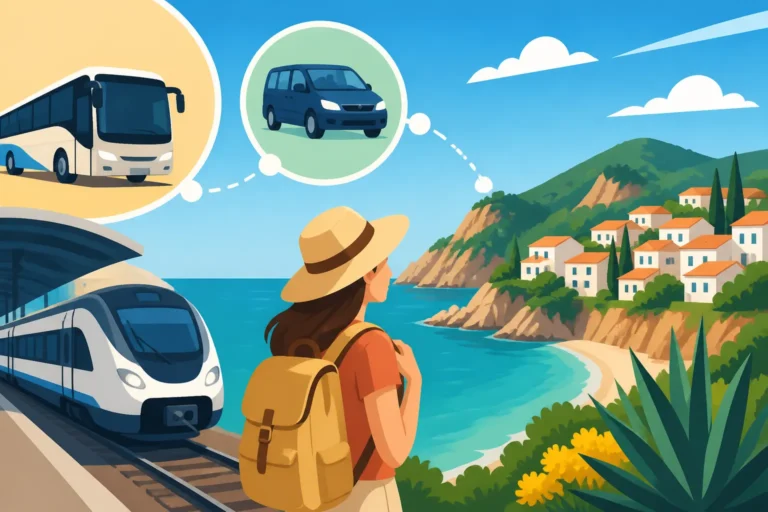
Navigating Transport and Logistics
Getting from point A to point B in Spain is a masterclass in non-verbal and verbal coordination. The train stations (Estaciones de Tren) and bus hubs are generally well-signed, but you will inevitably need to ask for a platform or a ticket office. The phrase "¿A qué andén va este tren?" (Which platform does this train go to?) is one you should have on speed dial. I’ve spent many a frantic morning at Atocha station in Madrid wishing I had practiced my numbers more, as hearing "vía cuatro" (track four) sounds remarkably like "vía ocho" (track eight) when announced over a crackly loudspeaker.
When using public transport, the communication is often about etiquette. On the Metro, it’s standard to stay to the right on escalators and let people off the train before boarding. If you’re in a crowded bus and need to get off, a simple "¿Sale?" (Are you getting off?) to the person blocking your path is the polite way to ask them to move. If you've organized your travel through Omio, you can usually avoid the ticket windows altogether, but keep your phone charged. Nothing stops a conversation faster than a dead battery when a conductor is asking for your "billete."
Taxis and ride-sharing apps (like Cabify or Uber) are also part of the mix. In a taxi, it's polite to greet the driver and state your destination clearly. "A la calle [Name], por favor" is all you need. Most drivers in major cities are used to tourists, but having the address written down or pulled up on your phone is a great "Plan B." If you’re traveling with a lot of luggage or a large group, communicating these needs beforehand through your booking platform ensures you don't end up with a tiny car that can't fit your suitcases.
Handling Emergencies and Misunderstandings
Even the best-planned trips hit snags, and this is where communication becomes critical. If you find yourself in a situation where you need help, the first thing to remember is the universal emergency number: 112. It’s the same across Europe, and they usually have English speakers available. If you need to find a doctor or a pharmacy, look for the green flashing cross. Pharmacists (farmacéuticos) in Spain are highly trained and can help with minor ailments, often saving you a trip to the hospital.
If you lose something or need to report a minor theft, you’ll need to go to the Policía Nacional to file a "denuncia" for insurance purposes. This can be an intimidating process, but many police stations in tourist-heavy areas have translation services or forms in multiple languages. Knowing Emergency Numbers in Spain: 112 and When to Use It is the bare minimum of preparation.
Finally, accept that misunderstandings are part of the adventure. If you realize you’ve offended someone or made a mistake, a sincere "Lo siento, mi español es muy malo" (I’m sorry, my Spanish is very bad) paired with a smile will fix 99% of social friction. Spaniards are generally a very forgiving and helpful people. They value the social connection over the linguistic perfection. As long as you are trying to participate in their world, they will almost always meet you halfway, helping you find your way, your food, and your voice in this incredible country.
Disclaimer
The information provided in this guide is for general informational purposes only and does not constitute legal, financial, or professional advice. While we strive to keep the information up to date and correct, we make no representations or warranties of any kind, express or implied, about the completeness, accuracy, reliability, or suitability of the content. Any reliance you place on such information is strictly at your own risk.