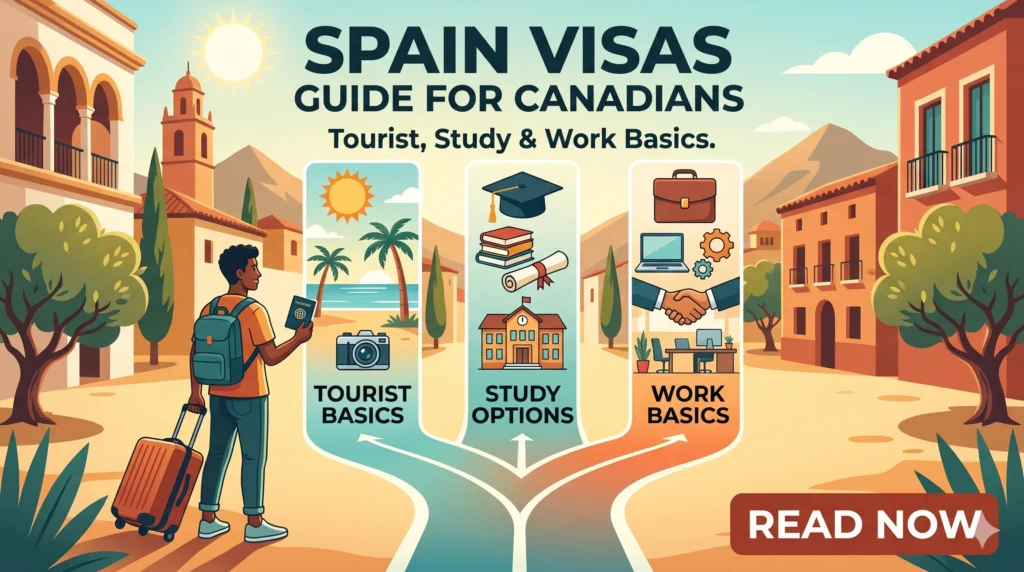
Spain Visa Guide for Canadian Citizens: Tourist, Study & Work Basics
Figuring out which Spanish visa you actually need as a Canadian—and navigating the exact documents the consulate demands—feels like a bureaucratic maze designed to make you quit. I once had a visa application stalled for a month simply because my Canadian police check wasn’t authenticated correctly. This guide breaks down the exact requirements for Canadians navigating tourist limits, student visas, and work authorizations without the headache.
Disclosure: This post may contain affiliate links. We may earn a commission at no extra cost to you if you make a purchase through these links. Read full disclosure.
Tourist Limits and the Schengen Area for Canadians
Canadians are used to traveling freely, but moving or staying in Europe requires strict calculation. As a Canadian citizen, you do not need a visa to enter Spain for short-term tourism, visiting friends, or attending a conference. However, you are entirely bound by the strict European border regulations.
The 90-Day Schengen Rule
The most common mistake new travelers make is assuming their Canadian passport grants them unlimited access to Europe. Spain is a member of the Schengen Area, and you are strictly bound by the 90/180-day rule.
This immigration rule dictates that Canadian passport holders can spend a maximum of 90 days within any rolling 180-day period inside the Schengen Area. The clock does not reset simply because you take a weekend trip to London or Morocco; border control officers literally count the cumulative days you have spent inside the zone over the preceding six months.
If you stay 91 days, you have illegally overstayed, which can result in heavy fines, detention, or a long-term ban from re-entering Europe. You can no longer spend half the year wintering in the Canary Islands without a formal visa. Understanding how this rolling calendar works is a foundational skill that eventually applies to residency limits, a dynamic heavily explored in How Long Can You Leave Spain Without Losing Residency?.
The Upcoming ETIAS Requirement
For decades, Canadian citizens simply showed up at the airport with a valid passport. Starting in the last quarter of 2026, the European Union is implementing the European Travel Information and Authorisation System (ETIAS).
ETIAS is not a visa; it is a pre-travel electronic authorization similar to the Canadian eTA system. Canadian citizens will need to apply online, pay a 7 EUR fee, and undergo a quick automated security check before boarding a flight to Spain. Once approved, the ETIAS is linked to your passport and remains valid for three years or until your passport expires. You must ensure your passport has at least three months of validity remaining beyond your planned departure date from the Schengen zone. If you plan to move between Canada and Spain frequently, managing your international footprint is crucial, a reality mapped out in Spain Visa Travel History: How Much Evidence Is Enough?.
Spanish Study Visas and the Youth Mobility Program
If you want to spend a gap year in Valencia, pursue a master’s degree in Madrid, or casually work your way across the country, your 90-day tourist limit will not suffice. You must apply for a specific visa through the Spanish consulate in Toronto, Montreal, or Ottawa.
Short-Term vs. Long-Term Studies
The Spanish consulate divides student visas into two distinct categories based on the duration of your academic program:
- Short-Term Student Visa (91 to 180 days): This is ideal for a single university semester abroad. The consulate will issue a visa that covers the exact duration of your course. You will not receive a physical residency card in Spain, and you generally cannot renew this visa from within the country.
- Long-Term Student Visa (More than 180 days): If you are enrolling in a full degree program or a year-long language course, you will receive a 90-day entry visa in your passport. Once you arrive in Spain, you must register your local address and apply for your physical Foreigner Identity Card (TIE). Securing your foundational tax identification numbers for this process is detailed in Getting an NIE for Employment or Study: Practical Overview.
To qualify for either, you must be enrolled full-time (minimum 20 hours per week) at an institution officially recognized by the Spanish Ministry of Education. Navigating these academic enrollment proofs is deeply explained in Spain Student Visa Application.
The Canada-Spain Youth Mobility Agreement
Canadians have a massive advantage over US citizens when it comes to living and working in Spain: The Youth Mobility Agreement. If you are a Canadian citizen between the ages of 18 and 35, you can apply for a special visa that allows you to work, travel, or complete an internship in Spain for up to a year.
This program includes several categories, such as a Working Holiday (allowing casual work to fund your travels), an internship category for post-secondary students, and a young professionals category for those with pre-arranged contracts. To qualify, you must prove you have sufficient funds for the first three months (set at $2,637 CAD for 2025/2026) and a return ticket.
Unlike standard work permits that require aggressive corporate sponsorship, the Youth Mobility Visa bypasses the local labor market test. It is the absolute easiest way for young Canadians to legally enter the Spanish workforce. If you use this route to establish a long-term career, understanding the transition to standard residency is vital, a process aligned with the timelines in Spain Residency Renewal Timing: Earliest and Latest Filing Windows.
Work Visas: Digital Nomads and Non-Lucrative Options
Moving to Spain to work in a standard corporate job post-graduation is incredibly difficult due to strict local labor laws. However, new remote work visas have completely revolutionized the expat landscape for Canadians.
The Digital Nomad Visa
If you are over 35 or want to bring your Canadian remote job to Spain, the Digital Nomad Visa (DNV) is your golden ticket. This visa allows you to live in Spain while working remotely for a company (or clients) located entirely outside of Spain.
To qualify, you must prove that you have been working for your current Canadian employer for at least three months, that the company has existed for at least a year, and that you earn approximately 200% of the Spanish minimum wage. Most importantly, your HR department must write a highly specific letter granting you explicit permission to perform your duties remotely from Spanish territory. Gathering and formatting this specific corporate paperwork is the core focus of Spain Digital Nomad Visa: How to Prove Remote Work Relationship.
Because your Canadian employment contracts, T4 tax slips, and HR permission letters are in English or French, they are legally useless to the Spanish reviewers until they are translated. You should use RushTranslate to quickly process your massive stacks of corporate evidence. Because RushTranslate provides highly accurate, certified translations with a lightning-fast turnaround, you can ensure the immigration officer perfectly understands your remote work arrangement without delaying your application. Utilizing RushTranslate prevents the reviewing officer from misinterpreting your employment status, keeping your digital nomad packet organized and compliant.
The Non-Lucrative Visa
If you are a Canadian retiree, or if you possess massive amounts of passive income (like Canadian rental properties, corporate dividends, or significant savings), you can apply for the Non-Lucrative Visa (NLV).
This visa strictly forbids any active work in Spain, including remote work for a Canadian company. You must prove you hold 400% of the IPREM (the national public income indicator) in passive income or liquid savings. Understanding the exact math and the strict distinction between active and passive income is heavily mapped out in Proof of Income for Spain Non-Lucrative Visa: Salaried vs Self-Employed.
To prove this wealth, you will submit Canadian bank statements and CRA tax returns. Again, utilizing RushTranslate is vital here. You cannot submit an English or French-language bank statement to a Spanish consulate. By leaning on RushTranslate for your dense financial files, you present a highly professional packet that instantly deflects consular suspicion regarding the origin of your funds. Furthermore, NLV applicants are heavily scrutinized on their healthcare, making the use of native localized policies an absolute necessity to avoid rejections based on foreign insurance deductibles.
Gathering and Authenticating Canadian Documents
Regardless of the visa you choose, the Spanish consulate in Canada will demand a mountain of authenticated paperwork that must be gathered in a very specific sequence.
The Hague Apostille in Canada
For decades, Canadian expats suffered through a miserable, multi-step legalization process for their civil documents because Canada was not part of the Hague Apostille Convention. Fortunately, as of January 2024, Canada officially joined the convention.
Spain requires a criminal background check from any country where you have lived for the past five years. As a Canadian citizen, you must obtain an RCMP Criminal Record Certificate with fingerprints. Provincial or local police checks are not accepted for national visas. Because the Spanish consulate has no way of verifying if a Canadian police document is forged, the RCMP certificate must carry a Hague Apostille.
Because Canada operates as a federation, the body that issues your Apostille depends on where the document was issued. Federal documents, like the RCMP check, must be Apostilled by Global Affairs Canada in Ottawa. Provincial documents, like a birth certificate from Ontario or British Columbia, are Apostilled by the respective provincial competent authority. Securing this specific stamp can take weeks, and if you translate the document before securing the Apostille, your entire application will be ruined. You can review the exact sequence of this authentication in Apostille for Spain: Which Documents Need It and How to Get One.
Medical Coverage and Certified Translations
The Spanish consulate will ruthlessly audit your healthcare plan to ensure you will not become a burden on the state. You must purchase a comprehensive private health insurance policy for the entire duration of your visa. The consulate explicitly demands that this policy has zero co-payments (sin copagos) and no waiting periods (sin carencias). If you try to rely on provincial Canadian health coverage (like OHIP) or a generic travel insurance policy, the consulate will reject your application instantly.
To completely bypass this administrative nightmare, you should secure a localized Spanish health policy natively through Innoinsure. Because Innoinsure caters specifically to the expat and international student market, their policies are explicitly underwritten to satisfy Spanish immigration laws. The certificates clearly display the required “sin copagos” phrasing right on the front page.
By utilizing Innoinsure, your policy is issued directly in Spanish, meaning the consulate accepts it immediately without requiring an expensive translation of a massive English or French policy booklet. Relying on Innoinsure guarantees your medical safety net is flawlessly compliant, a strategic integration perfectly aligned with the advice in Spain Visa Medical Insurance: Minimum Coverage and Exclusions to Avoid and Health Insurance in Spain: Options for Residents, Students, and Families.
Once your Canadian documents are Apostilled, they must be translated into Spanish. The consulate enforces rigid rules regarding how certain documents are translated. For highly sensitive government documents like your Apostilled RCMP background check, the consulate will strictly demand a Sworn Translation (Traductor Jurado). This is a professional directly authorized by the Spanish Ministry of Foreign Affairs (MAEC). Understanding when you must pay for this premium MAEC stamp is deeply explained in How to Translate Documents for Spain: Sworn Translators Traductor Jurado Guide.
For your supporting documents—such as your Canadian bank statements, corporate employment letters, or university transcripts—you can safely rely on RushTranslate. Utilizing RushTranslate provides you with perfectly formatted, certified translations that bridge the administrative gap efficiently. By leaning on RushTranslate for your everyday civil and financial evidence, and relying on Innoinsure to generate compliant native Spanish healthcare certificates, you drastically reduce your paperwork burden and increase your chances of a first-time visa approval.
| Visa Type | Duration Permitted | Can You Work? | Main Qualification |
| Tourist (Schengen) | Up to 90 days per 180 days | No | Valid Canadian Passport (ETIAS starting Q4 2026) |
| Student Visa | Duration of academic program | Up to 30 hours/week (if approved) | Full-time enrollment in recognized school |
| Youth Mobility | Up to 1 Year | Yes (Open work or internship) | Canadian aged 18-35, proof of funds |
| Digital Nomad | Up to 3 years (if applied in Spain) | Yes (Remote for non-Spanish companies) | Minimum income threshold, HR permission |
| Non-Lucrative | 1 Year (Renewable) | No (Strictly forbidden) | Substantial passive income or liquid savings |
Once your visa is finally approved and you arrive in Spain, your administrative journey continues. You will need to immediately secure local housing, establish your financial footprint as detailed in Opening a Bank Account in Spain: Step-by-Step for Foreigners, and register on the municipal census, a critical step outlined in How to Change Address on Your TIE Card After Moving in Spain. Mastering these early requirements guarantees you can fully enjoy your new life in Spain.
References
Primary sources (official)
- Ministerio de Asuntos Exteriores, Unión Europea y Cooperación (MAEC) – Youth Mobility Visa (Toronto Consulate): https://www.exteriores.gob.es/Consulados/toronto/en/ServiciosConsulares/Paginas/Consular/Youth-mobility-visa.aspx
- European Union Official Site – What is ETIAS: https://travel-europe.europa.eu/etias_en
- Ministerio de Asuntos Exteriores, Unión Europea y Cooperación (MAEC) – Economic means required for Entry, Stay, and Residence (Ottawa Embassy): https://www.exteriores.gob.es/Embajadas/ottawa/en/ServiciosConsulares/Paginas/Economic-means-required-for-Entry,-Stay,-and-Residence-in-Spain.aspx
Other helpful sources
- Global Affairs Canada – Authentication of Documents: https://www.international.gc.ca/gac-amc/about-a_propos/services/authentication-authentification/step-etape-1.aspx?lang=eng
- Frontex – About ETIAS and Schengen Borders: https://www.frontex.europa.eu/what-we-do/etias-ees/about-etias/
Disclaimer
The information provided in this guide is exclusively for educational and informational purposes and does not constitute official legal, immigration, or consular advising. The specific requirements for Spanish visas, the 90/180-day Schengen calculations, the implementation dates for the ETIAS system, and the strict enforcement of Hague Apostille and Sworn Translator (Traductor Jurado) mandates are highly dynamic and subject to frequent updates by the Spanish Ministry of Foreign Affairs. While we strive to ensure absolute accuracy regarding best practices, you should always consult a registered Spanish immigration lawyer (abogado de extranjería) and verify the exact documentary checklist directly with the specific Spanish consulate governing your Canadian province (Toronto, Montreal, or Ottawa) before submitting an application.