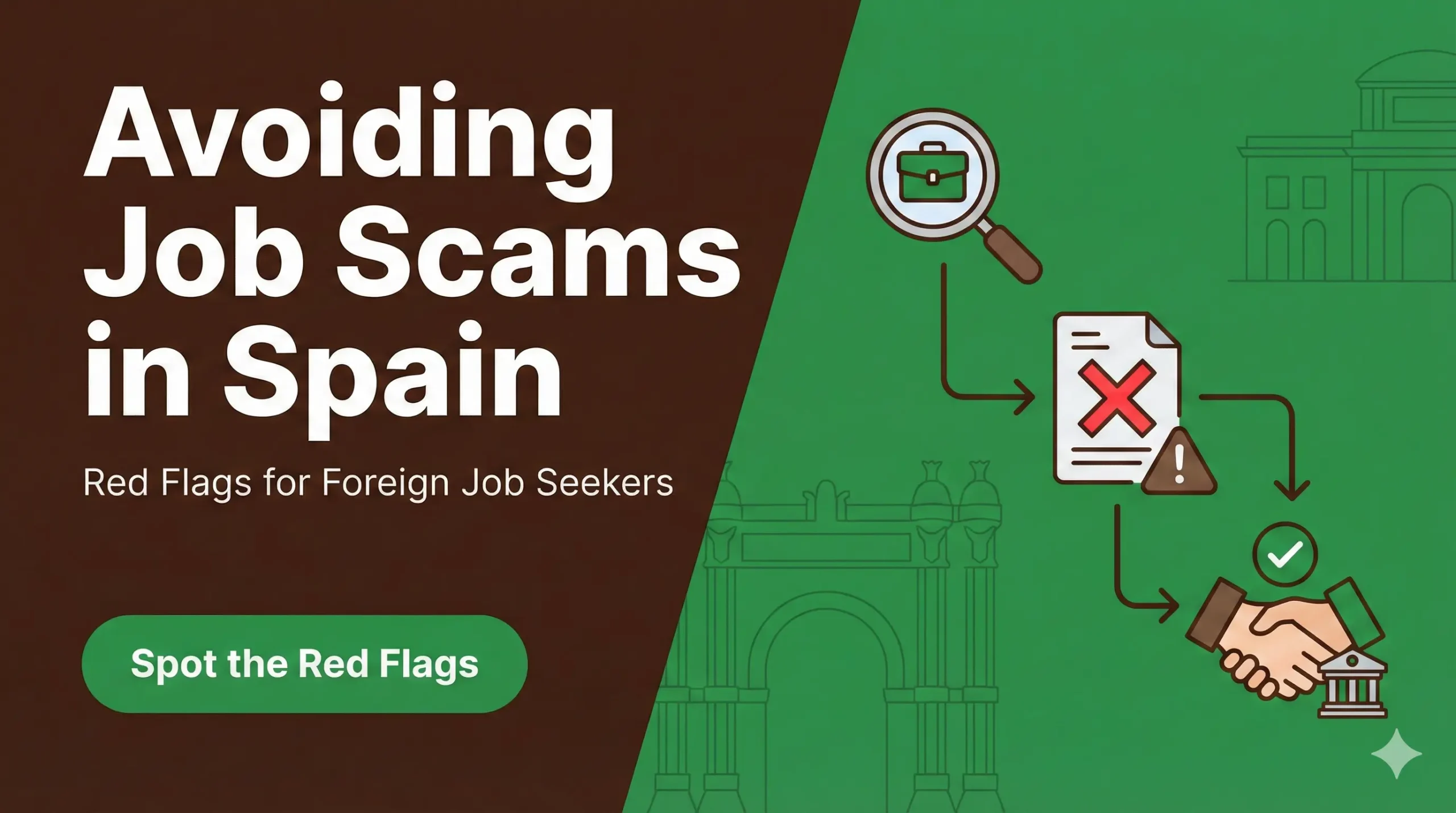
Avoiding Job Scams in Spain: Red Flags for Foreign Job Seekers
Disclosure: This article contains affiliate links. If you buy through them, we may earn a commission at no extra cost to you. Read our full disclosure.
Spain’s competitive job market makes foreign applicants prime targets for sophisticated employment scams. This guide exposes the most prevalent fraud tactics, from fake visa sponsorship fees to identity theft, and provides actionable steps to verify company legitimacy using official government registries.
The Golden Rule of Spanish Employment
Before diving into specific scam types, there is one foundational rule that governs all legitimate employment relationships in Spain. Memorize it:
In Spain, the employee never pays the employer for the right to work.
Legitimate recruitment agencies earn their money by charging the company a finder’s fee, not the candidate. Legitimate employers cover the administrative costs of hiring because they need your talent. If a “recruiter” or “HR Manager” asks you to transfer money for any reason—training materials, a laptop deposit, a background check fee, or a “visa processing charge”—stop communication immediately. It is a scam.
The Visa Sponsorship Trap
The most devastating scam targeting non-EU citizens involves the promise of a work visa. Scammers know that obtaining a work permit (Permiso de Trabajo) is difficult and requires a company to sponsor you.
How the Scam Works
You apply for a job on a major board like LinkedIn or Indeed. You receive an enthusiastic response stating that you are the perfect candidate. They offer you a high salary and, crucially, they promise to handle the entire visa process for you.
Then comes the catch. They claim that the Spanish immigration lawyers require an “expedited processing fee” or a “security deposit” to demonstrate your commitment to moving to Spain. They might ask for €500 to €2,000, promising it will be reimbursed in your first paycheck.
The Reality Check
In a legitimate hiring process, the employer bears the burden of proof. They must demonstrate to the Spanish government that they cannot find a suitable EU candidate for the role (unless the job is on the official list of hard-to-fill occupations). The company pays the legal fees and government taxes associated with the sponsorship.
- Red Flag: The request for payment is almost always via Western Union, MoneyGram, or a transfer to a bank account that is not in Spain (often in the UK, Lithuania, or Malta).
- Legal Fact: A company cannot ask you to pay for your own work permit application fees as a condition of hiring.
If you are unsure about the actual steps required for legal residency and want to cross-reference the procedure they are describing, you should review the standard protocols in Finding a Job in Spain: CV, Interviews, and Networking.
The Fake Contract for Residency Scheme
This is a “grey market” scam that targets foreigners already in Spain who are desperate to regularize their status (e.g., students whose visas are expiring or irregular migrants).
The Offer
You find an intermediary who offers to sell you a “pre-contract” (precontrato) or a job offer (oferta de empleo) for a fee, usually between €2,000 and €5,000. They claim this document will allow you to apply for Arraigo Social (Social Roots residency) or modify your student visa to a work permit.
The Consequence
This is highly illegal for both parties. Spanish immigration offices verify these contracts rigorously. They check the company’s economic activity and tax returns.
- The Ghost Company: Often, the company issuing the contract is a shell company with no activity. The immigration office will reject your application instantly.
- The Double Cross: Once you pay the fee, the “intermediary” vanishes.
- Legal Liability: If caught presenting a fraudulent contract, you can be banned from entering the Schengen zone and face criminal charges for document fraud.
Rather than risking your future on a fake contract, legitimate students should explore legal pathways such as modifying their status. Understanding the boundaries of your current situation is vital; for example, see our guide on Working Part-Time on a Spain Student Visa: Hours and Requirements to know what is legally possible without resorting to the black market.
Identity Theft and Data Harvesting
In the digital age, your personal data is as valuable as cash. Some fake job listings exist solely to harvest your information for identity theft.
The “Data Grab” Interview
You apply for a job, and the “HR Manager” immediately asks for highly sensitive documents before you have even had a proper interview or received a formal offer letter.
- The Request: They ask for a high-resolution scan of your passport (both sides), your NIE/TIE card if you have one, your driver’s license, and sometimes even your bank statement “for payroll setup.”
- The Risk: With these documents, scammers can open online bank accounts in your name, take out micro-loans, or rent apartments to use for other scams.
Protecting Your Documents
Never send a clean scan of your ID to a stranger online.
- Watermarking: If you must send an ID for a legitimate background check (which usually happens after an offer is made), watermark the image digitally. Write “ONLY FOR JOB APPLICATION AT [COMPANY NAME] – [DATE]” across the image. This prevents them from reusing your ID for other purposes.
- Verification: Ensure the company is real before sending a single pixel of data.
The Remote “Payment Processor” Mule Scam
With the rise of remote work, scammers have tailored a specific trap for those seeking work-from-home opportunities in Spain.
The Job Description
The role is often titled “Administrative Assistant,” “Payment Processing Agent,” or “Logistics Coordinator.” The job description is vague but promises high pay for simple work.
- The Task: You are told your job is to receive payments from “clients” into your personal bank account, keep a 5% commission, and transfer the rest to the “company headquarters” (usually via Bitcoin or international wire).
- The Trap: You are being used as a Money Mule. The money coming into your account is stolen (from hacked bank accounts or credit cards). When you transfer it out, you are laundering it.
- The Aftermath: When the victims report the theft, the police trace the money to your bank account. You are the one who gets arrested for money laundering, while the scammers remain anonymous and untouchable.
Legitimate Spanish employers will never ask you to use your personal bank account to handle client funds. To understand how normal banking and payroll work for foreigners, refer to Opening a Bank Account in Spain: Step-by-Step for Foreigners.
Red Flags in Job Advertisements
You can often spot a scam before you even click “Apply” by analyzing the language and structure of the job post.
1. Salary Anomalies
Spain is not a high-wage country compared to the US or UK. The minimum wage (SMI) in 2026 is strictly regulated, but average salaries are modest.
- The Scam: An entry-level “Customer Service” or “Data Entry” job offering €3,500 – €5,000 per month.
- The Reality: The average salary for these roles in Spain is typically €1,200 – €1,600 per month. If the offer is double the market rate for half the effort, it is a lie. You can gauge realistic income expectations by checking our Cost of Living in Spain: Monthly Budget Guide for Expats.
2. Generic Contact Details
Big companies do not use free email providers.
- Red Flag: An email from
[email protected]or[email protected]. Legitimate emails will always come from the official corporate domain (e.g.,@inditex.comor@bbva.com). - Note: Scammers sometimes buy domains that look similar (e.g.,
@bbva-jobs.com). Always type the main company website into your browser independently to check the real domain.
3. Immediate Hires with No Interview
“We have reviewed your CV and are happy to hire you immediately!”
- Reality: Spanish hiring culture is notoriously slow. It involves multiple rounds of interviews, HR screening, and bureaucratic delays. No legitimate Spanish company hires a foreigner based solely on a CV without at least a video call.
4. Poor Grammar and Formatting
While some Spanish recruiters may not speak perfect English, scam emails often use strange phrasing, excessive capitalization, or mix different languages illogically. They often use templates translated by low-quality AI.
Verification: How to Check a Spanish Company
In Spain, corporate transparency is high. Every legal business is registered in the Registro Mercantil (Mercantile Registry). You can—and should—investigate any company that offers you a job.
The CIF/NIF Number
Every Spanish business has a tax identification number known as the CIF (Código de Identificación Fiscal) or NIF. This code usually starts with a letter (A for Sociedad Anónima, B for Sociedad Limitada) followed by 8 digits.
- The Test: Ask the recruiter for the company’s CIF for your “records.” If they refuse or stop replying, it is a scam.
- The Lookup: Once you have the CIF or the company name, plug it into free verification websites like e-informa or Axesor. These sites will tell you if the company exists, if it is active, and even its approximate revenue.
Reverse Image Search
Scammers often create fake websites using stock photos of “our team.”
- The Test: Take the photo of the “CEO” or the “Office” from their website. Right-click and select “Search image with Google.”
- The Result: If that CEO appears on 50 other websites under different names, or if the office is actually a generic stock photo of a boardroom in New York, you have found a scam.
Specific Industry Risks
Certain sectors attract more scammers because they rely heavily on transient foreign labor.
TEFL (Teaching English as a Foreign Language)
- The Scam: Schools offering to fly you over and pay for housing, but asking for a “certification fee” or “placement fee” upfront.
- Reality: While some legitimate programs (like the Ministry’s Auxiliares de Conversación) exist, private academies rarely pay for flights or housing for entry-level teachers. Stick to well-known TEFL job boards and avoid Craigslist-style ads.
Au Pair Families
- The Scam: A “wealthy family” in Madrid wants you to look after their kids. They send a check to cover your “travel expenses” but “accidentally” send too much. They ask you to wire back the difference.
- The Trap: The check will bounce weeks later, and the money you wired back is gone from your own funds. This is a classic fake check scam.
Seasonal Fruit Picking
- The Scam: Recruiters charging fees to “reserve your spot” for the strawberry harvest in Huelva or grape picking in La Rioja.
- Reality: Legitimate agricultural recruitment happens through local cooperatives or temporary work agencies (ETTs), and they take their cut from your wages or the farmer, never an upfront fee from you.
Comparison: Legitimate Offer vs. Job Scam
Use this table to quickly assess any job offer you receive.
| Feature | Legitimate Spanish Job Offer | Job Scam |
| Email Domain | Official corporate (e.g., @repsol.com) | Free/Generic (e.g., @repsol-jobs.gmail.com) |
| Interview Process | Multiple rounds, video calls, skills test | Instant hire via chat/email, or very short interview |
| Fees | Zero. Employer pays all costs. | Request for visa fee, equipment deposit, or training |
| Salary | Aligned with market/collective agreement | Unrealistically high for the role |
| Visa Support | Clear discussion of legal steps/timeline | Vague promises of “fast-tracked” visas |
| Banking | Request for IBAN after contract signed | Request for bank login or “money processing” tasks |
| Communication | Professional tone, consistent | Urgency, pressure, poor grammar |
What To Do If You Have Been Scammed
If you realize you are in the middle of a scam, act immediately. Time is critical to saving your money and your identity.
1. Stop All Communication
Do not accuse them or try to “catch” them. Simply stop responding. Block their emails and phone numbers.
2. Contact Your Bank
If you sent money, call your bank’s fraud department immediately. Ask for a “recall” of the transfer. If you gave them your credit card details, cancel the card instantly.
3. Report Identity Theft
If you sent them your passport or ID:
- File a Police Report (Denuncia): Go to the Policía Nacional or Guardia Civil. This report is vital. If the scammer uses your ID to commit a crime later, this report proves your identity was stolen.
- Contact Your Embassy: Report your passport as compromised. You may need to cancel it and get a new one to prevent international travel fraud in your name.
4. Alert Authorities and Platforms
- The Platform: Report the job ad to LinkedIn, Indeed, or Glassdoor so they can take it down.
- INCIBE: Report the fraud to the Spanish National Cybersecurity Institute (INCIBE) via their helpline (017) or website.
Fake Bureaucracy Services
Sometimes the scam isn’t the job itself, but the services surrounding it. You might find websites posing as “Official Appointment Booking Services” for Cita Previa (appointments for TIE cards, SSN, etc.). They charge high fees for appointments that are legally free.
While using a gestor is a legitimate way to get help, be wary of websites that look like official government portals but have subtle differences in the URL. Always look for .gob.es in the URL for official Spanish government sites. For a reliable guide on navigating these appointments yourself without falling for copycat sites, see Spanish Bureaucracy for Daily Life: Padrón, IDs, and Local Services.
Conclusion
The search for a job in Spain requires patience, resilience, and a healthy dose of skepticism. The desire to make the move can sometimes cloud your judgment, making “too good to be true” offers seem like the lucky break you have been waiting for.
Remember that legitimate Spanish employers are bureaucratic and process-driven. They do not hire instantly, they do not ask for money, and they do not operate via Telegram chats. By doing your due diligence—checking the CIF, verifying the domain, and guarding your personal data—you can filter out the noise and focus your energy on the genuine opportunities that will launch your new life in Spain.
References
Primary sources (official)
- INCIBE (Spanish National Cybersecurity Institute): https://www.incibe.es/
- Policía Nacional (Fraud Reporting): https://www.policia.es/
- SEPE (State Public Employment Service – Scam Alerts): https://www.sepe.es/
- Registro Mercantil (Central Mercantile Registry): https://www.rmc.es/
Other helpful sources
- e-informa (Company Verification): https://www.einforma.com/
- Glassdoor (Company Reviews & Salaries): https://www.glassdoor.es/
- Facua (Consumer Rights Association): https://www.facua.org/
Disclaimer
The information provided in this article is for educational and informational purposes only and does not constitute legal or financial advice. Scammers are constantly evolving their tactics. If you suspect you are a victim of fraud, contact the Spanish authorities (Policía Nacional) and your financial institution immediately.