Spain Consumer Helplines: Where to File a Complaint (OMIC Guide)
Trying to get a refund from a Spanish telecom company or a stubborn landlord who ignores your emails is an incredibly helpless feeling. I once spent three months battling an illegal cancellation fee before realizing that arguing with customer service is completely useless here. This guide explains how to leverage Spain’s powerful consumer protection systems, specifically the OMIC, to force companies to resolve your disputes.
Disclosure: This post may contain affiliate links. We may earn a commission at no extra cost to you if you make a purchase through these links. Read full disclosure.
The Foundation of Spanish Consumer Rights
When expats arrive in Spain from the United States or the United Kingdom, they carry the cultural expectation that “the customer is always right.” If you are dissatisfied, you assume you can simply demand to speak to a manager and receive a swift refund. In Spain, customer service representatives operate under a completely different paradigm, and they will not hesitate to hang up on you. To get results, you must abandon verbal arguments and use the legal tools provided by the state.
Understanding the Hoja de Reclamaciones
The absolute ultimate weapon in the Spanish consumer’s arsenal is the Hoja de Reclamaciones (official complaint form). Every single legally registered business in Spain—from the smallest corner bakery to a massive multinational gym chain—is legally required to keep these official, standardized forms on the physical premises and provide them immediately upon request.
The document itself is a tri-color carbon copy form. When you fill it out, you press down hard so your complaint transfers across all three pages. The green page stays with the business for their records. The pink page is your personal receipt. The white page is the official, original document that you will physically take to the government to initiate an investigation. Because the form requires your official identification number to be valid, ensuring your paperwork is in order via the steps in Getting an NIE for Employment or Study: Practical Overview is your necessary starting point.
When filling out the form, you must be entirely objective, clear, and concise. Do not write an emotional essay about how rudely you were treated. State the exact date, the exact service or product failure, the financial amount in dispute, and your specific desired resolution (e.g., “I demand a refund of 50 euros for services not rendered”). Simply asking a stubborn manager for the Hoja de Reclamaciones is often enough to make them instantly honor your warranty or issue a refund, as having a formal complaint filed against them triggers the threat of municipal government inspections. Understanding how this ties into your right to return goods is heavily explored in Refunds in Spain: Return Periods and Proof You Need.
What to Do If a Business Refuses the Form
It is completely illegal for a business in Spain to refuse to give you the official complaint form. A common tactic used by shady electronics stores or aggressive gym managers is to lie to you. They will claim “we ran out of forms,” or “only the owner has the key to the cabinet, and he is on vacation.” Do not accept these excuses.
If a business refuses to hand over the form, or refuses to sign and stamp your copy after you fill it out, you step outside the building and call the Policía Local (the local municipal police, not the Policía Nacional). You inform the dispatcher that a business is refusing to provide the Hoja de Reclamaciones. The police will dispatch officers to the scene. The officers will force the business to produce the form, and they will fine the business heavily on the spot for attempting to deny your consumer rights.
If your dispute is with a digital business, an online retailer, or a telecom company, you obviously cannot ask for a physical piece of paper. In these instances, you must send a certified email or a Burofax (a certified postal letter that provides legal proof of content and delivery) to their official customer service address. This documented correspondence establishes the exact legal start date of your formal complaint.
Escalating Your Dispute to the OMIC
Having the pink and white copies of the complaint form in your hand does not mean the problem is solved. The company is not going to suddenly mail you a check out of guilt. You must escalate the paperwork to the government.
What Is the OMIC and When Do You Use It?
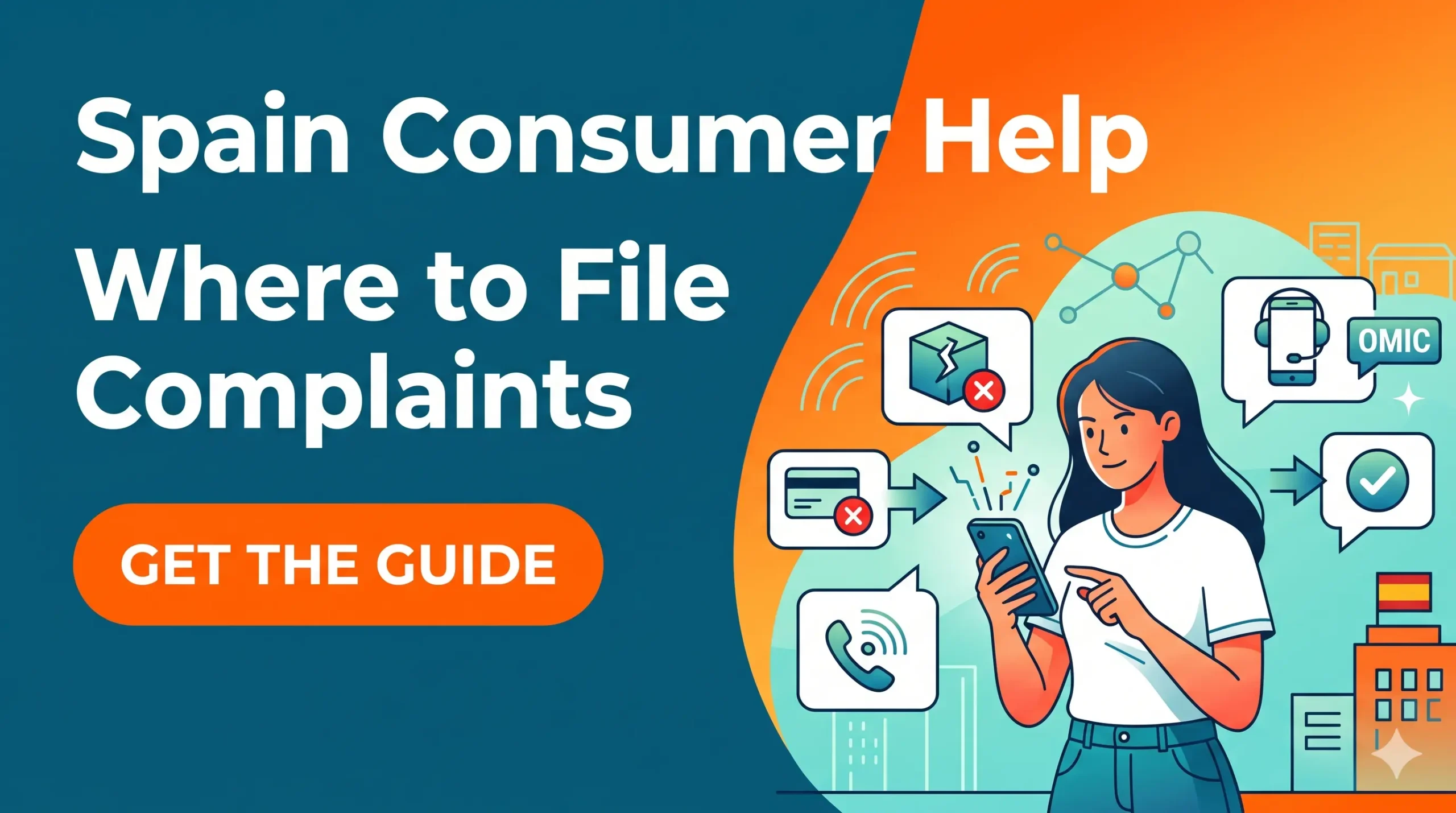
OMIC stands for Oficina Municipal de Información al Consumidor (Municipal Consumer Information Office). It is a completely free, government-funded agency operated by your local town hall (ayuntamiento). Their entire purpose is to protect consumer rights, provide free legal guidance, and mediate disputes between citizens and businesses.
However, there is a strict 30-day rule you must follow. You cannot march into the OMIC office the same day you get into an argument with your mechanic. By law, you must prove that you gave the company a fair chance to resolve the issue internally. You must wait exactly 30 days from the date you submitted the Hoja de Reclamaciones or sent the Burofax. If the company ignores you for a month, or if they send you a written reply rejecting your request for a refund, you are then legally cleared to bring the OMIC into the fight.
When the OMIC takes your case, they act as an official mediator, not a judge. They will formally contact the company’s legal department on your behalf, presenting your evidence and proposing a settlement. Because the OMIC carries the heavy, intimidating weight of the municipal government, companies that previously ignored your emails will suddenly respond very quickly to avoid further regulatory scrutiny.
The Step-by-Step Filing Process
Every major town and city district in Spain has a designated OMIC office. If you live in a tiny village, the service is usually handled by the broader provincial consumer office. You have two ways to submit your white form and initiate the mediation: digitally or in person.
If you have a Spanish Digital Certificate or Cl@ve installed on your computer, you can log into your local town hall’s virtual portal, scan your documents, and submit the complaint entirely online. If you prefer to go in person, you must go to your town hall’s website and book a cita previa (prior appointment) for the consumer office. Do not show up without an appointment, as the security guard will turn you away at the door.
When you file your case, you must provide overwhelming evidence. You need the original white copy of the Hoja de Reclamaciones, a copy of your passport or TIE, and every single receipt, signed contract, invoice, and email thread related to the dispute. Once submitted, do not expect overnight results. The Spanish administrative machine grinds slowly. It typically takes one to three months for the OMIC to process the file, contact the company, and facilitate a mediated agreement.
Consumer Arbitration and Cross-Border Disputes
Sometimes, mediation fails. A highly aggressive company might completely ignore the OMIC’s letters, or they might offer you a settlement that is insultingly low. When this happens, you have to utilize the higher tiers of the Spanish consumer protection framework.
The Junta Arbitral de Consumo
If the OMIC cannot secure a voluntary agreement, they will offer to escalate your case to the Junta Arbitral de Consumo (Consumer Arbitration Board). This is a completely free, out-of-court legal tribunal designed to relieve the burden on the traditional civil court system.
Arbitration requires the consent of both parties. However, thousands of Spanish businesses have proactively signed up for the “Sistema Arbitral de Consumo” as a sign of trustworthiness (you will often see an orange badge indicating this on their shop windows). If a business displays this badge, they are legally bound to participate in the arbitration process if you request it.
During arbitration, an independent panel reviews your evidence and the company’s defense. They then issue an Arbitral Award (Laudo). This decision is strictly legally binding. It carries the exact same legal weight as a judge’s ruling in a civil court. You do not need to hire a lawyer, making it an incredibly powerful and cost-effective tool for expats fighting larger corporations.
| Dispute Resolution Level | Who Manages It | Processing Time | Is the Decision Legally Binding? |
| Customer Service / Burofax | The Company | 30 Days | No |
| OMIC Mediation | Municipal Government | 1 to 3 Months | No (Voluntary agreement) |
| Junta Arbitral de Consumo | Regional Arbitrators | Up to 6 Months | Yes (Equivalent to a court ruling) |
| European Consumer Centre | EU Commission / Ministry | Varies | No (Cross-border mediation) |
The European Consumer Centre (ECC Spain)
The OMIC is brilliant for local disputes, but it is completely useless if your problem is with a company headquartered outside of Spanish territory. If your luggage is destroyed by an airline based in France, or a German online electronics retailer refuses to honor a return policy, the Madrid or Barcelona town hall has zero jurisdiction to help you.
Enter the Centro Europeo del Consumidor en España (ECC Spain). This is a highly specialized agency co-funded by the European Commission and the Spanish Ministry of Consumer Affairs. It is explicitly designed to handle cross-border disputes involving consumers residing in Spain and companies based elsewhere within the European Union, Norway, or Iceland.
You file your complaint with the ECC Spain directly through their digital portal, providing the same high level of documentation you would for the OMIC. The Spanish team will then coordinate directly with the ECC office located in the company’s home country to force a cross-border mediation.
Financial Defense Strategies During a Dispute
Waiting three months for a government mediator to force a telecom company to refund you is exhausting. While you fight the bureaucratic war, you must take immediate tactical steps to protect your bank account.
Controlling Direct Debits and Local Banking
The vast majority of consumer disputes in Spain involve aggressive telecom providers or utility companies overcharging you, a chaotic reality outlined in Typical Utility Bills in Spain: Electricity, Gas, Water (Examples). Instead of letting them drain your account while you wait for the OMIC, your first line of defense is stopping the financial bleeding at the source. You have the explicit legal right under European banking law to order your bank to return an unauthorized SEPA direct debit within eight weeks, a critical defensive process explained in How Direct Debits Domiciliacion Work in Spain: Setup and Cancellations.
To bypass the agonizingly slow bureaucracy and the punitive quarterly maintenance fees charged by traditional Spanish high-street banks, opening your daily operational account with N26 is highly strategic. N26 issues a fully recognized local Spanish IBAN directly from your smartphone interface.
You can use your N26 app to view all active direct debits and block a greedy utility provider with a single tap, long before you even file your OMIC paperwork. Because N26 eliminates the punitive monthly maintenance fees, it perfectly serves as your secure, agile financial hub, a reality exactly why it dominates guides comparing the Best Low-Fee Bank Accounts in Spain for New Residents and Opening a Bank Account in Spain: Step-by-Step for Foreigners.
Managing Cross-Border Settlements Safely
If your OMIC or ECC mediation is successful, you will either receive a refund or be required to pay a corrected, finalized settlement amount to close the dispute. If your primary savings are sitting in your home country, moving this money to satisfy a mediated agreement can incur heavy legacy banking fees.
Traditional banks will decimate your budget with hidden SWIFT network fees and terrible exchange rate markups. To fiercely protect your capital, you must route your international transfers through Wise. Utilizing Wise allows you to completely bypass the expensive, antiquated SWIFT network entirely. Wise converts your home currency to euros using the real, transparent mid-market exchange rate.
You can instantly transfer those cleanly converted euros directly to the Spanish company via Wise, or receive your mediated refund into your multi-currency account without bleeding money to bank margins. The deep mechanics of these cross-border savings are mapped out in Sending Money to/from Spain: Comparing Banks vs Transfer Services and Spanish Bank Transfer Terms: Transferencia, Bizum, SEPA Explained.
Insulating Your Long-Term Wealth from Collections
If a Spanish company aggressively refuses an OMIC mediation, they will not just walk away; they will weaponize the financial system against you. They will take the disputed debt and register your name on the ASNEF blacklist, effectively locking you out of the local economy. You must deeply understand this threat, which is heavily detailed in What to Do When a Spanish Company Sends You to Collections (ASNEF).
Furthermore, if they escalate the disputed debt to a local civil court in absentia, the Spanish legal system has the supreme authority to issue an electronic embargo, reaching directly into your local Spanish checking accounts to freeze your funds without your permission. Waking up financially paralyzed is a terrifying reality detailed in What to Do If Your Spanish Bank Account Is Frozen (Common Causes).
To protect your true wealth from localized embargoes while you fight a protracted consumer dispute, you must strictly compartmentalize your finances. To build robust long-term wealth securely, many veteran expats transfer their surplus capital into a global brokerage account like Interactive Brokers.
Utilizing Interactive Brokers allows you to build a sophisticated, multi-currency portfolio that remains entirely portable and heavily insulated from localized Spanish retail banking collections. It elegantly separates your long-term global wealth from the administrative chaos of your daily Spanish disputes. Keeping your financial footprint agile through platforms like Interactive Brokers ensures your money remains safe, while keeping you fully compliant with the tax structures detailed in Foreign Income Reporting in Spain: What Residents Need to Know and Spanish Taxes for Foreign Residents: Practical Guide to Staying Compliant.
References
Primary sources (official)
- Ayuntamiento de Madrid – Oficina Municipal de Información al Consumidor (OMIC): https://www.madrid.es/omic
- Ministerio de Derechos Sociales, Consumo y Agenda 2030: https://www.consumo.gob.es/
- Centro Europeo del Consumidor en España (ECC Spain): https://portal-cec.consumo.gob.es/
Other helpful sources
- Portal de la Administración General del Estado – Consumo: https://administracion.gob.es/
- Organización de Consumidores y Usuarios (OCU): https://www.ocu.org/
Disclaimer
The information provided in this guide is exclusively for educational and informational purposes and does not constitute official legal or financial advice. Spanish consumer protection laws, the procedures of the Junta Arbitral de Consumo, and the specific regulations governing the Hoja de Reclamaciones are highly complex and subject to strict enforcement by regional and municipal governments. While we strive to ensure absolute accuracy, you should always consult a registered Spanish consumer protection advocate, a legal professional (abogado), or your local OMIC office directly before initiating formal arbitration, blocking direct debits, or engaging in a protracted legal dispute with a corporation.