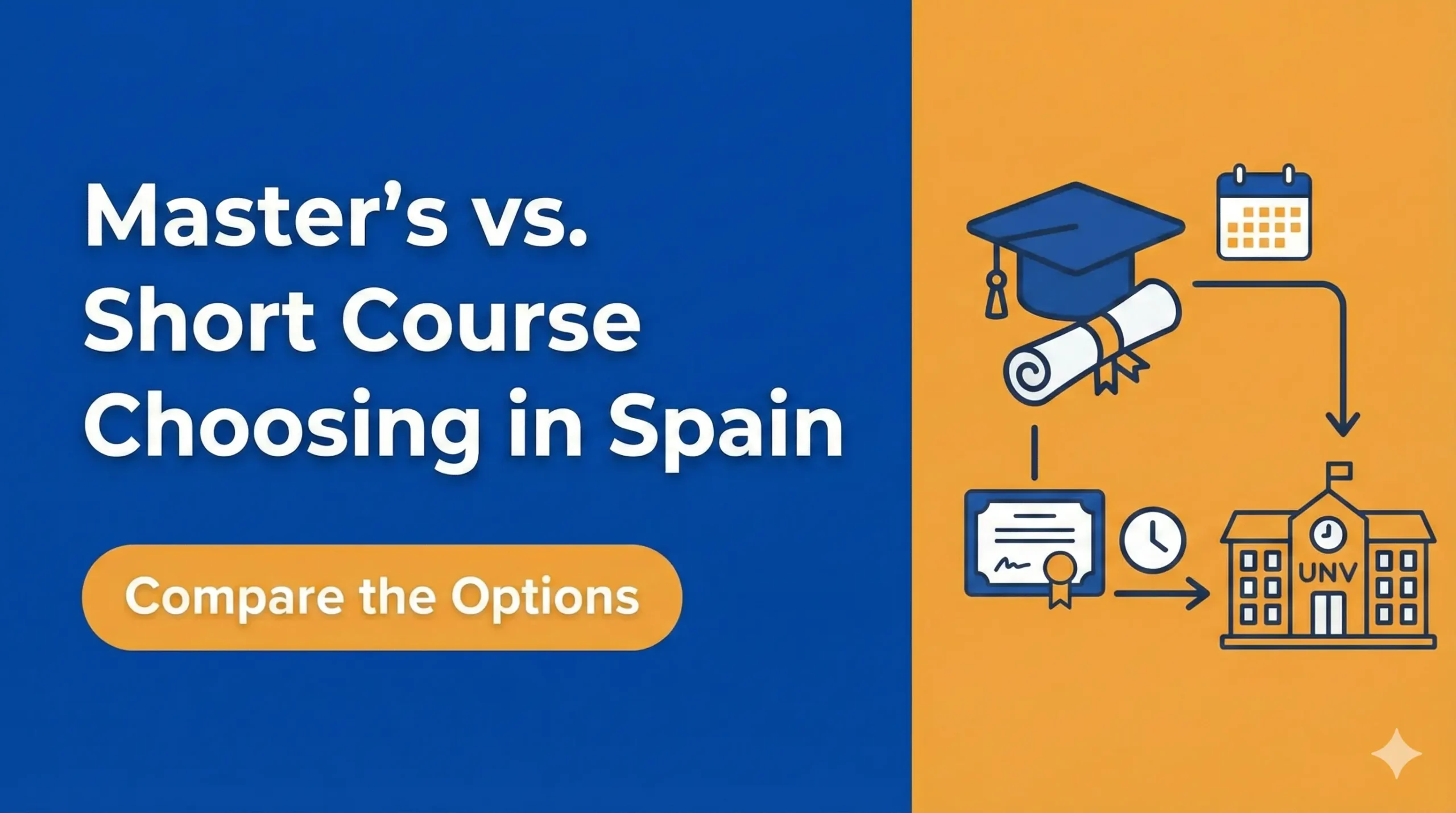
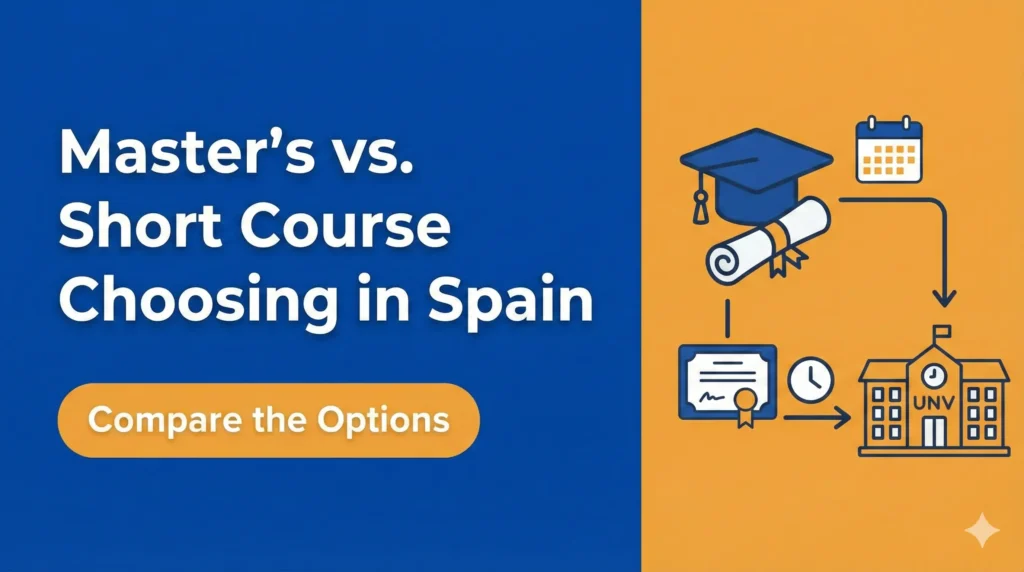
How to Choose Between a Master’s Program and a Short Course in Spain
Disclosure: This article contains affiliate links. If you buy through them, we may earn a commission at no extra cost to you. Read our full disclosure.
Deciding between a full Master’s degree and a short course in Spain depends on your career goals, budget, and visa needs. This guide compares the long-term residency benefits of university degrees against the flexibility of short courses, helping you choose the right path for your Spanish adventure.
The Visa Factor: Residency Rights and Work Permits
For non-EU citizens, the choice between a Master’s and a short course is often dictated by immigration law rather than academic preference. The type of program you choose directly determines the type of visa you can apply for, and consequently, your rights while living in the country.
The Long-Term Student Visa (Estancia por Estudios)
A Master’s program, which typically runs for 9 to 12 months (60 ECTS credits), qualifies you for a long-term student visa. This is the “golden ticket” for many expats because it opens the door to a TIE (Tarjeta de Identidad de Extranjero).
- Residency Card: You get a physical ID card that allows you to travel freely within the Schengen zone.
- Work Rights: Under current regulations, students on a long-term visa for higher education can work up to 30 hours per week, provided the work hours do not conflict with their studies.
- Post-Study Options: Graduating from an official Master’s program allows you to apply for the Búsqueda de Empleo (Job Search) visa, extending your stay for another year to find work.
If your goal is to transition to living in Spain permanently, a Master’s degree is almost always the superior strategic choice. It provides a legal runway to settle in, learn the language, and network. Before applying, you should familiarize yourself with the intricacies of the paperwork involved; our guide on Spain Student Visa: Application Steps and Common Mistakes covers the essential forms and deadlines.
The Short-Stay Student Visa (Under 180 Days)
Short courses—such as three-month coding bootcamps, semester-long Spanish language intensives, or summer business certificates—often fall under the 180-day rule.
- No TIE Card: If your course is less than six months, you generally do not get a residency card. You get a visa stamp in your passport.
- No Extension: These visas are typically non-renewable from within Spain. Once the course is done, you must leave.
- Limited Work Rights: While regulations are evolving, short-term students often face more hurdles in obtaining work authorization compared to their long-term counterparts.
Defining the Contenders: Masters vs Short Courses
To make an informed decision, you must understand what exactly defines these programs in the Spanish context. The terminology can be confusing, especially regarding the official status of the diplomas.
The Spanish Master’s Degree
In Spain, Master’s degrees are divided into two categories: Oficial (Official) and Propio (Private/Own).
- Máster Oficial (Universitario): These are regulated by the government and recognized across the European Higher Education Area (EHEA). They grant access to PhD programs and are essential for public sector jobs (oposiciones) or regulated professions (like law or architecture).
- Máster Propio (Título Propio): These are degrees created by the university itself, often in collaboration with private companies. They are more practical and flexible but are not technically recognized as “official” graduate degrees by the state. They are excellent for networking and private sector jobs but useless if you want to do a doctorate later.
If you are looking to have your foreign qualifications recognized or need your Spanish degree to be valid back home, understanding this distinction is vital. You can learn more about the validation process in our article on Recognition of Foreign Degrees (Homologación) in Spain: Overview.
The Short Course Landscape
Spain’s short course market is diverse and booming. It caters to those who want “just in time” learning rather than “just in case” learning.
- Language Immersion: Intensive Spanish courses (20+ hours a week) are the most common entry point for foreigners.
- Tech Bootcamps: Cities like Barcelona and Madrid are tech hubs offering 9-12 week bootcamps in Full Stack Development, UX/UI, and Data Science.
- University “Expert” Courses: Universities offer Curso de Experto or Curso de Especialización, which range from 15 to 30 ECTS credits. These are shorter than a Master’s but carry the university’s brand prestige.
Financial Commitment and ROI
Budget is often the deciding factor. However, comparing the costs requires looking beyond just the tuition fee. You must calculate the “Cost of Attendance,” which includes lost wages and living expenses.
Tuition Fees
- Public Master’s: Spain offers incredibly affordable public education. An official Master’s at a public university can cost between €800 and €4,000 for the entire year, depending on the region and your nationality (non-EU students sometimes pay a higher rate).
- Private Master’s: Business schools and private universities charge significantly more, ranging from €10,000 to €30,000+.
- Short Courses: These are often more expensive on a “per hour” basis. A 3-month coding bootcamp can cost €6,000 to €8,000. A specialized university expert course might cost €2,000.
Cost of Living
A Master’s requires you to sustain yourself for 10 to 12 months. In cities like Madrid or Barcelona, this is a significant financial undertaking. You will need to budget for rent, food, transport, and leisure for a full year. In contrast, a short course only requires 3 to 6 months of living expenses.
To get a realistic picture of what you will spend month-to-month, reviewing our breakdown of How to Budget for Student Life in Spain: Sample Monthly Costs is highly recommended before you commit to a year-long lease.
Comparison Table: Master’s vs. Short Course
The following table outlines the key differences to help you visualize the trade-offs.
| Feature | Master’s Degree (Máster) | Short Course (Curso Corto/Experto) |
| Duration | 9 – 18 Months (60 – 120 ECTS) | 2 Weeks – 6 Months (< 30 ECTS) |
| Visa Type | Long-Term Student Visa (Type D) | Short-Stay Student Visa / Tourist (90 days) |
| Residency Card (TIE) | Yes (Renewable) | No (Usually) |
| Work Rights | Up to 30 hours/week | Limited / None (depends on visa) |
| Academic Recognition | High (Official degrees give PhD access) | Variable (Certificates, Diplomas) |
| Focus | Theory, Research, Comprehensive knowledge | Practical skills, Upskilling, Language |
| Cost (Tuition) | €1,000 – €20,000+ | €500 – €8,000 |
| Internship Options | Mandatory in many programs | Rare (except bootcamps) |
Career Impact and Employability
Why are you studying? If the answer is “to get a job in Spain,” the Master’s degree is the clear winner.
The Master’s Advantage
Spanish employers value credentials. A Master’s degree signals commitment and integration. More importantly, nearly all official Master’s programs include Prácticas Externas (internships). These internships are the primary pipeline for foreigners to enter the Spanish labor market. Companies frequently hire their interns because it reduces the risk of recruitment.
- Networking: You spend a year with peers who will become your professional network in Spain.
- Language: A year gives you enough time to reach professional fluency, whereas three months usually leaves you at “conversational” level.
If you are considering working while you study to offset costs, you need to understand the legal boundaries. Our guide on Working Part-Time on a Spain Student Visa: Hours and Requirements explains the limitations of the student work permit.
The Short Course Niche
Short courses are ideal for professionals who already have a degree and experience but lack a specific skill. For example, a marketing manager taking a 3-month course in “Digital Marketing Analytics” or a graphic designer taking a UX/UI bootcamp.
- Upskilling: You get the skill quickly and return to the workforce.
- Gap Year/Sabbatical: Perfect for those who want a “career break” in Spain without the pressure of a thesis defense.
Accommodation and Lifestyle Differences
The length of your stay dictates your housing strategy.
The Long-Term Commitment
For Master’s students, finding a permanent apartment is essential. You will be signing a standard rental contract, dealing with utility bills, and registering on the Padrón (municipal census). This allows you to truly integrate into the city, making local friends and finding your favorite neighborhood haunts. However, the rental market in major Spanish cities is competitive. Knowing where to look is half the battle; check out Student Housing in Spain: Options and Typical Contracts to avoid scams and understand lease terms.
The Short-Term Flexibility
Short course students often rely on temporary solutions: Airbnbs, student residences with flexible booking, or homestays. While this is more expensive per month, it avoids the bureaucracy of setting up internet, water, and electricity in your own name. You live more like a long-term tourist than a resident, which can be liberating but less immersive.
Language Acquisition Expectations
Many students come to Spain specifically to learn the language. Which option is better?
It might seem counter-intuitive, but a Short Intensive Spanish Course is often better for learning the language than a Master’s degree taught in English.
- Master’s Reality: If you enroll in an English-taught MBA, you will spend your day reading English texts, listening to English lectures, and socializing with international students who speak English. Your Spanish might not improve as much as you expect unless you make a concerted effort outside class.
- Language Course Reality: In a dedicated language school, you spend 4 hours a day focusing solely on grammar and conversation. You progress rapidly.
However, if you take a Master’s degree taught in Spanish, that is the ultimate immersion. It is a trial by fire that will force you to reach near-native proficiency. If you are unsure of your current level, you might want to look into certification options first. Read about Language Exams in Spain (DELE/SIELE): What Students Need to see if you qualify for a Spanish-taught program.
Deep Dive: The Public University System
If you choose the Master’s route, do not overlook public universities. Institutions like the Complutense in Madrid, the University of Barcelona, or the University of Valencia rank highly globally.
- Pros: Very low tuition (even for non-EU students compared to the US), prestigious faculty, diverse student body.
- Cons: Bureaucracy is heavy. Administrative offices can be slow and disorganized. Class sizes can be large.
- Admission: The process is strict regarding GPA and paperwork. You will likely need to legalize and translate your undergraduate transcripts.
To understand the financial breakdown of these institutions versus private business schools, review Tuition Fees in Spain: Public vs Private Universities.
Deep Dive: The Rise of “Bootcamps”
Spain has become a European hub for tech bootcamps, particularly in Barcelona. These are strictly “short courses” but operate with a high-intensity philosophy.
- The Model: 9 to 12 weeks, 10 hours a day.
- The Visa: Many bootcamps assist with student visas, but because the course is short, it can be tricky to get a long-term visa unless the school packages the bootcamp with a longer Spanish language course to reach the 180-day mark required for a TIE.
- The Outcome: High placement rates in local startups. If you are a non-EU citizen, the challenge is transitioning from the student visa to a work permit after such a short stay.
Decision Framework: Questions to Ask Yourself
If you are still on the fence, use this framework to decide.
1. What is your primary goal?
- Residency/Immigration: Choose a Master’s.
- Career Pivot/New Skill: Choose a Short Course/Bootcamp.
- Academic Credential: Choose an Official Master’s.
2. What is your timeline?
- I have a year to explore: Choose a Master’s.
- I need to get back to work quickly: Choose a Short Course.
3. What is your budget?
- I have savings for tuition but limited living funds: Choose a Short Course (less rent to pay).
- I have a monthly budget but limited savings for high tuition: Choose a Public Master’s (low tuition, spread living costs).
4. Do you need a TIE (Foreigner Identity Card)?
- Yes: You must choose a program longer than 180 days.
Conclusion
Both Master’s programs and short courses offer valid pathways to experiencing life in Spain. The Master’s degree is an investment in stability, residency, and long-term career prospects within Europe. It is a marathon that requires endurance, bureaucracy, and patience. The short course is a sprint—an intense injection of skills and culture that allows you to taste the Spanish lifestyle without completely uprooting your existence.
Ideally, you should work backward from your desired outcome. If you see yourself living in Spain three years from now, enroll in the Master’s. If you see yourself back home with a new skill and a tan, take the short course. Whichever you choose, the experience of studying in Spain will remain a highlight of your personal and professional life.
References
Primary sources (official)
- Ministry of Universities (Register of Universities, Centres and Degrees – RUCT): https://www.educacion.gob.es/ruct/home
- Ministry of Inclusion, Social Security and Migration (Student Visa Info): https://www.inclusion.gob.es/en/web/migraciones/w/estancia-por-estudios
- SEPIE (Spanish Service for the Internationalisation of Education): http://sepie.es/international-students/index.html
- Ministry of Foreign Affairs (Consular Services): https://www.exteriores.gob.es/Portal/en/ServiciosAlCiudadano/Paginas/Visados.aspx
Other helpful sources
- Study in Spain (Official Portal): https://www.spain.info/en/study-spain/
- Erasmus+ (European Commission): https://erasmus-plus.ec.europa.eu/
Disclaimer
The information provided in this article is for educational and informational purposes only and does not constitute legal or academic advice. Visa regulations, tuition fees, and university admission requirements in Spain are subject to change by the Spanish government and individual institutions. We recommend consulting with the specific university, educational center, or a qualified immigration lawyer to ensure you meet the current requirements for your specific situation.