Can You Work Remotely in Spain on a Tourist Stay? Rules Explained
The allure of answering emails from a Spanish beach is strong, but is it legal? This guide explores the fine line between “business tourism” and illegal work, the risks of remote working on a standard tourist entry, and the legal pathways available for digital nomads.
Disclosure: This post may contain affiliate links. We may earn a commission at no extra cost to you if you make a purchase through these links. Read full disclosure.
The Legal Definition: Tourism vs. Work
To understand the rules, we must first understand how Spanish immigration law defines “tourism.”
When you enter Spain as a tourist—whether on a Schengen Visa or via a visa-waiver program (like citizens of the US, UK, and Canada)—you are entering for the purposes of leisure, recreation, or family visits. You are explicitly prohibited from engaging in professional or remunerated activities within Spain.
The “Work” Distinction
Spanish law does not historically distinguish well between “working for a Spanish company” and “working for a foreign company” when it comes to tourists. In the eyes of a strict border official, if you are performing labor and getting paid for it while physically present on Spanish soil, you are working.
However, there is a globally accepted tolerance for “incidental work.”
- Allowed: Checking emails, taking a quick emergency call, or managing your calendar while on vacation. This is considered incidental to your main purpose: tourism.
- Not Allowed: Working your full 9-to-5 shift every day, attending scheduled project meetings, or coding for 8 hours a day from a coworking space. This makes your main purpose work, not tourism.

The Schengen 90/180 Rule: The Hard Limit
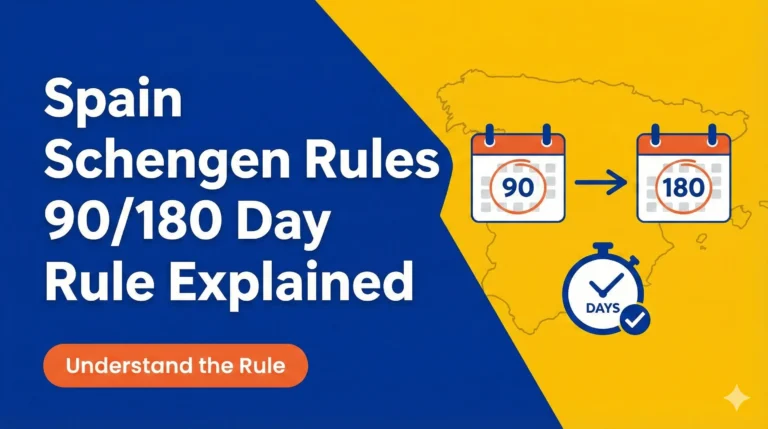
Even if you decide to take the risk and work quietly from your holiday rental, you face a hard mathematical limit: the Schengen Rule.
Tourists cannot stay in Spain for more than 90 days in any rolling 180-day period. This rule is absolute.
- You cannot “reset” this by hopping over to Morocco for a weekend.
- You cannot extend it by claiming you are “working remotely.”
If you stay for 91 days, you are an overstayer. This results in fines, a stamp in your passport marking you as an offender, and potential bans from re-entering the entire Schengen Zone for up to 5 years. For a detailed breakdown of how to calculate these days to avoid an accidental ban, read our guide on Spain Schengen Rules: 90/180 Day Rule Explained for Spain.
The “Grey Area”: Digital Nomads Under the Radar
Let’s address the elephant in the room. Do thousands of people work remotely from Spain on tourist visas every year? Yes.
Digital nomads often fly into Barcelona or Madrid, rent an apartment for two months, work from cafes, and leave before their 90 days are up. Historically, this has been difficult for authorities to police. If you are sitting in a Starbucks with a laptop, no police officer is going to tap you on the shoulder and ask to see your employment contract.
The Risks of the “Grey Area”
While enforcement inside the country is rare, enforcement at the border is increasing.
- Border Questioning: If you arrive at Madrid-Barajas airport with a laptop, a monitor, and professional camera gear, and you tell the border guard you are coming for a “3-month holiday,” they may be suspicious.
- Proof of Funds vs. Income: Tourists are often asked to prove they have sufficient funds for their stay (approx. €100 per day). If you say, “I don’t have savings, but I will be earning my salary while I’m here,” you have just admitted to illegal work. You can be denied entry and put on the next plane home.
- Coworking Spaces: While unlikely, labor inspections can technically occur in any workspace. If you are found working without a visa, you are liable for fines, and so is the coworking space hosting you.
The Business Visit Exception
There is a legal category that often gets confused with remote work: the Business Visit.
You ARE allowed to come to Spain to perform specific business activities without a work visa. This typically includes:
- Attending meetings with clients or colleagues.
- Attending conferences, trade fairs, or seminars.
- Signing contracts or legal documents.
- Conducting market research.
The Key Difference:
In a business visit, the activity is sporadic and non-remunerated in Spain. You are not “producing” value day-to-day; you are facilitating business. If you are a UK architect coming to sign a deal for a project, that is a business visit. If you sit in a hotel room drafting the blueprints for 8 hours a day, that is work.
If you are coming strictly for business meetings, carry an invitation letter from the Spanish company you are visiting. This clarifies your purpose to border control.
The Solution: The Digital Nomad Visa (DNV)
In 2023, Spain introduced the Digital Nomad Visa (DNV) specifically to solve this problem. It was created to take the “grey area” nomads and legalize them.
If you plan to spend more than a few weeks working in Spain, or if you want to stay longer than 90 days, this is your only safe option.
- Validity: 1 year (visa) or 3 years (residency card).
- Income Requirement: You must earn approx. €2,600/month (200% of SMI).
- Tax Benefit: Access to the “Beckham Law” (flat 24% tax rate).
Applying for the DNV removes the anxiety of border crossings. You can enter and exit freely, rent long-term apartments, and legally admit that you are working. For a full breakdown of the requirements, see Spain Digital Nomad Visa: Requirements, Documents, and Timeline.
Tax Implications of “Tourist” Work
Even if you ignore immigration rules, you must consider tax rules.
The 183-Day Rule
Generally, you become a tax resident in Spain if you spend more than 183 days in the country in a calendar year.
- Tourist: Since a tourist can only stay 90 days, you generally won’t trigger tax residency purely by time.
- The Trap: However, if you “chain” tourist stays (e.g., Jan-March in Spain, April in France, May-July in Spain), you could technically breach the 183-day limit while illegally overstaying or manipulating borders.
If the Spanish Tax Agency (Hacienda) decides you are a tax resident, they can claim tax on your worldwide income. Using a tourist visa to dodge taxes is a dangerous game that can lead to frozen bank accounts. Learn more about the thresholds in Tax Residency in Spain: 183-Day Rule and Practical Tests.
Permanent Establishment Risk
For your employer, you working in Spain carries a hidden risk. If you are a high-level executive or a sales director concluding contracts from a Spanish Airbnb, the Spanish tax authorities could argue that your foreign company has a “Permanent Establishment” in Spain. This could make your company liable for Spanish corporate tax. Most employment contracts explicitly forbid working abroad for this exact reason.
Comparison: Tourist vs. Business vs. Digital Nomad
To clarify the differences, here is a comparison of what is allowed under each status.
| Feature | Tourist Stay | Business Visit | Digital Nomad Visa |
| Primary Purpose | Leisure / Recreation | Meetings / Conferences | Remote Work |
| Max Duration | 90 days (per 180) | 90 days (per 180) | 1 to 5 Years |
| Can you work? | NO (Incidental only) | NO (Meetings only) | YES (Remote only) |
| Spanish Source Income? | Strictly Forbidden | Forbidden | Allowed (up to 20%) |
| Right to Rent? | Short-term / Holiday | Short-term / Hotel | Long-term leases |
| Tax Status | Non-Resident | Non-Resident | Resident (Special Regime) |
Practical Tips for the “Working Tourist”
If you are visiting for a month and plan to answer emails occasionally (the “incidental” work), here is how to avoid trouble:
- Be Honest but Specific at the Border: If asked the purpose of your trip, say “Tourism.” Do not volunteer “I’m going to finish a project.”
- Don’t Bring the Office: Traveling with two monitors, a desktop tower, and a printer screams “I am moving here to work.” Travel light.
- Keep it Short: Stays of 2-3 weeks rarely raise eyebrows. Stays of 89 days look suspicious.
- Have a Return Ticket: Always have a booked flight out of the Schengen zone within the 90-day limit.
- Address Matters: If you are staying at a known “coliving” or “coworking” hostel, border guards might ask more questions than if you are at a hotel.
Moving from Tourist to Resident
Many people come as tourists to “scout” locations before moving. This is perfectly legal. You can visit Madrid, Barcelona, and Valencia to look at neighborhoods and view apartments.
However, be careful about signing long-term contracts as a tourist. Landlords are legally required to request a residency permit or proof of income. If you show a US pay stub but no Spanish visa, they may refuse to rent to you. If you decide to make the move permanent, you will need to organize your paperwork. Start by reviewing our Moving to Spain in 2027: Step-by-Step Immigration Checklist.
Conclusion
Can you work remotely in Spain on a tourist stay? Legally, no. Practically, many do, but they are operating in a zone of legal vulnerability.
The tolerance for “digital tourism” is shrinking as Spain pushes its official Digital Nomad Visa. The government wants you to pay taxes and register properly, not just use the infrastructure on a tourist stamp.
If your plan is a two-week “workcation” where you check emails by the pool, you are likely fine. But if your plan is to live in Spain for three months and work a full-time job, you are risking fines, deportation, and a ban from the EU. With the Digital Nomad Visa now fully operational and offering a clear path to legality, the smart move is to legitimize your stay and enjoy the Spanish lifestyle without looking over your shoulder.
References
Primary sources (official)
- European Union – Schengen Border Code:https://home-affairs.ec.europa.eu/policies/schengen-borders-and-visa/schengen-area_en
- Spanish Ministry of Foreign Affairs (Visas):https://www.exteriores.gob.es/Consulados/londres/en/ServiciosConsulares/Paginas/index.aspx
- Ley de Extranjería (Spanish Immigration Law):https://www.boe.es/buscar/act.php?id=BOE-A-2000-544
Other helpful sources
- U.S. Embassy in Spain (Business Travel):https://es.usembassy.gov/
- Schengen Visa Info (90/180 Rule Calculator):https://www.schengenvisainfo.com/
Disclaimer
The information provided in this article is for general informational purposes only and does not constitute legal advice. Immigration laws are strictly enforced, and border officials have the final say on entry. We recommend consulting with a qualified immigration lawyer before attempting to work remotely from Spain to ensure you are compliant with current regulations.