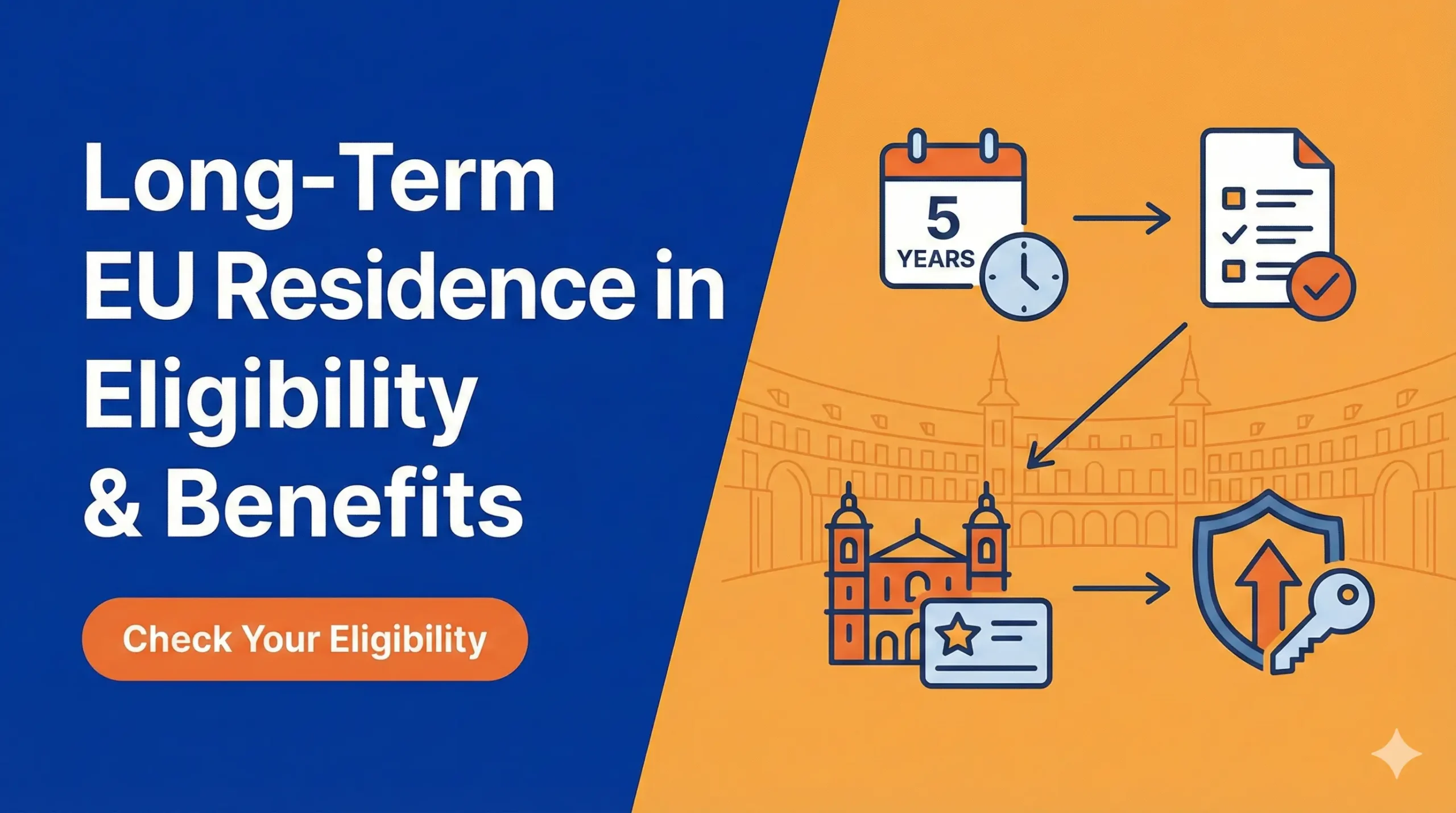
Long-Term EU Residence in Spain: Eligibility and Benefits
Reaching the five-year mark in Spain unlocks the “Golden Ticket” of immigration: Permanent Residency. But should you choose the national “Larga Duración” or the European “Larga Duración-UE”? This guide explains the critical differences, the stricter financial requirements for the EU version, and how it really impacts your mobility across Europe.
Disclosure: This post may contain affiliate links. We may earn a commission at no extra cost to you if you make a purchase through these links. Read full disclosure.
The Two “Forever” Cards: National vs. EU
Before you download any forms, you must understand the difference. Both cards grant you permanent residency in Spain for 5 years (renewable indefinitely). The difference lies in what happens if you want to leave Spain.
1. National Long-Term Residence (Larga Duración)
This is the standard permanent residency.
- Best for: People who plan to stay in Spain forever and have no intention of moving to another EU country.
- Requirements: Easier. You generally only need to prove you have lived in Spain for 5 years. You often do not need to prove financial means or health insurance again.
- Limitation: It gives you zero special rights to live in France, Germany, or Italy. If you move there, you start from scratch as a non-EU national.
2. EU Long-Term Residence (Larga Duración-UE)
This is the “premium” version governed by EU Directives.
- Best for: People who might want to work or retire in another EU country in the future.
- Requirements: Harder. You must prove stable financial resources and health insurance (similar to a fresh visa application).
- Benefit: It grants semi-automatic rights to move to other EU countries without obtaining a visa first.
Comparison Table
| Feature | National Long-Term | EU Long-Term |
| Spanish Name | Residencia de Larga Duración | Residencia de Larga Duración-UE |
| Validity | Indefinite (Card renews every 5 years) | Indefinite (Card renews every 5 years) |
| Financial Proof | Not Required (usually) | Required (Strict) |
| Health Insurance | Not Required (usually) | Required (Private or Public) |
| EU Mobility | None (Tourist rules apply) | Simplified residency in other EU states |
| Loss of Status | If out of EU for 12 consecutive months | If out of EU for 12 consecutive months |
| Absence Allowance | Lost if out of Spain for >6 years | Can stay out of Spain for 6 years (if in EU) |
Eligibility: The 5-Year Clock
To qualify for either permit, the core requirement is identical: Five years of continuous legal residence.
1. Continuous Residence
“Continuous” does not mean you can never leave. It means you haven’t abandoned your residency.
- The Limit: You cannot have been outside Spain for more than 6 consecutive months at any one time.
- The Total: The sum of all your trips outside Spain in the last 5 years cannot exceed 10 months.
- Work Exception: If your travel was for work reasons (and you can prove it), the total allowance extends to 12 months.
2. Student Visa Years (The 50% Rule)
This is the most common point of confusion. If you spent 3 years on a Student Visa and then 2 years on a work permit, do you have 5 years?
- No. Years spent on a student visa (estancia) count for 50% of the time.
- The Math: 3 years as a student = 1.5 years of residency. You would need 3.5 years of work residency to reach the 5-year total.
- Crucial Note: You generally must hold a valid residence permit (not a student stay) at the time you apply for Long-Term residency. You cannot usually jump directly from “Student” to “Long-Term” without an intermediate residence permit (like a job search or work permit).
3. Criminal Record
You must have a clean criminal record in Spain. If you have any police records (antecedentes policiales)—even for minor issues like driving offenses—you must cancel them before applying. See Spain Criminal Record Certificates: Which Ones You Need and When for details on how this impacts your status.
The Extra Hurdles for the “EU” Version
If you opt for the Larga Duración-UE, the immigration office will treat your application like a new visa. They want to ensure you are not a burden on the state.
1. Financial Means (2026 Standards)
You must prove stable and regular resources.
- The Benchmark: Typically 150% of the IPREM.
- 2026 Estimate: With the IPREM around €600/month, you need to show stable income (salary or savings) of roughly €900 – €1,080 per month for a single applicant, or significantly more for families.
- Proof: Employment contract, tax returns (Declaración de la Renta), or bank certificates. Unlike the National version, simply “being here” is not enough.
2. Health Insurance
You must have healthcare coverage identical to the National Health System.
- Workers: If you are employed or self-employed and paying Social Security, this is automatic.
- Non-Active: If you are not working, you need private health insurance with no copayments. Check our guide on Health Insurance for Spain Visas: Coverage Rules and Policy Checklist to ensure your policy qualifies.
The Mobility Myth: Moving to Another EU Country
Many expats believe the “Long-Term EU” card grants “Freedom of Movement” like an EU passport. It does not.
If you have a Spanish EU Long-Term card and want to move to Germany:
- No Automatic Right: You cannot just move to Berlin and start working tomorrow.
- No Visa Needed: You can enter Germany without applying for a visa at the German consulate in Madrid. You enter as a tourist.
- Apply for Residence: Within 90 days of arrival in Germany, you apply for a German residence permit.
- The Advantage: German authorities are required to process your application under simplified rules (Directive 2003/109/EC). You usually still need to prove you have a job offer or savings, but you skip the “labor market test” (proving no German could do the job) and the visa queue.
In Summary: It exchanges a “Visa + Residence” process for just a “Residence” process. It is a bridge, not a teleporter.
The Application Process
Applications for Long-Term residence are processed by the Immigration Office (Oficina de Extranjería) in your province.
Step 1: Check Your Timing
You can apply up to 60 days before your current card expires, or up to 90 days after.
- Recommendation: Apply 30 days before expiration. Do not let your card expire if you can help it, as it complicates banking and travel.
Step 2: Documents Checklist
- Form EX-11: Tick the box for either “Larga Duración” or “Larga Duración-UE”.
- Passport: Full copy of all pages (to count absences).
- Tasa 790-052: The administrative fee (approx. €22).
- Financial Proof: (Only for EU version) Bank statements, salary slips.
- Health Insurance: (Only for EU version) Policy certificate.
Step 3: Submission
Most applications are now submitted digitally via the Mercurio platform if you have a Digital Certificate. If not, you may need to hire a lawyer or “Gestor” to submit it for you, or fight for an in-person appointment.
Step 4: TIE Card Renewal
Once you receive the “Resolución Favorable” (Approval), you must book a police appointment (Toma de Huellas) to get your new TIE card.
- Validity: The card will be valid for 5 years.
- Note: The status is permanent; only the plastic card expires. Renewing it in 5 years is a simple fingerprint appointment, not a re-application.
- Resource: See How to Get the TIE Card in Spain: Fingerprints, Fees, and Pickup for the final steps.
Losing Your Status (and Getting it Back)
One of the massive hidden benefits of the EU Long-Term card is how hard it is to lose.
- Standard National Card: If you leave the EU for 12 consecutive months, your residency is extinguished.
- EU Long-Term Card: You can leave Spain and live in another EU country (like France) for up to 6 years without losing your Spanish permanent residency rights.
Recovery: If you do lose it (e.g., you moved to the USA for 2 years), recovering a Long-Term residency is much faster than starting over. You apply for a “Recovery of Long-Term Residence” visa, which is almost automatic if you have a clean criminal record.
Which One Should You Choose?
Choose the National “Larga Duración” if:
- You are currently unemployed or have low income.
- You cannot afford private health insurance and aren’t contributing to Social Security.
- You are certain you want to retire in Spain and have no interest in living elsewhere in Europe.
Choose the “Larga Duración-UE” if:
- You are working and meet the income thresholds easily.
- You are young/mobile and want the option to try working in Amsterdam or Berlin later.
- You want the maximum possible security against losing your residency during long absences from Spain.
Conclusion
Reaching the five-year mark is a massive achievement. You have navigated the bureaucracy, paid your taxes, and made Spain your home. Whether you choose the National or the EU route, the result is peace of mind: no more temporary visas, no more fears of non-renewal.
If you are currently on a Spain Digital Nomad Visa: Requirements, Documents, and Timeline, remember that your time counts 100% toward this goal. Keep your absences low, your taxes paid, and in five years, you will trade your “Nomad” status for “Permanent Resident”—the ultimate anchor in Europe.
Before you submit your application, do a final audit of your time outside Spain by checking the stamps in your passport. If you are close to the 10-month limit, consult a lawyer before applying.
References
Primary sources (official)
- Ministry of Inclusion (Portal de Inmigración): Official guide to Long-Term Residence (Larga Duración).https://www.inclusion.gob.es/web/migraciones/vivir-en-espana/residencia-de-larga-duracion
- European Commission: Information on the rights of long-term residents in the EU (Directive 2003/109/EC).https://home-affairs.ec.europa.eu/policies/migration-and-asylum/legal-migration-and-resettlement/long-term-residents_en
- Sede Electrónica (Forms): Download Form EX-11 and Tasa 790-052.https://sede.administracionespublicas.gob.es/pagina/index/directorio/modelos_extranjeria
- Boletín Oficial del Estado (BOE): Royal Decree 557/2011 (Immigration Regulation).https://www.boe.es/buscar/act.php?id=BOE-A-2011-7703
Other helpful sources
- Balcells Group: Comparison of National vs. EU Long-Term Residency.https://balcellsgroup.com/long-term-residency-spain-eu/
- Parainmigrantes: Guide to recovering lost long-term residency.https://www.parainmigrantes.info/recuperacion-de-la-larga-duracion/
Disclaimer
The information provided in this article is for educational and informational purposes only and does not constitute legal advice. Immigration laws, particularly regarding EU mobility and financial thresholds (IPREM), are subject to change. We strongly recommend consulting with a qualified immigration lawyer to determine the best residency path for your specific situation.