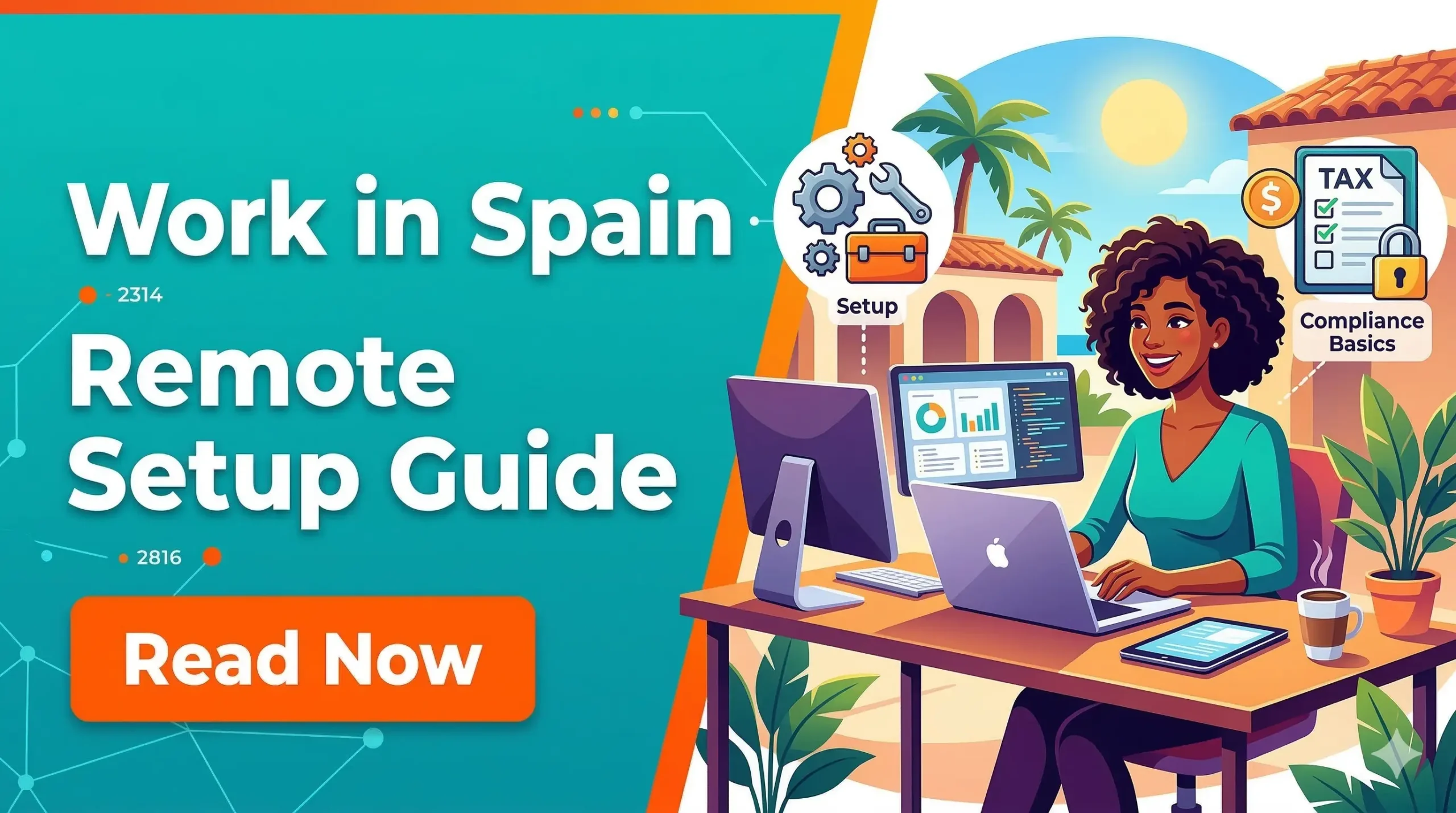
Remote Work in Spain: Practical Setup and Compliance Basics
Disclosure: This article contains affiliate links. If you buy through them, we may earn a commission at no extra cost to you. Read our full disclosure.
Trying to explain to a Spanish immigration officer why you are secretly working from a Barcelona cafe on a tourist visa is a panic-inducing nightmare. Many remote workers lose sleep over the fear of deportation because their remote employment can technically violate the terms of a temporary residency status. This comprehensive guide decodes the legal, financial, and practical setup required to successfully work remotely in Spain without running afoul of the authorities.
The Legal Landscape of Remote Work in Spain
The era of sneaking into Spain on a standard Schengen tourist visa and quietly working from your laptop is officially over. For years, digital nomads operated in a precarious legal gray area, hopping borders every ninety days and praying border control did not ask too many questions about how they funded their prolonged European vacations. The Spanish government has caught up to the modern remote working trend, and the legal pathways have fundamentally shifted.
Digital Nomad Visa Versus Tourist Realities
Attempting to work remotely on a tourist visa today is not only highly illegal, but it also completely blocks you from functioning in the local economy. Without a legal residency permit, you cannot sign a long-term apartment lease, you cannot secure a localized fiber-optic internet contract, and traditional banks will flatly refuse to open an account for you. You are effectively forced to live as a highly anxious financial ghost, relying entirely on expensive short-term holiday rentals.
To solve this exact crisis, the Spanish government introduced the highly anticipated Digital Nomad Visa. This visa is a massive structural breakthrough for remote workers. It legally allows non-EU citizens to reside in Spain for up to an initial three years—renewable for up to five—provided they can definitively prove they work remotely for companies located entirely outside of Spain. It completely legitimizes your presence in the country, granting you the crucial Foreigner Identity Card (TIE) that serves as your golden ticket to the Spanish administrative system. You can finally rent an apartment, buy a car, and sign up for public healthcare without looking over your shoulder.
Furthermore, the financial thresholds for the visa are uncompromising. You must mathematically prove a monthly income of at least two hundred percent of the Spanish minimum wage. For single applicants, this currently means demonstrating a guaranteed, stable income of several thousand euros every single month. The administrative friction involved in proving this income is notoriously frustrating for expats, as civil servants will not accept casual screenshots of your bank balance. Understanding how this initial hurdle dictates your broader relocation budget is a concept we explore deeply in Cost of Living in Spain: Budgeting for Expats.
The Autonomo Route for Independent Contractors
If you are a freelancer managing multiple international clients rather than a full-time employee of a single foreign corporation, your legal pathway shifts entirely. The Digital Nomad Visa technically accommodates freelancers, but only if less than twenty percent of your total global revenue comes from Spanish clients. If your goal is to actively build a local client base while managing your remote foreign portfolio, you must officially register within the Spanish system as a self-employed worker.
Declaring yourself as an independent worker in Spain means entering the infamous and highly structured self-employment regime. This is not a casual status you can toggle on and off when you land a new client. When you register, you become legally obligated to pay a massive, fixed monthly social security quota simply for the right to exist in the system and access public healthcare. This quota is completely decoupled from your actual monthly profit. Even if your primary remote client delays payment and you earn absolutely nothing in February, the Spanish state will ruthlessly withdraw their mandatory quota from your checking account on the very last day of the month.
Managing the dual registration process between the federal tax agency and the social security administration is where the vast majority of foreign freelancers make catastrophic, fine-triggering errors. You must secure a digital certificate, decipher complex economic activity codes, and set up the correct quarterly tax declarations before you issue your very first invoice. Because this specific process is the graveyard of countless expat business dreams, you must strictly follow the step-by-step blueprint detailed in The Autonomo System in Spain: How to Register as a Freelancer.
Using an Employer of Record
For full-time corporate employees whose home companies refuse to deal with the complexities of the Digital Nomad Visa, there is a powerful third alternative. Many massive North American and British corporations are terrified of accidentally triggering “permanent establishment” corporate tax liabilities by allowing an employee to work freely from a Spanish apartment. To protect their corporate tax exposure, they will demand that you completely sever your direct foreign employment contract.
In this scenario, you must utilize an Employer of Record (EOR). This is an incredible logistical workaround where a specialized, legally registered Spanish umbrella company technically hires you as a standard local employee. Your foreign company pays the umbrella firm a monthly fee, and the umbrella firm issues you a standard, legally flawless Spanish employment contract. To the Spanish government, you are simply a regular domestic worker. You are immediately plugged into the local social security system, you receive standard public healthcare, and your visa application switches to a standard highly qualified worker permit.
The massive US or UK salary you previously enjoyed will be brutally slashed by European tax rates before it ever hits your checking account. You will also be forced into the traditional Spanish payment structure, which often divides your annual salary into fourteen payments rather than twelve, severely choking your monthly liquidity. To accurately calculate exactly how much money will survive this transition and actually land in your pocket, you absolutely must review Spanish Salary Basics: Gross vs Net Pay and Common Deductions.
Tax Compliance and the Expat Reality
The greatest shock for remote workers moving to Spain is discovering that their geographic location permanently alters their global tax liabilities. Spain is an incredibly aggressive tax jurisdiction, and ignorance of the laws will not protect you from devastating financial audits.
Triggering Tax Residency The 183 Day Rule
The defining metric of your financial life in Spain is the concept of tax residency. The Spanish Agencia Tributaria operates on a remarkably simple, unforgiving mathematical formula known as the 183-day rule. If you are physically present on Spanish territory for more than 183 days within a single calendar year, you automatically become a Spanish tax resident.
The moment you trigger tax residency, the scope of your tax liability expands globally. You are no longer just taxed on the money you earn while sitting in your Spanish apartment; you are legally required to declare and pay taxes on your worldwide income. This includes the remote salary paid into your home-country bank account, the rental income from an apartment you own in London, and the capital gains from stock portfolios held in the United States.
Expats frequently try to outsmart this rule by taking weekend trips to Portugal or France, assuming they can simply subtract those days from their Spanish tally. The tax agency aggressively counters this by tracking your center of economic interest. If your spouse, your children, your primary apartment lease, and your local gym membership are in Spain, the government will legally classify you as a tax resident even if you spent half the year traveling. To deeply understand how these rules are enforced and when the specific filing deadlines occur, read Spanish Income Tax (IRPF) 101: Who Pays and When.
The Beckham Law Exemption for Remote Workers
Because the standard progressive income tax brackets in Spain can quickly consume nearly half of a high earner’s gross salary, remote workers are frequently terrified of triggering full tax residency. However, the Spanish government created a massive, highly lucrative loophole specifically designed to attract foreign talent and wealth.
This loophole is colloquially known as the Beckham Law (Régimen Especial para Trabajadores Desplazados). If you successfully apply and are approved for this specialized tax regime within your first six months of arriving in Spain, you are legally treated as a non-resident for tax purposes for your first six years. This means you only pay a flat, static tax rate of 24 percent on your Spanish-sourced income up to 600,000 euros, completely bypassing the brutal upper progressive brackets.
Crucially, under recent legislative updates, holders of the new Digital Nomad Visa are technically eligible to apply for the Beckham Law exemption, provided they meet strict corporate and historical residency criteria. Securing this status saves high-earning expats tens of thousands of euros annually and legally shields their foreign capital gains from Spanish taxation. If your salary exceeds sixty thousand euros a year, navigating the application process for this exemption should be your absolute highest priority, a topic expanded upon in How to File a Spanish Tax Return: A Guide for Expats (IRPF).
Navigating Double Taxation Treaties
When you are earning money from a foreign employer but living physically in Spain, you immediately collide with the terrifying prospect of double taxation—where both your home country and the Spanish government demand a massive cut of the exact same paycheck.
Fortunately, Spain maintains robust Double Taxation Treaties with dozens of major countries, including the United States, the United Kingdom, Canada, and Australia. These international treaties are specifically engineered to prevent you from being taxed into absolute poverty. Generally, they operate on a system of foreign tax credits. If you pay twenty percent income tax on your remote salary to the US government, the Spanish tax agency will credit that exact amount against your Spanish tax bill, ensuring you only pay the mathematical difference to reach the higher Spanish rate.
However, executing these treaties requires flawless, complex international accounting. You cannot simply check a box on a generic tax software program. You will likely need to file highly specific forms—such as the W-8BEN or W-9 for US citizens—and you must hire a specialized, cross-border Spanish tax accountant (asesor fiscal) to correctly structure your annual declarations. Attempting to navigate international tax credits by yourself is a guaranteed way to trigger a devastating federal audit. To ensure your global asset profile is fully compliant, review Wealth Tax and Solidarity Tax in Spain: Overview for Foreigners.
Setting Up a Functional Home Office
Working remotely requires infrastructure that is fundamentally more robust than a casual tourist connection. Setting up a professional, seamless home office in a Spanish apartment introduces a unique set of localized logistical hurdles.
Securing Reliable High Speed Internet
Spain boasts one of the most extensive and advanced fiber-optic networks in all of Europe. Once installed, the internet speeds are phenomenal, frequently offering symmetrical gigabit connections at highly affordable monthly rates. The crisis, however, lies entirely in the installation process.
You cannot simply walk into a Movistar or Vodafone store and walk out with a working router the same day. Telecommunications companies enforce rigid bureaucratic protocols. To sign an internet contract, you must possess a Spanish bank account for the direct debit, a signed apartment lease, and a Foreigner Identification Number (NIE). If you lack any of these documents, they will flatly refuse your business.
Once you finally sign the contract, you must wait for the physical installation technician. This can take anywhere from a few days to three agonizing weeks, depending on the age of your building and the specific neighborhood infrastructure. If your remote job requires constant Zoom meetings, you must absolutely secure a temporary 5G mobile hotspot or rent a coworking desk immediately upon arrival to bridge this unpredictable installation gap. To understand the total monthly budget required for this connectivity, read Utility Costs in Spain: Electricity, Gas, Water, and Internet.
Managing Utility Costs and Energy Surges
The physical reality of working from a Spanish apartment often shocks expats accustomed to central climate control. The vast majority of historical Spanish apartments lack proper insulation. During the blistering heatwaves of July and August, your home office will become an absolute oven; during the damp, bitter winters, it will feel like an icebox.
Because you are working from home, you will rely heavily on localized electric split-unit air conditioners to survive the summer, and portable electric radiators to survive the winter. This constant reliance on climate control causes utility bills to skyrocket. Spanish electricity pricing operates on highly complex, time-of-use tiered tariffs, meaning the electricity you consume during peak mid-day working hours is significantly more expensive than the electricity consumed late at night.
If you do not proactively manage your thermostat and understand the specific hours of your utility tariff, you will be hit with devastatingly high bi-monthly electricity bills that entirely destroy your carefully planned budget. Learning how to navigate these automated, aggressive utility direct debits is critical for your financial survival, a hurdle we explain completely in How to Pay Bills in Spain: Direct Debit, Cash, and Online Portals.
Coworking Spaces as an Alternative
Staring at the same four walls of your apartment for ten hours a day while struggling to communicate in a foreign language is a recipe for severe clinical depression. Remote work in a new country is incredibly isolating, and the lack of casual office banter deeply impacts expat mental health.
To combat this isolation, many veteran remote workers aggressively utilize the massive networks of coworking spaces available in hubs like Barcelona, Madrid, Valencia, and Malaga. Spaces like WeWork, Utopicus, or independent local hubs offer flawless, enterprise-grade internet, eliminating the stress of dealing with Spanish telecommunications providers entirely.
Managing Cross Border Finances and Payroll
A high-paying remote job is entirely useless if the global banking system blocks you from actually spending that money in your local Spanish grocery store. Managing the flow of capital across borders is the most vital logistical skill a remote worker must master.
Why Legacy Banks Fail Remote Workers
If you attempt to fund your daily Spanish life by executing direct international wire transfers from your home country bank to a traditional Spanish high-street bank, you will be financially crushed. Traditional legacy banks operate on archaic international protocols that actively penalize cross-border lifestyles.
If you wire a five-thousand-dollar remote salary from the United States to a legacy Spanish bank account, the bank will secretly pad the exchange rate with a massive hidden markup, usually ranging from three to five percent. They will also charge you a flat receiving fee simply for accepting international funds. On a monthly basis, you could be silently losing hundreds of euros of your hard-earned salary to these invisible banking spreads.
Furthermore, sudden, large incoming foreign wire transfers frequently trigger the automated Anti-Money Laundering (AML) algorithms of Spanish legacy banks. If the compliance department flags your remote salary deposit, they will instantly and brutally freeze your entire checking account without warning until you physically visit a branch with translated employment contracts to prove the origin of the funds. To gracefully bypass these hostile local branch protocols, review Opening a Bank Account in Spain as a Non-Resident.
Protecting Your Income with Transfer Services
To fiercely protect your cross-border capital and ensure your remote salary actually arrives intact, you must bypass the legacy wire system entirely and utilize a dedicated currency specialist like Wise. Veteran remote workers universally rely on Wise to build a protective financial bridge between their foreign employer and their local Spanish life.
By instructing your foreign employer or remote clients to pay your salary directly into your multi-currency Wise digital wallet, you receive the funds natively in your home currency without triggering international fees. When you actually need Euros to pay your Spanish rent or buy groceries, you convert the funds within Wise at the true, highly transparent mid-market exchange rate.
You completely eliminate the hidden bank markups and the predatory intermediary SWIFT fees. You can then use your Wise Euro balance to pay local vendors or instantly execute a free SEPA transfer to your localized Spanish checking account. Managing your capital with this digital-first approach ensures you dictate exactly when and how your money crosses borders. For a comprehensive look at how much wealth this strategy preserves, read Sending Money to/from Spain: Comparing Banks vs Transfer Services.
Handling Spanish Invoicing and IVA
If your remote work setup operates under the Spanish autónomo (freelancer) regime, getting paid introduces a complex layer of localized tax compliance. You cannot simply send a generic PayPal request to your international clients; you must issue formal, legally compliant Spanish invoices (facturas).
The most agonizing concept to grasp is the application of the Impuesto sobre el Valor Añadido (IVA), which is the Spanish Value Added Tax. If you are invoicing a remote client located outside of the European Union—such as a corporation in the United States or Canada—your service is legally classified as an export, and you generally do not charge them the 21 percent Spanish IVA.
Overcoming Cultural and Communication Barriers
Moving your laptop to a sunny Spanish balcony does not exempt you from the deep, unspoken cultural rules that govern the local economy. Remote workers who refuse to adapt to the Spanish rhythm inevitably fail to integrate and eventually leave out of pure frustration.
The Spanish Schedule and Time Zone Juggling
The most brutal logistical challenge for North American remote workers in Spain is the agonizing time zone overlap. If you are required to work synchronized hours with a company headquartered on the US East Coast, you are facing a massive six-hour delay. If the company is on the US West Coast, you are staring down a punishing nine-hour delay.
This means your remote workday often does not truly begin until 3:00 PM or 4:00 PM Spanish time, and you will be chained to your laptop participating in Zoom meetings until 11:00 PM or midnight. While this schedule initially sounds great for exploring the city during the morning, it completely isolates you from the standard Spanish evening social life, which heavily revolves around late dinners and evening tapas.
Furthermore, if you are collaborating with local Spanish vendors or clients, you must respect their rigid daily rhythms. You absolutely cannot expect an email reply or a signed contract between the hours of 2:00 PM and 4:00 PM, as the entire corporate sector shuts down for the mandatory, extended lunch break. Attempting to force your hyper-efficient Anglo-Saxon timeline onto a local supplier will only generate deep resentment. To decode these unspoken daily rhythms, you absolutely must read Spanish Work Culture: Hours, Holidays, and Workplace Etiquette.
Language Barriers in Local Administration
The most dangerous myth sold to expats is that you can easily navigate life in major Spanish cities speaking only English. While a bartender in a tourist district will gladly switch to English to take your drink order, the foundational pillars of your life—the town hall, the tax agency, the local internet installers, and your landlord—operate exclusively in Spanish.
If you cannot independently read a commercial rental contract, argue a fabricated charge with your utility provider, or comprehend a certified letter from the tax authority, your overhead costs will skyrocket as you are forced to hire expensive translators for every minor task. True remote freedom requires linguistic independence.
To actively protect yourself and rapidly accelerate your professional vocabulary, dedicating daily time to SpanishPod101 is an incredibly effective strategy. Unlike generic flashcard apps, SpanishPod101 provides structured, highly contextual audio modules that teach you exactly how to navigate formal banking negotiations, understand dense legal vocabulary, and transition smoothly between casual and formal corporate dialogue. Investing in this linguistic infrastructure is just as important as investing in your high-speed internet.
Building a Local Professional Network
Because you do not have a physical Spanish office to commute to every morning, you lack the built-in social network that standard corporate expats naturally inherit. It is terrifyingly easy to fall into the “remote work trap,” where your entire week consists of moving from your bed to your laptop and back again, never speaking to a local citizen.
You must aggressively force yourself out of your apartment to build a local professional network. Attending industry-specific Meetups, participating in local tech conferences in Barcelona or Madrid, and joining localized professional associations are mandatory survival tactics.
When you do attend these events, you must adapt to the Spanish networking style, which heavily prioritizes personal trust over transactional efficiency. You must be willing to attend long after-work networking drinks (afterworks) where no actual business is discussed until personal rapport is established. To understand how to effectively pitch your remote services to local Spanish clients without offending their cultural sensibilities, review Finding a Job in Spain: CV, Interviews, and Networking.
Renting and Registering as a Remote Worker
The final, and often most stressful, hurdle of the remote work transition is securing the physical roof over your head. The Spanish real estate market is incredibly hostile to foreign remote workers because you lack the standard documentation that domestic landlords inherently trust.
Proving Income to Spanish Landlords
When you attempt to sign a long-term apartment lease, the landlord or the real estate agency will demand to see your last three monthly payslips (nóminas) and an indefinite Spanish employment contract. This paperwork proves to them that you are a stable, low-risk tenant.
As a remote worker or a freelancer earning foreign income, you do not possess these specific, highly localized documents. When you hand a Spanish landlord a massive, complex US tax return or a generic PDF invoice from a British client, they simply do not know how to evaluate the risk. Many landlords will flatly reject your application, even if your remote salary is triple the local average, purely because your income is unfamiliar and foreign.
To overcome this localized bias, you must proactively offer alternative financial guarantees. Veteran remote workers bypass this rejection by offering to pay six months of rent entirely upfront in cash, or by securing a formal bank guarantee (aval bancario) from a local Spanish bank, which locks a massive chunk of your capital in an escrow account to assure the landlord they will be paid. To safely navigate these massive upfront liquidity drains, you must thoroughly understand the dynamics outlined in Renting in Spain: How to Budget for Deposits, Fees, and Utilities.
The Elusive Empadronamiento
You cannot officially exist in the Spanish administrative system until you secure your Certificado de Empadronamiento (colloquially known as the padrón). This document is your official registration on the local municipal census, proving to the government exactly where you sleep at night.
You absolutely need a padrón to apply for the Digital Nomad Visa, to register as a freelancer with the tax agency, and to access the public healthcare system. However, to get the padrón, you must present a legally binding rental contract at the town hall.
Understanding Rental Contracts and Clauses
When you finally find a willing landlord, you must meticulously review the physical contract. Do not rely on an English translation provided by a highly commissioned real estate agent; they often omit crucial, expensive details. You must use the Spanish skills you honed on SpanishPod101 to read the original legal document yourself.
You must specifically look for the duration of the contract. Many agencies target remote workers with “seasonal contracts” (contratos de temporada) which typically last exactly eleven months. These contracts are legally designed to bypass the strict tenant protections of the Spanish Housing Law, allowing the landlord to kick you out or drastically raise the rent before a full year passes. Furthermore, seasonal contracts legally force the tenant to pay massive real estate agency fees, a cost that is legally shifted to the landlord for standard, long-term 5-year contracts. Be fiercely protective of your capital and demand a long-term contract if you plan to stay.
| Remote Work Pathway | Legal Status | Taxation Profile | Best Expat Use Case |
| Digital Nomad Visa | Temporary Resident | Progressive IRPF (or 24% Flat if Beckham Law approved) | High-earning remote corporate employees. |
| Autónomo (Freelancer) | Self-Employed | Progressive IRPF + High fixed monthly social quotas | Independent contractors with multiple global clients. |
| Employer of Record (EOR) | Standard Spanish Employee | Progressive IRPF + Standard social deductions | Employees whose foreign companies require a local entity. |
| Tourist Visa (Schengen) | Non-Resident | Illegal to work remotely | Completely unsustainable for long-term relocation. |
References
Primary sources (official)
- Ministerio de Inclusión, Seguridad Social y Migraciones – Movilidad Internacional (Nómadas Digitales): https://www.inclusion.gob.es/web/migraciones/movilidad-internacional
- Agencia Tributaria (AEAT) – Residencia de las personas físicas y jurídicas: https://sede.agenciatributaria.gob.es/Sede/no-residentes/residencia-personas-fisicas-juridicas.html
Other helpful sources
- Expatica – Working as a freelancer or self-employed in Spain: https://www.expatica.com/es/working/self-employment/freelance-in-spain-471565/
- The Local Spain – Pros and cons: What Spain’s digital nomad visa is really like: https://www.thelocal.es/20230526/pros-and-cons-what-spains-digital-nomad-visa-is-really-like
Disclaimer
The information provided in this article is for educational and informational purposes only and does not constitute formal legal, corporate tax, or immigration advice. Spanish immigration laws regarding the Digital Nomad Visa, the rigorous eligibility criteria for the Beckham Law (Régimen Especial para Trabajadores Desplazados), and the strict determination of tax residency under the 183-day rule are highly complex and subject to frequent legislative updates by the Agencia Tributaria and the Ministerio de Inclusión. Always consult directly with a certified Spanish tax accountant (asesor fiscal) and a registered immigration lawyer (abogado de extranjería) before finalizing cross-border employment contracts, shifting your global tax domicile, or operating a remote business on Spanish territory.