Spain Volunteer Visas: What’s Allowed and What’s Not
Spain’s volunteer visa offers a unique pathway to live in the country while serving the community. This guide details the strict eligibility requirements, the difference between volunteering and “employment,” and why using a tourist visa for programs like Workaway carries significant legal risks.
Disclosure: This post may contain affiliate links. We may earn a commission at no extra cost to you if you make a purchase through these links. Read full disclosure.
What is the Spain Volunteer Visa?
The Volunteer Visa allows non-EU citizens to reside in Spain for more than 90 days to participate in non-lucrative programs serving the general interest. It grants you the status of “stay” (estancia) rather than “residency” (residencia), which is an important distinction for those hoping to eventually gain permanent residency or citizenship.
Unlike the Spain Non-Lucrative Visa: Financial Proof, Insurance, and FAQs, which is purely for those who want to retire or live passively, the Volunteer Visa requires you to be actively engaged in a specific program. However, unlike a Work Permit, that engagement cannot be purely for your own financial gain.
Core Requirements for 2026
To qualify, you must build a robust application dossier. The consulate will be looking for proof that you are a genuine volunteer and not a disguised worker.
1. The Host Organization
You cannot volunteer for just anyone. The organization must be:
- Officially Recognized: It must be a non-profit entity registered with the relevant Spanish government registry (General Registry of Volunteering Entities).
- Liability Covered: The organization must have specific civil liability insurance (Seguro de Responsabilidad Civil) that covers your activities. You cannot be “at your own risk.”
2. The Collaboration Agreement (Convenio)
This is the most critical document. It is a signed contract between you and the organization. It is not enough to have an “acceptance letter.” The Convenio must specifically detail:
- Activities: A clear description of your tasks (which must be non-labor in nature).
- Schedule: The hours you will dedicate (usually 25-35 hours/week).
- Supervision: Who is responsible for your training and oversight.
- Coverage: How your accommodation, food, and small travel expenses are covered (if applicable).
- Resources: The organization’s commitment to cover the cost of your return trip if needed.
3. Financial Means (IPREM)
Even though the organization might provide food and lodging, the Spanish government requires proof that you have your own financial safety net.
- The Rule: You must prove you possess 100% of the IPREM (Public Multiple Effects Income Indicator) for every month of your stay.
- 2026 Estimate: With the IPREM sitting around €600/month, you generally need to show bank statements with approximately €7,200 for a one-year stay.
- Exception: If the Convenio explicitly states that the organization provides full board and lodging, some consulates may reduce this financial requirement, but it is safer to show the full amount to avoid rejection.
For a deeper dive into how to present your bank statements, read our guide on Proof of Funds for Spain Visas: Accepted Bank Statements and Formats.
4. Medical Insurance
You generally need a comprehensive private health insurance policy. Travel insurance is often rejected for stays over 90 days; you need a policy that offers coverage equivalent to the Spanish National Health System with no copayments. Check our Health Insurance for Spain Visas: Coverage Rules and Policy Checklist to ensure you buy the right policy.
5. Background Checks
If your stay exceeds six months, you must provide a clean criminal record certificate from the countries where you have lived in the past five years. This document must be Apostilled and translated. Learn more about the specific requirements in Spain Criminal Record Certificates: Which Ones You Need and When.
The “Workaway” Trap: A Legal Warning
A common misconception among travelers is that they can enter Spain on a tourist visa (or the 90-day Schengen waiver) and participate in informal volunteering exchanges like Workaway, WWOOF, or HelpX.
The Legal Risk:
While thousands of travelers do this without issue, it is technically illegal under Spanish immigration and labor laws.
- Compensation in Kind: Spanish law defines “employment” broadly. If you provide labor (gardening, cleaning, reception work) and receive “payment in kind” (a bed and food) in return, an employment relationship exists.
- The Violation: Since you are on a tourist visa, you have no authorization to work. If a Labor Inspection (Inspección de Trabajo) visits the hostel or farm where you are staying, both you and the host can face severe penalties.
- The Consequence: You could be fined, deported, and banned from re-entering the Schengen zone. The host faces fines ranging from €3,000 to €10,000 per illegal worker.
The Verdict: For a casual week-long stay, this is rarely prosecuted. But for any long-term plan, relying on a tourist status for “work-for-food” exchanges is a dangerous gamble. If you want to stay longer than 90 days, you must get the proper visa.
What is Allowed vs. What is NOT Allowed
The Volunteer Visa is restrictive. Understanding these boundaries is essential to maintaining your legal status.
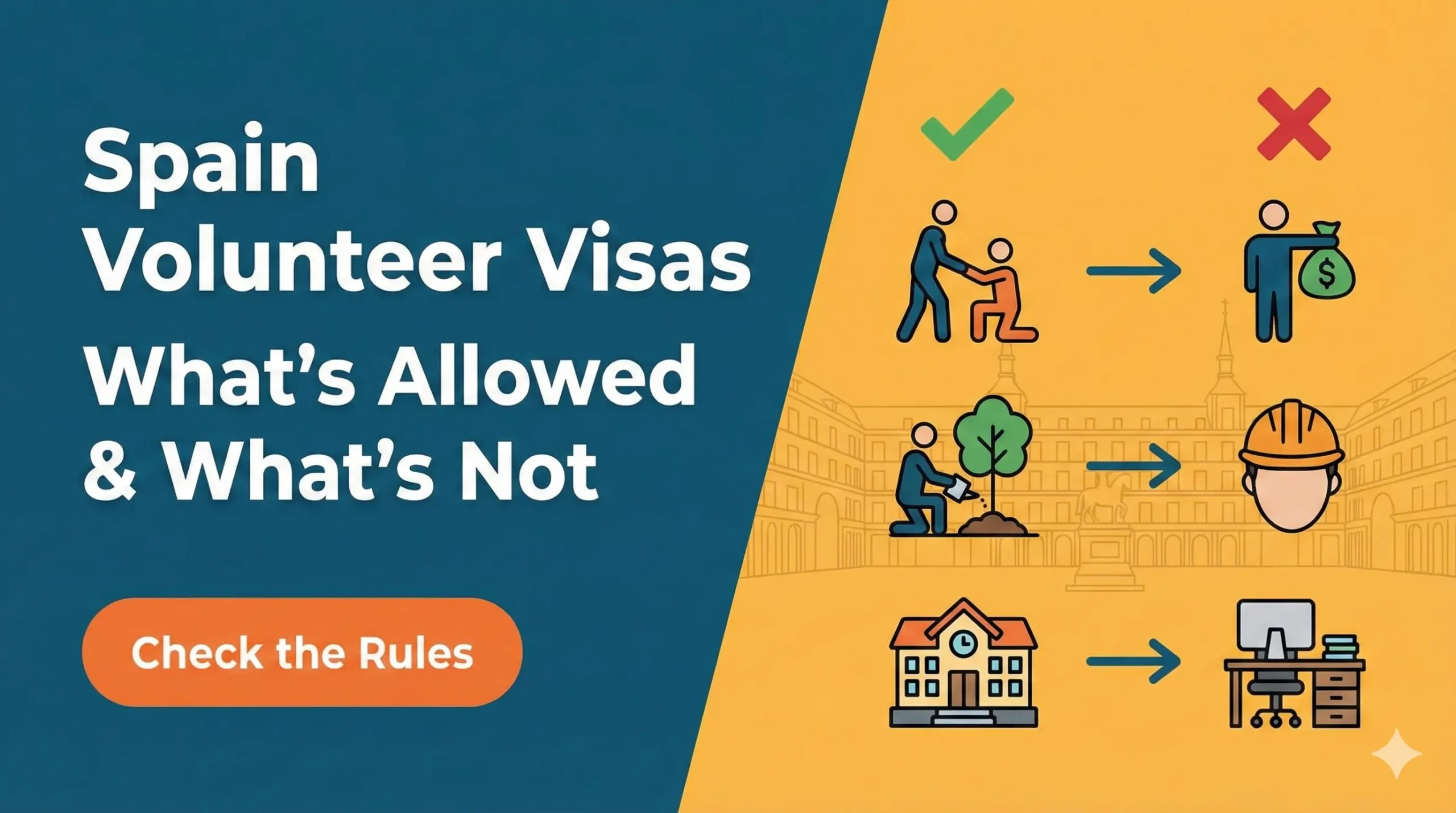
✅ What is Allowed
- Pocket Money: You can receive a small stipend for personal expenses (often called dinero de bolsillo), provided it is not a “salary” calculated by hourly work.
- Accommodation & Food: The host organization can cover your living costs directly.
- Training: You can receive non-formal education and language training as part of your program.
❌ What is NOT Allowed
- Replacing Paid Staff: You cannot do a job that would normally be done by a paid employee. If you are scrubbing floors 40 hours a week at a commercial hostel that fired its cleaning staff, you are not a volunteer; you are an exploited illegal worker.
- Receiving a Salary: Any payment that correlates to “hourly wages” is forbidden.
- Side Jobs: Unlike the standard Student Visa, which allows for part-time work up to 30 hours/week in unrelated fields, the Volunteer Visa generally does not automatically authorize work. You are expected to dedicate your time to the volunteer program.
European Solidarity Corps (ESC)
For young people (18-30), the European Solidarity Corps is the gold standard of volunteering.
- The Perk: These programs are fully funded by the EU, covering travel, insurance, accommodation, and a monthly allowance.
- Non-EU Eligibility: While primarily for EU citizens, citizens from “Partner Countries” (e.g., Ukraine, Western Balkans, South-Mediterranean countries) can apply for specific projects.
- Note for US/UK/Canada: Citizens of these countries are generally not eligible for ESC volunteering unless they are already legal residents in an EU country or part of a specific bilateral partnership. For these nationals, the standard Volunteer Visa via a private NGO is the only viable route.
Comparison Table: Choosing Your Path
| Feature | Volunteer Visa | Student Visa (University) | Tourist (Schengen) |
| Max Duration | 1 Year (renewable) | Duration of Studies | 90 Days |
| Main Activity | Social/Charitable Work | Academic Study | Leisure / Travel |
| Can you work? | NO (Strict) | YES (up to 30h/week) | NO |
| Compensation | Pocket money / Food | None | None |
| Bureaucracy | High (Convenio needed) | High (Enrollment needed) | None / Low |
The Application Timeline
- Find a Program (Months 1-3): Secure a placement with a recognized Spanish NGO. Do not leave this until the last minute; organizations take time to issue the Convenio.
- Sign the Convenio: Ensure the contract clearly states they cover liability and outlines your tasks.
- Consulate Appointment (Month 4): Apply for the visa in your home country.
- Visa Decision (Month 5): Wait for the approval (usually 1 month).
- Arrival & TIE: Once you arrive in Spain, if your visa is for more than 180 days, you must apply for your physical residency card within 1 month.
Don’t forget that upon arrival, one of your first steps will be registering your address. Review Empadronamiento in Spain: How to Register Your Address to understand why this certificate is required for your TIE application.
Conclusion
The Volunteer Visa is a fantastic option for those who want to immerse themselves in Spanish society without the financial pressure of a student visa or the passivity of a non-lucrative visa. It is perfect for gap years, sabbaticals, or career breaks focused on social impact.
However, it is not a loophole for working under the table. The Spanish government watches this visa category closely to prevent labor fraud. If your goal is to work remotely while living in Spain, you should pivot your strategy and look into the Spain Digital Nomad Visa: Requirements, Documents, and Timeline instead.
If you are ready to proceed, start by vetting your host organization. A legitimate NGO will be familiar with the Convenio process and happy to help you navigate the paperwork.
References
Primary sources (official)
- Ministerio de Asuntos Exteriores: Information on Study and Volunteer Visas (Visado de Estudios).https://www.exteriores.gob.es/Consulados/londres/en/ServiciosConsulares/Paginas/Consular/Visado-de-estudios.aspx
- European Solidarity Corps: Official EU portal for youth volunteering opportunities and eligibility.https://youth.europa.eu/solidarity_en
- Boletín Oficial del Estado (BOE): Ley 45/2015, de 14 de octubre, de Voluntariado (Law on Volunteering).https://www.boe.es/buscar/act.php?id=BOE-A-2015-11072
Other helpful sources
- Adventure Volunteer: Guide to volunteering programs in Spain.https://www.adventurevolunteer.org/en/volunteer-in-spain/
- Curiara Immigration: Detailed breakdown of volunteer visa requirements and documents.https://curiara.com/europa/en/volunteer-visa-spain/
Disclaimer
The information provided in this article is for educational and informational purposes only and does not constitute legal advice. Immigration laws and IPREM values in Spain are subject to change. We strongly recommend consulting with a qualified immigration lawyer to review your specific volunteer agreement and visa application.