Spain Researcher and Academic Permits: Options for Universities
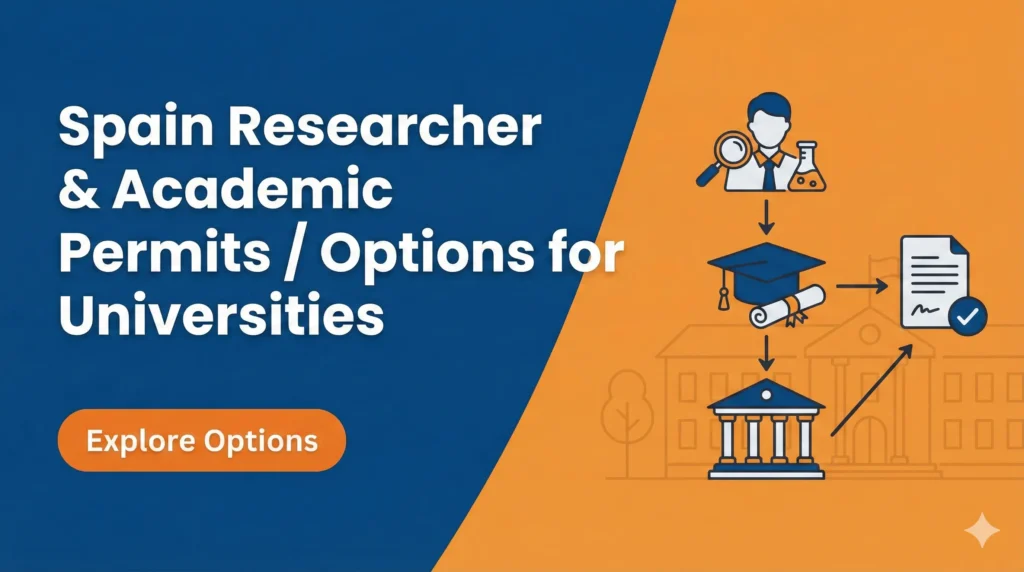
Spain offers specialized residency paths for researchers and academics, primarily through the Law 14/2013 “Researcher Visa.” This guide explains the critical role of the Convenio de Acogida (Hosting Agreement), how PhD students can upgrade from student visas to researcher permits, and when high-level academics should opt for the EU Blue Card.
Disclosure: This post may contain affiliate links. We may earn a commission at no extra cost to you if you make a purchase through these links. Read full disclosure.
The Three Main Pathways for Academics
Before diving into the paperwork, we must identify which bucket the applicant falls into. In the Spanish immigration system, not all “academics” are treated equally.
1. The Research Residence (Residencia para Investigación)
This is the “Gold Standard” for most academic staff. Governed by Law 14/2013, it is a fast-track residence permit designed for:
- Research personnel conducting R&D activities.
- Scientific and technical staff handling R&D equipment.
- PhD students who have a contract (not just a scholarship).
- Professors hired by universities or business schools.
Key Advantage: It bypasses the Labor Market Test (meaning you don’t need to prove no Spaniard could do the job) and offers a 20-day processing time.
2. The EU Blue Card
This is for the “elite” layer of academia—highly paid professors or directors of research institutes.
- Requirement: The salary must generally be 1.5 times the average gross salary in Spain (approx. €40,077 in 2026, though this varies).
- Benefit: Offers mobility to other EU countries after 12 months.
3. The Student Visa (Estancia por Estudios)
This is the default for most Master’s students and unpaid PhD candidates.
- Limitation: It is a “stay” (estancia), not “residency” (residencia). This distinction matters for citizenship clocks and family rights.
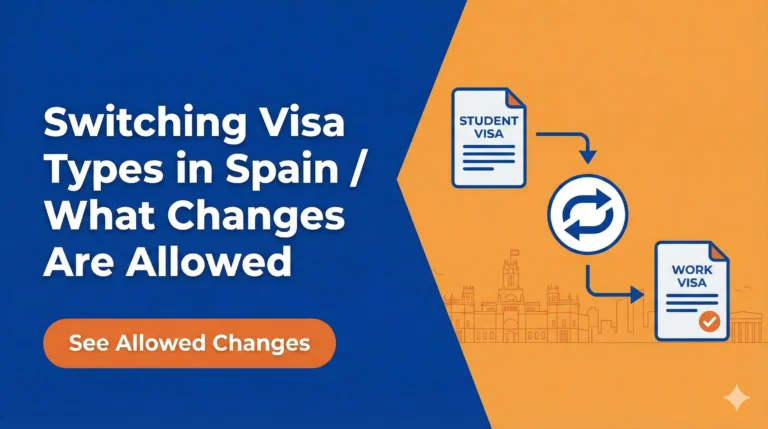
- Upgrade: Many PhD students start here and switch to the Researcher Residence once they get a formal contract.
Deep Dive: The Researcher Permit (Law 14/2013)
For 90% of cases involving a university or research center, this is the permit you will use. It effectively treats researchers as “VIPs” of the immigration system.
Who Qualifies as a “Host Entity”?
You cannot just come to Spain to “do research” on your own in a library. You must be hosted by a recognized entity. Valid hosts include:
- Public and private universities.
- The CSIC (Consejo Superior de Investigaciones Científicas).
- Public research bodies (OPIs).
- Private companies with a dedicated R&D department (must be recognized by the Ministry of Economy).
The Convenio de Acogida (Hosting Agreement)
This document is the heart of the application. It is a formal agreement signed between the researcher and the host entity. It serves two purposes:
- Immigration Proof: It proves to the government that the researcher has a place to work and sufficient funding.
- Liability: The host entity guarantees that the researcher has the necessary skills and financial means.
The Convenio must specify:
- The title and purpose of the research project.
- The start and end dates.
- The commitment of the organization to cover the researcher’s living expenses and return journey if they stay illegally (though this is rarely enforced if the permit is processed correctly).
The “Researcher” vs. “PhD Student” Dilemma
This is a frequent point of confusion.
- Scenario A: You are a PhD student receiving a grant/scholarship (beca) that pays for your tuition and living costs, but you are not on the university payroll.
- Result: You typically apply for a Student Visa.
- Scenario B: You are a PhD student with a predoctoral contract (contrato predoctoral). You receive a salary, pay social security, and are considered staff.
- Result: You qualify for the Researcher Residence.
Why choose the Researcher Residence?
If eligible, always choose the Researcher Residence over the Student Visa.
- Time Counts: Years spent on a Researcher Residence count 100% towards the 5-year requirement for Permanent Residency and the 10-year requirement for Citizenship. Years on a Student Visa usually count only 50% or not at all for certain processes.
- Family: Spouses of researchers get automatic work authorization. Spouses of students do not.
Application Process: The UGE-CE Fast Track
Unlike standard work permits that rot in provincial offices for months, Researcher Permits are processed by the Large Business and Strategic Groups Unit (Unidad de Grandes Empresas y Colectivos Estratégicos or UGE-CE) in Madrid.
Step 1: Digital Submission (The Employer’s Role)
The host university or research center initiates the process. They cannot send you to the consulate yet.
- The university logs into the Mercurio platform using their corporate Digital Certificate.
- They upload the Convenio de Acogida, the researcher’s passport copy, degree certificate, and the project description.
- Timeline: The UGE-CE has 20 business days to decide.
- Silence: If they do not respond in 20 days, the application is theoretically approved by “Positive Administrative Silence” (though waiting for the formal resolution is safer).
Step 2: Visa Application (The Researcher’s Role)
Once the UGE-CE issues the Favorable Resolution (Resolución Favorable), the researcher takes action.
- If outside Spain: You have 6 months to apply for the visa at the Spanish Consulate in your home country. You present the Resolution, your passport, and your background checks.
- If inside Spain: You can skip the consulate entirely! If you are legally in Spain (e.g., as a tourist or student), you can apply directly for the residency card.
Step 3: The TIE Card
Upon arrival (or approval), the researcher must apply for the physical card.
- Booking: Make an appointment for “Policía – Toma de Huellas”.
- Fees: Pay the Tasa 790-012.
- Documents: Passport, Resolution, Photo, and Application Form EX-17.
- Resource: For a detailed walkthrough of this final step, read How to Get the TIE Card in Spain: Fingerprints, Fees, and Pickup.
Comparison Table: Research Visa vs. Blue Card vs. Student Visa
| Feature | Researcher Residence (Law 14/2013) | EU Blue Card | Student Visa |
| Who is it for? | Contracted Researchers, PhDs with contracts, R&D staff | High-salary Professors (>€40k) | Master’s/PhD students on scholarships |
| Sponsor | University / R&D Center | Any Employer meeting salary threshold | Educational Institution |
| Key Requirement | Convenio de Acogida | 1.5x Avg Salary | Enrollment Letter |
| Family Rights | Immediate + Spouse can work | Immediate + Spouse can work | Immediate + Spouse cannot work |
| Citizenship Time | Counts 100% | Counts 100% | Often doesn’t count / counts 50% |
| EU Mobility | Limited (Notification procedure) | High (After 12 months) | Limited (Studies only) |
The EU Blue Card: When is it Better?
While the Researcher Residence is the default, the EU Blue Card in Spain: Eligibility, Salary Thresholds, and Benefits is superior in specific cases.
Scenario: A senior professor from the US is hired by a Spanish business school with a salary of €80,000. They plan to work in Spain for two years and then transfer to a partner university in Germany.
- Why Blue Card? The EU Blue Card allows for Intra-EU Mobility. After 12 months in Spain, the professor can move to Germany with a streamlined process, without needing a fresh visa from the US. The Researcher permit has mobility provisions, but the Blue Card is more universally recognized for long-term employment shifts.
Salary Thresholds (2026):
To qualify for the Blue Card, the academic must generally earn roughly €40,077 (or ~€54,000 for managerial roles). If the research position pays less (e.g., a junior post-doc earning €28,000), they must use the Researcher Residence; the Blue Card is off the table.
Family Members: A Crucial Benefit
One of the biggest anxieties for international academics is bringing their families. The General Immigration Regime makes this difficult, often requiring the worker to be in Spain for a year before applying for family reunification.
Under Law 14/2013 (Researcher Visa), this restriction is removed.
- Simultaneous Application: Spouses and children can apply for their visas at the same time as the researcher. They can travel together.
- Work Rights: The spouse receives a residency permit that authorizes them to work in Spain immediately (both as an employee or freelancer). They do not need to find a sponsor.
This is a massive selling point for universities trying to attract mid-career academics with families.
Essential Documents Checklist
Whether you are the HR manager preparing the file or the researcher gathering papers, missing a document can cause delays.
For the UGE-CE (Digital Phase):
- [ ] Convenio de Acogida: Signed by both parties.
- [ ] Passport Copy: All pages.
- [ ] NIF of the University: Tax ID of the host.
- [ ] Project Description: A brief summary of the R&D activity.
- [ ] Proof of Qualification: PhD or Master’s degree relevant to the research.
For the Consulate (Visa Phase):
- [ ] Resolution Letter: The approval from UGE-CE.
- [ ] Criminal Record Certificate: From the last 2-5 years (depending on interpretation, 5 is safer). Must be Apostilled and Translated. See Spain Criminal Record Certificates: Which Ones You Need and When to ensure validity.
- [ ] Medical Certificate: Standard statement of health.
- [ ] Proof of Funds: Often waived if the contract salary is shown, but having bank statements helps. See Proof of Funds for Spain Visas: Accepted Bank Statements and Formats.
After the Research: The “Job Search” Permit
What happens when the 3-year research grant ends? Does the researcher have to leave Spain immediately?
No. Spain offers a soft landing called the Residence for Job Search (Residencia para la búsqueda de empleo).
- Eligibility: Researchers who have finished their contract or students who have finished their degree.
- Duration: 12 months (non-renewable).
- Purpose: To find a job suitable to their level or to start a business.
- Transition: Once they find a job, they can switch to a Highly Qualified Professional Permit (Spain): How It Works or a standard work permit from within Spain.
Common Pitfalls for Universities
1. Using the Wrong Form
Using a standard employment contract model instead of the specific Convenio de Acogida format can lead to rejection. The Convenio has specific legal clauses regarding liability that a standard labor contract lacks.
2. Salary Mismatches
While the Researcher Visa doesn’t have a rigid threshold like the Blue Card, the salary must still be “sufficient.” If a university tries to hire a researcher on a part-time contract earning €600/month, the UGE will reject it because it falls below the IPREM (living wage) index.
3. Criminal Record Delays
Researchers coming from countries like the US or UK often face delays in getting their background checks apostilled. Universities should advise their hires to start this process at least 3 months before the start date.
Conclusion
Spain’s Researcher and Academic permits are among the most efficient in Europe. By recognizing that scientific talent is a strategic asset, the government has created a system that—when used correctly—is fast, family-friendly, and flexible.
For universities, the key is leveraging the UGE-CE digital platform and the Convenio de Acogida. For researchers, the key is ensuring your personal documentation (degrees and background checks) is impeccable.
Once the researcher arrives and settles into the lab, the next administrative step is often tax-related. If the researcher qualifies for the special tax regime (paying a flat 24% tax), they should explore the options detailed in Spain Work Permit via Sponsorship: Employer Process Explained (specifically regarding the Beckham Law application).
References
Primary sources (official)
- Ministry of Inclusion (UGE-CE): Official portal for the Research Residence under Law 14/2013.https://www.inclusion.gob.es/web/migraciones/vivir-en-espana/investigacion
- EURAXESS Spain: The European Commission’s guide for researcher mobility in Spain.https://www.euraxess.es/spain/information-assistance/researcher-visa
- Boletín Oficial del Estado (BOE): Law 14/2013 on support for entrepreneurs (Section on Researchers).https://www.boe.es/buscar/act.php?id=BOE-A-2013-10074
- Sede Electrónica (Mercurio): Portal for digital submission of researcher applications.https://sede.administracionespublicas.gob.es/mercurio/
Other helpful sources
- Gentile Law: Detailed analysis of the Research Residency Permit in Spain.https://www.gentile.law/en/what-is-the-research-residency-permit-in-spain/
- Jobbatical: Comparison of the Researcher Visa vs. EU Blue Card for employers.https://www.jobbatical.com/blog/spain-highly-qualified-eu-blue-card
Disclaimer
The information provided in this article is for educational and informational purposes only and does not constitute legal advice. Immigration laws, salary thresholds, and UGE criteria in Spain are subject to change. We strongly recommend universities and researchers consult with a qualified immigration lawyer to ensure the correct drafting of the Convenio de Acogida.