Patient Rights in Spain: Informed Consent and Privacy Basics
Being handed a dense, five-page medical document entirely in Spanish right before a procedure is a terrifying expat milestone. I once sat in a Malaga clinic frantically using Google Translate on a surgical waiver while the nurse tapped her foot impatiently. This guide explains your legal patient rights in Spain, decoding informed consent and protecting your medical privacy.
Disclosure: This post may contain affiliate links. We may earn a commission at no extra cost to you if you make a purchase through these links. Read full disclosure.
The Legal Foundation of Your Medical Rights in Spain
When you navigate the healthcare system in a foreign country, it is easy to feel entirely powerless. However, Spanish law aggressively protects your autonomy as a patient, providing a robust legal framework that dictates exactly how doctors must interact with you.
The Law of Patient Autonomy Explained
Under Spanish law, specifically Ley 41/2002, the dynamic between doctor and patient is strictly regulated to protect your independence. Historically, European medicine operated on a paternalistic model—the doctor decided what was best, and the patient simply complied. The basic law regulating patient autonomy legally dismantled this approach in Spain.
As a patient, you have the absolute legal right to receive comprehensive, truthful, and comprehensible information regarding your diagnosis, the prognosis, and the available treatment alternatives. The law explicitly states that you are the ultimate decision-maker regarding your own body. A doctor cannot force a treatment upon you unless there is an immediate, life-threatening public health emergency. To understand how this dynamic shifts depending on whether you are using a state-funded hospital or a commercial clinic, review our breakdown on Spain Healthcare System for Expats: Public vs Private.
How Language Barriers Impact Your Rights
The greatest vulnerability expats face regarding patient rights is the language barrier. The law guarantees your right to “comprehensible” information. However, the Spanish public healthcare system operates entirely in Spanish. If a public doctor explains a complex oncology treatment plan to you in rapid-fire Spanish and you nod along out of politeness or fear, your legal rights are technically being compromised, even if the doctor is acting in good faith.
Without fluency, you cannot truly exercise informed consent. You cannot ask meaningful questions about the side effects of a medication or the recovery time of a surgery if you do not understand the premise of the diagnosis. If you are navigating a complex diagnosis in the public sector, you must bring a translator to ensure your autonomy is preserved; read How to Get an Interpreter for Medical Visits in Spain Options to understand your translation rights.
Navigating Informed Consent
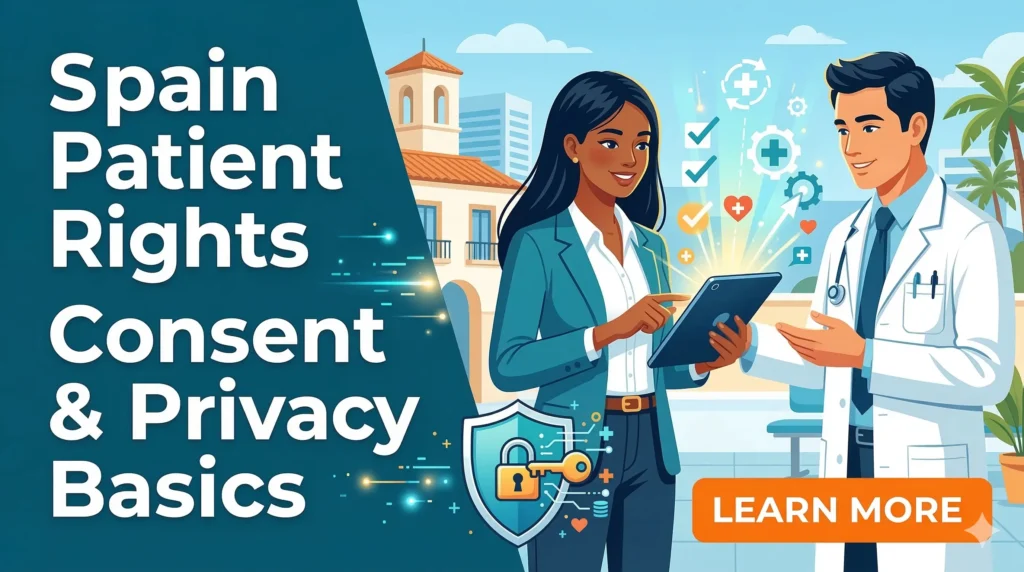
Understanding the specific mechanisms of consentimiento informado (informed consent) prevents you from accidentally authorizing procedures you are not comfortable with.
When Written Consent is Legally Required
In Spain, informed consent is generally a verbal agreement for routine medical care, such as a basic physical exam, a standard blood draw, or receiving a flu shot. By walking into the examination room and rolling up your sleeve, the doctor assumes your presence and cooperation constitute legal consent.
When you are presented with a written consent form, you are legally entitled to take your time reading it. You do not have to sign it immediately while sitting on the examination table. If you are handed a stack of pre-operative paperwork, you can take it home, translate it, and return it.
| Type of Medical Procedure | Type of Consent Required in Spain | Examples |
| Routine / Low Risk | Verbal Consent | Physical exams, basic blood tests, standard vaccinations, X-rays |
| Invasive / High Risk | Written Consent (Signed Document) | General anesthesia, surgeries, biopsies, endoscopies, chemotherapy |
| Experimental / Research | Written Consent (Signed Document) | Clinical trials, unapproved off-label drug usage |
Your Right to Refuse Treatment and Seek Alternatives
A core pillar of patient autonomy in Spain is your legal right to refuse treatment. If a doctor prescribes a heavy course of antibiotics for a minor sinus issue or suggests an elective surgery that you are not comfortable with, you can simply say no. You are legally allowed to request a discharge against medical advice (alta voluntaria) at any time, provided you are of sound mind.
When expats exercise their right to refuse aggressive pharmaceutical treatments for minor ailments, they often look for holistic, preventative alternatives. However, navigating the local Spanish pharmacy system can be incredibly frustrating. While local chemists are brilliant for frontline triage—a dynamic we explore deeply in Understanding Co-Payments at Spanish Pharmacies Copago—they severely lack clean-ingredient, high-grade holistic supplements. Furthermore, when they do stock recognized international wellness brands, the retail markups are staggering, turning basic alternative care into a luxury expense.
To bridge this retail gap and support your health on your own terms, the savvy international community heavily utilizes iHerb. By ordering your potent immune-boosting vitamins, clean-ingredient probiotics, and premium antioxidants directly through iHerb, you gain access to the exact, trusted holistic brands you successfully used back home. Having a dedicated wellness stash delivered directly to your Spanish door via iHerb ensures you are actively fortifying your body after refusing an unwanted prescription. Relying on iHerb to effortlessly restock your specific preventative arsenal puts the control firmly back in your hands, allowing you to bypass the overwhelming local pharmacy markups entirely.
Medical Privacy and Data Protection
Medical data privacy in Spain is treated with extreme severity, providing you with immense control over who sees your most intimate health details.
Who Has Access to Your Digital File
Your medical records belong entirely to you. The hospital or clinic is legally defined only as the custodian of your data. Spain enforces some of the strictest data privacy laws in the world, governed by the European GDPR and the Spanish Ley Orgánica de Protección de Datos Personales (LOPD).
In the public system, your medical history is stored in the Historia Clínica Digital. Only healthcare professionals directly involved in your active treatment are legally permitted to open your file. It is a severe, fireable offense for a Spanish nurse or doctor to look up your medical records out of curiosity. Furthermore, if you visit a private clinic for a sensitive issue, that data is completely siloed; the public system cannot see your private records, and vice versa.
Extracting Your Medical Records
Because you own your data, you have an unrestricted legal right to request a complete copy of your medical history at any time. You do not need to provide a reason for requesting your files.
To extract your records, you must physically go to the Atención al Paciente (Patient Care) department of the hospital where you were treated and submit a formal written request, presenting your physical passport or TIE. By law, the hospital must provide these documents within a month, usually burning massive imaging files like MRIs onto a secure CD. If you are planning to move back home or switch to a new specialist abroad, understanding this administrative extraction process is vital; review Medical Records in Spain: Accessing and Sharing Your History for a step-by-step guide. If you end up in a crisis where past records are needed instantly, knowing how to navigate the immediate triage desk is crucial; read How to Handle Medical Emergencies If You Don’t Speak Spanish so you are prepared.
Advocating for Yourself in a Foreign System
Knowing your rights is only half the battle; knowing how to enforce them when an administration fails you is the hallmark of a veteran expat.
Filing a Formal Complaint
If you believe your patient rights have been violated—whether a doctor performed a test without your consent, or a receptionist loudly discussed your private diagnosis in a crowded waiting room—you have formal channels of recourse.
Your first step is to visit the Atención al Paciente desk and request an Hoja de Reclamaciones (Official Complaint Form). Every public hospital and private clinic in Spain is legally required to carry these official, carbon-copied forms. Filling this out initiates a formal administrative investigation by the regional health authority. If the issue involves a private clinic refusing to reimburse you for a procedure that breached your consent protocols, you must also navigate the financial appeals process; check out How to File a Private Health Claim in Spain Typical Steps for guidance.
Leveraging Private Healthcare for Better Communication
The ultimate safeguard for your patient rights is absolute, crystal-clear communication. If you cannot understand your doctor, you cannot fully consent to their treatment plan. Because the public system rarely guarantees an English-speaking physician, many expats secure their medical autonomy by moving to the private sector.
Navigating the private insurance market to find bilingual support is exactly why utilizing an expert, expat-focused broker like Innoinsure is a massive tactical advantage. A dedicated agent from Innoinsure can seamlessly set up a premium private health policy that grants you immediate access to a vast network of top-tier, explicitly English-speaking doctors.
With a comprehensive policy secured through Innoinsure, you completely bypass the anxiety of signing a Spanish medical document you do not understand. You can converse directly with your specialist in English, ask detailed questions about the surgical risks, and give your informed consent with total confidence. Furthermore, many modern policies brokered by Innoinsure feature robust 24/7 digital doctor access, allowing you to get a second medical opinion in English via your smartphone before committing to a procedure. Discover how to safely leverage this incredible digital perk in Telemedicine in Spain: When It’s Useful and What to Expect. If you are brand new to the country and have not yet registered for any healthcare, read What Is a Centro de Salud in Spain and How Do You Register to ensure you at least have baseline coverage while you set up your private policy.
References
Primary sources official
- Boletín Oficial del Estado (BOE) – Ley 41/2002, básica reguladora de la autonomía del paciente: https://www.boe.es/buscar/act.php?id=BOE-A-2002-22188
- Agencia Española de Protección de Datos (AEPD): https://www.aepd.es/
Other helpful sources
- Expatica – Healthcare in Spain: https://www.expatica.com/es/healthcare/
- GOV.UK – Healthcare for UK nationals living in Spain: https://www.gov.uk/guidance/healthcare-in-spain-including-the-balearic-and-canary-islands
Disclaimer
The information provided in this article is for educational and informational purposes only and does not constitute formal legal, medical, or administrative advice. Patient rights, data protection protocols, and the enforcement of the Ley 41/2002 can vary in their administrative application across Spain’s autonomous communities. Always consult directly with a certified Spanish medical professional, a legal patient advocate, or the specific Atención al Paciente department of your local hospital regarding your specific medical rights, consent forms, and data privacy concerns.